



Table of Contents
- 1. Why a Growth-Driven Marketing Department Matters
- 2. Signs Your Current Approach Isn’t Cutting It
- 3. Start with Strategy: Define Goals and Align with Sales
- 4. Essential Roles and Skills in a High-Performing Marketing Team
- 5. Structuring Your Marketing Department for Success
- 6. In-House vs. Outsourced: Adopting a Hybrid Model
- 7. Focus on Inbound Marketing, SEO/GEO, and Content to Drive Growth
- 8. Streamlining Your Content Creation Process (Consistency is King)
- 9. Measuring Results and Continuously Improving
- 10. Checklist: Steps to Build a Growth-Driven Marketing Department
- 11. FAQs About Building Your Own Marketing Department

 Feb 4, 2026 ·
  40 min read ·
  Summarize in ChatGPT
Building a marketing department is a pivotal step for any established business looking to accelerate growth. Unlike startups that often “wing it” with ad-hoc tactics, mature companies (especially B2B and professional services firms) need a structured marketing function to consistently generate leads, strengthen the brand, and contribute to revenue. In this comprehensive guide, we’ll walk through how to create a marketing department that actually drives growth, covering everything from laying a solid strategy and hiring the right people to leveraging hybrid in-house/agency models and focusing on high-ROI tactics like SEO, GEO, and inbound marketing. We’ll also include visuals, statistics, checklists, and references to back up best practices and help you take action.
Why a Growth-Driven Marketing Department Matters
Marketing done right is not a cost center; it’s a growth engine. A well-run marketing department attracts new customers, builds awareness, and directly increases revenue. Consider that B2B marketing efforts typically deliver a 5:1 ROI, meaning $5 in revenue for every $1 spent. In fact, SEO leads are among the highest ROI drivers, averaging an astounding 748% ROI for B2B companies. This far outpaces many traditional sales tactics and underscores why investing in marketing yields real business results. Companies with strong inbound marketing (content, SEO, etc.) generate 54% more leads than those relying on outbound methods and can reduce cost-per-lead by 80% after just 5 months of consistent inbound efforts. In short, a strategic marketing department can become the growth engine of your organization, systematically driving demand and sales.
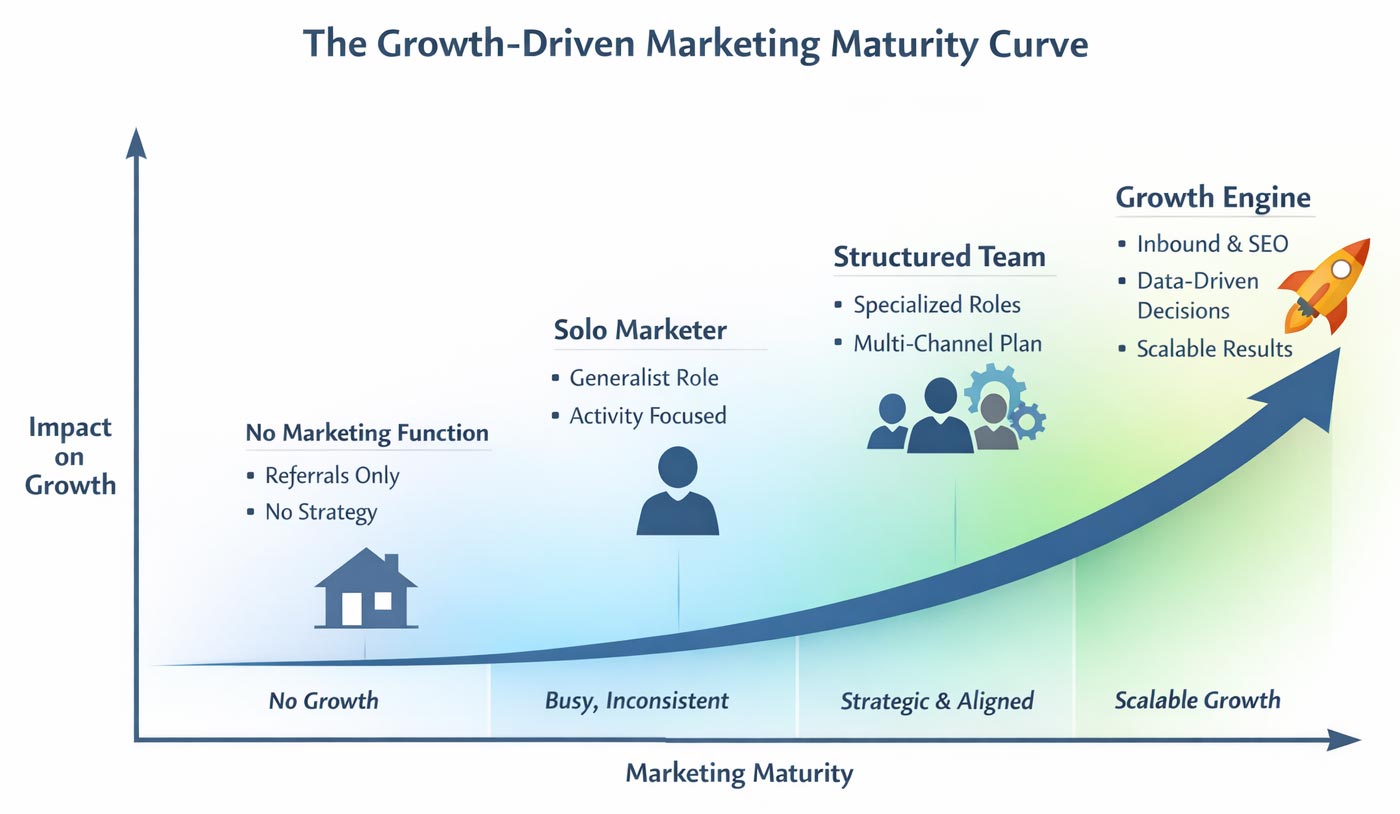
On the flip side, underinvesting in marketing can stifle growth. Industry benchmarks show the average B2B firm allocates around 8% of revenue to marketing. If you’ve been scraping by with a lone marketing generalist and a shoestring budget, you may be starving the very function that could propel your next stage of growth. In fact, half of B2B companies missed their 2024 revenue goals partly due to lack of marketing budget. A marketing department that’s set up for growth ensures you’re not leaving market share on the table.
| Stage | Typical Setup | Primary Focus | Common Outcome |
|---|---|---|---|
| No Marketing Function | No dedicated marketer | Referrals and word of mouth | Unpredictable growth |
| Solo Marketing Manager | One generalist | Activity and execution | Inconsistent results |
| Structured Team | Defined roles or specialists | Strategy and channels | More stable pipeline |
| Growth Engine | Integrated team and partners | Revenue accountability | Scalable growth |
Signs Your Current Approach Isn’t Cutting It
How do you know it’s time to build out a real marketing department (or revamp the one you have)? Here are some common red flags that your current approach is falling short:
- Inconsistent or Ad-Hoc Marketing: If your marketing consists of sporadic campaigns, infrequent social posts, or one-off brochure updates without any cohesive strategy, it’s a sign of trouble. Marketing shouldn’t be an afterthought or a reactive task list; it needs strategic planning and consistent execution. Businesses without a clear strategy often end up “shooting in the dark” and wasting resources.
- Overreliance on One Person: Many growing companies hire a single marketing manager and expect them to handle everything from strategy to social media to events. This one-person-band approach usually leads to burnout and superficial results. If your “marketing department” is just one overwhelmed individual, it’s time to consider adding structure and support.
- Declining or Stagnant Leads: A major warning sign is when sales start slipping or lead flow isn’t keeping up with growth goals. Declining sales can signal that your current marketing isn’t working and needs higher-level expertise. For example, if you’ve been relying purely on referrals or a salesperson’s rolodex, you likely have an untapped opportunity to generate leads through modern marketing techniques.
- Failed Past Attempts: Perhaps you’ve tried hiring a marketing role or outsourcing an agency in the past, but it “didn’t work out.” Often, such failures are due to lack of a clear plan, hiring the wrong skill set, or not giving the effort enough resources or time to succeed. Don’t let those experiences deter you. Instead, learn from them. A failing point could be lack of strategy or leadership (e.g. a junior marketer with no guidance) or inconsistent branding and messaging that confused your audience. Identifying what went wrong will help you build a stronger foundation this time around.
- No Bandwidth for Marketing: If you (the owner or executive) are personally handling marketing in your “spare time” and it keeps getting pushed to the back burner, that’s unsustainable. It likely means marketing initiatives are not happening at the scale or quality needed. As your company grows, you simply can’t afford to treat marketing as a side project. It requires dedicated talent and focus.
If several of these pain points resonate, it’s a clear indicator that a more robust marketing department is needed. The good news: by addressing these issues with a proper team and strategy, you can unlock significant growth. In the sections that follow, we’ll detail how to do exactly that.
Expert Insights from 321 Web Marketing

Building a marketing department in-house is easier when you’re guided by people who’ve already done it. Instead of guessing what works, you gain proven strategies, clear expectations, and a faster path to real growth, without learning every lesson the hard way.
Start with Strategy: Define Goals and Align with Sales
Building a marketing department that drives growth begins not with hiring, but with strategy. Before adding staff or engaging an agency, you must clarify what success looks like. Ask: What specific outcomes do we expect from marketing, and how do they tie into our business goals?
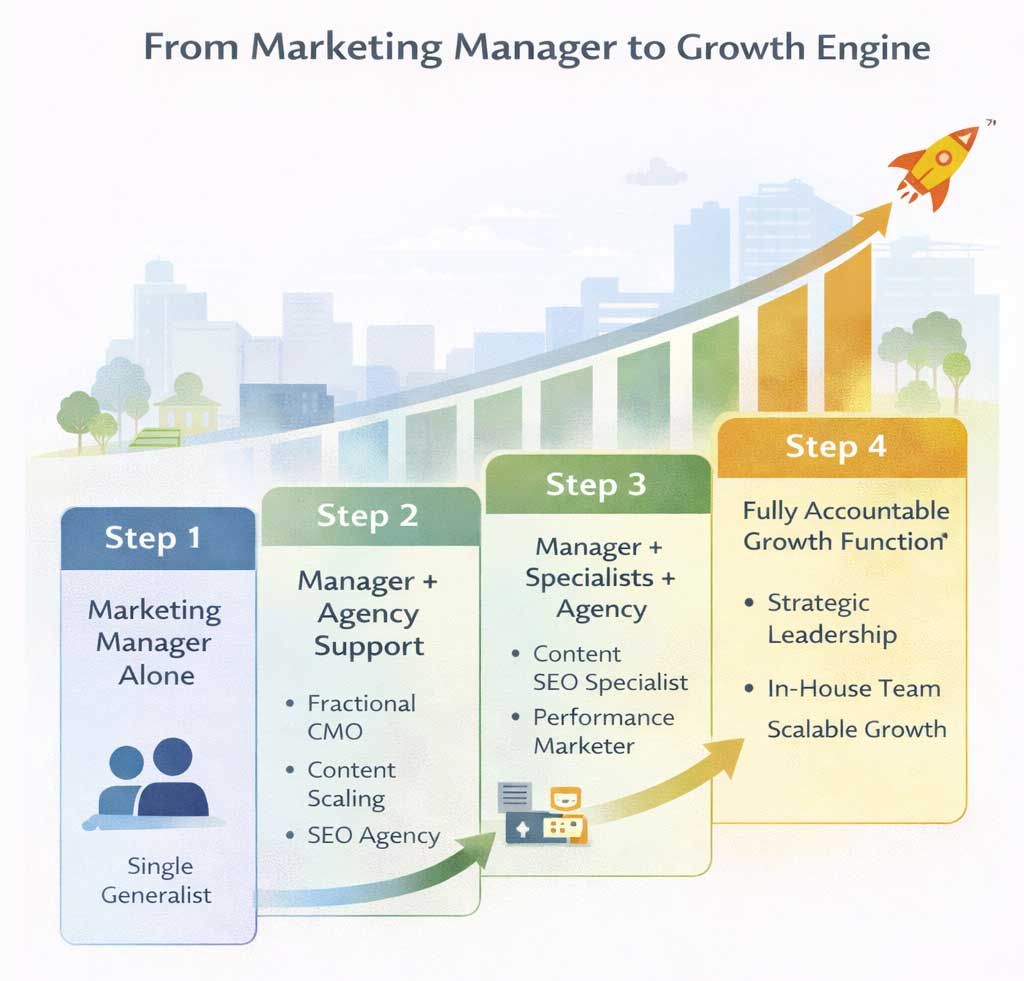
Start by defining your primary marketing goals. Common goals include lead generation, brand awareness, entering a new market, customer retention, or enabling the sales team. Be specific: for many B2B professional services firms, a top goal will be high-quality lead generation and nurturing those leads into sales opportunities. You might set targets like “increase qualified inbound leads by 50% in 12 months” or “contribute 30% of new revenue via marketing-sourced deals.” This clarity will drive all other decisions.
Next, ensure alignment with sales. Marketing and sales should work hand-in-hand to drive growth. In B2B especially, the sales cycle is often long and involves multiple touches (the median B2B sales cycle has ballooned from 120 to 408 days in recent years). Marketing’s role is to shorten this cycle where possible and keep prospects engaged throughout. That means your marketing goals must dovetail with sales goals. For example, if Sales has a revenue target, Marketing might have a lead generation target and a pipeline contribution target that feed into it. Both teams should agree on what a “qualified lead” looks like, how leads will be handed off, and how to nurture those that aren’t ready to buy yet. Companies that excel at this kind of lead nurturing generate 50% more sales-ready leads at 33% lower cost than those that don’t nurture effectively.
When crafting your marketing strategy, consider these key elements (a mini-checklist from strategy through execution):
- Target Audience and Positioning: Be clear on who you are trying to reach (e.g. CFOs of mid-size tech companies in North America) and why they should pay attention. Research your customers’ pain points and what differentiates your offering. This will guide your messaging and content topics.
- Core Channels and Tactics: Choose the marketing channels most likely to reach your audience and influence their buying journey. For a B2B professional services firm, common high-impact channels include content marketing/SEO (to capture search-driven prospects), LinkedIn and other social media for thought leadership, email marketing for lead nurturing, and perhaps webinars or events for education. You don’t need to do everything, but identify the 3-5 channels that matter most and plan to do them well.
- Budget and Resources: Assess how much budget you can allocate (remember the ~8% of revenue benchmark as a guideline). This budget will cover people, tools, and campaigns. Also decide on the mix of internal team versus external help (we’ll discuss the hybrid model later). If budget is tight, prioritize the tactics with highest ROI, for instance, content and SEO often yield compounding returns over time at lower cost than large ad buys (SEO efforts average a 9.1x return over 3 years).
- Metrics and KPIs: Define how you’ll measure success. Common marketing KPIs for growth include website traffic, number of leads, lead-to-customer conversion rate, cost per lead, marketing-generated revenue, and ROI by channel. Setting up analytics from the start will allow you to track progress and adjust strategy. (We’ll cover measurement in a later section, because it’s that important.)
By clearly defining strategy and goals upfront, you create a roadmap that guides all other decisions (from team structure to campaign planning). This prevents the common pitfall of “random acts of marketing” that don’t ladder up to business growth. Instead, every activity the marketing department undertakes should tie back to the strategic goals you’ve set. As one marketing expert put it: a well-planned org structure and strategy ensures the team is aligned with business priorities, “eliminating confusion and improving workflow efficiency.” In short: plan first, hire second.
Essential Roles and Skills in a High-Performing Marketing Team
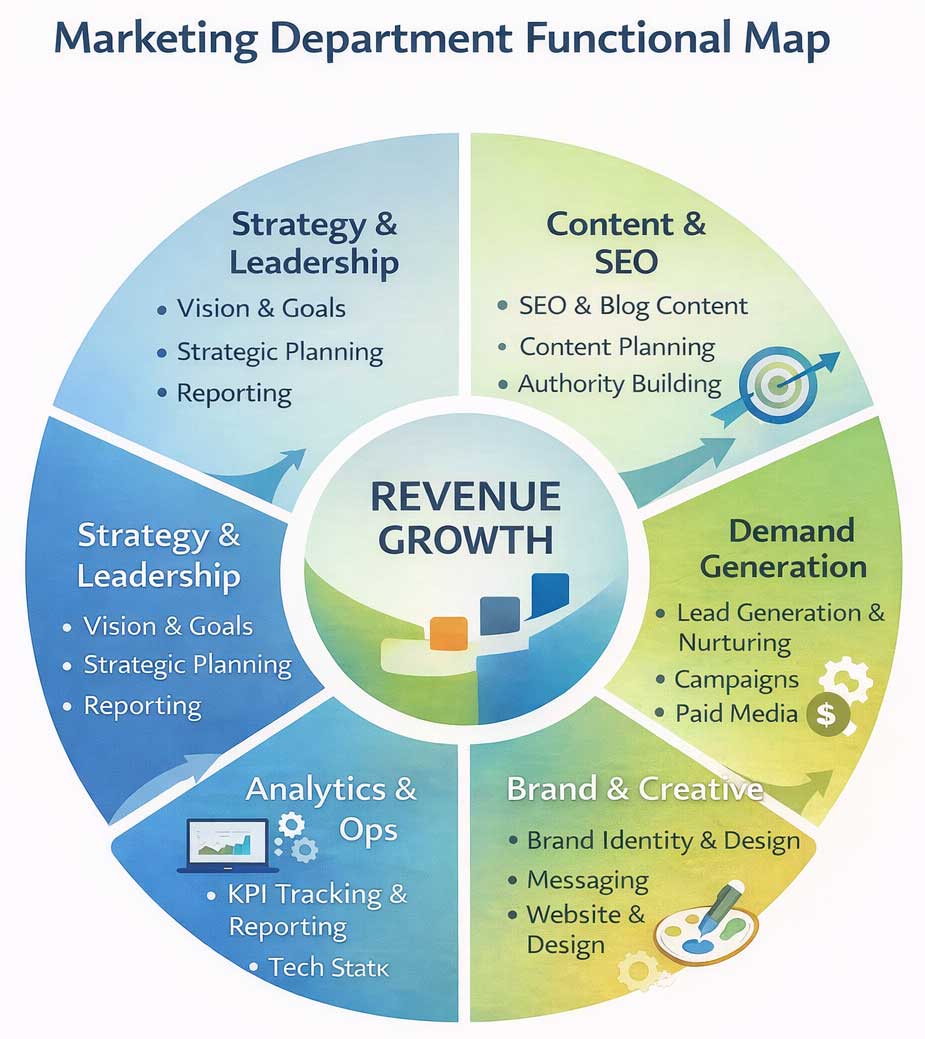
What does a growth-focused marketing department actually do day to day? And who do you need on the team? The answers will vary depending on company size and industry, but most successful marketing teams cover a set of core functions that work in concert. Here are the essential functions and roles you should consider when building your department:
- Marketing Leadership & Strategy: Who’s driving the ship? Every marketing department needs someone to define strategy, coordinate the team, and be accountable for results. In a larger firm this is a Chief Marketing Officer (CMO) or VP of Marketing; in a smaller company it might be a Head or Director of Marketing, or even a Marketing Manager doubling as team lead. This person ensures marketing plans align with business goals, sets campaigns in motion, and often is the liaison to the executive team. If you’re not ready to hire a full-time seasoned leader, consider a Fractional CMO (a part-time executive) who can fill this strategic role. Many mid-sized businesses use fractional marketing leadership to get high-level guidance without the full-time cost. The key is to have someone with strategic expertise at the helm to avoid junior staff running tactics without direction.
- Content Marketing & SEO: Content is the fuel of modern marketing engines. You’ll need talent to create valuable content (articles, whitepapers, videos, infographics, etc.) that attracts and educates your target audience. Roles here include Content Creators/Writers and potentially a Content Marketing Manager to plan and oversee content strategy. Closely related is the SEO Specialist, who optimizes content so that your company is highly visible in search engines. (Often one person can handle both content writing and basic SEO, especially early on.) Since content marketing is proven as one of the highest ROI strategies, 79% of companies with a blog report a positive ROI from inbound marketing, this function is mission-critical. Great content brings inbound leads and establishes your authority in the market.
- Digital Marketing & Demand Generation: This function focuses on driving traffic and leads through various online channels. Key skills/roles might include Digital Marketing Manager, Campaign Manager, or specialists in areas like Email Marketing, Paid Advertising (PPC), and Social Media Management. These team members run campaigns on platforms like Google Ads, LinkedIn, or industry publications, manage your website and landing pages, execute email nurture sequences, and grow your social media presence. Their goal is to generate demand and capture leads through digital touchpoints. For example, an Email Marketing Specialist can nurture your prospects with drip campaigns (a channel with excellent ROI; email averages a $36 return for every $1 spent in marketing). A Social Media Manager (or simply a content person wearing the social hat) can amplify content and engage your community on platforms like LinkedIn, where 80% of B2B social media leads originate.
- Branding & Creative: Even the best strategy can falter with poor execution in branding and creative. Your marketing department should cover the creation of compelling visuals, consistent brand messaging, and persuasive copy. Early on, you might not have a separate “brand team,” but ensure someone handles graphic design, copywriting, and perhaps video production if it’s relevant. Larger teams often have a Creative Director or Brand Manager, but in a small department a content marketer or an external creative agency can fill this need. The goal is to maintain a cohesive brand image and produce marketing assets that look professional and resonate with your audience.
- Analytics & Marketing Operations: A truly growth-driven marketing department is data-driven. This function involves setting up the systems to track performance and making sense of the metrics. Roles include a Marketing Analyst or an Operations Manager. They use tools (analytics software, CRM reports) to measure campaign results, track KPIs, and provide insights to the team. Data-savvy marketers will, for example, analyze which content is generating the most leads or how different channels contribute to pipeline. This ensures you double down on what works and fix what doesn’t. Even if you don’t hire a dedicated analyst at first, someone on the team should own reporting. Regularly review metrics like website visitors, conversion rates, cost per lead, and marketing-influenced revenue. Being data-driven is key to continuously improving and proving marketing’s value.
These core functions (leadership, content/SEO, digital demand gen, creative, and analytics) are the pillars of a balanced marketing department. In a small team, one person may wear multiple hats (for example, a Marketing Manager might do strategy, oversee content, and coordinate contractors for design). That’s fine initially, but make sure all functions are accounted for. As you grow, you can specialize roles further. The iCreatives marketing guide notes that even a small 2025 marketing team should cover at least content creation, SEO, and a marketing generalist to handle other channels. Each role is crucial to contribute to a cohesive strategy that drives growth.
| Function | Primary Responsibilities | Business Impact |
|---|---|---|
| Strategy and Leadership | Vision, prioritization, alignment | Direction and accountability |
| Content and SEO | Authority building, inbound traffic | Demand creation |
| Demand Generation | Lead capture and nurturing | Pipeline growth |
| Brand and Creative | Messaging and positioning | Trust and differentiation |
| Analytics and Operations | Measurement and optimization | Smarter decisions |
Core Marketing Department Functions
Tip: When outlining roles, consider future needs too. If lead generation is your primary goal, perhaps your first hires (or outsourced partners) are a Content/SEO specialist and a Digital Marketing specialist, while you as the owner handle strategy (or hire a fractional strategist). If brand awareness is a bigger gap, you might prioritize a Marketing Communications/PR role or a Brand Designer. Tailor the roles to your goals, but ensure the core competencies above are on your roster in some form.
Lastly, remember that you don’t necessarily need a big team out of the gate. Focus on quality and versatility. A few skilled marketers who collaborate well can outperform a larger disjointed team. It’s also wise to involve your sales team or client-facing staff for input, they often have insight into what content or messages resonate, which can help shape roles and priorities. By covering the bases with a small, cross-functional team, you set the stage for efficient campaigns that produce results.
Structuring Your Marketing Department for Success
How you structure your marketing team (i.e., who reports to whom and how responsibilities are divided) can greatly impact effectiveness. A clear structure brings focus and accountability, whereas a muddled one breeds confusion and dropped balls. Many growing companies start with a functional structure, where marketers are organized by their specialty (content, digital, design, etc.), reporting up to the marketing head. This is a logical approach for most, as it ensures each function has an owner (deep expertise) and aligns with how marketing tasks are naturally grouped. For example, you might have a Content/SEO function, a Digital Marketing function, and an Analytics/Operations function, all reporting to the Marketing Director. This setup works for companies of all sizes and promotes skill development within each area. The downside can be silos. To counter that, encourage lots of communication and teamwork on campaigns across functions.
Other structures exist too, and as you grow you might evolve into them:
- Channel-Based Structure: Teams organized by marketing channel (one team for web/SEO, one for social media, one for events, etc.). This is useful if your marketing is very channel-specific, but can lead to duplicate efforts unless carefully managed.
- Product-Based Structure: Marketers are assigned to specific product lines or services. Common in larger firms with diverse offerings; each product team has a mini marketing squad. This ensures deep product knowledge but can be inefficient for a smaller company with one main offering.
- Customer/Segment-Based Structure: Teams focus on different customer segments (e.g. one team markets to enterprise clients, another to SMBs). This allows highly tailored messaging to each segment. It’s advanced, and only makes sense if your customer base is clearly divided and large enough to warrant separate efforts.
For most mid-sized B2B businesses building their first real marketing department, a functional structure with some cross-functional collaboration is the best starting point. The key is to clarify roles and reporting lines. Who is responsible for what outcomes? Ensure every important area (as discussed in the prior section) has an owner. An organizational chart can help visualize this. It doesn’t have to be fancy, even a simple diagram showing who leads content vs. digital vs. analytics under the marketing head will do. A well-defined org chart “clarifies roles & responsibilities, enhances accountability, and streamlines communication” in a marketing team. People know their duties and whom to go to for various decisions, which reduces overlap or tasks falling through cracks.
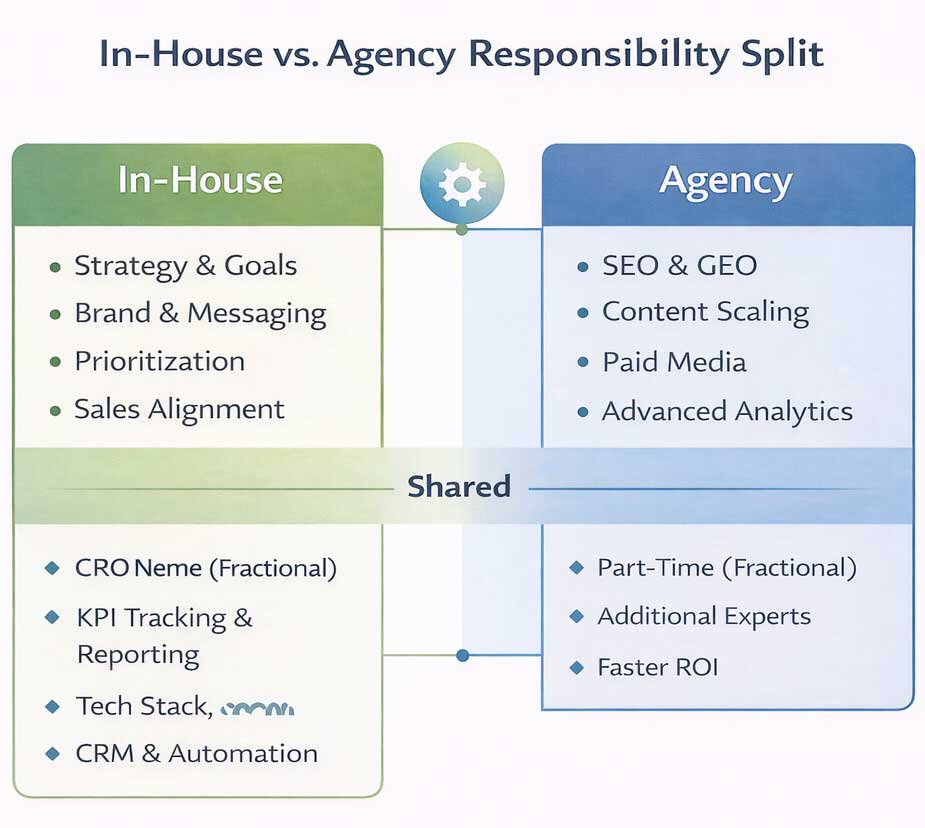
As you structure the team, also think about scalability. What gaps might you need to fill in the future? For instance, today your “digital marketing” person might handle social media, PPC, and email. As workload grows, you could split that into two roles or bring in an agency for one channel. Or if you expand into new regions, you might adopt a regional structure later. You don’t need to solve for the 5-year future immediately, but design a structure that can flex. A flexible structure will let you adapt quickly as market conditions change.
Finally, consider the leadership span: how many direct reports will your marketing leader have? If it’s just 2-3, that’s manageable. If you anticipate 5-6 or more, you might insert a mid-level layer (e.g. Marketing Manager overseeing a couple of specialists) to keep things efficient. The marketing leader (or fractional CMO) should have enough visibility to guide strategy, but not be drowning in daily micromanagement of too many individuals.
In summary, design your marketing org intentionally. Even if it’s small today, set it up with clear ownership of key functions. This not only makes your current efforts more effective, it also lays a foundation you can build on as the team grows. Remember the adage: structure follows strategy. Because you defined your marketing goals and strategy first, structuring the team becomes about enabling those goals. If lead generation is king, structure to emphasize that (perhaps a Growth Marketing Manager role focused on campaigns). If content is core, maybe your first hire after the marketing head is a strong Content Manager who can also coordinate freelancers. Let your priorities shape the structure. And don’t be afraid to evolve it; agility is an asset. Just avoid chaos by keeping everyone’s role clear at each stage.
In-House vs. Outsourced: Adopting a Hybrid Model
One of the biggest questions in building a marketing department is what to keep in-house versus outsource. The reality is, you don’t have to choose one or the other. Many successful companies use a hybrid model, combining a lean internal team with external experts or agencies. This approach can be especially powerful for mid-sized businesses: you get strategic control and institutional knowledge from your in-house team, while tapping into specialized skills and extra capacity via external partners.
Consider these points when crafting your hybrid strategy:
- Leverage Agencies for Specialized Skills: Some marketing activities require deep expertise or tools that might be impractical to maintain in-house early on. A prime example is SEO and “GEO” (Growth-Engine Optimization). SEO best practices change frequently and involve technical nuances; an agency that specializes in SEO/GEO can likely deliver better results faster. (GEO is an emerging term referring to an integrated, AI-powered approach that goes beyond traditional SEO to create a “growth ecosystem” of content and optimization.) Similarly, PPC advertising, advanced web analytics, or creative design can often be effectively outsourced to agencies or freelancers who live and breathe that niche. By outsourcing these, you instantly get a team’s worth of talent; for example, hiring an SEO agency might give you access to strategists, content writers, and link builders all at once, which would be costly to hire individually.
- Keep Core Strategy In-House (or Fractional): Strategy and brand knowledge are vital to retain on the inside. Your internal marketing leader (or a fractional CMO you hire as a contractor) should be the one setting objectives, deciding messaging, and coordinating all efforts. They ensure any external partners are on-brand and aligned with your goals. It’s fine if execution is outsourced, but ownership of the marketing plan should be within your company. As noted earlier, if you can’t afford a full-time CMO, a fractional CMO can step in to fill that strategic role part-time, bringing senior expertise to guide both your internal team and external vendors. This gives you leadership without the full salary burden.
- Augment Bandwidth with Freelancers/Contractors: In addition to agencies, consider individual freelancers for certain tasks. Many companies use freelance content writers, graphic designers, or videographers to produce content at scale while the in-house team manages quality and strategy. In fact, about two-thirds of B2B marketers outsource their blog content creation to freelancers or agencies. If you have one internal content manager, they might set the topics and tone, then farm out writing to a trusted pool of freelance writers. This hybrid content model keeps costs flexible and output high. The same can apply to design or social media management.
- Cost Efficiency: A hybrid model can be cost-efficient. Hiring a full in-house staff for every specialty (SEO, design, copywriting, PR, etc.) is expensive, and some roles may not be needed at full capacity year-round. With agencies or contractors, you can pay for only what you need, when you need it. For instance, you might engage an agency for a 6-month SEO project to boost your rankings, then taper down. Or use a design freelancer per project instead of a salaried designer. Many businesses find that an agency retainer is cheaper than hiring one or two additional mid-level employees, yet provides a wider range of skills.
- Focus In-House Team on What You Can’t Outsource: What should remain internal? Typically, anything that requires deep institutional knowledge, close collaboration with sales/product, or real-time responsiveness. Examples: product marketing (positioning specific to your offerings), high-level content approval (to ensure thought leadership is accurate), and immediate customer communications. Also, internal folks maintain the relationship with outside partners. You’ll want someone in-house (like a Marketing Manager) who coordinates and communicates with any agencies to keep everyone on the same page.
| In-House Ownership | Shared Responsibilities | Agency Execution |
|---|---|---|
| Strategy and goals | KPI tracking and reporting | SEO and GEO |
| Brand and messaging | Tech stack management | Content scaling |
| Prioritization | CRM and automation | Paid media |
| Sales alignment | Optimization insights | Advanced analytics |
A quick scenario to illustrate a hybrid approach: Imagine you have one Marketing Manager in-house and one Marketing Coordinator. Together, they handle strategy, manage projects, and create some content. You then outsource SEO to a specialist agency (who handles keyword research and technical optimizations), outsource blog writing to a freelance network for volume, and outsource PPC advertising to an agency that optimizes your Google Ads. Your internal team focuses on integrating all these pieces, reviewing content for brand voice, and running things like webinars or client communications that benefit from insider knowledge. This way, you’ve essentially extended your department with fractional experts.
Importantly, the hybrid model doesn’t absolve you from building internal knowledge. Treat your agencies and freelancers like extensions of your team. Bring them into planning meetings, share your business objectives, and give them feedback as you would an employee. The more they understand your business, the better their output. Also, set clear metrics and expectations for external partners, just as you would for staff. For example, if you hire an agency to run inbound lead gen, agree on target KPIs (like cost per lead or number of SQLs per quarter) so you can measure their impact.
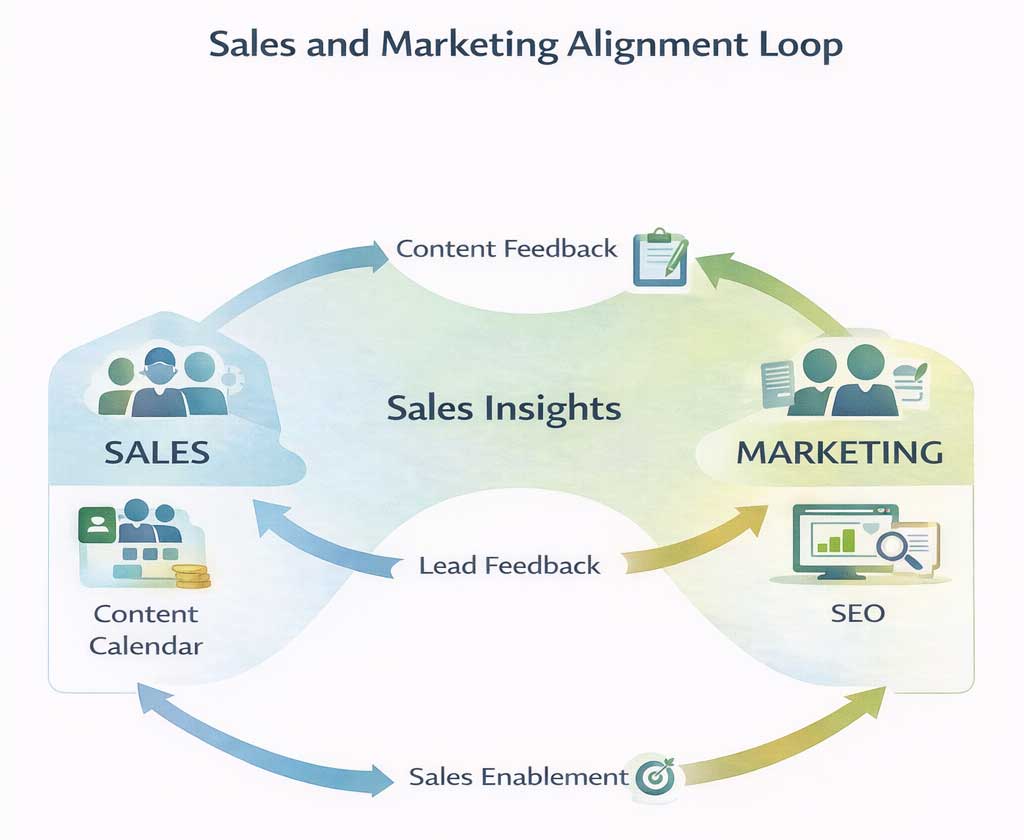
Done well, an in-house + agency combo offers the best of both worlds: strategic control and brand intimacy on the inside, plus scalability and specialized execution from the outside. It’s a model particularly suited to companies that have “some semblance of an in-house team” (maybe one marketing generalist) and need to level-up fast without waiting to recruit a full team. By embracing a hybrid department, you can rapidly implement sophisticated marketing campaigns; for example, launching an SEO-driven content program or an account-based marketing campaign that your small internal team alone might struggle to execute.
Finally, be open about adjusting the mix over time. You might start with heavy outsourcing, then gradually bring more in-house as you generate results (and justify expanding headcount). Or vice versa: maybe you’ll hire a couple key roles in-house and later outsource additional tasks as you scale up campaigns. Flexibility is a strength of the hybrid model. The goal is simply to build the best marketing “team” for your company’s growth, regardless of payroll boundaries. In today’s world, whether someone is a full-time employee, a contractor, or an agency matters less than how effectively you can integrate their talents to drive results.
Focus on Inbound Marketing, SEO/GEO, and Content to Drive Growth
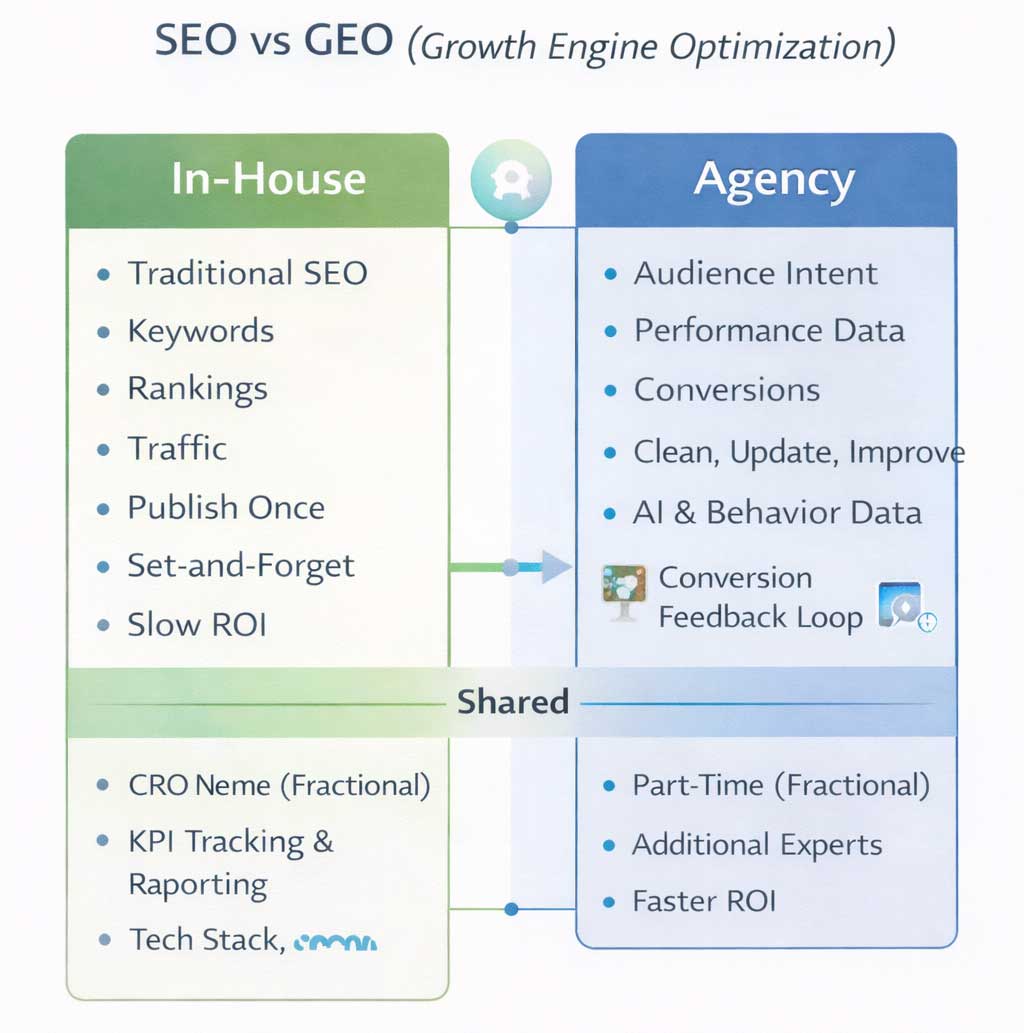
To truly drive growth, the strategy your marketing department implements is just as important as how it’s staffed. For B2B and professional services especially, inbound marketing, which attracts customers through valuable content and ensures your company is easily found when they search, is the engine that can deliver sustainable, compounding growth. This is in contrast to pure outbound tactics (like cold calling or direct mail), which can still play a role but are often more expensive and harder to scale. In this section, we’ll highlight why focusing on inbound—particularly SEO (and its evolved form “GEO”) and content marketing—is a smart move, and how to execute these strategies effectively.
Why Inbound? Inbound marketing earns the attention of customers naturally, rather than begging or interrupting. By creating content that answers prospects’ questions or helps solve their problems, you attract qualified traffic to your website or business over time. These prospects are actively seeking what you offer, which means they’re higher quality leads. Statistics bear this out: Inbound tactics generate 54% more leads than traditional outbound methods, and importantly, inbound leads cost 61% less on average than outbound leads (due to the efficiency of digital content). Over the long term, inbound marketing can dramatically lower your customer acquisition cost. For example, companies report that after just 5 months of consistent inbound marketing, their average cost per lead drops by 80%.
| Traditional SEO | GEO (Growth Engine Optimization) |
|---|---|
| Keyword focused | Audience intent focused |
| Rankings and traffic | Conversions and pipeline |
| Publish once | Continuous optimization |
| Slower ROI | Faster, compounding ROI |
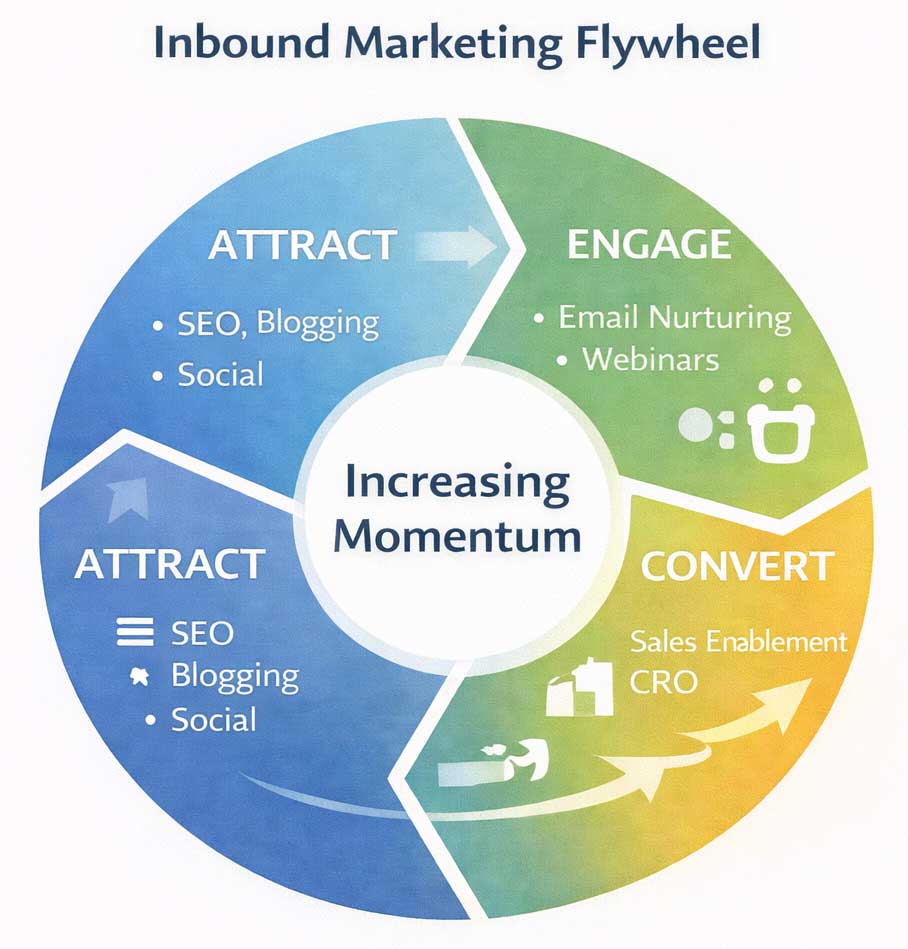
Inbound is a broad approach that includes content marketing, search engine optimization (SEO), social media, email marketing, and conversion optimization. Let’s break down a few core components your marketing department should prioritize:
- Content Marketing: This is the heart of inbound. By producing high-quality content (blog posts, whitepapers, case studies, videos, podcasts, etc.), you establish your company as a thought leader and build trust with your audience. Content draws in visitors (via search or social sharing) and nurtures leads through the funnel. A robust content strategy can yield tremendous ROI: 79% of companies with a blog report positive ROI for inbound marketing. Key types of content for B2B include how-to guides (like the one you’re reading), industry research, explainer videos, and webinars. One especially effective tactic is to address common questions or challenges your customers have, these make for great blog topics that can rank on Google and attract your ideal buyers. It’s worth noting that 80% of business decision-makers prefer to learn about a company through a series of articles (content) rather than ads, so your content can heavily influence buyers who are researching solutions.
- SEO (Search Engine Optimization): SEO is about ensuring your company’s content is discoverable on search engines. Given that B2B buyers conduct extensive online research (nearly 75% of B2B buyers will research online before ever contacting a vendor), showing up in those search results is critical. Your marketing team should continuously optimize your website and content for relevant keywords, earn backlinks, and improve technical performance so that you rank highly on Google for topics related to your services. The payoff is huge: SEO leads have a 14.6% close rate, far higher than the 2% close rate of outbound leads like cold calls. Why? Because people coming through SEO often have intent and trust in your content. As mentioned earlier, SEO offers one of the best ROI of any channel, in B2B it breaks even within ~9 months and then can soar to that 748% ROI over a few years. To succeed, invest in keyword research (find out what terms your prospects search), on-page optimization (use those terms naturally in your content), and building content clusters or “hubs” that establish your authority on key subjects. Modern SEO is less about tricking algorithms and more about being the best answer to the questions people are asking.
- GEO (Growth-Engine Optimization): GEO is an emerging concept that takes SEO a step further. It combines content strategy, AI-driven insights, and continuous optimization to create an integrated growth engine. Think of GEO as SEO on steroids: it’s not just ranking for keywords, but constantly analyzing content performance (like engagement, conversion rates) and tweaking your approach in real time to maximize growth. For instance, a GEO approach might involve creating a content cluster (a pillar page and related blog posts around a theme) and then using AI tools to monitor how each piece performs, updating underperforming content, refining the internal linking, and testing different headlines to improve click-through rates. The result is a more agile content strategy that adapts to audience behavior. Companies using GEO principles have seen dramatic improvements. For example, after implementing a GEO-driven content overhaul, one case study (TechNova, via Grawlix) saw monthly site traffic jump 8x and inbound leads surge from 15 to 160 per month. While you don’t need to get hung up on buzzwords, the takeaway is: invest in ongoing content optimization. Don’t adopt a “publish and forget” mindset. Revisit and improve content based on data. This is how you build a compounding growth machine with content.
- Lead Nurturing & Email: Attracting leads is only half the battle; you must also nurture them effectively. B2B buyers often aren’t ready to purchase immediately when they first engage. Your marketing department should implement an email marketing and lead nurturing program that follows up with content and offers tailored to a lead’s interest. (For example, if someone downloads an eBook on a topic, enroll them in an email sequence with related tips or case studies.) This kind of nurturing keeps your brand top-of-mind during the buyer’s research phase. Companies that excel at lead nurturing generate 50% more sales-ready leads at a 33% lower cost (as noted earlier), proving that systematic follow-up pays off. Make sure you have a good CRM or marketing automation tool (like HubSpot, Marketo, etc.) to automate these sequences and track engagement.
- Conversion Rate Optimization (CRO): Driving traffic is great, but converting that traffic into leads and customers is the end goal. Pay attention to your website’s user experience: is it easy for a visitor to understand what you do? Do you have clear calls-to-action (CTAs) encouraging them to contact sales, request a consultation, or download a resource? Optimize landing pages where you send campaign traffic (like a specific page for a Google Ad campaign or a LinkedIn ad) to maximize form fill rates. Small tweaks like improving page load speed, simplifying forms, or adding testimonials can boost conversion percentages, which significantly improves your marketing ROI without needing more traffic.
A well-structured inbound marketing funnel guides prospects from initial awareness to conversion. By providing valuable content at each stage and nurturing leads over time, a marketing department can turn strangers into loyal customers. Companies that master lead nurturing see 50% more ready-to-buy leads at 33% lower cost than those that don’t. In a growth-driven marketing model, every funnel stage (from attracting traffic at the top to engaging and educating in the middle to closing deals at the bottom) is strategically managed to maximize conversion and revenue.
To implement these inbound strategies, your marketing department should streamline its content and campaign processes (which we’ll discuss next) and work closely with sales. Share insights both ways: marketing can inform sales about which content a lead consumed (so sales can tailor their conversation), and sales can tell marketing what objections or questions they hear (so marketing can create content to address those). This alignment ensures that the content and SEO work you do isn’t in a silo; it directly fuels the sales pipeline.
One more point: inbound does not mean you ignore outbound entirely. Often the best approach is a blend. For instance, Account-Based Marketing (ABM) (a targeted outbound approach) can complement inbound by having marketing and sales jointly target a shortlist of high-value accounts with personalized outreach. In fact, 64% of client-centric organizations see much higher ROI from ABM than broader strategies. The key is that even outbound efforts should be informed by inbound intelligence (e.g., use content engagement data to inform who’s “warm”). Many B2B companies find success combining content-driven inbound to build broad awareness and capture active buyers, with selective outbound to proactively go after big-fish clients.
However, if you’re just starting to build your department and need to allocate limited resources, investing in content, SEO/GEO, and inbound lead gen is usually the wisest first choice. It creates a foundation that not only brings in leads now, but keeps yielding results long-term (content you publish today can keep attracting visitors for years). It’s marketing that works for you around the clock. As one marketing blogger put it succinctly: “Inbound marketing is the hero of cost-effectiveness as it targets those already on the hunt for what you offer, making every marketing move count.” That’s exactly the kind of efficient growth engine you want your marketing department to build.
Streamlining Your Content Creation Process (Consistency is King)
Having a great strategy and talented people won’t translate into growth unless your marketing department can execute efficiently and consistently. One hallmark of a high-performing marketing team is a streamlined content and campaign process. This means having the workflows, tools, and habits in place to produce quality marketing outputs regularly (blog posts, social updates, emails, etc.), without constant fire drills or bottlenecks. As the saying goes, “ideas are easy, execution is everything.” So let’s talk about how to set up your department’s processes for maximum productivity and minimum wasted effort.
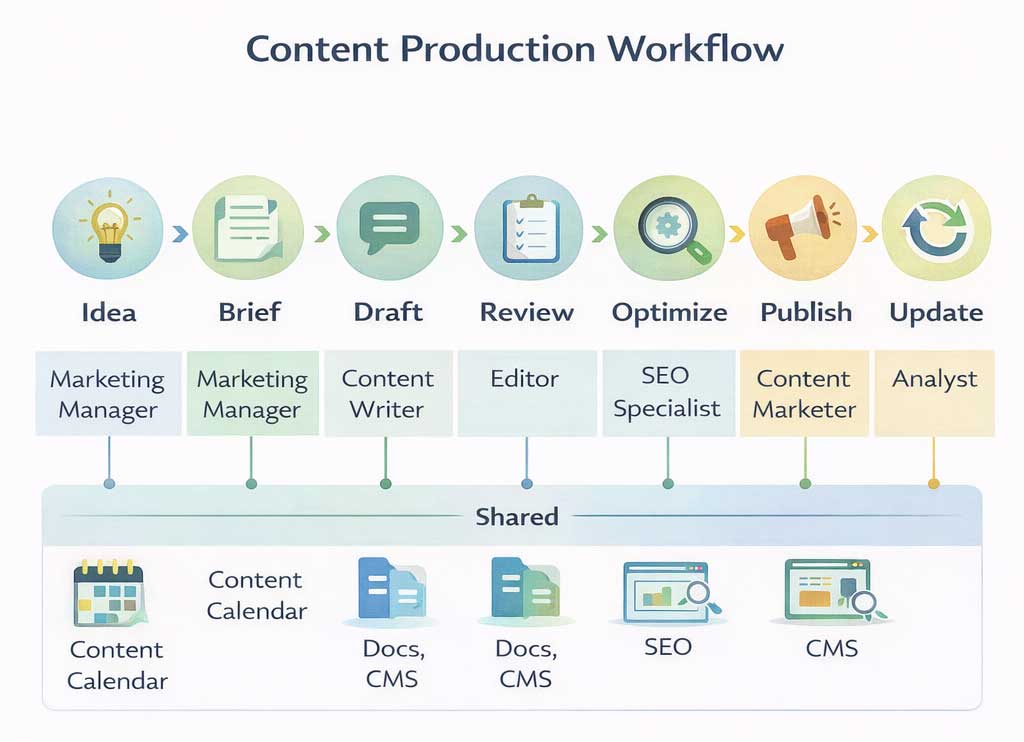
A marketing team collaborating on content planning. Establishing a clear content creation workflow (from brainstorming and drafting to design, approval, and publishing) ensures timely delivery and consistent quality. Streamlining this process allows your team to produce higher-quality content at a steady cadence, aligning efforts with business goals and driving more value for the company. Defining roles (who writes, who edits, who posts) and using tools like content calendars helps avoid last-minute scrambles and keeps everyone on the same page.
Here are key practices to streamline marketing workflows and particularly content production:
- Define Clear Roles and Responsibilities: As mentioned earlier, clarity in “who does what” is vital. For content creation, map out each step (ideation, writing, editing, design, publishing, promotion) and assign ownership. For example, a content writer drafts the blog, an editor or marketing manager reviews it, a designer creates accompanying graphics, and a social media coordinator handles distribution. When roles blur, things fall through the cracks (imagine a scenario where the writer assumes the social media team will post it, and the social team assumes the writer will, the result is that it never gets shared). Avoid that by documenting the workflow. A simple checklist for each piece of content that lists each person’s task can help. Clear roles prevent the “everyone thought someone else would do it” syndrome and increase accountability.
- Use a Content Calendar: A content calendar is your best friend for consistency. This is a forward-looking schedule (often a simple calendar or spreadsheet) where you plan what content will be published when, and on what channels. It provides a bird’s-eye view of your content strategy, ensuring a steady flow of content rather than sporadic bursts. Populate the calendar with blog topics mapped to dates, social media plans, email campaign timelines, etc. By planning at least a month or two ahead, you can align content with key business events (product launches, conferences, seasonal trends) and avoid the last-minute “what do we post this week?” scramble. Many tools like Trello, Asana, or CoSchedule can help manage content calendars collaboratively. The calendar also helps balance content types, for example, ensuring you’re not accidentally publishing five case studies in a row with no how-to articles in between.
- Establish Standard Operating Procedures (SOPs) and Guidelines: Document the processes your team will follow. This can include style guides (for writing tone, branding, design elements) and templates for common tasks. A well-crafted style guide keeps everyone on the same page about voice, terminology, formatting, and so on. Templates might include a blog post template with predefined subheadings and image spots, or an email campaign template. These reduce the time spent reinventing the wheel and ensure consistency across all content. When everyone follows shared guidelines, the output feels cohesive and aligned with your brand identity. It also speeds up onboarding of new team members or freelancers; they can refer to the SOPs to get up to speed.
- Repurpose and Reuse Content: Growth-focused marketing departments squeeze maximum value from every piece of content. This means repurposing content across multiple channels rather than doing one-and-done. For example, if you publish a research report, that can be turned into several blog posts, a couple of infographics, a webinar, and a series of social posts. A single blog post can be broken into a short video or a slide deck for LinkedIn. This strategy significantly boosts efficiency by leveraging work you’ve already done. It ensures a consistent message everywhere while reducing fresh content needs. Your team should habitually ask, “how else can we use this?” for each major content piece. Not only does repurposing save time, it often reinforces your message by meeting your audience in different formats (some prefer video, others a quick infographic). It’s a smart shortcut to maintain a presence on many channels without creating everything from scratch repeatedly.
- Leverage Collaboration Tools and Automation: Utilize project management and collaboration tools to streamline workflows. Platforms like Asana, Monday.com, or Jira can track tasks, deadlines, and approvals for marketing projects. A shared editorial calendar (as discussed) can live in these tools or a simple Google Sheet accessible to all. For communication, if your company uses Slack or Microsoft Teams, have dedicated channels for marketing projects to quickly address questions and share updates. Also, automate where possible: use a social media scheduling tool to queue up posts, use email marketing software to automate drip campaigns, use a content management system to schedule blog publish dates. Automation can handle repetitive tasks (like sending a welcome email to new leads or posting to multiple social accounts) so your team can focus on higher-level work.
- Consider a Content “Factory” Approach: If content marketing is a major part of your strategy (which for growth, it likely is), treat content production like a well-oiled factory line. Some companies establish a cadence like: brainstorming on Monday, writing Tue-Wed, editing Thursday, design Friday, publish next Monday, for instance. Find a rhythm that fits your team’s capacity. You might have weekly “editorial meetings” to plan upcoming content and review performance of last week’s content. The key is to institutionalize content creation as an ongoing process, not a sideline activity. When your team gets into a rhythm, content flows more easily.
- Outsource to Supplement Capacity: Even with a great team, there will be times when you need extra hands, say you want to scale content production or tackle a big project. Don’t hesitate to collaborate with content writing services or freelancers to keep things moving. As mentioned, many B2B marketers outsource a portion of content. Using external writers or designers can eliminate bottlenecks (like waiting on one overloaded writer) and ensure you never miss an opportunity due to lack of time. The ContentWriters guide we referenced suggests that working with an external content service can “ensure you always have fresh content ready to go”, while they handle hiring vetted writers, managing deadlines, and bringing new ideas to the table. Your internal team then focuses on core messaging and final approvals. Essentially, scaling content via outsourcing, combined with a solid in-house editorial process, is what the “best” marketing departments do to dominate content output in their niche.
| Stage | Owner | Primary Output |
|---|---|---|
| Idea | Marketing Manager | Topic aligned to goals |
| Brief | Marketing Manager | Clear content direction |
| Draft | Writer | First draft |
| Review | Editor | Quality and clarity |
| Optimize | SEO Specialist | Search and conversion readiness |
| Publish | Marketer | Live content |
| Measure | Analyst | Performance insights |
| Update | Team | Improved results |
By streamlining your processes, you allow your marketing strategy to come to life efficiently. The benefit isn’t just internal productivity, it’s that your audience sees consistent, high-quality content and campaigns from you, which builds trust and engagement. They’ll notice if your blog suddenly goes silent for two months or if your social posts are erratic. Consistency breeds credibility, which in turn drives growth.
Moreover, efficient workflows maximize the return on your marketing budget. Every hour saved through better process is an hour that can be reinvested in creative work or analysis that improves results. As one expert put it, optimizing your content process “aligns your efforts with business goals, enhancing content performance and ultimately driving more value for your business”. That’s exactly what we want: more value, less wasted effort.
Measuring Results and Continuously Improving
Peter Drucker’s famous quote, “If you can’t measure it, you can’t improve it,” holds very true for marketing. To ensure your new marketing department is truly driving growth, you must track performance diligently and use those insights to refine your approach. This final piece of the puzzle is about establishing a data-driven culture: setting up the right KPIs, monitoring them, and iterating on your strategy for continuous improvement.
Key Metrics to Track: First, define the key performance indicators (KPIs) that align with your marketing goals. These might include:
- Lead Volume: Number of leads generated per month (often broken down by source (e.g., how many from organic search vs. referrals vs. campaigns)).
- Lead Quality: This could be measured by the conversion rate of leads to opportunities or to customers. If you use lead scoring, track how many marketing leads meet the “qualified” threshold.
- Customer Acquisition Cost (CAC): How much you spend on marketing/sales to acquire a new customer. Also track cost per lead for each channel.
- Pipeline and Revenue Contribution: The dollar value of sales pipeline generated by marketing, and eventually the revenue from marketing-sourced or marketing-influenced deals. This connects your work directly to business growth.
- Web Traffic & Engagement: Overall site visits, but also deeper metrics like organic traffic growth (if SEO is a big play), time on site, and bounce rate (to gauge content effectiveness).
- Conversion Rates: At various stages (e.g., visitor-to-lead conversion rate, lead-to-customer conversion rate). Also monitor email open/click rates, landing page conversion rates, etc., for micro-optimizations.
- ROI by Campaign: If you run distinct campaigns or use paid channels, measure the ROI of each (revenue or pipeline generated vs. cost). This helps in budget allocation decisions.
Make sure you have tools set up to capture these. Typically, a combination of Google Analytics (for web traffic), your CRM (for lead and revenue data), and possibly a marketing automation platform (for email and campaign tracking) will do the job. It might take some initial effort from an analyst or technically inclined marketer to create dashboards or reports that bring the data together (for instance, a dashboard showing leads per channel with their conversion to opportunities). But it’s worth it. These dashboards become your marketing scorecard.
| Metric Layer | Example Metrics | Why It Matters |
|---|---|---|
| Traffic and Engagement | Visits, time on site | Top-of-funnel health |
| Qualified Leads | MQLs, SQLs | Lead quality |
| Revenue and Pipeline | Opportunities, revenue | Business impact |
Regular Reporting Cadence: Establish how often and to whom you report these metrics. Internally, the marketing team should review key numbers at least monthly (if not weekly for some metrics) to assess what’s working. Also report to company leadership regularly (e.g., a slide in the quarterly business review on marketing performance). Transparent reporting builds credibility. Keep in mind that marketing metrics may be met with skepticism in some organizations (in fact, 64% of B2B marketing pros say their business doesn’t trust marketing measurement). You can combat this by jointly defining metrics with leadership (so they buy in) and focusing on metrics that execs care about (pipeline, revenue) rather than vanity metrics. Use data to tell the story of how marketing is contributing to growth.
Analyze and Learn: Tracking numbers is only useful if you derive insights. Set aside time to analyze why. For example:
- If web traffic spiked in March, was it due to a particular blog post going viral or an SEO boost from content you added earlier? Identify the cause so you can replicate it.
- If a certain campaign underperformed, dig into the funnel: did it get clicks but not conversions on the landing page (meaning the landing page may need changes)? Or low clicks to begin with (meaning the offer or targeting wasn’t resonating)?
- Look at lead quality by source: perhaps you find that leads from SEO content close at a higher rate than those from a purchased email list. That insight would tell you to invest more in SEO and maybe nix the list purchase.
- Use A/B testing where possible to learn what works. Test different email subject lines, different call-to-action button colors or text, different ad creatives. Over time these incremental improvements add up.
The goal is to create a feedback loop: Data -> Insight -> Decision -> Action -> (back to) Data. For instance, your data shows a low conversion on a form page, insight is that the form is too long, decision is to shorten it, action is you do so, and then data next month should show improved conversion which validates the hypothesis.
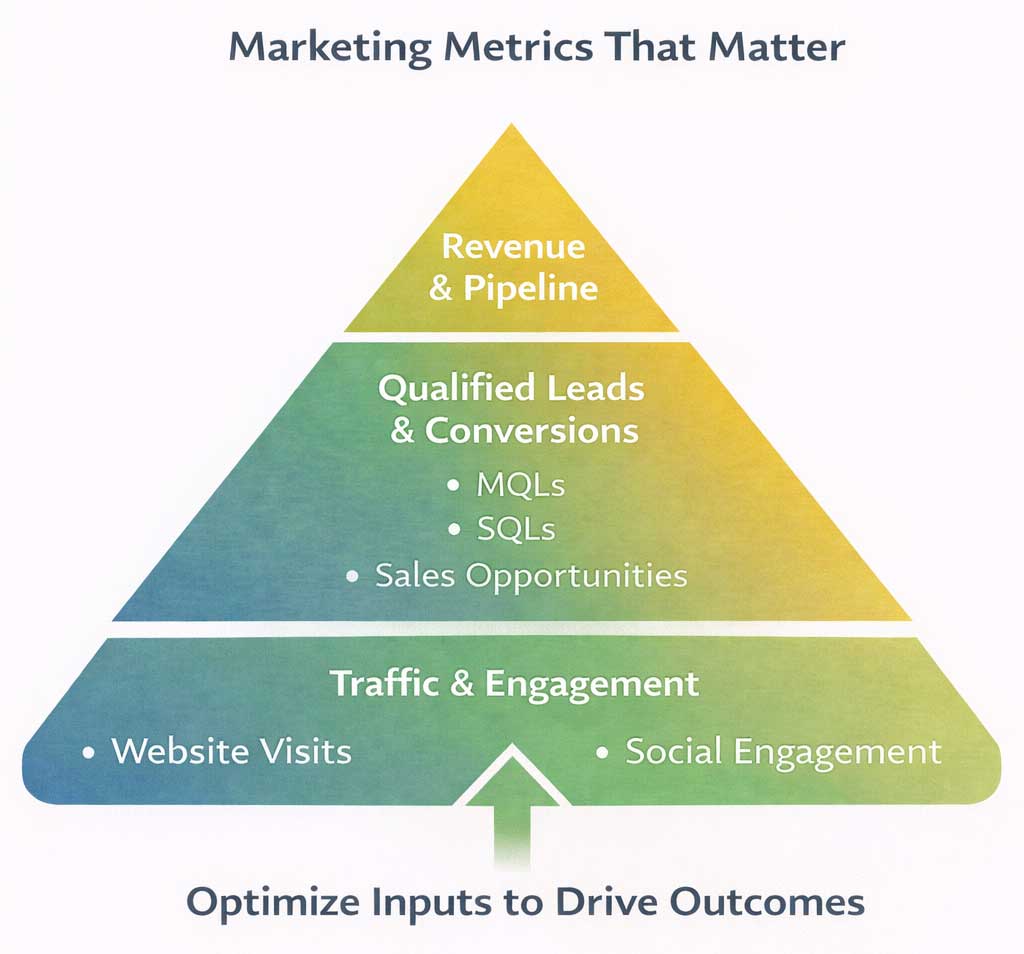
Also pay attention to the big picture trends. Are your marketing-sourced leads and revenue trending up quarter over quarter? Is your brand awareness improving (perhaps measured through increase in direct traffic or social media followers, etc.)? If you’re not seeing positive movement after a few quarters, it’s a flag to revisit your strategy or execution: maybe the messaging isn’t hitting the mark, or maybe you need additional tactics like PR or partnerships to boost reach.
Optimize for Both Short-term and Long-term: A data-driven approach helps balance quick wins and long-term growth. For example, you might see a quick win in a paid search campaign generating a few immediate leads; the data will show that ROI quickly, which is great. But also track longer-term plays like SEO or brand development, which may not pay off in one month but show strong trends over a year. Avoid knee-jerk reactions like cutting an initiative that’s slow-burn but high-potential. Use benchmarks and historical data to set realistic expectations for those. (If SEO typically takes 6-9 months to break even, don’t kill your blog in month 3 for “low ROI.” Instead, measure leading indicators like growing organic traffic.)
Celebrate and Replicate Success: When data shows a particular campaign or content piece knocked it out of the park, double down. For instance, if an eBook generates 50% of your quarterly leads by itself, analyze why. Was it the topic, the promotion strategy, the format? Consider creating more assets like it or expanding its reach (e.g. turn that eBook into a webinar series, etc.). Data can highlight your home runs, allowing you to allocate resources for maximum impact.
Iterate Your Strategy: A marketing department that drives growth is never on autopilot. Plan, execute, measure, tweak continuously. You might discover new information that changes your strategy. Example: your initial plan focused on LinkedIn ads, but after a few months the data says LinkedIn isn’t delivering quality leads, while webinars you hosted had excellent engagement. That insight might shift your strategy to do more webinars and less on that ad channel. This is normal and good! The strategic plan from the beginning is not set in stone; it’s a hypothesis to be tested. Through measurement, you validate assumptions and adjust course. Over time, this makes your marketing far more effective because it’s grounded in reality, not just theory.
Finally, ensure you’re measuring not just output (what marketing did) but outcomes (what marketing achieved). It’s easy to get busy and say “we published 10 blogs, sent 3 email campaigns, got 5,000 clicks, etc.” Those are outputs and intermediate metrics. The business outcome is how many leads or opportunities or dollars resulted. Keep those north-star metrics in focus when presenting results. It will reinforce that your marketing department is a growth driver, not just a cost center churning out activities. And when you can show a trend like “Marketing-influenced revenue grew from 5% of total sales last year to 15% this year,” that is a powerful justification for further investment in marketing.
By closing the loop with measurement and learning, you create a culture of continuous improvement. Your team will get smarter and more efficient over time, your campaigns will yield higher ROI, and your company’s leadership will gain confidence in marketing as an indispensable part of the growth engine. In essence, you transform marketing from a fuzzy expense into a data-backed, optimized business function: precisely what a modern marketing department should be.
Checklist: Steps to Build a Growth-Driven Marketing Department
For quick reference, here’s a checklist summarizing the key steps and best practices covered in this guide. Use this as a roadmap as you embark on building (or refining) your marketing department:
Define what “driving growth” means for your business. Set clear marketing goals (e.g. increase qualified leads by X%, contribute to Y% of revenue) and ensure they align with sales targets and overall business objectives. Secure appropriate budget (remember, successful B2B firms invest around 8% of revenue in marketing on average).
Identify gaps in your current marketing efforts. Do you lack strategy, sufficient personnel, or specific skills? Acknowledge any past failures (e.g. a hire that didn’t work out, or campaigns that flopped) and pinpoint why. This will inform what to prioritize as you rebuild (for instance, bringing in a fractional CMO if high-level strategy was missing).
Before hiring en masse, create a strategic plan. Define your target audience, key messaging, and the channels/tactics you will focus on (such as content marketing, SEO, email, LinkedIn, etc.). Map the customer journey and ensure your strategy covers the full funnel from awareness to conversion. Importantly, get buy-in from leadership and sales on this strategy so everyone is on the same page.
Determine the essential functions your marketing team needs to cover (strategy leadership, content/SEO, digital demand gen, creative design, analytics). Decide which skills you need in-house and which you can outsource. For each function, write a brief role description. This will guide hiring or agency selection.
Choose a structure that fits your size and goals, a functional structure is a great starting point (specialists in content, digital, etc., reporting to a Head of Marketing). Ensure every key responsibility has an owner. Create a simple org chart to clarify roles, reporting lines, and how teams will collaborate. This will help prevent confusion as you grow.
Fill the most critical positions first. Often this means hiring a capable marketing leader (if one isn’t in place) who can drive strategy and coordinate the team. Then add roles like a Content Marketing Manager/Writer and a Digital Marketing Specialist to start executing on lead generation. Look for adaptable people who can wear multiple hats initially. If budget is a concern, consider part-time or fractional experts for leadership or specialized skills to get started.
Plan for a mix of in-house staff and external partners to maximize your department’s capabilities. Engage agencies or freelancers for specialized needs (e.g. an SEO agency to handle technical optimizations and advanced content strategy, freelance writers to produce content at scale, or a design agency for polished creatives). This hybrid approach gives you flexibility and access to talent without huge overhead. Keep the strategic core (planning, key messaging) internal, but outsource to augment bandwidth and expertise.
Start creating value-driven content that will attract your target audience. Launch or improve your company blog with consistent, quality posts addressing your customers’ pain points. Optimize your website for search (SEO fundamentals) so that you rank for relevant keywords, consider a “pillar and cluster” content model for SEO authority. Develop lead magnets (e.g. eBooks, webinars) to capture leads, and set up an email nurturing system to follow up with those leads over time. Embrace GEO principles by continuously refining content based on performance data (update and improve content regularly rather than “set and forget”). Over time, these inbound efforts will create a self-sustaining pipeline of organic leads.
Establish a clear content creation and campaign execution process. Use a content calendar to schedule and coordinate all marketing activities. Define roles for each workflow stage (writing, approval, publishing, etc.) so everyone knows their part. Set up regular team meetings or check-ins to plan and review progress. Leverage tools (project management software, collaboration platforms) to keep work organized and on schedule. By creating efficient workflows, you’ll be able to maintain consistency and quality, which are essential for growth.
Ensure your marketing and sales teams communicate frequently. Develop a shared lead definition and agree on the process for lead handoff and feedback. Marketing should inform sales of upcoming campaigns and content, and sales should loop back with insights (e.g. what questions prospects are asking). This alignment is crucial for improving lead quality and conversion rates. Also collaborate with product/service teams to understand upcoming features or case studies that marketing can leverage.
Invest in the marketing tools that will make your team effective. At minimum, use a good CRM (to track leads and their source), an email marketing/marketing automation platform (for email campaigns and lead nurturing), and analytics tools (Google Analytics for web, plus possibly dashboards like Google Data Studio or others for reporting). If social media is key, use a social scheduling tool. For content, project management tools help as noted. The right technology helps automate repetitive tasks and gives you data to work with.
From day one, define your KPIs and set up tracking. Monitor results monthly (if not more often) and compile reports that show how marketing activities translate into leads, opportunities, and revenue. Use this data to continuously improve, double down on tactics that yield the best ROI, and iterate or drop those that underperform. For example, if you find SEO-driven content brings in the most high-quality leads, allocate more resources there. Conversely, if a particular paid channel isn’t delivering ROI, refine targeting or reallocate that budget. Create a feedback loop where campaigns are never static; they’re optimized through A/B testing and analysis. Over time, this will significantly increase marketing’s impact on growth.
Lastly, build a culture in your marketing department (even if it’s small) that encourages creativity, open communication, and learning. Encourage team members to share new ideas, test innovative approaches (like trying a new social platform or an AI tool for content), and stay updated with marketing trends. Provide training or resources for skill development, marketing evolves quickly (SEO algorithms change, new ad features roll out, etc.), so ongoing learning is key. A motivated, knowledgeable team will drive more growth than a disengaged one. Plus, a positive culture helps retain your marketing talent, which saves you the cost and disruption of high turnover.
By following this checklist and the guidance throughout this guide, you’ll be well on your way to building a marketing department that not only exists, but excels; one that is truly a driving force for your company’s growth. Remember that building anything worthwhile is a process: start with a strong strategic foundation, add the right people and partners, focus on high-impact activities, and continuously refine as you learn. With time and persistence, your marketing department will become a growth engine that powers your business to new heights. Good luck, and happy marketing!
FAQs About Building Your Own Marketing Department
For most established B2B and professional services companies, meaningful traction typically appears within three to six months. This assumes leadership alignment, a clear strategy, and consistent execution. Channels like SEO and content marketing usually take longer to mature but deliver compounding returns over time.
No. Many companies see strong results with a small internal team, often one marketing manager, supported by fractional agencies or contractors. What matters most is strategic clarity and execution quality, not headcount.
The most important first hire is someone who can own strategy and coordination. This may be a marketing manager with broad experience or a fractional CMO. Hiring execution roles without strategic leadership often leads to wasted spend and poor results.
A common benchmark is five to ten percent of annual revenue, depending on growth goals and industry competitiveness. Companies seeking aggressive growth typically invest toward the higher end of that range.
Marketing should align closely with sales but not report directly into it. Both functions should report into executive leadership with shared revenue goals and clear collaboration processes.
It is possible but not recommended for most companies. Strategy, brand knowledge, and sales alignment are best kept internal. Agencies perform best when they execute within a clear internal framework rather than operating independently.
The most reliable indicators are qualified lead volume, pipeline contribution, and marketing influenced revenue. Activity metrics like traffic and engagement are useful, but outcomes tied to revenue matter most.
Most failures stem from lack of strategy, unrealistic expectations, or insufficient resources. A structured approach with clear goals, leadership oversight, and the right partners often produces very different results.
Content marketing is critical. Buyers in professional services conduct extensive research before contacting vendors. High quality content builds trust, demonstrates expertise, and shortens the sales cycle.
Inbound should be the foundation for most B2B organizations. Outbound tactics can complement inbound efforts, especially for targeted account based strategies, but inbound provides more scalable and cost effective growth over time.
At minimum, a CRM, analytics platform, email marketing system, and project management tool are required. As the department matures, marketing automation and advanced reporting tools become increasingly valuable.
An agency makes sense when specialized expertise is required, internal bandwidth is limited, or faster execution is needed. SEO, content scaling, and paid media are common entry points for agency support.
Tie marketing goals directly to revenue, track performance rigorously, and continuously optimize. Marketing becomes a cost center only when outcomes are unclear or accountability is missing.
Resources
- Marketing Department Org Chart Structurehttps://www.organimi.com/marketing-department-org-chart-structure/
- B2B Marketing ROI Benchmarks 2026: What Actually Works (And What Doesn't)https://www.data-mania.com/blog/b2b-marketing-roi-benchmarks-2025/
- 40+ Latest Inbound Marketing Statistics (2025 Report)https://www.sender.net/blog/inbound-marketing-statistics/
- Readout: 33 B2B marketing statistics from 2024 - Sword and the Scripthttps://www.swordandthescript.com/2024/12/b2b-marketing-statistics-2024-2/
- Thinksia - Business Transformation & Growth Advisorshttps://www.thinksia.co/insights/who-needs-a-fractional-cmo
- 20 Inbound Marketing Statistics to Inspire SMB Growth in 2025https://www.salesgenie.com/blog/inbound-marketing-statistics/
- Create a Winning Marketing Team Structure with These 10 Templates - i creativeshttps://www.icreatives.com/iblog/create-a-winning-marketing-team-structure-with-these-10-templates/
- B2B Marketing in 2025 | B2B Marketing Statistics | Coalition Technologieshttps://coalitiontechnologies.com/blog/must-know-b2b-marketing-statistics-for-2025
- From Zero to GEO: A Case Study in AI-Optimized Content Successhttps://www.linkedin.com/pulse/from-zero-geo-case-study-ai-optimized-content-success-grawlix-xobkf
- 78 Best Digital Marketing Statistics for Marketers in 2025https://landingi.com/digital-marketing/statistics/
- How to Streamline Your Content Creation Workflowhttps://contentwriters.com/blog/how-to-streamline-your-content-creation-workflow/


Kim Greer
OFP Law
One of the best business decisions I ever made was to contract with 321 Web Marketing. Jonathan Gessert and his team are knowledgeable, efficient, and effective, making digital marketing goals easy to achieve and helping [...]

Kelly Cole
Business Benefits Group
My company hired 321 Web Marketing in February 2016 to resurrect our web site. We feel our web site is the face to our business and desperately needed a make over. 321 took us from blah to WOW effortlessly and what a difference [...]

Emily Hawkins
Diener & Associates
Thanks to 321 Web Marketing, the client has seen an increase in their search engine leads, averaging 12 qualified leads per month. The client has also achieved prominent Google Maps and search placement. The team manages the engagement [...]

Trevor Telesz
Paw Pals Pet Sitting
321 Web Marketing successfully translated the client’s design into a stunning and refreshed website, ensuring seamless functionality across all dynamic views. The team provided clear timelines and stuck to them, keeping everything [...]

Corey Davis
Spartan Animal & Pest Control
321 Web Marketing is truly phenomenal at what they do. Their ability to communicate and describe the steps and actions that they are implementing , Alex Zarpas in particular, is excellent. Delivering on promises is all they have done for me [...]

Alec Roberts
MFE Insurance
I can’t say it enough, Jonathan and his team have gone above and beyond since day one to accommodate our needs and meet our goals. I run a specialty insurance brokerage based in LA and once we found 321 we never looked [...]

Richard Wilbur III
Advantage.Tech
Thanks to 321 Web Marketing’s web development work, the client increased rankings and traffic from search engines. Also, their business secured prominent positions on Google Maps and industry-relevant, profitable keywords. The client also [...]

Bruce Gemmill
FVCbank
After the website revamp, the client saw a steady rise in leads from search engines, resulting in additional traffic. 321 Web Marketing is highly punctual when it comes to deliverables, and internal stakeholders are impressed with the service [...]

Drew Weeks
VAE
321 Web Marketing delivered a sleek website that accurately portrays the size and quality of the client’s organization. All of their completed websites have received positive feedback from users who have been impressed by the UX/UI. The [...]

Ryan Masten
Masten Pools
321 Web Marketing has increased the client’s leads from zero to 53 monthly. Their SEO efforts pay off impressively due to a top-ranking position on Google and making the site the number one result for several local service keywords. The [...]