


 Dec 15, 2025 ·
  4 min read ·
  Summarize in ChatGPT
Performance marketing tends to hinge on small distinctions, and few are as overlooked as the gap between CPL and CPQL. At first glance, they seem interchangeable, yet that single added letter signals a shift in how you measure real progress in a campaign.
Businesses often track leads without understanding what distinguishes noise from genuine pipeline movement, and that distinction can significantly impact strategy, budget decisions, and long term outcomes. You’re about to see why CPL and CPQL represent two very different lenses for evaluating marketing performance.
The deeper you look, the clearer it becomes that one metric tells you you are attracting attention, while the other hints at revenue potential. The full picture forms once you understand how each metric functions inside a structured, data driven marketing system.
CPL vs. CPQL: What’s The Difference (& Why It Matters)
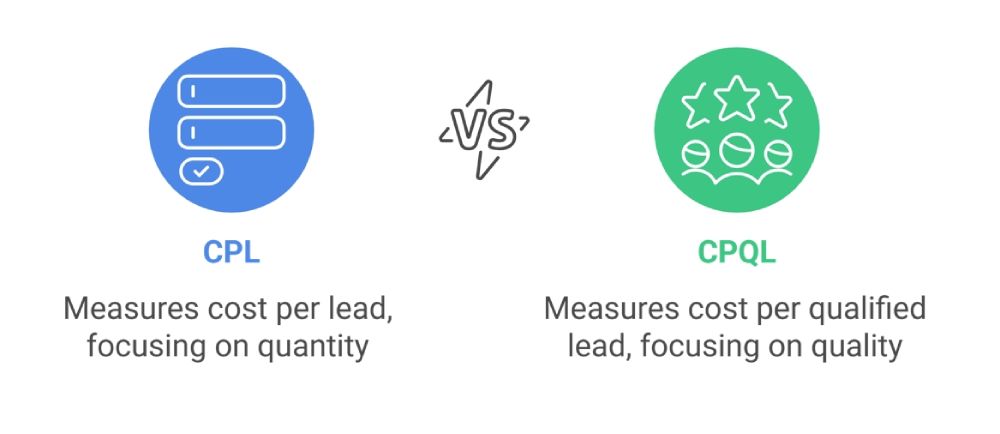
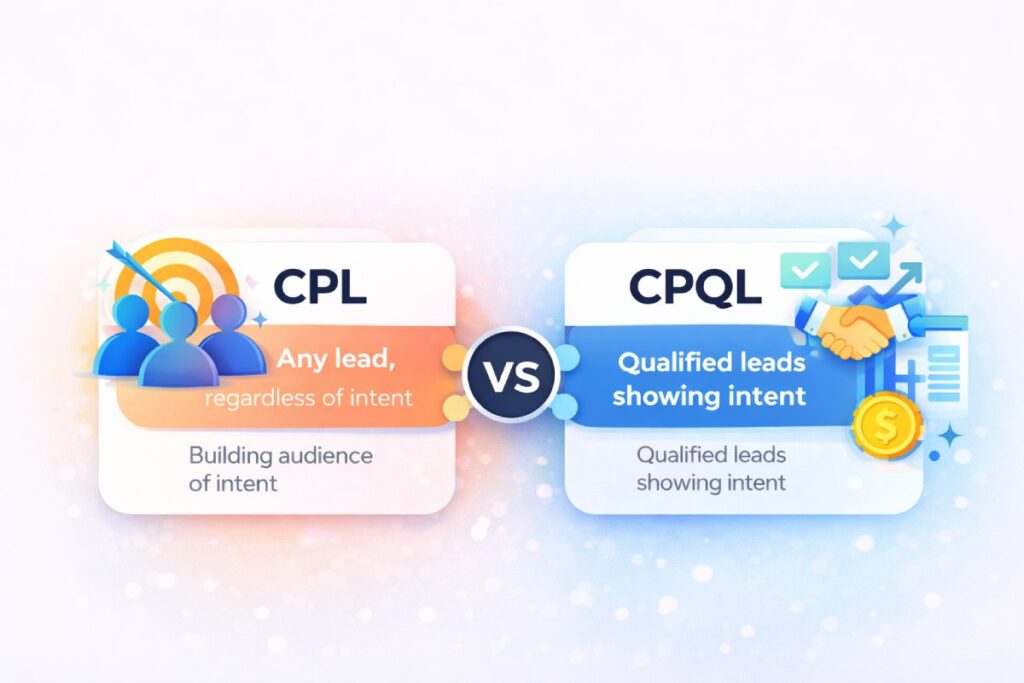
Understanding how CPL and CPQL function helps clarify why marketing performance can look strong on paper while pipeline progression remains weak. Both metrics relate to lead acquisition, yet each tells a different story about intent, value, and sales readiness.
CPL (Cost Per Lead)
CPL measures the cost to generate any lead, regardless of buying intent.
Best for: Top-of-funnel campaigns focused on reach and early engagement.
What CPL Is Commonly Used For
- Building audience volume
- Testing messages or creative
- Driving early-stage awareness
- Measuring cost efficiency across broad campaigns
Benefits Of CPL
Why teams rely on it:
- Simple to calculate and compare across channels
- Large datasets enable experimentation with audiences and creative
- Quick visibility into which campaigns generate the most hand-raises for the lowest cost
Drawbacks Of CPL
Where issues show up:
- High lead volume may mask low intent or poor fit
- Leads may lack buying authority or relevance to your ICP
- Sales spends time pursuing contacts unlikely to convert
- Marketing is pressured to fix targeting later in the funnel
- CPL alone does not reveal misalignment between volume and quality
CPQL (Cost Per Qualified Lead)
CPQL measures the cost of acquiring leads that match predefined qualification criteria and demonstrate meaningful intent.
Qualifications may include:
- Firmographic fit (industry, size, title)
- Engagement thresholds (downloads, repeat visits)
- Intent signals (pricing page visits, demo requests)
Benefits Of CPQL
Why teams adopt it:
- Prioritizes quality over volume for better sales alignment
- Focuses campaigns on decision makers and high fit accounts
- Intent rich behavior leads to more efficient targeting and spend
- Data driven lead scoring and CRM tracking refine qualification
- Shared qualification rules create a smoother marketing → sales handoff
Operational Impact
- Sales gains a clearer picture of high value leads
- Marketing gets actionable insight into which campaigns influence pipeline
- The organization reduces wasted effort by filtering out low-intent contacts
Why CPQL Is a Better Metric For B2B Marketing
| CPL (Cost Per Lead) | CPQL (Cost Per Qualified Lead) | |
|---|---|---|
| Shows cost per any lead | vs | Focuses on sales ready contacts |
| Inflated numbers if targeting is broad | vs | Shows revenue potential and pipeline contribution |
| Doesn’t show buying intent | vs | Helps prioritize high intent audiences |
The first table shows the basic differences between CPL and CPQL. Next, we’ll look at how these metrics actually impact sales, campaigns, and revenue so you can see why focusing on qualified leads drives smarter marketing decisions.
| CPL (Cost Per Lead) | CPQL (Cost Per Qualified Lead) | |
|---|---|---|
| Lead Quality & Buying Intent | Treats all form submissions the same, hiding buying intent | Tracks sales ready contacts, showing clear contribution to revenue and pipeline growth |
| Sales Efficiency & Prioritization | Marketing and sales spend time on low intent leads | Enables teams to focus on high-value leads, making efforts more efficient |
| Targeting Strategy & Campaign Messaging | Campaigns may emphasize broad formats, channels, and messaging | Campaigns shift toward intent-driven offers and high-fit audiences |
| Forecasting & Revenue Attribution | Forecasting and reporting focus on surface level engagement | Qualified lead counts correlate with actual revenue, improving forecast accuracy |
| Channel Performance Signals | Paid social may appear more effective due to lower CPL | Paid search often drives more qualified leads at a lower cost per qualified lead, signaling higher revenue potential |
Campaign adjustments follow naturally once CPQL takes center stage. Ads and landing pages are shifting toward intent driven offers, such as demo requests or detailed assessments. Targeting shifts toward high fit audiences instead of broad lists.
CRM data is essential for improving strategies, and nurturing paths become stronger as marketing monitors which actions show that someone is ready to engage. CPQL supports a full funnel view of performance that aligns with revenue objectives.
Moving Toward a Quality First Model
Marketing efforts begin to align with the conditions that produce genuine opportunities, rather than generating large volumes of unqualified leads. CPQL transforms your marketing from generating activity to generating opportunity.
If your team is aiming for stronger revenue alignment and more predictable pipeline performance, 321 Web Marketing can help you implement a qualification-driven strategy that moves real deals forward. Connect today for a free consultation to put a smarter, data-driven strategy in motion.

Kim Greer
OFP Law
One of the best business decisions I ever made was to contract with 321 Web Marketing. Jonathan Gessert and his team are knowledgeable, efficient, and effective, making digital marketing goals easy to achieve and helping [...]

Kelly Cole
Business Benefits Group
My company hired 321 Web Marketing in February 2016 to resurrect our web site. We feel our web site is the face to our business and desperately needed a make over. 321 took us from blah to WOW effortlessly and what a difference [...]

Emily Hawkins
Diener & Associates
Thanks to 321 Web Marketing, the client has seen an increase in their search engine leads, averaging 12 qualified leads per month. The client has also achieved prominent Google Maps and search placement. The team manages the engagement [...]

Trevor Telesz
Paw Pals Pet Sitting
321 Web Marketing successfully translated the client’s design into a stunning and refreshed website, ensuring seamless functionality across all dynamic views. The team provided clear timelines and stuck to them, keeping everything [...]

Corey Davis
Spartan Animal & Pest Control
321 Web Marketing is truly phenomenal at what they do. Their ability to communicate and describe the steps and actions that they are implementing , Alex Zarpas in particular, is excellent. Delivering on promises is all they have done for me [...]

Alec Roberts
MFE Insurance
I can’t say it enough, Jonathan and his team have gone above and beyond since day one to accommodate our needs and meet our goals. I run a specialty insurance brokerage based in LA and once we found 321 we never looked [...]

Richard Wilbur III
Advantage.Tech
Thanks to 321 Web Marketing’s web development work, the client increased rankings and traffic from search engines. Also, their business secured prominent positions on Google Maps and industry-relevant, profitable keywords. The client also [...]

Bruce Gemmill
FVCbank
After the website revamp, the client saw a steady rise in leads from search engines, resulting in additional traffic. 321 Web Marketing is highly punctual when it comes to deliverables, and internal stakeholders are impressed with the service [...]

Drew Weeks
VAE
321 Web Marketing delivered a sleek website that accurately portrays the size and quality of the client’s organization. All of their completed websites have received positive feedback from users who have been impressed by the UX/UI. The [...]

Ryan Masten
Masten Pools
321 Web Marketing has increased the client’s leads from zero to 53 monthly. Their SEO efforts pay off impressively due to a top-ranking position on Google and making the site the number one result for several local service keywords. The [...]