
 Oct 29, 2026 ·
 7 min read ·
 Summarize in ChatGPT
You’ve seen the headlines that claim being cited in AI overviews can more than double your clicks. Last month you were cited multiple times, but your click-through rate (CTR) saw only a moderate lift. The pages held their rankings the whole time, and nobody on the team could say what the citations had bought.
Now you need to know if chasing those citations was worth the spend, and how to approach a changing marketing environment.
Cited Beats Uncited, but Nothing Beats a Clean SERP
Seer Interactive tracked 53 brands across 5.47 million queries and 2.43 billion organic impressions from January 2025 through February 2026. For a query cluster pulling 10,000 organic impressions per month, the 2026 update found roughly:
- 335 clicks when no AI overview appears
- 207 clicks when the page is cited in an overview
- 94 clicks when an overview appears but doesn’t cite the page
A citation delivers 120% more clicks than going uncited on the same SERP, which is a real advantage over competitors. But cited pages still trail overview-free results by 38%.
That difference shows how an overview changes what the SERP is. A clean result page is a list of doors. The user has to open one to get an answer. An overview puts the answer above the doors, where most users read it and leave.
Being cited doesn’t recover what the overview takes, but only determines who gets the smaller share of clicks that remain.
What Overviews Did to Click-Through Overall
| Study | What it measured | Sample | Finding |
|---|---|---|---|
| Seer Interactive, February 2026 | Clicks by whether the page was cited in the overview | 53 brands, 5.47M queries, 2.43B impressions, January 2025 to February 2026 | Cited pages earned 120% more clicks than uncited pages, and 38% fewer than pages on an overview-free SERP |
| Pew Research Center, July 2025 | Whether users clicked any link at all | 900 US adults, 68,879 searches, 12,593 with an AI summary, March 2025 | Users clicked a link on 8% of searches with a summary, against 15% without one |
| Ahrefs, April 2025 | Click-through rate on the same keywords before and after overviews appeared | 300,000 keywords, March 2024 against March 2025 | Click-through rate fell 34.5% |
| Ahrefs, February 2026 | The same study, repeated | 300,000 keywords, December 2023 against December 2025 | Click-through rate fell 58% |
Three independent studies confirm the pattern suggested by Seer Interactive’s data.
The Pew Research Center tracked 68,879 searches by 900 U.S. adults and found results with an AI summary produced a click 8% of the time versus 15% without one. Ahrefs studied 300,000 keywords and found overviews correlated with a 34.5% lower click-through rate in April 2025, then 58% lower when they repeated the study in February 2026.
The trend line shows how the drop in CTR nearly doubled in under a year, which suggests that users are learning to read the overview and stop. The summary that Google assembles from your content is, for a growing share of searches, the only thing anyone reads.
That changes who loses clicks, and how many they lose. If your page ranks well for a query that now triggers an overview, your impressions may hold steady while your clicks fall, because Search Console counts an overview impression the same as any other impression.
Which raises the question, “How do you advertise effectively online when overviews are the new default?”
Position Inside the Overview Decides Who Gets the Click
In September 2025, Search Engine Land published an analysis of 20,000 ranking queries. They found that being the first citation in an AI overview delivered a click volume comparable to the sixth organic position. Being the fifth citation in an overview was comparable to being “on the 10th page of Google’s search results.”
Pew’s data reinforces the scale problem: clicks on source links inside the summary itself accounted for just 1% of all visits where an AI summary appeared.
Because Google Search Console doesn’t tell you which citation slot you capture, position reporting becomes a real problem. Overview impressions are bundled into the same count as every other impression, so a page that slides from the second citation to the fifth will appear to have flat impressions but a falling click-through rate.
The risk is assuming the problem is content quality and completely rewriting the page, when the page wasn’t the issue.
Tracking where your page sits in the list of citations in an overview takes either a rank tracker that captures overview markup or an analyst to run your priority queries on a schedule and log the citation order by hand.
Fewer Clicks Can Still Mean More Value
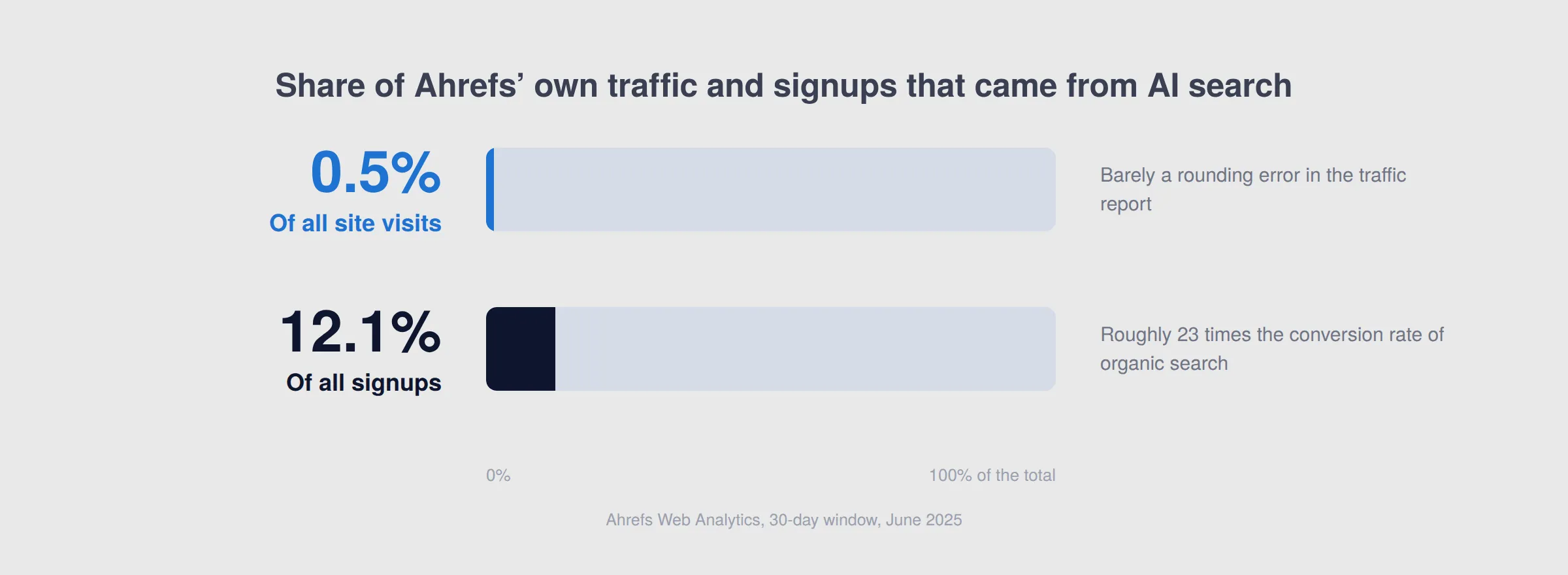
In conversion data published by Ahrefs in June 2025, AI search accounted for 0.5% of visits over a 30 day window and produced 12.1% of signups, a conversion rate roughly 23 times its organic average.
Later that month, Ahrefs published a second study covering about 82,000 websites, and engagement figures pointed the other way. AI-referred visitors averaged 4.0 pages per session against 5.2 for search visitors, and they bounced at 67.8% against 63.7%. Ahrefs asked whether AI-referred traffic is better quality and answered, “from a user behavior perspective, not quite.”
That both of these findings come from the same company within the same month suggests an interesting explanation. AI referred visitors arrive on your page having already read a summary. They land, read one page, and either convert or leave.
That behavior produces a high bounce rate and a high conversion rate at the same time.
It also changes which pages are worth having cited. A page that offers little more than a definition that AI can easily summarize in full doesn’t give a user a reason to come to your page or convert.
A page that documents how you measured something, what your sample was, and where your method fails isn’t easily compressed into a summary. That citation gives the reader a reason to click and keep reading.
Sorting your existing content library by how compressible each page is can help you reorder your roadmap.
How To Tell if Citation Is Paying Off
Before you set a benchmark, consider that in the months between December 2025 and February 2026, Seer’s monthly series showed click-through rates bottoming out at 1.31% and then recovering to 2.36%.
The effect of AI overviews on click-through rates has been volatile. Users are still learning to use the new tools, and their behavior keeps shifting. At the same time, the tools themselves are being updated periodically, giving users different value over time.
Four changes to your reporting will tell you more than any published study.
- Compare your cited pages against your own overview-free queries, not against what those pages earned before overviews existed. Google began rolling out AI overviews in the U.S. in May 2024, so any baseline from earlier describes a SERP that is gone.
- Track where you appear in the list of citations. Appearing early in the list of citations has a dramatic impact on click-through rates, and Search Console doesn’t report it for you.
- Report conversion quality rather than sessions. Conversion rate on AI-referred visits and branded search volume both sit in tools you already have, and both will show value that a sessions chart hides.
- Add a “How did you hear about us” field to your conversion forms. That answer comes from the customer rather than a platform, and it is the only place where someone can tell you if they found your organization from an AI citation.
Citation rate and slot position are lead measures your team can move within a sprint, while conversion and branded demand are the lag measures that leadership funds. Reporting both together ties the day-to-day work to the outcomes that justify the budget.
Auditing Your Citation Performance
Most teams can see that they’re being cited but can’t tell whether those citations are driving clicks or just inflating impressions. A 321 Web Marketing GEO citation and CTR audit maps your slots, click quality, and downstream conversions, then shows you where to focus.
Kim Greer
OFP Law
One of the best business decisions I ever made was to contract with 321 Web Marketing. Jonathan Gessert and his team are knowledgeable, efficient, and effective, making digital marketing goals easy to achieve and helping [...]

Kelly Cole
Business Benefits Group
My company hired 321 Web Marketing in February 2016 to resurrect our web site. We feel our web site is the face to our business and desperately needed a make over. 321 took us from blah to WOW effortlessly and what a difference [...]
Emily Hawkins
Diener & Associates
Thanks to 321 Web Marketing, the client has seen an increase in their search engine leads, averaging 12 qualified leads per month. The client has also achieved prominent Google Maps and search placement. The team [...]
Trevor Telesz
Paw Pals Pet Sitting
321 Web Marketing successfully translated the client’s design into a stunning and refreshed website, ensuring seamless functionality across all dynamic views. The team provided clear timelines and stuck to them, [...]

Corey Davis
Spartan Animal & Pest Control
321 Web Marketing is truly phenomenal at what they do. Their ability to communicate and describe the steps and actions that they are implementing, Alex Zarpas in particular, is excellent. Delivering on promises is all [...]

Alec Roberts
MFE Insurance
I can’t say it enough, Jonathan and his team have gone above and beyond since day one to accommodate our needs and meet our goals. I run a specialty insurance brokerage based in LA and once we found 321 we never looked [...]

Richard Wilbur III
Advantage.Tech
Thanks to 321 Web Marketing’s web development work, the client increased rankings and traffic from search engines. Also, their business secured prominent positions on Google Maps and industry-relevant, profitable [...]
Bruce Gemmill
FVCbank
After the website revamp, the client saw a steady rise in leads from search engines, resulting in additional traffic. 321 Web Marketing is highly punctual when it comes to deliverables, and internal stakeholders are [...]
Drew Weeks
VAE
321 Web Marketing delivered a sleek website that accurately portrays the size and quality of the client’s organization. All of their completed websites have received positive feedback from users who have been [...]

Ryan Masten
Masten Pools
321 Web Marketing has increased the client’s leads from zero to 53 monthly. Their SEO efforts pay off impressively due to a top-ranking position on Google and making the site the number one result for several [...]