



Table of Contents
- 1. Introduction
- 2. The real cost of an in-house marketer isn’t the salary
- 3. What an in-house team actually does better than any agency
- 4. What an agency actually does better than any in-house team
- 5. The stage-based framework: what to hire and when
- 6. The hybrid model most companies actually need
- 7. The questions to ask before you make the call
- 8. Closing: the decision framework
- 9. Frequently Asks Questions

 Jun 22, 2026 ·
  24 min read ·
  Summarize in ChatGPT
Introduction
A chief marketing officer (CMO) at a midsize SaaS company spent nine months hiring her first senior marketing lead. She passed on strong candidates, worked through the offer, and handled the hire’s onboarding herself. By month nine, the new hire had left.
The exit exposed a deeper issue than skill fit. The hire cited burnout and a leadership team that could not agree on what marketing had to deliver. The company had paid the salary, spent the search time, and still had no pipeline from the role.
That failed hire shows the cost of a weak marketing team structure. The cost does not appear as one clean line in the budget. It shows up as lost time, stalled demand work, and another search cycle.
The pressure on senior marketing leaders has grown. Average CMO tenure has reached an all-time low, with burnout and poor alignment between leadership and marketing execution behind much of the strain (Sheridan, 2023). That strain gets worse when no one owns the choice of whom to hire, what to keep in-house, and what to outsource.
The same problem affects revenue. About 80% of the buying process now happens before a buyer talks to sales, which puts more weight on the content, campaigns, and proof that marketing creates early in the process (Ruffolo, 2025). A weak marketing structure leaves that work under-owned.
The wrong starting point is simply choosing between in-house marketing vs agency. The better question is what mix of internal talent and outside help fits the company’s stage, budget, goals, and current team. That question also decides when to hire a marketing agency, when to hire in-house, and when to use both.
Four factors guide the right mix: stage, capacity, specialization, and accountability. Stage sets the amount the company should spend before it overbuilds. Capacity shows when the current team has more work than it can manage well. Specialization shows where outside help adds skills the company does not need full-time. Accountability shows who owns results when targets are missed.
This article uses those four factors to explain marketing team structure by company stage.
The cost of replacing an employee can range from 50% to 200% of their annual salary, depending on their level.
— Regina Dyerly, Partner and Chief Operations Officer, Vida HR
The real cost of an in-house marketer isn’t the salary
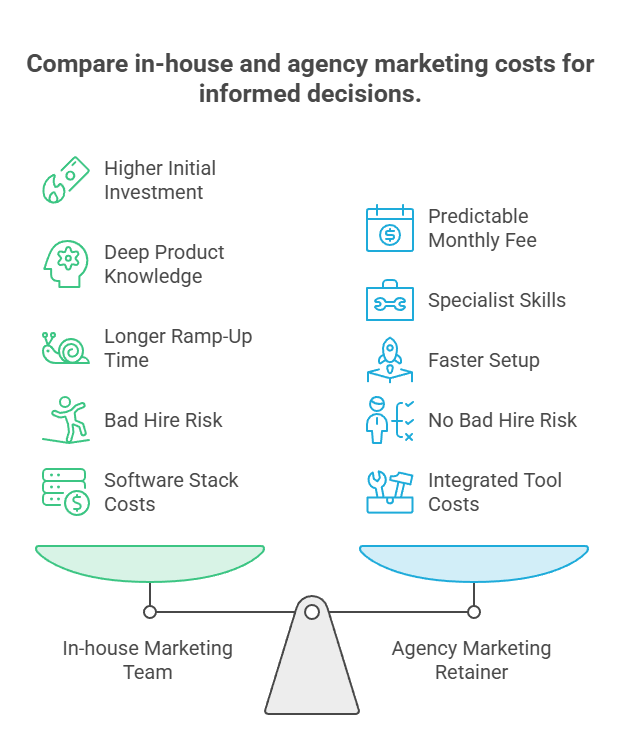
Most hiring plans start with salary because salary is the first fixed cost in the offer. A $70,000 marketing coordinator appears in the hiring plan as a $70,000 annual cost. The full employer cost rises once the company adds benefits, tools, training, and management time.
The U.S. Bureau of Labor Statistics reports that wages and salaries make up 70.1% of total employer pay for private industry workers. Benefits make up the other 29.9% (U.S. Bureau of Labor Statistics, 2026). Based on that pay mix, a $70,000 salary points to roughly $100,000 in total pay before software, equipment, and training enter the budget.
The agency vs in-house cost comparison gives a false result when it stops at salary. A company has to pay for the person, plus the tools, direction, and work process around that person. The cost of an in-house marketing team includes pay, tools, direction, and ramp time.
All-in cost breakdown
Salary is the primary cost. The real cost of an in-house marketer also includes payroll tax, benefits, equipment, software subscriptions, training, and the management hours needed to guide the work. A new hire needs tools, clear direction, and time before the position produces work at the level the job requires.
A base salary leaves out the benefit share of total employer pay before tax, tools, and training enter the budget. Payroll tax, software, equipment, and training raise the total further.
A small in-house team with a marketing manager and a few specialists costs $120,000 to $250,000 per year, including software and benefits (RB Oppenheim Associates, 2026). The specialist vs generalist marketing hire decision affects where the company lands in that range. A content lead, paid media manager, and part-time designer push the cost toward the high end, while a solo generalist with light freelance help keeps the cost near the low end.
The agency retainer vs salary comparison also changes over time. A full-time content manager gains product, buyer, sales, and brand knowledge each month. That compound learning makes the direct hire more efficient than a premium agency retainer as the person becomes faster and more fluent in the company’s voice (Ruffolo, 2025).
Meanwhile, an agency brings specialist skills and a faster setup. It does not build the same day-to-day product, sales, and buyer context inside the company. That expertise matters when the work depends on sales calls, product details, customer pain points, and a clear brand voice.
The hidden costs most budgets miss
Most budgets miss three types of costs when hiring in-house. The first cost is ramp time. A new marketing hire needs time to learn the brand, the product, the buyer, and the internal process.
During that ramp period, the company pays full salary for partial output. The hire is working, but the work has not reached the level the position was meant to deliver. Ramp time matters most in jobs tied to pipeline, demand, and revenue.
The second cost is a bad hire. Replacing one employee costs 50% to 200% of that person’s annual salary, based on the level of the position (Dyerly, 2025). For a $70,000 marketing manager, one bad hire costs $35,000 to $140,000.
That figure rises for senior positions. It also leaves out lost campaign work, lost team focus, and lost sales support. Those losses continue until the next hire reaches full output.
The third cost is the software stack. An agency retainer folds tool costs into the monthly fee. An in-house team pays for each tool on its own.
The marketing technology market now includes more than 14,000 tools, a 27.8% increase from the year before (Baiocchi, 2025). That growth adds two costs for in-house teams. The marketing team must choose the right tools and keep paying for those tools after the choice is made.
Tools such as Ahrefs, HubSpot, Semrush, Adobe Creative Cloud, a customer data platform (CDP), and an analytics platform raise annual spend beyond salary. A mid-range tool stack adds $5,000 to $10,000 per year on top of salary costs (RB Oppenheim Associates, 2026). An agency retainer folds access to these tools into the fee.
The agency retainer vs salary calculation works only after these costs are added. A fair comparison counts ramp time, bad-hire risk, and the software stack on top of the base pay.
Table 1: Year-one cost comparison: in-house coordinator vs. mid-tier agency retainer
| Line item | In-house marketing coordinator | Mid-tier agency retainer |
| Base cost | $70,000 salary | $3,000 to $10,000 per month |
| Benefits and payroll load | About $30,000, based on BLS total pay data | Included in retainer |
| Software and tools | $5,000 to $10,000 per year | Included in retainer |
| Equipment, training, and management time | Varies by company | Included in agency fee or workflow |
| Year-one cash cost | About $105,000 to $110,000 before ramp cost | $36,000 to $120,000 |
| Ramp time | Several months before full output | Faster setup because the team and process are already in place |
| Scope of skill | One person with a limited range | Strategy, content, paid media, design, SEO, and reporting, depending on scope |
| Bad-hire or bad-fit risk | Replacement cost can reach 50% to 200% of annual salary | Contract can be ended or changed without replacing an employee |
| Scale path | Requires more hires or freelancers | Scope can expand through the retainer or project work |
Cost data: RB Oppenheim Associates, 2026; U.S. Bureau of Labor Statistics, 2026; SHRM, as cited in Dyerly, 2025
Note: This table compares the year-one planning cost and does not equal output. A coordinator gives the company one internal hire. A mid-tier agency gives access to a broader team, but the quality of that access depends on scope, account fit, and the strength of the internal lead managing the work.
What an in-house team actually does better than any agency
The in-house marketing vs agency choice starts with one question: Which work needs daily access to the product, sales team, and buyer? An agency brings specialist skills from outside the company. An in-house team works inside the company, where product plans, sales feedback, support issues, and leadership calls change each week.
Three kinds of work belong closest to the company: institutional knowledge, speed, and brand voice control. These strengths matter most when the company sells a complex product, builds a new category, or needs tight links between marketing, sales, and production.
Institutional knowledge and product depth
In-house marketing is a company’s internal team that handles marketing work for the business (Indeed Editorial Team, 2025). Internal marketers learn the product through daily work. They sit in meetings with sales, support, product, and leadership.
That access gives internal marketers the raw material for better buyer copy. They hear sales objections, see customer pain points, and learn why deals stall. The result is sharper copy, stronger campaign briefs, and better product claims.
Authentic content works best in-house because the internal staff understands product details in ways an outside team does not (Ruffolo, 2025). A marketer who joins pricing, product, and sales meetings writes with less guesswork. The work starts from direct knowledge instead of a kickoff deck.
This advantage matters most in category-defining, product-led, and technical businesses. Companies building a new category revise their market story as sales calls reveal which claims buyers accept. Product-led companies need marketers close to product updates, user paths, and sales data.
Technical businesses need even more internal depth. Developer tools, infrastructure platforms, and regulated software require exact language. Buyers in those markets reject vague claims and weak product knowledge.
Having an in-house marketing team becomes more important when the product demands that level of fluency (Indeed Editorial Team, 2025). HubSpot gives a clear example of in-house content strength at scale. Its internal blog team used historical optimization to update older posts, which more than doubled monthly leads and raised monthly organic search views by an average of 106% (HubSpot, 2025).
That result came from an internal team with access to content data, buyer data, and product knowledge. The team found more value in content the company already owned. The work depended on close access and long-term context.
Speed on short-horizon work
Internal teams handle urgent work faster because they sit closer to the source. They join sales calls, hear customer issues, and see product changes as they happen. That access shortens the time between request, decision, and output.
No agency retainer gets the same daily context. A Slack thread with a vendor does not replace a marketer sitting in the same planning meeting as the sales and production teams. Short-horizon work depends on proximity.
Visual content also rewards speed. For social, launch, and sales support work, fast visual output helps the company respond while the topic is still current.
An in-house creator using Canva or Figma ships a product launch graphic, sales slide, or social asset on the same day. An agency works through intake, review, queue, and revision steps. That process protects quality, but it slows down work that needs a same-day response.
In-house vs outsourced marketing turns on speed when the work supports an active sales call or launch. Sales needs a one-pager before a key call. Production needs a launch graphic before release day. Internal teams can handle these without friction.
Brand voice and cross-functional coordination
A senior in-house marketer works inside the company’s decision-making process. That person helps set positioning with the CEO, sales leader, and product lead. The work happens in planning meetings, sales reviews, and product talks.
An agency receives the brief after those choices take form. The agency then completes the work and reports back on a set cycle. The senior in-house hire writes the brief, manages tradeoffs, and answers for the result.
The marketing agency vs in-house team question matters most when marketing affects the company’s direction. Brand voice, product claims, sales proof, and launching plans need one owner close to the business. When one internal lead owns those choices, the homepage, pitch deck, press release, and sales content use the same claims, tone, and proof points.
Strengths only in-house delivers
Consider the following strengths that only in-house teams can provide:
- Product depth built through customer calls, sales meetings, and product work
- Same-day response for sales, product, and customer requests
- Direct input into positioning with leadership, sales, and production
- Brand voice control across campaigns, web copy, sales content, and launch work
- Company knowledge that grows each month
- Direct access to engineering, support, sales data, and buyer feedback
- Fast changes to weak campaigns without a change order
What an agency actually does better than any in-house team
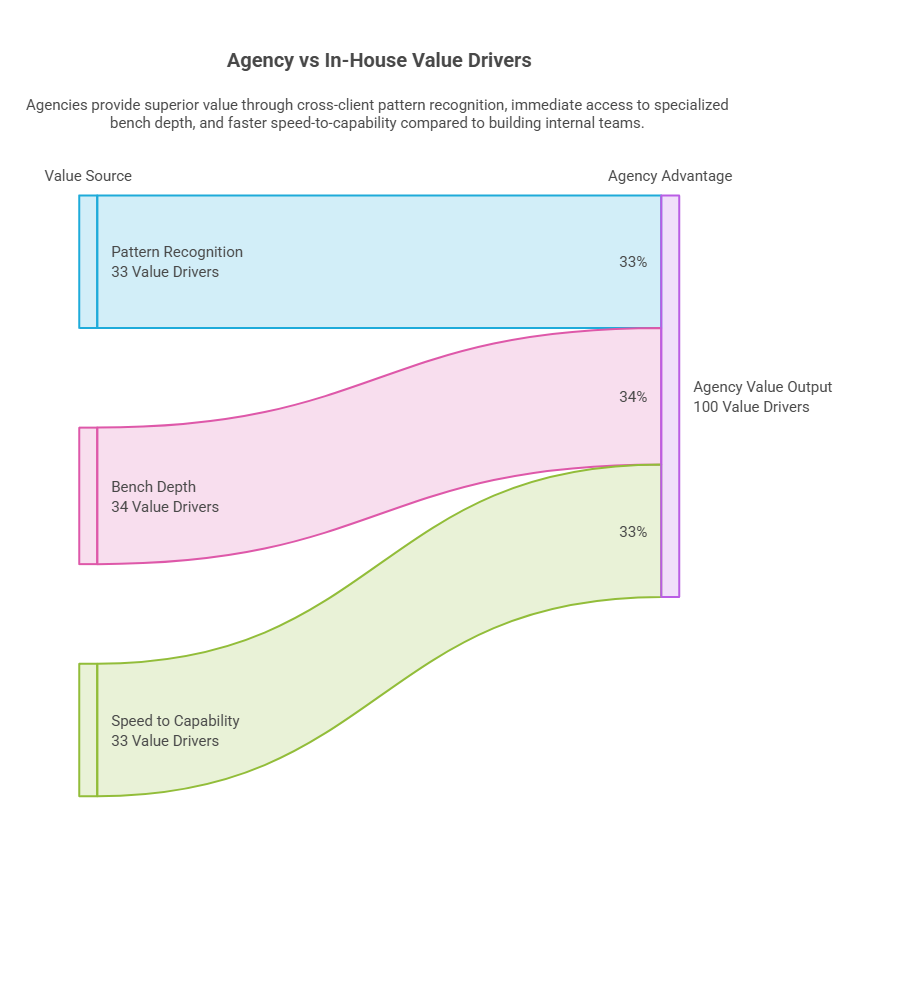
An agency fits work that needs specialist skills, fast setup, or data from projects across many accounts. An in-house team owns the core brand and product work. An agency handles work that needs several skill sets, an existing work process, or short-term production volume.
More firms now bring agency work inside. The Association of National Advertisers (ANA) found that 82% of its member firms run an in-house agency, up from 78% in 2018 and 58% in 2013. ANA expects that share to peak near 85% to 90% (Association of National Advertisers, 2023).
Even with that growth, outside agencies still have a defined job in marketing org design. In-house teams should own work that needs daily product and sales access. Agencies fit specialist work that the company does not need every week or cannot staff at full depth.
Cross-client pattern recognition
An agency sees similar campaigns across several client accounts at the same time. A single internal marketer sees one company’s tests, results, and budget limits. The agency builds a wider base of tested ideas from its larger set of work.
Cross-client pattern recognition matters in paid media, SEO, and creative testing. The agency sees which messages lose response, which search changes hurt traffic, and which page tests improve leads. That wider view helps the agency spot a pattern before one account shows enough data on its own.
Paid media shows the point most clearly. An agency sees creative fatigue, audience overlap, and platform changes across its client list. SEO works the same way because search changes affect many sites at once.
Cross-account data gives firms new to marketing a clear path. Agencies also help firms avoid costly mistakes that come from building a department by trial and error (RB Oppenheim Associates, 2026). That learning curve adds cost during the first year of an in-house build.
Bench depth and specialization
A midsize agency gives one account access to several skill sets, such as strategy, SEO, paid media, design, development, and analytics. That bench starts without a hiring cycle. Building the same bench in-house requires separate hires, tools, and more management time.
Most firms do not need every one of those skills every week. A technical SEO issue needs a specialist. A landing page test needs design, copy, development, and analytics. A campaign launch needs several people for a short, fixed window.
Some specialist work also needs skills that are hard to hire. Site speed is one example. Websites that take longer than 3 seconds to load lose up to 53% of mobile users (Baiocchi, 2025).
Agencies built around technical SEO and image improvement have the staff to fix slow pages. They fix the speed issue before slow pages keep more mobile users from staying on the site. An in-house team would need a technical SEO specialist and a performance engineer to match that depth.
Pairing one senior in-house lead with an agency gives the company access to SEO, paid media, creative, and analytics without hiring each function full-time. Building the same coverage in-house requires several hires and a larger fixed payroll.
Speed to capability
An agency starts faster because the team, tools, and process already exist. A new in-house hire needs time to learn the product, meet the team, and build a work rhythm. At inflection points, speed decides when to hire a marketing agency.
A funding round, product launch, or new market entry creates work that cannot wait for a long hiring cycle. The in-house vs outsourced marketing choice depends on how soon the business needs the work in the market. An agency starts with an existing team, while a new department has to form one hire at a time.
Speed also lowers the cost of a bad fit. If an agency does not match the need, the company ends the contract or changes the scope. If a senior hire does not match the need, the company pays salary, severance, search fees, and another replacement cycle.
That difference matters in early-stage growth. The product, buyer profile, and message still change during early-stage growth. An agency gives the company room to adjust without rebuilding the whole team.
Table 2: Function coverage: agency bench vs. in-house equivalent
| Function | Agency bench | In-house equivalent |
| Strategy | Account strategist or marketing strategist | Senior marketing lead |
| SEO | SEO lead or technical SEO specialist | SEO specialist |
| Paid media | Paid media specialist | Paid media manager |
| Creative | Designer or creative lead | Designer or content creator |
| Development | Web developer or landing page developer | Web developer |
| Analytics | Analyst or reporting specialist | Marketing operations or analytics hire |
| Management | Account manager or project lead | Marketing manager or department lead |
| Year-one setup | Available through the retainer scope | Requires recruiting, onboarding, tools, and management time |
| Cost structure | Monthly fee tied to scope | Fixed payroll, benefits, tools, and overhead |
| Best fit | Specialist work that does not require a full-time hire | Core work that needs daily product, sales, and customer access |
| Full bench cost | Included within the agreed agency scope | Requires several full-time hires before benefits, software, and overhead |
Note: This table compares function coverage, not identical output. An agency bench gives access to several skills through one contract. An in-house team gives more direct control, but each function requires hiring, training, tools, and management time.
The stage-based framework: what to hire and when
Annual recurring revenue (ARR) means the subscription revenue a company collects in one year. ARR ties team size to the revenue base that funds the team. It helps leaders decide when to hire a CMO, when to add an agency, and when to keep work in-house.
Marketing budgets have dropped to a record low in 2026. Companies now spend 9.0% of revenue and 9.6% of total company budget on marketing (Moorman, 2026). With less budget room, leaders have to choose the structure that funds the work without overbuilding.
Marketing budget allocation by stage keeps hiring tied to the work the company must fund next. A company with under $1M ARR does not need the same team as a company at $25M ARR. Stage sets the budget, the work pace, and the level of skill the company needs next.
Companies now put nearly 60% of growth budgets toward market penetration, which means selling more to current customers instead of chasing new markets (Moorman, 2026). That spend mix affects marketing team structure by company stage because retention, expansion, and new demand require different skills.
Stage 1: Pre-product-market-fit or under $1M ARR
A pre-product-market fit company needs one senior generalist or a fractional CMO with a few targeted freelancers. The company is still testing the product, buyer profile, price, and offer. A fixed agency retainer spends money on a scope that becomes outdated before the next work cycle starts.
The senior generalist owns the plan and changes the work as sales calls reveal new facts. Freelancers handle narrow tasks such as landing pages, email, design, or basic paid tests. That model keeps spend tied to learning instead of a fixed scope.
The common mistake at this stage is hiring a junior in-house marketer first. A $70,000 coordinator handles tasks, but not positioning, channel choice, agency direction, or leadership alignment. The first marketing hire needs enough skill to make the plan, not just execute tasks.
Stage 2: $1M to $5M ARR, product-market fit established
A company with product-market fit needs its first senior marketing hire. A Head of Marketing or VP of Marketing fits this stage because the team is still small, and the work still mixes strategy with execution. The senior hire owns strategy, brand, demand planning, and the first repeatable lead system.
This stage also starts the question of when to hire a CMO. The CMO title fits better when marketing has multiple functions, more staff, and board-level revenue pressure. Before that point, the company needs a senior operator who still works close to execution.
Agency support enters for specialist work such as SEO, paid media, creative production, or lifecycle campaigns. The senior in-house hire writes the brief, checks the work, and owns the result. The hybrid model starts here because the company needs internal control and outside skill.
Technology marketers report higher confidence in effectiveness at 66%, compared with 59% for the wider B2B average (Rose, 2025). That gap is linked to earlier use of integrated data systems. At this stage, better data helps leaders fund the next hire or agency scope with less guesswork.
Stage 3: $5M to $25M ARR, scaling known channels
At $5M to $25M ARR, the marketing team becomes more specialized. The in-house team grows to 3 to 6 people across demand generation, content, product marketing, and marketing operations. Each function owns a metric such as pipeline, leads, conversion rate, or revenue.
Agencies stay useful for work that needs specialized skills for a fixed scope instead of a full-time employee. Enterprise SEO, paid media at scale, web testing, and video production fit this group. The internal team sets the plan, while the agency handles volume and specialist tasks.
This stage needs clear ownership. The in-house lead owns channel strategy, budget, and results. The agency is limited to the scope it agreed to deliver.
Stage 4: $25M ARR and above
At $25M ARR and above, a full department oversees marketing. The company has functional leads across demand generation, product marketing, content, brand, marketing operations, and analytics. A CMO sets the plan and manages the link between marketing, sales, production, finance, and the board.
At this size, the company keeps more core work in-house. Agencies move from daily execution to defined projects. These projects include brand campaigns, category creation, international expansion, and mergers and acquisitions (M&A) integration.
Global research and advisory firm Gartner expects marketing teams to flatten as AI handles more execution work and human-AI work crosses team lines (Weiss, 2025). That change supports the same structure used in this framework. A senior internal core owns strategy, while specialists handle work that needs depth or scale.
When to break the pattern
The four-stage model fits most companies, but some firms need a different team order. Category-defining brands move more story and product work in-house earlier because buyer feedback keeps changing the message. Regulated industries also move in-house earlier because finance, healthcare, and pharmaceutical companies need tighter control over claims, approvals, and compliance reviews.
Low-margin and high-volume firms keep agencies longer when paid media testing and cost per acquisition decide profit. In those firms, agency scale in testing matters more than brand control in the early team build.
Table 3: Four-stage roadmap for marketing team structure
| Stage | Revenue stage | Internal marketing structure | Agency involvement | Best-fit model |
| Stage 1 | Pre-product-market fit or under $1M ARR | Senior generalist or fractional CMO with targeted freelancers | Minimal. Use freelancers for narrow tasks | Senior lead plus freelancers |
| Stage 2 | $1M to $5M ARR, product-market fit established | First senior marketing hire, such as Head of Marketing or VP of Marketing | SEO, paid media, creative production, or lifecycle campaigns | Senior in-house lead plus agency support |
| Stage 3 | $5M to $25M ARR, scaling known channels | 3 to 6 in-house hires across demand generation, content, product marketing, and marketing operations | Enterprise SEO, paid media at scale, web testing, video, and other specialist work | Specialized in-house team plus agencies |
| Stage 4 | $25M ARR and above | Full in-house team with functional leaders and a CMO | Defined projects such as brand campaigns, category creation, international expansion, and M&A integration | Full in-house team plus specialist agencies |
Note: This roadmap shows the most common structure by stage. The right mix still depends on capacity, specialization, and accountability.
The hybrid model most companies actually need
The hybrid marketing model fits companies with $1M to 25M ARR because the work needs internal control and outside specialist depth. One senior in-house lead is in charge of strategy, brand, and company context. One or two agencies handle specialist work that the company does not need to staff full-time.
The model works when the internal lead handles decisions and the agency is in charge of defined execution. The internal lead owns the plan, the brief, the budget, and the result. The agency supplies depth in SEO, paid media, creative production, lifecycle marketing, or other work that needs skill and scale.
A weak hybrid model wastes more money because teams are buying more tools without the staff to run them. Among technology marketers, 85% have moved past the trial phase of AI adoption. Yet 51% of their 2026 budget increases go to AI tools instead of the people needed to manage them (Rose, 2025).
The same problem appears in marketing technology performance. No marketing technology activity scores above 5 on a 7-point performance scale, and ROI generation scores 4.4 (Moorman, 2026). A company that buys more tools without clear ownership adds cost, not output.
What a working hybrid looks like
A working hybrid starts with a senior in-house lead. That person is a Head of Marketing, VP of Marketing, fractional CMO, or CMO, based on company size. The internal lead is responsible for strategy, branding, sales alignment, product alignment, and leadership reporting.
The fractional CMO vs agency decision starts with ownership. When the budget cannot support a full-time senior hire, a fractional CMO fills the strategy seat. An agency then supports execution under that senior lead.
The agency handles work that needs specialist skills or production volume. SEO, paid media, creative production, lifecycle marketing, web testing, and analytics fit this group. The internal lead sets direction, reviews the work, and reports results to leadership.
The structure breaks when the company treats the agency as the marketing leader. An agency performs best when a senior internal owner writes clear briefs, sets targets, and defines success before the work starts.
Where the hybrid breaks down
Hybrid teams break down when ownership is unclear. If the internal lead and agency share the same result without separate duties, no one owns the result in practice. The fix is a written scope that assigns each part of the funnel, pipeline, and reporting process to one owner.
The second failure point is weak internal leadership. A coordinator does not have the seniority to judge agency output, challenge strategy, or protect the budget. The in-house marketing vs agency model breaks down when the company hires an agency before it has someone senior enough to manage the work.
The third failure point is assigning the wrong work to the agency. Some companies treat agencies like extra staff. Others expect agencies to lead strategy without access to sales calls, product plans, customer data, or leadership tradeoffs.
The marketing agency vs in-house team model works when each side has clear responsibilities.
How to structure the agency relationship inside a hybrid
A working hybrid needs four operating rules:
- A written scope with deliverables, dates, metrics, and ownership lines
- One point of contact on each side
- A monthly review using the same dashboard and the same metrics
- Targets agreed in writing before the contract starts
Hire or assign the senior in-house lead first. Add the agency after the internal lead has the authority to brief the work, judge the output, and own the result.
A strong internal lead gives the company one owner for the plan, even before an agency joins. An agency with no internal lead creates more activity without clear control. The agency should enter the structure after the company knows who owns the plan, who owns the budget, and who answers for the result.
Figure 1: Working hybrid marketing structure at a $5-15M ARR Company
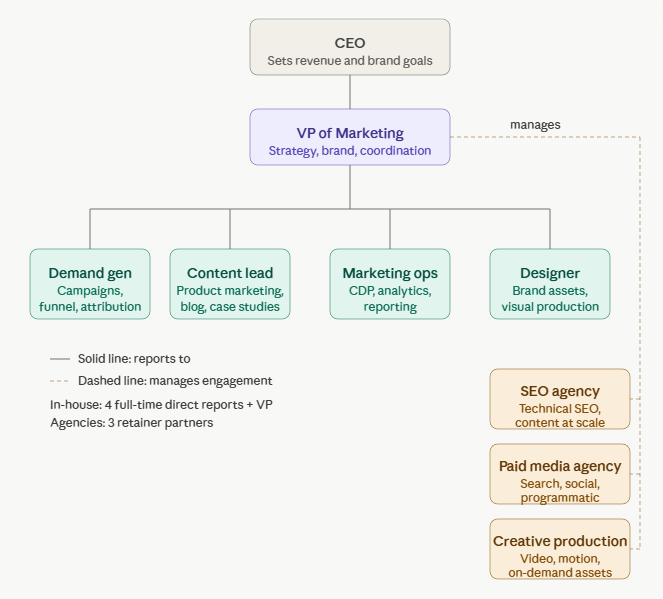
A senior in-house team of four reports to a VP of Marketing, while three specialist agencies support SEO, paid media, and creative production through retainer agreements.
The questions to ask before you make the call
Cost starts the build vs buy marketing decision, but ownership decides whether the structure works. Leadership, marketing, sales, and finance need the same target before the company hires or signs an agency. If each group judges success by different rules, the structure will produce blame instead of results.
The gap starts when budget owners stay outside the work. In marketing events, 90% of attendees are marketers, while 2% come from sales and 5% come from leadership. This split “kills marketing morale” (Sheridan, 2023).
Budget choices show the same split between stated goals and actual spend. Customer acquisition spend is 26% higher than retention spend, even though retention delivers stronger performance outcomes (Moorman, 2026). That mismatch leads companies to make hiring in-house marketing, agency vs in-house cost, and build vs buy marketing decisions without tying the choice to pipeline, retention, or revenue data.
10-question decision checklist
Use this checklist before the next leadership meeting:
- Is the work repeatable or one-time? Repeatable work belongs in-house. One-time or specialist work belongs to an agency.
- Will the workload fill a full-time seat for the next 12 months? If not, use a contractor or agency.
- Who owns the target, budget, and final call? Shared ownership turns missed targets into blame.
- Is the brief clear enough for a scope of work? If not, fix the brief before hiring or signing the agency.
- Does the work need daily access to sales, product, or customer data? If yes, keep the work in-house.
- Does the work need data across many accounts? Paid media, SEO at scale, technical SEO, and creative testing favor agency support.
- Does the work need a same-day response? Sales support, launch updates, and product changes belong close to the internal team.
- Are the success metrics agreed in writing before work starts? If not, pause the hire or contract.
- Who manages the agency or the new hire? If no senior owner exists, assign that owner first.
- What breaks if the person or agency leaves tomorrow? If the company depends too much on one person or vendor, keep core knowledge and reporting inside the business.
Closing: the decision framework
Choose the marketing structure by matching revenue stage, senior ownership, and work type.
- Under $1M ARR or pre-product-market fit: Use a fractional lead with freelancers.
- $1M to $5M ARR: Hire a senior in-house lead first and then add agencies for SEO, paid media, or creative work.
- $5M to $25M ARR: Build a 3- to 6-person in-house team. Keep agencies for high-volume or specialist work.
- $25M ARR and above: Run marketing through a full in-house team and use agencies for defined projects.
- Any stage with weak senior ownership: Assign one owner for the plan, budget, and results before adding more people or agencies.
The marketing agency vs in-house team choice depends on stage, capacity, specialization, and accountability. In 2026, the right structure connects people, process, and technology to one revenue goal (Rose, 2025). When that structure is clear, the company knows how to choose the more fitting marketing setup.
Book a marketing structure consultation if you need a clear recommendation on what to hire, what to outsource, and what to keep in-house. You can also request a custom plan based on your revenue stage, goals, budget, current team, and growth targets.
Frequently Asks Questions
The better question is not in-house versus agency, but what mix fits the company’s stage, budget, goals, and current team. Four factors guide it: stage, capacity, specialization, and accountability. Most companies between $1M and $25M ARR land on a hybrid, with a senior internal lead owning strategy and agencies handling specialist execution.
Salary is only the starting point. Per BLS data, wages and salaries make up about 70 percent of total employer pay, so a $70,000 salary points to roughly $100,000 before tools and training. Add payroll tax, benefits, equipment, software, ramp time, and management hours, and the full cost climbs well past base pay.
Replacing one employee costs 50 to 200 percent of that person’s annual salary, depending on the level. For a $70,000 marketing manager, that is $35,000 to $140,000, and the figure rises for senior roles. It also leaves out lost campaign work, stalled pipeline, and lost sales support until the next hire reaches full output.
In-house teams win on institutional knowledge, speed, and brand voice control. They sit in sales, product, and leadership meetings, so they write from direct buyer knowledge instead of a kickoff deck. They ship same-day work for launches and sales calls, and one internal lead keeps claims and tone consistent across every channel.
Agencies bring cross-client pattern recognition, bench depth, and speed to capability. They see what works across many accounts at once, supply several specialist skills through one contract without a hiring cycle, and start fast because the team and process already exist. That fits specialist work a company does not need to staff full-time.
It depends on stage. Under $1M ARR, use a fractional lead with freelancers. From $1M to $5M, hire one senior in-house lead, then add agencies for SEO, paid media, or creative. From $5M to $25M, build a 3 to 6 person team and keep agencies for specialist work. Above $25M, run a full in-house team and use agencies for defined projects.
The hybrid model pairs one senior in-house lead who owns strategy, brand, and company context with one or two agencies handling specialist execution like SEO, paid media, or creative. It fits companies between $1M and $25M ARR. It works only when the internal lead owns the plan, budget, and result, and the agency owns defined deliverables.
Resources
- Baiocchi, S. (2025, January 20). 7 marketing tools for small business growth in 2025. IMPACThttps://www.impactplus.com/blog/marketing-tools-small-business-growth
- Moorman, C. (2026, April). The CMO Survey: Highlights and insights report - 2026. The CMO Survey. https://cmosurvey.org/wp-content/uploads/2026/04/The_CMO_Survey-Highlights_and_Insights_Report-2026.pdf
- RB Oppenheim Associates. (2026). When to hire a marketing agency vs. build an in-house team: A guide for business owners. https://rboa.com/when-to-hire-a-marketing-agency-vs-build-an-in-house-team-a-guide-for-business-owners/
- Rose, R. (2025, November 12). Technology content and marketing trends: 2026 insights. Content Marketing Institute. https://contentmarketinginstitute.com/technology-research/content-marketing-technology-research
- Ruffolo, B. (2025, June 12). Marketing agency vs. in-house team: What’s best for your business? IMPACT. https://www.impactplus.com/blog/independent-marketing-contractors-vs.-internal-marketing-team-vs.-marketing-agencies
- Sheridan, M. (2023, March 6). How a lack of sales and leadership buy-in is killing marketing morale worldwide. IMPACT. https://www.impactplus.com/blog/how-a-lack-of-sales-and-leadership-buy-in-is-killing-marketing-morale-worldwide
- Dyerly, R. (2025). The myth of replaceability: Preparing for the loss of key employees. SHRM. https://www.shrm.org/executive-network/insights/myth-replaceability-preparing-loss-key-employees
- U.S. Bureau of Labor Statistics. (2026). Employer costs for employee compensation – December 2025 (USDL-26-0505).https://www.bls.gov/news.release/pdf/ecec.pdf
- HubSpot. (2025). The ultimate round-up of content marketing tips. https://blog.hubspot.com/marketing/content-marketing-tips
- Association of National Advertisers. (2023). The continued rise of the in-house agency: 2023 edition.https://www.ana.net/miccontent/show/id/rr-2023-05-rise-in-house-agency
- Weiss, E. (2025, December). The future of marketing: 5 trends and predictions for 2026. Gartner.https://www.gartner.com/en/articles/future-of-marketing
- Indeed Editorial Team. (2025, December 16). In-house vs. ad agency marketing: Pros and cons (with tips). Indeed Career Guide. https://www.indeed.com/career-advice/career-development/in-house-vs-ad-agency

Kim Greer
OFP Law
One of the best business decisions I ever made was to contract with 321 Web Marketing. Jonathan Gessert and his team are knowledgeable, efficient, and effective, making digital marketing goals easy to achieve and helping [...]

Kelly Cole
Business Benefits Group
My company hired 321 Web Marketing in February 2016 to resurrect our web site. We feel our web site is the face to our business and desperately needed a make over. 321 took us from blah to WOW effortlessly and what a difference [...]

Emily Hawkins
Diener & Associates
Thanks to 321 Web Marketing, the client has seen an increase in their search engine leads, averaging 12 qualified leads per month. The client has also achieved prominent Google Maps and search placement. The team [...]
Trevor Telesz
Paw Pals Pet Sitting
321 Web Marketing successfully translated the client’s design into a stunning and refreshed website, ensuring seamless functionality across all dynamic views. The team provided clear timelines and stuck to them, [...]

Corey Davis
Spartan Animal & Pest Control
321 Web Marketing is truly phenomenal at what they do. Their ability to communicate and describe the steps and actions that they are implementing, Alex Zarpas in particular, is excellent. Delivering on promises is all [...]

Alec Roberts
MFE Insurance
I can’t say it enough, Jonathan and his team have gone above and beyond since day one to accommodate our needs and meet our goals. I run a specialty insurance brokerage based in LA and once we found 321 we never looked [...]

Richard Wilbur III
Advantage.Tech
Thanks to 321 Web Marketing’s web development work, the client increased rankings and traffic from search engines. Also, their business secured prominent positions on Google Maps and industry-relevant, profitable [...]

Bruce Gemmill
FVCbank
After the website revamp, the client saw a steady rise in leads from search engines, resulting in additional traffic. 321 Web Marketing is highly punctual when it comes to deliverables, and internal stakeholders are [...]

Drew Weeks
VAE
321 Web Marketing delivered a sleek website that accurately portrays the size and quality of the client’s organization. All of their completed websites have received positive feedback from users who have been [...]

Ryan Masten
Masten Pools
321 Web Marketing has increased the client’s leads from zero to 53 monthly. Their SEO efforts pay off impressively due to a top-ranking position on Google and making the site the number one result for several [...]