



Table of Contents

 Sep 30, 2026 ·
  13 min read ·
  Summarize in ChatGPT
The best law firm marketing agencies in 2026 include 321 Web Marketing, Consultwebs, Hennessey Digital, Juris Digital, LawRank, Mockingbird Marketing, Postali, Rankings.io, and Scorpion. That order is alphabetical, so read it as a set of options rather than a ranking. The right fit depends on how a firm measures return on its legal marketing spend.
Cost per qualified lead, or CPQL, is the measure used throughout this comparison. CPQL is what a firm spends to produce a prospect who matches its case criteria and signs a retainer, which makes it directly comparable to average case value. Cost per click, the figure most agencies report each month, sits several steps away from firm revenue.
Managing partners tend to open these calls with the same question: which cases came from marketing? Traffic and form-fill counts answer a different question. They describe search performance accurately, and they stop at the point where revenue starts. Adding signed case data to the same report closes that gap.
How to Evaluate a Legal Marketing Agency Before You Sign
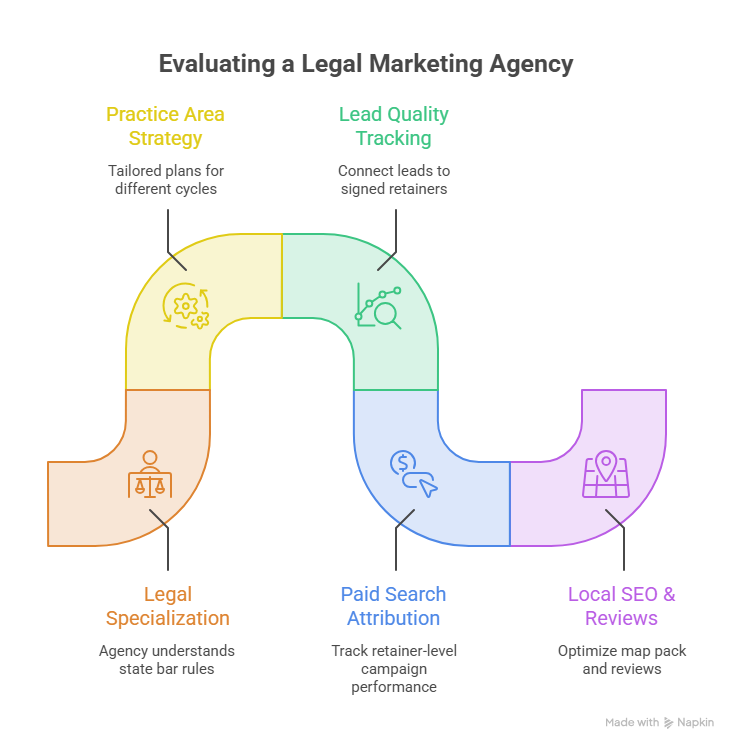
Five areas predict how a law firm’s digital marketing engagement performs over a multi-year contract. An agency’s published campaign work will usually answer all five before the first call.
Legal specialization comes first, because attorney advertising runs on state bar rules that vary by jurisdiction. An agency splitting attention across eight industries won’t track those differences. The ABA Model Rules permit a firm to pay for internet-based lead generation as long as the lead generator doesn’t recommend a specific lawyer, and every state adapts that language to its own standard. A campaign built to the model rule can still violate the version a firm actually practices under.
Practice area strategy comes next, because the sales cycles aren’t comparable. A personal injury inquiry often converts within days of the accident. An estate planning prospect may research for months before booking a consultation. An agency running one content calendar across both is averaging two buying cycles into a single plan and calling it a strategy.
Lead quality tracking determines whether reporting stays connected to revenue. Ask how the agency attributes a signed retainer back to a specific keyword or campaign, then ask the same question about phone calls, since that’s where most legal inquiries start. Lead tracking that stops at the form fill can’t tell a firm which practice area is earning back the spend.
Paid search raises the price of getting attribution wrong. Legal is the most expensive industry in Google Ads on both cost per click and cost per lead, and competitive injury markets in major metros run well above the category average. A firm bidding at those rates without retainer-level attribution is buying clicks and estimating everything downstream of them.
Local SEO and review management carry more weight in legal than in most industries, since map pack placement and review volume both shape which firms make a prospect’s shortlist. Content credibility is the fifth area. Attorney-reviewed content reads differently from volume-produced legal writing, and it holds up better under bar review.
Legal Paid Search Benchmarks by Practice Area
Attorneys and legal services carry the highest cost per lead of any industry in Google and Microsoft Ads, at $131.63 against an all-industry average of $66.69. Costs vary widely by practice area.
| Practice Area | Avg. Cost Per Click | Avg. Conversion Rate | Avg. Cost Per Lead |
|---|---|---|---|
| Accidents & Personal Injury | $9.30 | 5.45% | $159.17 |
| Tax | $11.82 | 13.30% | $120.30 |
| Family | $7.69 | 8.52% | $103.54 |
| Criminal | $12.30 | 9.90% | $101.49 |
| General Practice | $9.97 | 5.52% | $96.54 |
| Bankruptcy | $11.70 | 13.56% | $82.27 |
| Estate & Probate | $7.92 | 9.65% | $72.24 |
The Best Law Firm Marketing Agencies for Multi-Practice Firms
Agency Comparison at a Glance
| Agency | Base | Legal-Only Clients | Best Fit For | Published Contract Terms | Reporting Model |
|---|---|---|---|---|---|
| 321 Web Marketing | Northern Virginia | No | Multi-practice or multi-location firms, $5M to $40M | Not published | CPQL measured at the signed retainer, with lead and lag measures reported separately |
| Consultwebs | Raleigh, NC | Yes | Firms in major metros and smaller regional markets, solo through large | Not published | LawEval dashboard, multi-platform, tracks a lead through to signed client |
| Hennessey Digital | Distributed team | Yes | Personal injury and mass tort firms with large, technically complex sites | Not published | Standard analytics platforms, no proprietary dashboard |
| Juris Digital | Denver, CO | Yes | Firms wanting cost visibility before a sales call; consumer and business law | Yes, pricing published; engagements typically one year or longer | Not specified publicly |
| LawRank | Not published | Yes | Injury and criminal defense firms in top-tier metros; Spanish-language markets | Not published | Not specified publicly |
| Mockingbird Marketing | Seattle, WA | Yes | Firms with in-house marketing staff; firms blocked elsewhere by exclusivity | Yes, month to month | Call tracking tied to campaign source; clients keep their own ad accounts |
| Postali | Columbus, OH | Yes | Solo through midsize firms rebuilding brand and offline presence | Not published | Not specified publicly |
| Rankings.io | Marion, IL | Yes | Personal injury firms in competitive markets | Yes, month to month | Not specified publicly |
| Scorpion | Lehi, UT | No | Firms wanting intake, advertising, and reporting from one provider | Not published | Revenue Intelligence, connects signed cases back to campaigns |
321 Web Marketing
321 Web Marketing runs legal accounts against CPQL measured at the signed retainer. Consultations are tracked as their own step, since a retainer is booked revenue and produces a cost figure that lines up against average case value.
Reporting separates lead measures from lag measures. Lag measures cover signed cases and revenue by practice area. Lead measures cover the weekly activity that moves those numbers, intake response time included.
Legal content is built to reflect a firm’s actual case selection standards. A defense practice that declines certain matters should have content that says so, because the alternative is paying for inquiries the firm will turn down.
The agency also handles WordPress rebuilds through its website development services, structured so practice area depth and attorney credentials are legible to search engines and to prospective clients. It serves firms in the $5 million to $40 million range with multiple practice areas or locations. In one published law firm case study, an immigration firm saw a 10x increase in monthly organic traffic, doubled monthly qualified leads, and ranked on page one of Google for 160+ keywords across three practice areas within 12 months.
Consultwebs
Consultwebs works from Raleigh, North Carolina, with law firms exclusively. It takes on firms in major metros and in smaller regional markets, so its recommendations don’t assume big-city budget levels.
Search and paid advertising anchor the service list, and the agency keeps licensed attorneys and legal writers on staff for content review. Moving legal review inside the content workflow shortens the approval cycle for firms in states with stricter advertising standards.
LawEval, the agency’s reporting dashboard, pulls results from several ad platforms into one view and follows a lead through to a signed client. It also monitors the website and its contact forms, so a firm can confirm the site is capturing what the marketing produces.
Coverage spans most civil and criminal practice areas, and client size runs from solo practitioners to large firms. That range suits a firm marketing more than one practice area.
Hennessey Digital
Hennessey Digital built its name on the technical side of law firm digital marketing, working with personal injury and mass tort firms. The team works remotely, so specialists join an account based on skill rather than office location.
Search anchors the work, supported by digital PR and content. The technical emphasis suits a firm whose site has grown large enough that page structure and load speed affect results.
Recent positioning has moved toward visibility in AI search results. A firm drawing heavy early-stage traffic from informational pages should ask how that visibility gets measured, since the reporting there is less settled than it is for rankings and clicks.
Reporting runs through standard analytics platforms rather than a proprietary dashboard, so a firm keeps its data in tools it already owns. Pricing, contract length, and market exclusivity come up on a call, which makes them worth raising early.
Juris Digital
Juris Digital works from Denver with a distributed team and publishes more operational detail on its site than a firm would normally get before a sales conversation. That shortens evaluation.
Published pricing is the notable piece. A firm can estimate cost before the first call, which makes early comparison possible without sitting through four pitches.
Programs are grouped separately for newer firms and established firms, with website work quoted as its own project. Engagements typically run a year or longer, which suits a firm planning around a full budget cycle.
The agency caps how many competing firms it will take on in a single market and states that cap as standing policy. For a firm in a crowded city, confirm how the cap applies to a specific practice area and location before signing.
Its own website platform, JurisPage, puts site technology and marketing services with one provider. Other named products include Ascend, a program for established firms, and JD Assistant for website chat. Practice area support covers consumer and business law.
LawRank
LawRank works with law firms only and concentrates on highly competitive city markets, including New York, Houston, Los Angeles, and Miami. Competing there takes more content and more link building than a smaller market would.
An attorney founded the agency, and it shows in how content is handled. Legal writing gets reviewed by someone with a law degree before it publishes, which covers bar advertising rules and the credibility signals search engines weigh.
Much of the staff is bilingual, and Spanish-language legal marketing is a core service. For injury and criminal defense firms in Southern California, Texas, Florida, and New York, that reaches searchers most campaigns serve only in English.
Clients keep full ownership of their website, which matters to any firm that later changes agencies. The work centers on search, with attorney-written content and link building behind the rankings, and paid advertising is available within the program. Contract length and minimum spend come up on a call.
Mockingbird Marketing
Mockingbird Marketing is founder-led out of Seattle. Its founder spent years in the legal directory business, and that background shapes how the agency evaluates directories and lead vendors for its clients.
Two contract terms sit on the homepage, where most agencies hold them for a sales call. Contracts run month to month, and clients keep access to their own advertising accounts. The agency also takes on firms without market exclusivity limits, so availability doesn’t hinge on whether a competitor signed first.
Search and paid advertising form the core, supported by call tracking that shows which campaigns produce inquiries. The agency also works directly with in-house law firm marketing departments. Firms with marketing staff already in place should ask how that partnership is structured.
The agency publishes constantly, including books on local search and legal directories, a legal marketing podcast, and trade columns. That material explains the approach in more detail than a sales presentation will.
Postali
Postali works from Columbus, Ohio, with law firms exclusively, and names its target size directly, solo through midsize. Stating firm size that plainly makes it easy for a practice to tell whether it fits.
The service list reaches past search into brand and offline work. Visual identity and direct mail sit alongside website and search services, which suits a firm reworking how it presents itself and not only how many inquiries arrive.
The agency describes itself publicly as a marketing fiduciary, committing to recommendations in the firm’s interest regardless of how Postali benefits from them. Ask how that applies to ad spend decisions and vendor recommendations, since those are where it gets tested.
Practice area coverage is broad, with depth on the consumer side and support for business matters.
Rankings.io
Rankings.io works from Marion, Illinois, and has focused on personal injury firms for most of its history. That focus shows in the depth of the injury work, which runs from broad case-type pages down to individual accident scenarios.
Contracts run month to month, so a firm can continue or stop at the end of any billing cycle.
Market exclusivity works differently here. Before taking a new client, the agency reviews how many firms it already serves in that area, and its top service level lets a firm name specific competitors to exclude. Firms in busy injury markets should ask who the agency already works with nearby.
The work centers on search and paid advertising, including Local Services Ads, and clients own their sites outright. The agency is paid through service fees and takes no share of case outcomes.
Scorpion
Scorpion works from Lehi, Utah, serving law firms alongside other service industries. Scale is what a firm is buying, with a wide product range and consistent delivery across accounts.
Its software reflects that scale. Convert, its intake tool, answers calls and messages from prospective clients. Revenue Intelligence, its reporting tool, connects signed cases back to the campaigns that produced them. A firm that wants intake and advertising handled by one company has fewer relationships to manage.
Scorpion describes itself as Google’s largest Local Services Ads partner, which is relevant because a growing share of legal inquiries arrives through that pay-per-lead channel. Google verifies a state bar license and professional liability insurance before those ads run, so the channel screens for firms in good standing.
Work is delivered through the Scorpion platform and its dashboard. A firm committed to its own reporting stack should ask how the two fit together.
How to Choose a Law Firm Marketing Agency for Your Practice
The questions below have answers a firm can verify, and the full list fits inside one sales call.
What Should a Firm Ask About a Ranking Guarantee?
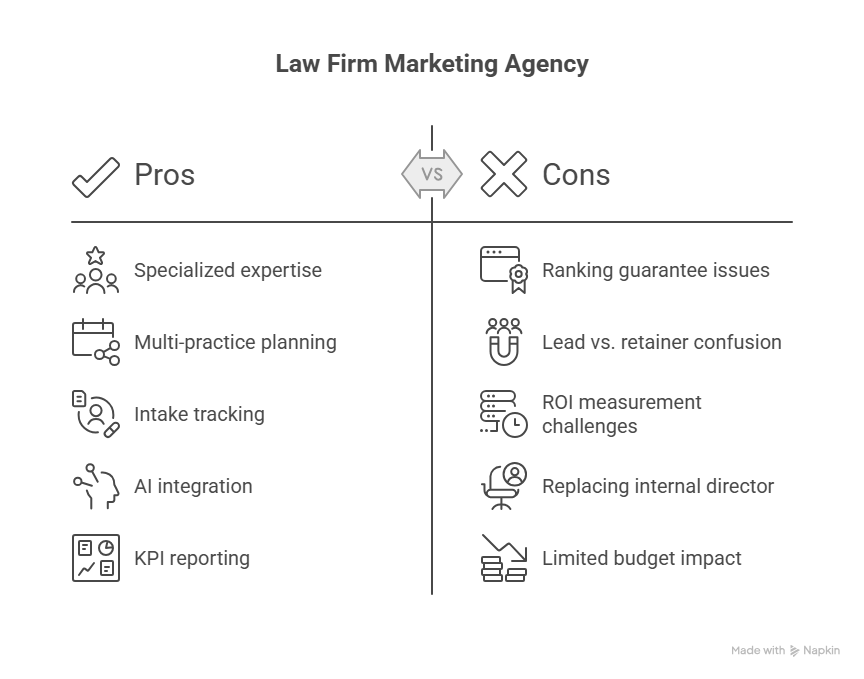
Ask which specific queries the guarantee covers and what each one gets in monthly search volume. A guarantee on four phrases with 20 searches a month between them is a guarantee about almost nothing. The answer shows how much traffic the promise actually represents.
What Separates a Lead From a Signed Retainer?
A lead is an inquiry. A signed retainer is a matter the firm accepted. Both belong in the report, broken out by practice area, because a lawyer lead generation program can lift the first number for months while the second stays flat.
Intake sits between the two and often decides how much of a campaign becomes revenue. Ask what happens to a call that arrives at 6:15 on a Friday. A firm that can’t answer that is measuring lead volume against an intake process nobody has inspected.
How Should ROI Be Measured When Cases Take Six to 12 Months?
Put the measurement on two clocks. Review lead indicators monthly, and review signed case value against spend each quarter. Reporting stays current while the longer case cycle finishes.
Comparing performance against lead gen benchmarks for similar firms gives a reference point in the meantime. Benchmarks also add context to a single quarter, since the same numbers mean different things in a flat market and a growing one.
What Changes for Firms Above $15 Million?
Ask about multi-practice content planning. Topical authority builds fastest when the highest-value practice areas each get dedicated content instead of sharing a general calendar.
Intake tracking works better separated by practice area at that size. A family law inquiry and a catastrophic injury inquiry carry different values, and reporting them together hides both.
Firms with an internal marketing director should ask how the agency plans to work alongside that team. A useful answer describes the execution capacity and specialized skill the agency adds to work the director already owns. A less useful answer describes replacing them.
What Changes for Smaller and Newer Practices?
The math runs differently. At the same budget, a strategy built around one or two practice areas tends to outperform a broad program, because content and link investment concentrates instead of spreading across topics that each get a fraction of the effort.
How Should AI Search Factor Into the Conversation?
Every firm should raise it. Generative engine optimization affects how informational legal queries get answered, and how an attorney marketing firm handles that question is a fair read on how current its approach is.
What Reporting Should an Agency Show Before a Contract?
Ask for the reporting template before signing, since the metrics an agency displays are the metrics it manages. Look for law firm KPIs covering signed cases and revenue alongside rankings and sessions. An agency that treats its template as proprietary has told you something useful.
Run a CPQL Benchmark Against Your Practice Areas
Comparing agencies gets easier once a firm knows its own numbers. 321 Web Marketing will run a CPQL benchmark against your practice areas using your existing ad accounts and intake data. You’ll see cost per signed retainer broken out by practice area, along with which channels are producing matters your firm accepts. Request a benchmark review and we’ll walk through the findings with your team.


Kim Greer
OFP Law
One of the best business decisions I ever made was to contract with 321 Web Marketing. Jonathan Gessert and his team are knowledgeable, efficient, and effective, making digital marketing goals easy to achieve and helping [...]

Kelly Cole
Business Benefits Group
My company hired 321 Web Marketing in February 2016 to resurrect our web site. We feel our web site is the face to our business and desperately needed a make over. 321 took us from blah to WOW effortlessly and what a difference [...]

Emily Hawkins
Diener & Associates
Thanks to 321 Web Marketing, the client has seen an increase in their search engine leads, averaging 12 qualified leads per month. The client has also achieved prominent Google Maps and search placement. The team [...]

Trevor Telesz
Paw Pals Pet Sitting
321 Web Marketing successfully translated the client’s design into a stunning and refreshed website, ensuring seamless functionality across all dynamic views. The team provided clear timelines and stuck to them, [...]

Corey Davis
Spartan Animal & Pest Control
321 Web Marketing is truly phenomenal at what they do. Their ability to communicate and describe the steps and actions that they are implementing, Alex Zarpas in particular, is excellent. Delivering on promises is all [...]

Alec Roberts
MFE Insurance
I can’t say it enough, Jonathan and his team have gone above and beyond since day one to accommodate our needs and meet our goals. I run a specialty insurance brokerage based in LA and once we found 321 we never looked [...]

Richard Wilbur III
Advantage.Tech
Thanks to 321 Web Marketing’s web development work, the client increased rankings and traffic from search engines. Also, their business secured prominent positions on Google Maps and industry-relevant, profitable [...]

Bruce Gemmill
FVCbank
After the website revamp, the client saw a steady rise in leads from search engines, resulting in additional traffic. 321 Web Marketing is highly punctual when it comes to deliverables, and internal stakeholders are [...]

Drew Weeks
VAE
321 Web Marketing delivered a sleek website that accurately portrays the size and quality of the client’s organization. All of their completed websites have received positive feedback from users who have been [...]

Ryan Masten
Masten Pools
321 Web Marketing has increased the client’s leads from zero to 53 monthly. Their SEO efforts pay off impressively due to a top-ranking position on Google and making the site the number one result for several [...]