




 Sep 9, 2026 ·
  12 min read ·
  Summarize in ChatGPT
You have been with your agency for 12 months. They send a monthly report. It looks professional, with charts trending upward and a summary that reads well. But you still cannot answer the question your CEO will ask at the next quarterly review: is this working?
Most marketing leaders struggle to evaluate agency performance because they do not have a framework for what “good” looks like. Traffic and rankings are easy to report. Connecting that activity to qualified leads and revenue is harder, and it is the connection that determines whether the investment is justified.
This guide gives you that framework. Whether you are a solo marketing manager at a $5 million company or a VP overseeing a $25,000-a-month agency budget, the questions are the same. The five questions below work as a diagnostic you can take into your next agency review. The red flags and green flags that follow show you what to watch for between reviews. And the stay-or-switch framework at the end gives you a defensible basis for the decision, whichever direction it goes.
The 5 Questions Your Agency Should Be Able to Answer
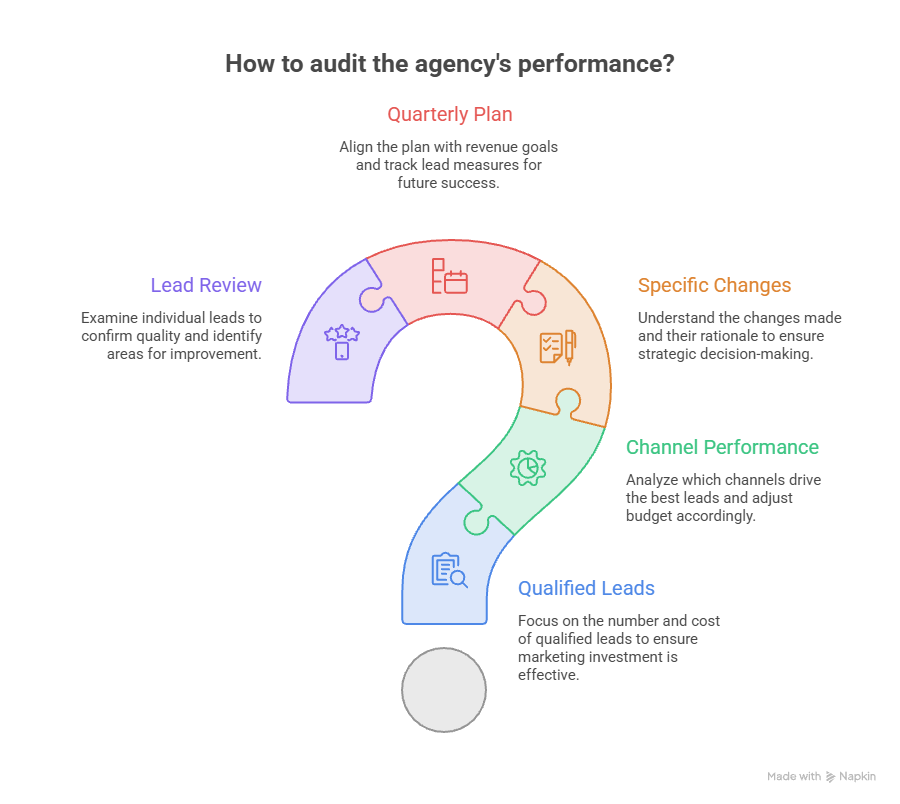
Use these questions to audit your agency during a monthly or quarterly review. A strong agency answers each one with data it already tracks and can explain clearly. An agency that needs to “get back to you” on most of these is telling you something about how it measures its own work.
1. How Many Qualified Leads Did We Generate Last Month, and What Did Each One Cost?
Cost per qualified lead (CPQL) is the metric that connects marketing spend to sales-ready opportunities. If your agency reports traffic and rankings but cannot connect those numbers to qualified leads, there is a gap between what you are paying for and what you are getting.
Start by agreeing on what counts as qualified. A contractor may count homeowners inside a defined service area who request an estimate. A B2B company may qualify leads based on company size and service need. The definition should reflect the leads your sales team would actually pursue, not a platform conversion total.
Then confirm which costs are included. One calculation may use media spend only. Another may include agency fees, tools, and production. Both are useful when they are clearly labeled. Including more of the total marketing investment gives leadership a broader view of what each qualified opportunity actually costs.
One note on platform data: Google’s “Conversions” column can include both observed and modeled conversions, where Google estimates outcomes it cannot directly observe. Those estimates can take up to five days to stabilize. Platform totals are useful for campaign management. Lead records in your CRM show who actually contacted the business and what happened next.
Your agency should know your CPQL cold. If it cannot produce this number without advance notice, the measurement infrastructure is not where it needs to be.
2. Which Channels Are Driving the Best Leads, and How Should We Shift Budget?
If every channel is “performing well” in the agency’s report, the reporting is not granular enough. You should be able to rank channels by cost per qualified lead, not just by lead volume.
Lead volume tells you how many inquiries a channel produces. CPQL tells you what each qualified one costs. Close rate tells you how often those leads become customers. A channel that produces fewer leads at a higher cost may still be the best investment if those leads close at twice the rate of a cheaper source.
Attribution affects how this picture appears. Google Analytics 4 uses an attribution model to assign credit across marketing touchpoints. Ask your agency which model it uses and whether any recent changes have affected how credit appears in your reports. Customer relationship management (CRM) data helps connect outcomes back to where each lead originated, which gives you a clearer read than platform-only reporting.
The goal is to make budget decisions based on qualified lead cost and sales results, not on which channel produces the most raw activity.
3. What Specific Changes Did You Make Last Month, and Why?
“We published four blogs” tells you nothing. “We published four articles targeting specific service queries because organic lead volume for those services dropped 15% last quarter” tells you the agency is paying attention.
Activity reporting shows what was done. Decision reporting explains why it deserved attention. The difference separates an agency that is executing a strategy from one that is running a checklist.
Ask for a monthly change log. Each entry should show what was adjusted and what data prompted the decision. A documented process makes this easier because decisions are recorded as work moves through the team.
It is also worth asking what the agency considered but chose not to pursue this month. Marketing teams have limited time and budget. Seeing how the agency prioritizes tells you as much as the completed task list.
4. What Is the Plan for Next Quarter, and How Does It Connect to My Revenue Goals?
If the agency is running the same activities month after month without adjusting based on performance data, it is coasting. A quarterly plan should start with the business result the program is expected to influence, then work backward to the activities and budget required.
Start with the revenue target. Average deal value estimates how many new customers are needed. Your historical close rate estimates how many qualified leads are required. CPQL checks whether the budget can produce that volume. If the numbers do not work, the team addresses it before the quarter starts, not after.
The agency should also name the lead measures it will track during the quarter, the activities it can act on directly, like publishing pages aimed at qualified prospects or testing landing page changes. Revenue is a lag measure that shows results after the work has happened. Tracking both connects the work happening now to the business results that follow.
Compare the new quarter’s plan with the previous quarter. Repeated activities are fine when the data supports them. When performance shifts and the plan stays the same, that is worth questioning.
5. Can You Show Me the Actual Leads, Not Just the Numbers?
Lead-level transparency is the final test. You should be able to see form submissions, listen to recorded calls, and verify that the leads in the report match the opportunities reaching your sales team.
A month of lead records often reveals patterns that summary totals hide. Existing customers or vendors may appear inside the overall lead count. Search terms may show opportunities to improve targeting. Missed calls may point to an intake issue that affects what happens after someone contacts the business.
Proper call tracking supports this when phone calls are an important lead source. Privacy requirements may limit access to some records, but the agency and client should still maintain a shared view of lead quality.
If your agency resists lead-level reporting, ask why. The answer will tell you whether the resistance is about privacy compliance or about what the data would show.
| Question | What a Strong Answer Sounds Like | What a Weak Answer Sounds Like |
| How many qualified leads, and what did each cost? | “We generated 23 qualified leads at $412 each, down from $480 last quarter.” | “We had 340 conversions. I’d need to check what qualified means.” |
| Which channels are driving the best leads? | “Organic is producing leads at $290 CPQL with a 22% close rate. Paid is at $510 with 11%.” | “All channels are performing well. Here’s the traffic breakdown.” |
| What did you change last month, and why? | “We rewrote three service pages because organic lead volume for those services dropped 15%.” | “We published four blogs and ran the same ad campaigns.” |
| What’s the plan for next quarter? | “Based on a $200K revenue target and your 18% close rate, we need 45 qualified leads.” | “We’ll keep doing what’s working and look for new opportunities.” |
| Can you show me the actual leads? | “Here’s the lead log. Let’s walk through the ones that reached your sales team.” | “We can send you the conversion report from Google Ads.” |
Red Flags That Your Agency Is Underperforming
One signal on its own may have a reasonable explanation. Several together tell a different story.
- The report centers on vanity metrics. Impressions, estimated traffic value, and social follower counts fill the page, but qualified lead data is absent or buried. Traffic and rankings deserve context. They are not the bottom line.
- Performance problems get blamed on external factors. The algorithm changed. The market softened. Your sales team is not following up fast enough. Some of these may be true, but an agency that consistently points outward is not looking inward.
- The strategy has not changed in six or more months. Markets shift. Competitors adjust. Buyer behavior changes. If the plan looks the same as it did two quarters ago with no data-driven reason to hold course, the agency is coasting.
- Communication has become difficult. Emails take days. Your point of contact changes without notice. Meeting prep is visibly thin. Responsiveness is a leading indicator of account priority.
- Your website has not been touched since launch. Traffic patterns and buyer needs change over time. Ongoing website development keeps conversion paths aligned with the strategy that drives traffic to the site. An untouched site is a sign the agency treats the website as a finished product rather than a working asset.
- The agency resists call tracking or lead-level reporting. If you cannot see the individual leads behind the numbers, you cannot verify quality. Transparency is not optional.
- For larger engagements ($15,000 or more per month): the agency cannot provide location-level or service-line reporting. A blended total works for an executive summary. Marketing decisions require segmented data. Multi-location and multi-service companies need to see where budget is producing results and where it is not.
Green Flags That Your Agency Is Performing Well

- The agency brings recommendations backed by data before you ask. Proactive strategy adjustments show the team is watching performance, not waiting for direction.
- Marketing activity connects to business outcomes. Reports include qualified leads, CPQL, and pipeline contribution alongside traffic and rankings.
- The agency pushes back when you have a bad idea. This is a green flag. An agency that explains tradeoffs protects the strategy when priorities compete. An agency that agrees with everything protects the relationship at the expense of results.
- The website stays connected to the marketing strategy. Pages get updated. Conversion paths get tested. The site reflects the current strategy, not last year’s launch.
- Content marketing reflects the company’s actual expertise. First-hand examples, internal data, and a clear point of view give prospects useful information and give search systems original material to associate with the brand.
- Competitive insights arrive without being requested. Changes in how competitors position a service or adjust an offer can surface opportunities worth testing.
- For larger engagements: reporting is structured for different audiences. Leadership receives a concise business summary. The marketing team gets the tactical detail needed to manage campaigns. Both come from the same data.
How to Have the Performance Conversation
Schedule a quarterly business review if you do not already have one. Send the five questions in advance so the agency has time to bring the supporting data. That gives the meeting more room for decisions and planning.
A few additional questions keep the discussion focused:
- What is our CPQL by channel, and how has it changed over the last two quarters? If you use a benchmark tool, ask how closely the comparison matches your business and market.
- Which tests gave us the most useful information this quarter?
- What would you do differently if we were planning the next 90 days from a clean sheet?
- What information or access from our team would help you improve the program?
The conversation itself is diagnostic. A strong agency welcomes scrutiny, discusses gaps openly, and ends the meeting with documented next actions. A weak agency gets defensive, redirects to vanity metrics, or answers in generalities. Pay attention to which pattern you see.
When to Stay and When to Switch
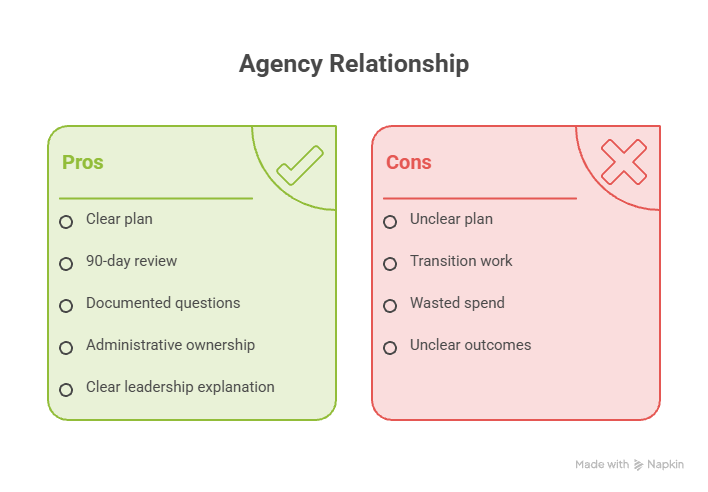
Stay if: the agency acknowledges the gaps, presents a specific plan to address them, and shows measurable improvement within 90 days. Some revenue outcomes take longer depending on the sales cycle, but the leading indicators (lead quality, CPQL trends, strategic adjustments) should move within that window.
Switch if: the same measurement gaps persist after they have been raised, the plan remains vague, or the agency deflects rather than addressing the questions directly.
Account for the switching cost. A new agency typically needs three to six months to ramp. Confirm that your company owns administrative access to its core marketing accounts (advertising platforms, analytics, search console, domain, CRM) before any transition begins. Those accounts belong to the business, not the agency.
But weigh the cost of staying. A periodic check for wasted marketing spend helps quantify where the budget is producing qualified demand and where the plan needs adjustment. Staying with an underperforming agency has a compounding cost: wasted budget, lost time, and eroding confidence in the marketing function.
For VPs and directors, the final test is this: if your CEO asks what the company is getting for $20,000 a month in marketing spend and you cannot answer clearly with qualified lead data and a next-quarter plan, the agency’s performance problem becomes your credibility problem.
Start With the Five Questions
If you cannot answer these five questions about your current agency, the framework above gives you the structure to get those answers at your next review.
Take the five questions into your next meeting. Score the quality of the responses. Use the red and green flags to assess what you see between reviews. And if the picture still is not clear, use the stay-or-switch framework to make a defensible decision based on evidence rather than frustration.
321 Web Marketing helps marketing leaders connect campaign activity to qualified leads and business outcomes. If you want a second set of eyes on how your marketing performance is being measured, schedule a conversation to review your current program and identify where the gaps sit.


Kim Greer
OFP Law
One of the best business decisions I ever made was to contract with 321 Web Marketing. Jonathan Gessert and his team are knowledgeable, efficient, and effective, making digital marketing goals easy to achieve and helping [...]

Kelly Cole
Business Benefits Group
My company hired 321 Web Marketing in February 2016 to resurrect our web site. We feel our web site is the face to our business and desperately needed a make over. 321 took us from blah to WOW effortlessly and what a difference [...]

Emily Hawkins
Diener & Associates
Thanks to 321 Web Marketing, the client has seen an increase in their search engine leads, averaging 12 qualified leads per month. The client has also achieved prominent Google Maps and search placement. The team [...]

Trevor Telesz
Paw Pals Pet Sitting
321 Web Marketing successfully translated the client’s design into a stunning and refreshed website, ensuring seamless functionality across all dynamic views. The team provided clear timelines and stuck to them, [...]

Corey Davis
Spartan Animal & Pest Control
321 Web Marketing is truly phenomenal at what they do. Their ability to communicate and describe the steps and actions that they are implementing, Alex Zarpas in particular, is excellent. Delivering on promises is all [...]

Alec Roberts
MFE Insurance
I can’t say it enough, Jonathan and his team have gone above and beyond since day one to accommodate our needs and meet our goals. I run a specialty insurance brokerage based in LA and once we found 321 we never looked [...]

Richard Wilbur III
Advantage.Tech
Thanks to 321 Web Marketing’s web development work, the client increased rankings and traffic from search engines. Also, their business secured prominent positions on Google Maps and industry-relevant, profitable [...]

Bruce Gemmill
FVCbank
After the website revamp, the client saw a steady rise in leads from search engines, resulting in additional traffic. 321 Web Marketing is highly punctual when it comes to deliverables, and internal stakeholders are [...]

Drew Weeks
VAE
321 Web Marketing delivered a sleek website that accurately portrays the size and quality of the client’s organization. All of their completed websites have received positive feedback from users who have been [...]

Ryan Masten
Masten Pools
321 Web Marketing has increased the client’s leads from zero to 53 monthly. Their SEO efforts pay off impressively due to a top-ranking position on Google and making the site the number one result for several [...]