



Table of Contents
- 1. AI Search Changes What Marketing Teams Can See
- 2. AI Citations and Brand Mentions Measure Different Results
- 3. Seven Factors That Affect AI Search Visibility
- 4. Agency Pressure Test for AI Search
- 5. Website Traffic Needs More Context
- 6. How the Priorities Change Across B2B Industries
- 7. A 90-Day AI Search Action Plan
- 8. Find Your AI Citation Gaps

 Oct 5, 2026 ·
  11 min read ·
  Summarize in ChatGPT
Artificial intelligence (AI) search is changing what marketing teams see in their reporting. Organic rankings can remain consistent while clicks decline because Google AI Overviews, ChatGPT, and Perplexity answer questions before someone visits a website.
That shift creates a measurement problem for B2B service companies. Traditional search engine optimization (SEO) still matters, but rankings and traffic no longer show every place where a company appears during the research process.
Generative engine optimization (GEO) adds AI citations and brand mentions to that picture. For a marketing leader, the main concern is whether the company appears when prospective buyers use AI tools to research services, compare providers, and answer questions before contacting sales.
In March 2026, Ahrefs researchers Louise Linehan and Xibeijia Guan reviewed 863,000 Google searches and 4 million URLs cited in AI Overviews. Their findings show that top organic rankings help, but they don’t determine which pages receive citations.
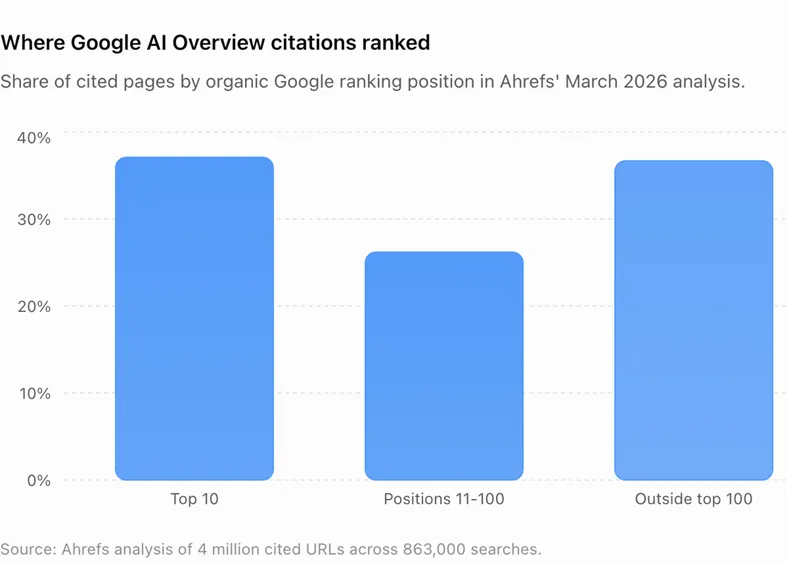
A company therefore has content that AI search finds useful even when that page doesn’t hold a top position for the original search. Marketing teams need to evaluate rankings and AI visibility as related measurements with different purposes.
AI Search Changes What Marketing Teams Can See
Traditional SEO reporting tracks search visibility and website traffic, then connects those measures to lead performance. AI-generated answers add another form of visibility because a company appears in search without receiving a website visit.
According to Google’s guidance, its AI search features run related searches around a person’s original question. Google calls this process query fan-out. Those searches help the system gather information that addresses different parts of the original topic.
For a B2B company, relevant related searches include questions that arise before a sales conversation. A prospect researching cybersecurity might ask how long a System and Organization Controls 2 (SOC 2) audit takes or what evidence is required before looking for a provider.
A broad service page covers the main subject, while supporting pages address narrower questions. A content model built around those relationships gives the company more opportunities to appear during the research process.
Declining organic traffic now needs more context. Lower rankings reduce clicks, and AI-generated answers also keep some searches from producing a website visit.
Marketing teams compare traffic with AI citations and brand mentions to see whether visibility changed along with traffic. Lead performance then shows if the shift reached the sales pipeline.
AI Citations and Brand Mentions Measure Different Results
An AI citation links to a company’s website as a source, while a brand mentions the company directly in the generated answer. Marketing reports need to separate these outcomes because they do not always occur together.
A Semrush study reviewed 3,981 domain appearances across 115 prompts in 14 countries. The researchers found that 62% were “ghost citations,” meaning the website appeared as a source while the company name stayed out of the answer.
ChatGPT cited a source in 87% of the appearances measured in that study but named the brand in 20.7%. Appearing in an AI answer does not create the same level of company recognition as a direct brand mention.
| Metric | What It Shows | What Marketing Teams Should Review |
| AI citation | The website appears as a source in a generated answer. | Which pages and subjects earn citations repeatedly. |
| Brand mention | The company is named directly in the answer. | Which searches connect the company with its services or expertise. |
| Organic traffic | Searchers continue from search results to the website. | Whether traffic changes match movements in rankings or AI visibility. |
| Qualified leads | Search activity contributes to business opportunities. | Whether changes in visibility are reaching the sales pipeline. |
A citation framework places those measurements alongside existing SEO reporting without forcing them into a single visibility score.
Seven Factors That Affect AI Search Visibility
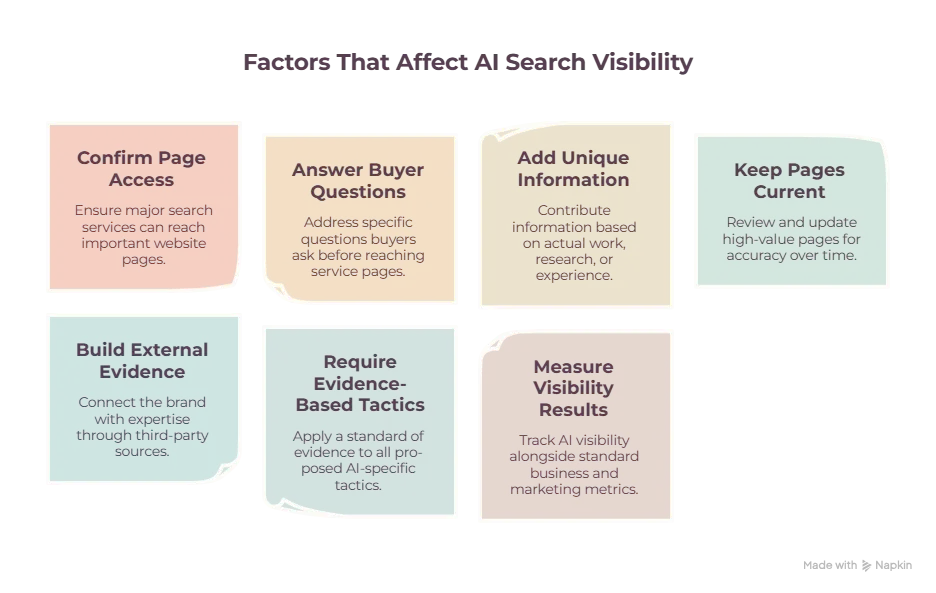
The seven factors cover site access, content that earns citations, and the measurements marketing teams need to track.
1. Confirm AI Search Can Reach Important Pages
Marketing managers don’t need to manage website access settings. The agency or web team confirms that major search services have access to the pages the company wants surfaced.
Website settings and security systems block automated search tools in ways that don’t appear in standard marketing reports. Months of content work won’t solve an access problem that limits where those pages appear.
This check belongs alongside a standard SEO audit before a larger content project begins. The team needs to provide evidence that priority pages are accessible.
2. Answer the Questions Buyers Actually Ask
AI search creates more opportunities around specific questions because generated answers can combine information from several parts of a subject. A useful content program accounts for the questions buyers ask before they reach a service page or contact sales.
For a cybersecurity company, those questions could cover:
- Pricing and typical project costs
- Audit schedules and preparation timelines
- Compliance requirements
- Implementation timelines
- Project scope and common limitations
Each topic supports the same service while answering a different research need. A new page makes sense when the question has enough substance to address separately and matters to the sales process.
Existing content also requires a review for overlap. Several articles covering the same basic answer leave more valuable questions untouched, while a stronger content strategy gives each page a defined purpose.
Marketing leaders test the structure by identifying the buyer question each major page answers. When several pages provide nearly the same answer, consolidation takes priority before another article is added.
3. Add Information Competitors Can’t Easily Repeat
Many websites provide the same general explanation of a service, regulation, or process. Pages become more useful as sources when they contribute information based on actual work, research, or documented experience.
Useful source material includes:
- Client trends across a defined period
- Benchmark data with a stated sample
- Project results with a clear comparison point
- Process data collected during service delivery
- Observations that come from repeated client work
A benchmark includes a sample size and timeframe to show what the number represents. Those details give readers the context required to evaluate the finding.
Case study results require the same context. A statement that leads increased by 42% carries more meaning when the page identifies the measurement period, comparison point, and work responsible for the change.
4. Keep High-Value Pages Current
Many B2B pages contain information that changes over time. Regulations and software platforms change. Pricing ranges and benchmarks also need periodic review.
Marketing teams don’t need to rewrite the entire content library every quarter. Start with pages that influence qualified leads. Then review pages tied to commercially relevant searches and fast-changing subjects.
A content review should look for changes in:
- Regulations or formal requirements
- Platform features and capabilities
- Pricing or benchmark figures
- Recommended processes
- Examples that no longer reflect current conditions
Changing a publication date without reviewing those facts provides little value. An ongoing SEO strategy should account for the accuracy of existing pages alongside new production.
5. Build Evidence Beyond Your Website
AI search tools also find information about a company on other websites. Trade publications and industry interviews connect the brand with specific areas of expertise. Podcasts and conference coverage add more third-party evidence.
Research connects brand mentions fro third-party sources with higher AI visibility. The studies measure correlation, so they don’t establish that a mention directly causes a citation.
Marketing teams review where the company is mentioned and which subjects appear alongside the brand. Relevant industry coverage provides stronger third-party evidence around the subjects the company wants to be known for.
The goal is to build credible outside evidence around those subjects. Marketing reports track where those mentions appear and how that presence changes over time.
6. Require Evidence Behind AI-Specific Tactics
The growth of GEO has produced tactics that sound specific to AI search even when their effect remains uncertain. Marketing teams apply the same evidence standard they use for any other proposed investment.
| Recommendation | What the Evidence Supports |
| Schema markup | Useful for standard search when it accurately describes page content. Google hasn’t identified a special schema that produces AI citations. |
| llms.txt | Google says Search ignores the file, so it doesn’t provide a documented Google AI search benefit. |
| Phrase repetition | Repeating the same idea in several variations doesn’t create a documented AI citation advantage. |
| Purchased low-quality mentions | Existing brand-mention research doesn’t establish that manufactured placements produce the same result as legitimate outside coverage. |
Technical work remains testable when a clear theory supports it. The agency explains what the change is expected to do, what evidence supports that expectation, and which measurement determines whether the test worked.
This standard leaves room for experimentation while separating experimental work from practices supported by stronger evidence.
7. Measure AI Visibility Alongside Business Results
AI search reporting gives marketing teams more context for changes in visibility and performance.
A baseline starts with a consistent group of questions that prospective buyers ask during research. Check those questions across major AI search services on a regular schedule and record the cited sources and companies named in each answer.
Repeat the same questions over time because generated answers vary between searches. Recurring appearances identify which sources and brands show up consistently across multiple checks.
Reporting then compares AI visibility with the measures already used by marketing and sales:
- AI citations
- Brand mentions
- Organic rankings and traffic
- Branded search activity
- Qualified leads
An SEO lead generation strategy connects those measurements while keeping each one distinct. Each metric measures a different part of search performance, while qualified leads show what reaches the sales pipeline.
Agency Pressure Test for AI Search
Marketing leaders don’t need to become AI search specialists to evaluate the work their agency is doing. They should be able to ask a defined set of questions and receive answers supported by data, examples, or documented platform behavior.
| Ask Your Agency | A Useful Answer Should Show |
| Can AI search tools access our priority pages? | Evidence that important pages are available to the search services the company wants to appear in. |
| Which buyer questions are we missing? | Specific gaps between questions prospects ask and information currently available on the site. |
| Where are we being cited? | Recurring citation tracking by subject, page, and AI search service. |
| Where is our brand being named? | Brand mentions reported separately from website citations. |
| Why are we creating this page? | A specific buyer question, service need, or content gap. |
| How will we measure the work? | Citations and brand mentions reviewed alongside rankings, traffic, branded searches, and qualified leads. |
The agency separates documented platform behavior from independent research and its own testing. This gives marketing leaders a clear basis for evaluating each recommendation.
AI search platforms change how their products work and do not fully disclose how sources are selected. Strategy adjusts when stronger evidence changes the recommendation.
Website Traffic Needs More Context
AI-generated answers have already changed click behavior in broader Google searches. Pew Research Center studied 68,879 Google searches made by 900 adults in the United States during March 2025 and found that users clicked a traditional search result in 8% of visits when an AI summary appeared.
Searches without an AI summary produced a traditional result click in 15% of visits, while a source link inside the AI summary received a click in 1% of visits containing a summary.
The study covered general Google users, so those percentages shouldn’t become B2B conversion benchmarks. The findings still provide evidence that an AI summary can change click behavior even when someone continues using Google to research the same subject.
That difference matters during year-over-year reporting because fewer website visits have several explanations. A useful agency report examines rankings, search demand, AI visibility, branded activity, and leads before assigning a traffic decline to one cause.
How the Priorities Change Across B2B Industries
The same general AI search principles apply across B2B service companies, while the content standard changes with the information being discussed.
| Industry | What the Content Needs to Show |
| IT and cybersecurity | The standard, version, project scope, and date when those details affect the answer. Technical explanations should separate formal requirements from provider recommendations. |
| Healthcare | The source and scope of administrative or compliance claims, with stronger review applied to clinical information. |
| Legal | The jurisdiction and review date near legal rules, with a clear distinction between the law and the firm’s practical interpretation. |
| Insurance | The policy type, location, and conditions that change the answer, with separate coverage when state or carrier differences become substantial. |
For B2B technology companies, IT marketing turns technical knowledge into clear answers that marketing managers and buyers can use.
Healthcare, legal, and insurance content requires tighter sourcing because the scope of the answer affects its accuracy. Each page should state the conditions that apply to the information it presents.
These standards guide how content is written and reviewed across industries.
A 90-Day AI Search Action Plan
Marketing teams make progress on AI search this quarter by reviewing the current site before rebuilding the SEO program or approving a large new content calendar.
- Establish a baseline. Choose a group of questions prospects regularly ask before contacting sales and record which companies and sources appear across major AI search tools.
- Review current content before producing more. Identify pages tied to qualified leads, confirm the questions they answer, and look for overlapping content that serves the same purpose.
- Confirm site access. Ask the agency or web team to verify that priority pages can be reached by the search services the company wants to appear in and provide evidence from the site.
- Improve pages for a specific reason. Update outdated information, strengthen weak evidence, combine duplicate coverage, and create new pages when an important buyer question remains unanswered.
- Expand reporting. Add citations and brand mentions to the existing view of rankings, traffic, branded search activity, and qualified leads so changes can be traced across the search process.
A GEO framework turns that first baseline into an ongoing program once the audit shows where the strongest opportunities and gaps currently sit.
Find Your AI Citation Gaps
321 Web Marketing helps businesses improve visibility across search engines and AI assistants. Our team reviews your current site and marketing funnel to identify opportunities, gaps, and strengths. Schedule a meeting to discuss where AI search fits into your current marketing program.
Kim Greer
OFP Law
One of the best business decisions I ever made was to contract with 321 Web Marketing. Jonathan Gessert and his team are knowledgeable, efficient, and effective, making digital marketing goals easy to achieve and helping [...]

Kelly Cole
Business Benefits Group
My company hired 321 Web Marketing in February 2016 to resurrect our web site. We feel our web site is the face to our business and desperately needed a make over. 321 took us from blah to WOW effortlessly and what a difference [...]

Emily Hawkins
Diener & Associates
Thanks to 321 Web Marketing, the client has seen an increase in their search engine leads, averaging 12 qualified leads per month. The client has also achieved prominent Google Maps and search placement. The team [...]
Trevor Telesz
Paw Pals Pet Sitting
321 Web Marketing successfully translated the client’s design into a stunning and refreshed website, ensuring seamless functionality across all dynamic views. The team provided clear timelines and stuck to them, [...]

Corey Davis
Spartan Animal & Pest Control
321 Web Marketing is truly phenomenal at what they do. Their ability to communicate and describe the steps and actions that they are implementing, Alex Zarpas in particular, is excellent. Delivering on promises is all [...]

Alec Roberts
MFE Insurance
I can’t say it enough, Jonathan and his team have gone above and beyond since day one to accommodate our needs and meet our goals. I run a specialty insurance brokerage based in LA and once we found 321 we never looked [...]

Richard Wilbur III
Advantage.Tech
Thanks to 321 Web Marketing’s web development work, the client increased rankings and traffic from search engines. Also, their business secured prominent positions on Google Maps and industry-relevant, profitable [...]

Bruce Gemmill
FVCbank
After the website revamp, the client saw a steady rise in leads from search engines, resulting in additional traffic. 321 Web Marketing is highly punctual when it comes to deliverables, and internal stakeholders are [...]

Drew Weeks
VAE
321 Web Marketing delivered a sleek website that accurately portrays the size and quality of the client’s organization. All of their completed websites have received positive feedback from users who have been [...]

Ryan Masten
Masten Pools
321 Web Marketing has increased the client’s leads from zero to 53 monthly. Their SEO efforts pay off impressively due to a top-ranking position on Google and making the site the number one result for several [...]