



Table of Contents
- 1. Introduction
- 2. What AI Marketing Technology Actually Is
- 3. The Core Categories of AI Marketing Technology
- 4. How AI Marketing Technology Creates Value
- 5. The Risks and Realistic Limitations
- 6. Building an Investment Thesis Before You Buy
- 7. Evaluating AI Marketing Tools and Vendors
- 8. Integration Considerations for Your Existing Stack
- 9. Team Readiness and Change Management
- 10. Measuring ROI on AI Marketing Investments
- 11. Build, Buy, or Wait Decisions
- 12. The AI Marketing Vendor Space in 2026
- 13. Common Mistakes Marketers Make When Investing in AI Tools
- 14. A Practical Framework for Your First or Next AI Investment
- 15. Conclusion
- 16. Frequently Asks Questions

 Jul 20, 2026 ·
  29 min read ·
  Summarize in ChatGPT
Introduction
Top marketing executives face a drastically different software market in 2026 than they did two years ago, as the rapid commercialization of machine learning models has turned artificial intelligence into a mandatory operational requirement (Ziakis & Vlachopoulou, 2023). Making an AI marketing investment now carries heavy financial stakes, shifting the technology from an experimental side project into the core infrastructure driving modern customer acquisition. Because AI martech integrates deeply into daily operations, a poor software choice carries severe penalties, possibly embedding bad data and creating operational bottlenecks directly into your revenue engine.
If a generative model produces incorrect pricing or a predictive algorithm corrupts your primary database, the financial damage compounds, requiring leadership to assess structural risks just as aggressively as it evaluates promised efficiency gains. This guide serves as a practical resource for marketers preparing to allocate capital, helping decision-makers separate genuine technical capability from exaggerated vendor marketing. Whether you are building a board-level business case or choosing AI marketing software for a specific campaign, this framework provides the evaluation criteria required to make a defensible, profitable decision.
What AI Marketing Technology Actually Is
The definition of AI marketing technology has expanded beyond predictive lead scoring, now spanning a complex market of content production, programmatic advertising, and customer analytics (Rita et al., 2025). Establishing a definition before evaluating tools is essential; otherwise, you risk overpaying for basic software disguised as advanced artificial intelligence. Vendors frequently capitalize on this confusion, rebranding outdated automation sequences as machine learning by attaching basic generative plugins to legacy platforms. The procurement team must demand technical transparency during the evaluation phase, prompting sales representatives to prove how their native neural networks ingest data, recognize patterns, and operate adaptively.
Classifying tools correctly saves money and prevents overlapping systems. Without clear boundaries, you will purchase duplicate software, which will complicate your data architecture. Enforcing a consistent standard keeps your organization away from buying technology just for the sake of modernization. Instead, it allows you to acquire systems that solve real problems, boost the bottom line, and avoid unnecessary administrative work.
Defining AI Marketing Technology
At its core, AI marketing technology encompasses any software that natively uses machine learning, large language models, or generative artificial intelligence to inform, automate, or execute marketing decisions by mimicking humans and performing activities intelligently (Vlačić et al., 2021). This differs from traditional software. Legacy AI marketing automation relies on static rules. A human marketer writes an “if/then” logic sequence, and the software simply follows instructions.
True AI technology operates adaptively. It analyzes unstructured data, recognizes complex patterns, and generates original outputs or decisions without requiring explicit, step-by-step human programming for every single variable.
The Difference Between AI Tools and AI-Enhanced Tools
Buyers must evaluate the technical distinction between platforms built natively on AI and legacy platforms that have merely layered AI features onto older architectures. Native AI marketing tools use language models as their foundational database and processing engine. They learn and adapt fundamentally.
Conversely, AI-enhanced tools usually feature a small generative text box bolted onto a 10-year-old user interface. This distinction directly impacts platform performance, processing speed, roadmap velocity, and long-term reliability. Bolted-on features break frequently, while native tools scale efficiently.
How AI Martech Has Changed Through 2026
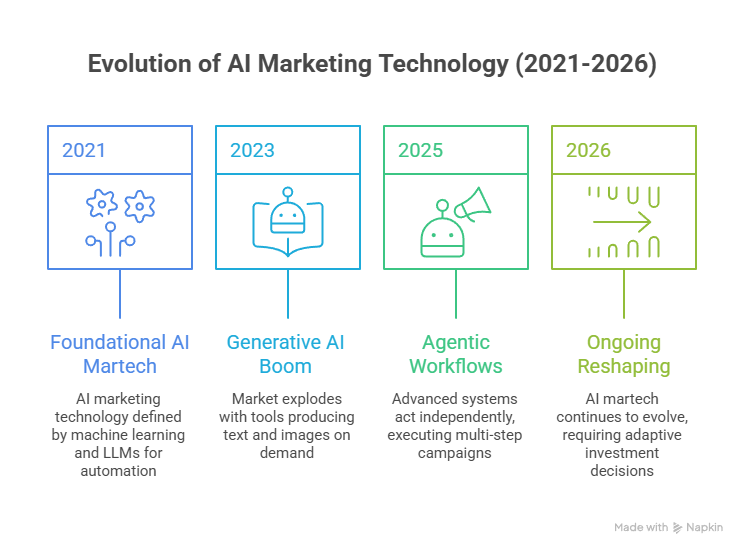
The timeline of AI martech development reveals a rapid shift in operational capability (Ziakis & Vlachopoulou, 2023). Five years ago, the technology focused on predictive analytics, analyzing historical data to guess future customer behavior. The market then exploded into generative models, producing text and images on demand.
Today, the most advanced systems operate as agentic workflows. These tools do not just generate assets; they act independently on behalf of marketing teams, executing multi-step campaigns, revising bids in real time, and adjusting messaging based on live feedback. Current investment decisions must account for a software category that is still actively reshaping its own boundaries.
The Core Categories of AI Marketing Technology
Categorization dictates budget ownership, integration requirements, and technical oversight. You cannot evaluate a generative text platform using the same criteria you apply to a predictive analytics engine. Most enterprise marketing teams will eventually combine several distinct categories into a functional AI martech stack rather than attempting to buy an all-in-one platform.
Without a clear classification system, departments make purchasing decisions in isolation, leading to redundant software. For example, a copy team might buy standalone AI content marketing tools to write drafts, unaware that demand generation already licensed enterprise AI marketing platforms with those exact features. This fragmentation inflates costs and complicates your data pipeline. Establishing a formal framework encourages cross-functional collaboration before finalizing any AI marketing investment.
Clear categorization also establishes the technical baseline for your AI marketing tools evaluation. Generative software requires workflows for brand voice compliance and human editorial oversight, whereas predictive analytics systems demand deep system compatibility and clean historical datasets. Trying to apply a single corporate procurement rubric across these differing technological layers will paralyze your integration efforts.
By grouping your AI marketing software into logical, functional categories from day one, you clarify exactly which technical resources are needed for deployment, which internal teams own daily administration, and how the business will accurately measure financial returns.
AI-Powered Content Creation and Optimization
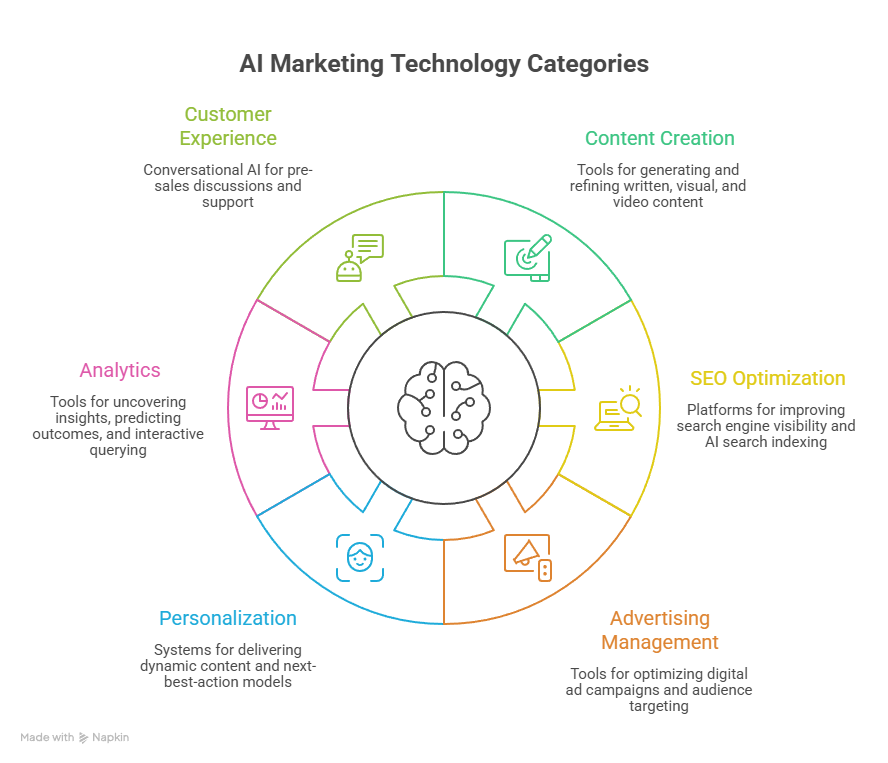
This category includes tools that generate, edit, refine, or repurpose written, visual, and video content at scale. AI content marketing tools reduce the time required to draft initial creative briefs, write baseline copy, and produce dozens of ad variant images. However, generative AI marketing tools demand rigorous editorial workflows. While the software excels at variant production and formatting, human oversight remains mandatory for verifying factual accuracy, maintaining brand voice, and preventing the publication of generic, uninspired content.
| Category | What it handles | What it demands |
|---|---|---|
| Content creation and optimization | Generates, edits, refines, and repurposes written, visual, and video assets at scale | Rigorous editorial workflows and human oversight for factual accuracy and brand voice |
| SEO and generative engine optimization | Traditional search visibility, AI search indexing, and citation tracking across large language models | Tools for AI Overview monitoring, semantic content scoring, and entity optimization |
| Advertising and campaign management | Tests creative variations, finds audience segments, and updates bids faster than humans | Independent oversight, since AI ad platforms often run inside closed systems |
| Personalization, CRM, and lifecycle | Predictive segmentation, dynamic content, and next-best-action models per buyer | Clean, normalized data, or the tools produce detectable automation errors |
| Analytics, attribution, and predictive modelling | Surfaces insights, predicts revenue, and replaces static dashboards with natural-language querying | Advanced algorithmic modelling to handle multi-touch attribution |
| Customer experience and conversational tools | Manages pre-sales questions, automates support, and gathers live feedback | Early cross-department agreement on who buys the tool and owns the dialog workflows |
AI-Driven SEO and Generative Engine Optimization
Search engine optimization now requires specialized artificial intelligence tools. These platforms focus on traditional search visibility, AI search indexing, and citation tracking across various large language models. Categories include monitoring tools for AI Overviews, content scoring systems that evaluate semantic depth, and entity-based optimization platforms.
As search engines replace standard blue links with synthesized answers, marketing teams must use these specific tools to guarantee their brand data feeds accurately into the models that construct those answers.
AI Advertising and Campaign Management
Algorithms currently manage most digital ad budgets. Because AI-driven ad platforms often process data within closed systems, marketing teams lose a degree of manual oversight. To regain that control, marketers use independent AI tools for marketers that run right alongside these main networks. These applications test creative variations, find new audience segments, and update bids much faster than a human operator could accomplish manually.
AI Personalization, CRM, and Lifecycle Marketing
Artificial intelligence is reshaping customer relationship management to provide consumer-centricity (Rita et al., 2025). Major AI personalization platforms use predictive segmentation to serve specific dynamic content and execute next-best-action models for individual buyers. Instead of sending a generic newsletter to 10,000 people, the system builds 10,000 individualized newsletters dynamically.
However, this capability relies on data infrastructure. Personalization AI only functions effectively when fed clean, normalized data. Without a pristine database, these tools produce superficial, easily detected automation errors.
AI Analytics, Attribution, and Predictive Modelling
AI-driven analytics tools surface hidden insights, predict revenue outcomes, and replace static traditional dashboards with interactive, natural language querying. A marketing director can simply ask the software to identify the most profitable geographic region of the past quarter.
However, these tools introduce severe attribution challenges. In an AI-mediated, multi-touch environment, tracking the exact origin of a complex sale requires advanced algorithmic modelling rather than simple first-click or last-click tracking frameworks.
AI Customer Experience and Conversational Tools
Conversational AI drives marketing results by managing pre-sales discussions, automating support, and gathering immediate feedback. Today’s voice and chat applications help buyers work through difficult questions without relying on frustrating phone menus. Purchasing these applications calls for deliberate internal teamwork. Because the boundary between marketing-driven lead generation and customer support often blurs, departments must agree early on who buys the software and who controls the dialog workflows.
How AI Marketing Technology Creates Value
Expecting a sudden sales spike causes many business owners to misunderstand how algorithmic systems generate returns. Real value emerges when AI marketing platforms create structural efficiency, upgrade decision quality, and scale operations (Ziakis & Vlachopoulou, 2023). You should measure software against these patterns rather than trusting a generic AI marketing ROI projection. Integrating targeted AI tools for marketers accelerates data analysis and campaign deployment. This shift moves personnel out of repetitive data entry and into strategic roles.
Predictive models eliminate gut feelings from customer segmentation. By allocating ad budgets based on mathematical probability, they improve your decision quality. Modern AI marketing technology allows organizations to expand capacity without inflating payroll expenses. To leverage this advantage, company executives must abandon vanity volume metrics. Focus heavily on how the software lowers customer acquisition costs and pushes deals through the pipeline faster. Grounding your acquisitions in these realities prevents bad purchases and builds a predictable revenue pipeline.
Efficiency Gains and Operational Leverage
AI delivers measurable time savings across repetitive marketing tasks, allowing personnel to automate repetitive work and focus on client connections (Labib, 2024). Drafting email sequences, summarizing weekly performance reports, producing creative asset variants, and conducting baseline competitor research all happen in fractions of a second. These efficiency gains translate directly into operational leverage. A business can either reduce its overall agency spend by bringing execution in-house, or it can reallocate that recovered employee capacity toward higher-value strategic work that artificial intelligence cannot replicate.
Decision Quality and Predictive Insight
Predictive models improve financial forecasting, customer segmentation, and budget prioritization. When fed accurate, historical data, an AI analytics platform can predict which specific leads possess the highest probability of closing. This level of decision-quality improvement proves impossible to replicate manually at any reasonable scale. It allows marketing directors to concentrate expensive sales resources on the most profitable segments of the pipeline.
Scale Without Proportional Headcount
Artificial intelligence enables marketing departments to expand their operational output exponentially without requiring linear hiring growth. A team of three marketers armed with the right tools can execute the campaign volume of a 20-person department. However, this scaling pattern introduces tradeoffs. The oversight burden increases massively, quality control becomes a daily challenge, and brand consistency can easily fracture if the team fails to implement editorial guidelines over the AI output.
The Risks and Realistic Limitations
Vendors rarely surface structural risks during pitches, making an honest assessment of platform limitations mandatory to prevent data breaches and public relations failures. When evaluating an AI marketing investment, company leadership must look beyond flashy software capabilities to scrutinize data custody, as many commercial generative AI marketing tools train public models on user inputs, risking proprietary data exposure and violating global regulations like the EU’s General Data Protection Regulation (GDPR) or the California Consumer Privacy Act (CCPA) (Vlačić et al., 2021).
Algorithmic hallucinations threaten brand reputation because text and image models operate on statistical probability rather than factual verification. Deploying outputs from AI marketing software without human editorial workflows creates a vulnerability that can instantly erode buyer trust through fabricated product or customer details.
An inadequate AI marketing tools evaluation also blinds companies from hidden technical debt and platform dependencies, especially with startups that rely on third-party application programming interfaces (APIs) rather than proprietary neural networks. This reliance leaves operations vulnerable to sudden pricing escalators, model deprecations, or vendor bankruptcy.
Once a department builds its daily routines around customized logic, extracting data and migrating platforms becomes exceptionally expensive. To avoid severe vendor lock-in, procurement teams must demand total data portability and clearly defined exit clauses before signing any software service agreements.
Quality, Accuracy, and Hallucination Risk
Generative AI remains prone to factual errors, fabrication, and severe inconsistency. When language models hallucinate, they invent statistics, misquote historical facts, and confidently present false information as absolute truth. Deploying AI outputs directly to the public without sufficient human review introduces editorial, legal, and brand risks. A single hallucinated claim regarding a product specification can result in immediate customer churn and potential liability.
Data Privacy, Security, and Compliance Concerns
Feeding customer records, prospect lists, or proprietary corporate data into commercial AI tools introduces heavy privacy implications that must be protected through data protection and ethics (Vlačić et al., 2021). Marketers must evaluate how the vendor uses uploaded data. If the vendor trains its public models on your private customer lists, you lose your competitive advantage instantly. Compliance considerations regarding GDPR, CCPA, and sector-specific frameworks heavily influence vendor selection. Security must approve the data routing before the marketing department signs the contract.
Vendor Lock-In and Platform Dependency
AI tools create deep operational lock-in through proprietary models, customized training data, and tight workflow embedding. Once a marketing team builds its entire daily routine around a specific vendor’s interface, migrating to a competitor becomes exceptionally expensive and painful. To reduce this lock-in exposure, buyers must negotiate favorable contract terms, demand total data portability, and build a clear exit plan before the initial implementation even begins.
Building an Investment Thesis Before You Buy
Strong technology acquisitions start with a defined investment thesis rather than a reactive tool shortlist. Developing this thesis separates strategic buyers from impulsive executives who simply chase software trends by forcing the organization to isolate specific mechanical failures or capacity limits within current operations.
Whether the goal is compressing asset production costs or closing a data gap in revenue attribution, naming the precise problem acts as a filter before any vendor demonstrations. Authorizing an AI marketing investment or building an AI martech stack simply to satisfy a modernization checklist may also lead to a directionless deployment; every software feature must tie directly back to a documented operational deficit.
This thesis demands a realistic calculation of the total cost of ownership, recognizing that monthly licensing fees represent only a fraction of the actual financial commitment. An accurate model must account for the hidden hard costs of technical implementation, API connections, database normalization, and intensive employee training.
Calculating these integration expenses upfront transforms choosing AI marketing software into a disciplined financial exercise rather than an emotional, trend-driven purchase. If the projected financial return does not overwhelmingly exceed this complete cost model, the investment thesis fails, and leadership must cancel the acquisition.
Identifying the Real Problem You’re Solving
You must name the specific marketing problem that the software is expected to address. Are you trying to reduce content production costs, increase campaign launch speed, improve lead quality, expand team capacity, or close an analytical insight gap? Problem clarity serves as the single best predictor of post-purchase satisfaction. If you buy a tool simply because it uses artificial intelligence, you will inevitably struggle to prove its value during the next budget review.
Mapping Tools to Workflow, Not the Other Way Around
Retrofitting your internal workflows to accommodate a new software tool stands as one of the most common and costly purchasing mistakes a company can make. You must document your current marketing workflows before evaluating any tools that might augment or replace them. The software should map directly to your established processes. If a vendor requires you to upend your departmental structure to use their platform, the integration will fail.
Estimating Total Cost of Ownership
A software license fee represents only a fraction of the actual financial commitment. You must build a realistic Total Cost of Ownership model that survives executive scrutiny. This model must include the hard costs of technical implementation, data integration, employee training, ongoing editorial oversight, and the opportunity cost of team distraction during the onboarding phase. A tool that costs $1,000 a month in licensing often requires $10,000 a month in internal management.
Evaluating AI Marketing Tools and Vendors
With the marketing technology market experiencing rapid expansion and volatile consolidation, executing a thorough AI marketing tools evaluation requires treating vendor selection as an exercise in risk management. The AI marketing tools market features over 15,500 products, yet roughly 1,367 platforms disappeared over the past year alone, proving that smaller, underfunded vendors carry replacement risk (Brinker, 2026). Partnering with an unstable provider carries major operational liabilities. If a selected vendor faces bankruptcy, your organization risks losing its entire upfront implementation investment alongside the customized agentic workflows engineered to run your daily campaigns.
To insulate your corporate budget from vaporware, procurement teams must establish rigid AI vendor evaluation criteria that force sales representatives to prove their technical legitimacy. Company leadership must demand absolute model transparency, disqualifying opaque platforms that withhold detailed system cards outlining data sources and subprocessor networks. Choosing AI marketing software requires contractual bans against using proprietary inputs for public model training. Solidifying model change notifications, uptime service-level agreements, and total data portability ensures your infrastructure remains resilient when identifying the best AI marketing tools 2026 has to offer.
Core Evaluation Criteria
Your evaluation must prioritize model transparency, data handling protocols, integration depth, support quality, roadmap clarity, and pricing structure. The weight of these criteria changes based on the role the tool will play in your broader stack. A core CRM enhancement requires absolute security and deep integration, whereas a standalone brainstorming tool carries much lighter security requirements and demands a lower price point.
What to Ask Before You Sign with an AI Vendor
Do not accept vague technical answers during a software demonstration. You must demand clear responses to a specific set of questions. Ask about model provenance: did they build the model natively, or are they simply wrapping a public API? Ask exactly how they secure training data. Question their historical uptime, their specific support SLAs, their contract flexibility, and their pricing escalators upon renewal. Answers that include hard technical data should reassure you, while answers that deflect to marketing jargon should immediately raise concern.
Red Flags in AI Marketing Vendor Pitches
Warning signs appear early in the sales process if you know what to look for. Opaque pricing models that refuse to define the cost of scaling usage indicate future budget overruns. Vague model descriptions suggest the vendor lacks proprietary technology. Unverifiable case studies and high-pressure contract terms signal a company desperate for cash flow rather than a stable technology partner. These minor pitch tells often expose structural problems within the vendor’s engineering team.
Integration Considerations for Your Existing Stack
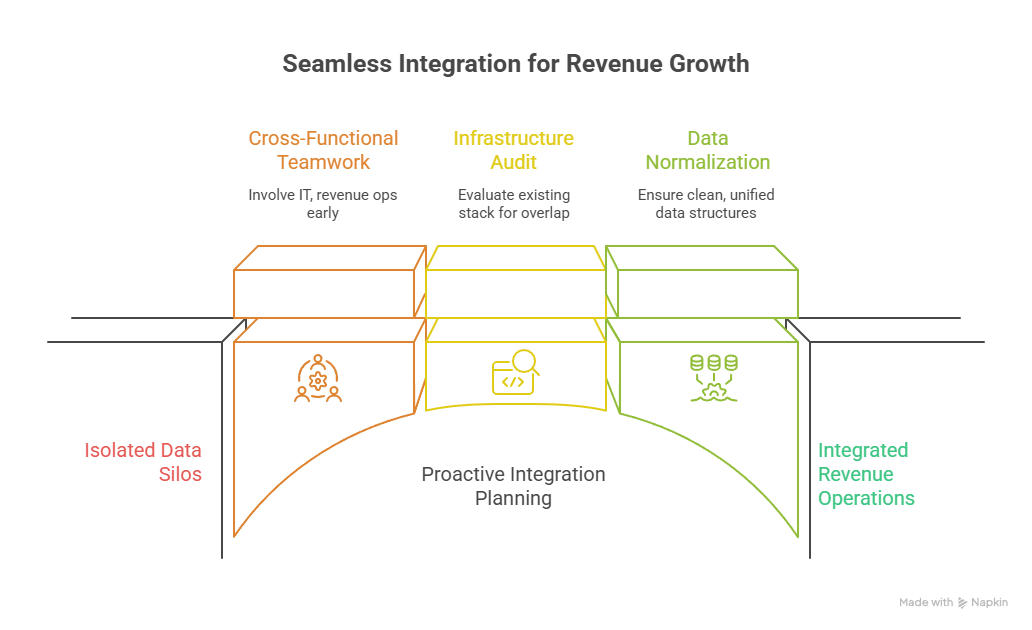
Integration costs often catch buyers off guard. Technical architects must evaluate API limits, data transfer protocols, and processing speeds before signing any contract. By bringing the revenue operations and IT teams into the process early, companies prevent isolated data silos that break reporting pipelines. This cross-functional teamwork proves especially necessary when linking new algorithmic tools to your primary customer relationship management (CRM) system or customer data platform (CDP). Feeding duplicate records or incomplete histories into a predictive application multiplies those errors. High-performing setups rely on clean, normalized data structures so the artificial intelligence protects your pipeline tracking instead of corrupting it.
Proactive planning also minimizes the financial drain of tool sprawl in a market that now exceeds 15,500 solutions (Brinker, 2026). Organizations have to execute a strict infrastructure audit before adding new software subscriptions. If an established platform already includes an automated segmentation engine, licensing a separate application for that exact purpose wastes capital and complicates security. Eliminating this technical overlap keeps your corporate systems lean, secure, and focused on driving revenue rather than creating administrative overhead.
API, Data, and System Compatibility
A new tool will function well if its technical requirements match your existing infrastructure. Evaluating API access, data protocols, and system compatibility is a necessary step before making a financial commitment. To do this correctly, involve IT, revenue operations, and security leadership early in the buying process. When software lacks two-way communication with your database, it creates isolated data silos that paralyze corporate reporting.
CRM, CDP, and Analytics Integration
The most common integration points involve your CRM system and CDP. Making these connections productive requires flawless data hygiene. If you feed duplicate records and outdated contact information into an AI routing tool, the tool will amplify the errors at lightning speed. Integration patterns that push unified, normalized data into the AI model work exceptionally well. On the other hand, integration patterns that dump unstructured noise into the model create reporting failures.
Avoiding Tool Sprawl and Overlap
As legacy platforms release new generative features, standalone AI tools frequently duplicate capabilities already present in your existing technology stack. You must conduct a ruthless audit of your current stack before adding new tools.
If your current email marketing platform just launched an AI subject line generator, you do not need to buy a separate software subscription for that exact same function. Auditing prevents tool sprawl and protects the departmental budget.
Team Readiness and Change Management
Software adoption fails more often from internal team friction than from technology limitations. Treating team readiness as a prerequisite rather than a parallel workstream increases the likelihood of the AI marketing software being used. When leadership introduces advanced systems without preparing the workforce, employees often resist the disruption, reverting to manual legacy processes or creating fragmented workarounds. Mitigating this risk requires a comprehensive evaluation of your team’s current data literacy and technical capabilities prior to authorization. Identifying the skill gaps early allows organizations to design targeted training initiatives, converting potential operational resistance into active alignment.
Successfully integrating automated platforms requires an intentional workflow redesign supported by governance structures. Organizations must identify and empower internal champions who are proficient operators piloting the systems, constructing initial prompt templates, and establishing best practices for the broader department. At the same time, leadership must institutionalize clear usage policies and editorial review chains to police algorithmic outputs and protect brand consistency. This structured approach ensures that your AI marketing investment transitions smoothly from a disruptive novelty into a deeply embedded operational asset that drives measurable revenue growth.
Skills and Training Required
Operating modern software requires new skill profiles. Artificial intelligence integration actively enhances professionals’ abilities, skills, and marketability, indicating that dedicated technology integration education is required (Elhajjar et al., 2020). Your team needs advanced training in prompt design, data literacy, and editorial oversight. You must assess your current team’s capabilities against the demands of the new tooling. A brilliant copywriter might struggle significantly with the analytical logic required to program an agentic AI workflow. Identify the skill gaps and fund the necessary training programs before the software deployment begins.
Workflow Redesign and Adoption Curves
These tools almost never function as simple slot-in substitutions. They require complete workflow redesigns. Teams experience a distinct productivity dip immediately following the software launch as they learn the new interfaces and rewrite their daily processes. Company leadership must anticipate this dip and communicate realistic adoption curves. Expecting an immediate surge in output on day one guarantees deep disappointment.
Internal Champions and Governance
Identifying and empowering internal champions accelerates software adoption drastically. These early adopters test the boundaries of the tool and build the initial templates for the rest of the department. Simultaneously, you must establish governance structures. Define explicit usage policies, mandate quality standards, and create escalation paths for resolving technical errors. Strong governance prevents shadow tool sprawl and keeps the entire department operating securely within approved software environments.
Measuring ROI on AI Marketing Investments
Calculating definitive AI marketing ROI proves far more difficult than vendor case studies imply. Measurement is an operational discipline. It must be established before the purchase occurs, as you cannot retrofit a measurement framework onto a software deployment six months after the fact.
Financial officers routinely reject vague productivity claims. Instead, they demand concrete proof of how an AI marketing investment impacts the bottom line. To satisfy this executive scrutiny, organizations must isolate leading indicators, such as reduced customer acquisition costs or accelerated pipeline velocity, prior to launching any new platform.
Relying on vanity metrics like the volume of automated email variants fails to justify enterprise software expenses. Output volume does not equal revenue. True financial accountability requires tracking incremental profit gains and comparing platform performance against a control group. Because AI marketing platforms operate across hidden attribution layers, early baseline establishment prevents departments from taking false credit for organic customer conversions.
Build the reporting dashboard before finalizing your AI marketing tools evaluation. Doing so forces long-term accountability, allowing your software dollars to generate measurable top-line growth instead of basic technical overhead.
Defining Success Metrics Upfront
Select leading and lagging indicators tied directly to your original investment thesis. If you bought the software to increase speed, measure the average days to launch a campaign. If you bought it to reduce costs, measure the blended cost per lead. You must explicitly separate vanity metrics and activity metrics from actual business outcomes. Generating 500 blog posts is an activity metric; generating 50 qualified sales consultations from those posts represents a business outcome.
Attribution Challenges With AI-Driven Outcomes
Artificial intelligence introduces severe attribution complications. Because these tools operate across multiple touchpoints and obscure decision layers, tracing a closed deal back to a specific AI intervention requires complex modelling. Practical approaches solve this problem through incrementality testing, holding out control groups, and executing controlled, phased rollouts. These scientific methods isolate the impact of the software and produce defensible measurement data.
Reporting Frameworks That Hold Vendors Accountable
Establish reporting cadences and dashboards that make the tool’s financial performance visible to corporate leadership. A robust reporting framework shows underperformance early enough to allow for immediate operational corrections. Some metrics indicate that artificial intelligence exhibits an anticipated 99% return on investment within five years of deployment (Labib, 2024). If the software fails to hit the agreed-upon efficiency metrics by the end of the second quarter, the marketing director must have the data required to cancel the contract or force the vendor to provide dedicated engineering support.
Build, Buy, or Wait Decisions
Every technology evaluation forces marketing teams to choose among three distinct paths. Grasping the framework that informs this choice prevents costly misallocations of capital and technical resources. Building proprietary systems internally makes financial sense only when an organization possesses exclusive data structures, specialized compliance requirements, or distinct operational workflows that commercial software cannot address.
For the majority of enterprise organizations, attempting to engineer custom software creates immense technical debt and diverts expensive internal engineering resources away from core product development. In contrast, choosing to buy from an established vendor accelerates implementation timelines, allowing the business to license mature, pre-tested models that immediately plug into existing workflows.
However, selecting a deliberate wait strategy often serves as the most profitable financial decision when managing a volatile sector. If a specific category of AI marketing technology is undergoing rapid fragmentation, or if your internal deployment goals lack precision, delaying the purchase preserves capital and prevents long-term vendor lock-in. Waiting allows market competitors to fund the initial, expensive beta-testing phase of immature platforms while your organization prepares its primary data architecture for a more stable, second-generation rollout.
Anchoring the decision-making process in operational readiness rather than industry pressure allows your company to allocate its technology budget only when the market can deliver a verifiable, long-term return on investment.
| Path | Best fit when | Main tradeoff |
|---|---|---|
| Build in-house | You hold proprietary data, exclusive workflows, scale needs, and want defensible IP | Cost of ML engineers, compute, and constant maintenance, plus heavy technical debt for most teams |
| Buy from a vendor | A vendor already solves a universal problem like programmatic bidding or content variation | Requires a financially mature, stable vendor with real roadmap depth to justify a multi-year commitment |
| Wait | The category is immature, the vendor market looks unstable, or your problem is not yet clearly defined | Preserves capital and avoids lock-in, but you delay any upside while preparing your data architecture |
When to Build In-House AI Capability
Building proprietary, in-house AI capability makes sense under specific conditions. If your company possesses volumes of proprietary data, utilizes exclusive operational workflows, demands scale advantages, and requires defensible intellectual property, building is justified. However, you must accept the realistic cost of hiring specialized machine learning engineers, securing server compute time, and managing endless software maintenance cycles.
When to Buy from an Established Vendor
Buying commercial tools delivers better outcomes than in-house alternatives for the vast majority of marketing departments. When a vendor solves a universal marketing problem, like programmatic ad bidding or content variation, buying their solution saves years of development time. You must identify vendors that possess the financial maturity, operational stability, and roadmap depth required to justify a multi-year commitment.
When to Wait and Why That Can Be the Right Call
In many scenarios, waiting significantly outperforms acting. If a software category remains immature, the vendor market looks unstable, or your internal problem definition lacks clarity, delaying the purchase preserves capital. You can easily communicate a deliberate wait decision to executive leadership by framing it as a strategic risk-mitigation maneuver rather than indecision. Waiting allows competitors to pay for the initial beta testing while you acquire the refined, second-generation software later.
The AI Marketing Vendor Space in 2026
The AI marketing technology market moves at breakneck speed, constantly shifting between aggressive consolidation and rapid fragmentation. Vendor selection requires ongoing reassessment, as the platform you evaluate today may get acquired or pivot its entire model tomorrow. Monolithic enterprise suites continuously acquire point solutions to expand their native features within the broader index of more than 15,500 available solutions (Brinker, 2026). For leadership teams searching for the best AI marketing tools 2026 provides, this constant market velocity means procurement can no longer be treated as a static, one-time project.
The instability forces organizations to maintain a flexible AI martech stack capable of swapping out failing applications without disrupting core operations. When choosing AI marketing software, procurement teams must prioritize vendors demonstrating long-term financial stability and clear product roadmaps over startups offering flashy but unsustainable pricing models. A sudden corporate acquisition or major structural shift can alter a tool’s core functionality, disrupt API integrations, or introduce unfavorable data custody terms overnight. Maintaining an ongoing review process protects your technology infrastructure, validating that your systems remain secure, compliant, and continuously aligned with your primary revenue goals.
Enterprise Platforms With AI Layers
Major enterprise platforms, such as HubSpot, Salesforce, and Adobe, are actively integrating native AI layers deeply into their existing product lines. Buying AI capabilities directly from your established platform provider offers advantages regarding data integration, vendor consolidation, and interface familiarity. However, these monolithic platforms often move more slowly than agile startups, meaning their AI features may lag slightly behind the absolute cutting edge of the market.
Pure-Play AI Marketing Startups
AI marketing startups constantly push the boundaries of agentic workflows and generative video. When searching for the best AI marketing tools 2026 has to offer, buyers must look past the flashy demonstration. Evaluate their venture capital runway, their core security architecture, and their longevity. A brilliant tool provides zero value if the company goes bankrupt six months after you finish the integration.
Specialized Tools for Specific Marketing Functions
Category-specific AI tools have matured enough to warrant standalone investment. Platforms dedicated to AI search engine optimization, advanced creative variation, or complex pricing algorithms fit perfectly into broader technology stacks. These specialized tools outperform generalized language models because they train exclusively on hyper-specific marketing datasets. They deliver a level of precision that broad enterprise platforms simply cannot match.
Common Mistakes Marketers Make When Investing in AI Tools
The same predictable traps cause technology investments to fail year after year. Many marketing executives buy into strong sales pitches and approve an AI marketing investment just to follow a trend. Rushing into choosing AI marketing software based on superficial demos means teams skip mapping their actual workflows. This oversight causes technical friction and forces employees to twist their daily routines to fit a mismatched platform.
Ignoring basic data hygiene is just as damaging. Linking premium AI marketing platforms to messy data backfires immediately because algorithms just accelerate and multiply existing errors. Furthermore, companies regularly underbudget the onboarding process by looking only at basic subscription fees. They overlook the expensive technical hours needed for API setup and human editorial oversight. Basing your AI marketing tools evaluation on data readiness avoids these traps and saves corporate capital.
Buying for Hype Instead of Outcomes
Vendor narratives and peer pressure routinely drive purchases that do not align with any actual internal marketing needs. A chief marketing officer reads a trend report and immediately mandates an AI purchase just to check a box. Filtering out the hype during the evaluation process requires anchoring every single conversation back to the original investment thesis. If the software does not explicitly solve a documented problem, walk away.
Underestimating Implementation Effort
Marketing teams consistently and severely underbudget the time, capital, and engineering resources required for successful implementation. Cost categories frequently surprise buyers after the contract is signed. Data cleaning, API configuration, workflow redesign, and staff training consume bandwidth. If you allocate 100 hours for implementation, expect the actual project to demand 300 hours before the tool functions correctly.
Ignoring Data Quality As the Foundation
Artificial intelligence amplifies data quality problems; it does not solve them. If you connect a predictive analytics engine to a database filled with duplicate records, outdated pricing, and broken lead routing, the AI will confidently generate inaccurate revenue predictions. Data hygiene work must precede or accompany any software investment. A pristine database remains the absolute foundation of any functional AI strategy.
A Practical Framework for Your First or Next AI Investment
Turning abstract strategies into an operational process requires a repeatable system. This structure acts as the ultimate marketing technology buying guide, adjusting easily for different team sizes, budgets, and specific needs. A reactive purchasing strategy often traps teams in software contracts driven by emotional sales pitches rather than disciplined audits. An objective framework removes this subjectivity, setting up a clear pipeline from the moment you identify a problem to your final vendor selection.
This blueprint standardizes acquisitions through a strict, phased deployment process. The methodology requires a pre-purchase review of the total cost and data hygiene before you even schedule a vendor demo. After a tool passes this initial check, teams run a restricted pilot phase to gather real performance metrics before rolling it out to the entire department. Institutionalizing this approach protects corporate capital and confirms that every new technology actually boosts the bottom line.
A Pre-Purchase Checklist
Before agreeing to any vendor demonstrations, complete a pre-purchase checklist. You must finalize the problem definition, map the exact current workflow, estimate the total cost of ownership, establish the specific evaluation criteria, audit integration requirements, confirm team readiness, and document the measurement plan. Using this checklist forces internal participants to align completely, preventing sales representatives from controlling the narrative.
Pilot Design and Success Criteria
Structure a meaningful pilot program that produces a defensible signal within a constrained timeline. Do not deploy the software to the entire department immediately. Limit the pilot to a small, trained cohort for 60 days. Define exact success thresholds that justify continued investment. If the pilot fails to increase efficiency by the targeted percentage, terminate the contract immediately rather than hoping performance improves over time.
Scaling From Pilot to Full Deployment
Scaling a successful pilot requires deliberate, phased execution. Expand the rollout slowly, integrating one new team at a time. Expand the training programs to cover edge cases and advanced usage. As the deployment grows, refine your governance structures to monitor platform costs and API usage limits. Scaling systematically allows the software to embed deeply into the company culture without breaking existing revenue operations.
Conclusion
Strategic technology investments separate market leaders from those that simply burn capital on trends. Acquiring software should never serve as the primary objective. The actual goal is acquiring the specific marketing outcomes that artificial intelligence happens to make possible. Marketing executives who treat artificial intelligence as a magic solution inevitably fracture their operations and bloat their budgets. True market advantage belongs to the organizations that treat these systems as specialized operational tools designed to solve defined revenue problems.
By applying strict evaluation criteria, defending your primary data infrastructure, and demanding measurable financial returns, you ensure that your next software investment drives actual top-line revenue. This disciplined approach prevents your teams from wasting hours managing overlapping platforms. When you force every vendor to prove their technical legitimacy and align directly with your investment thesis, you transform your technology stack from a source of corporate noise into a predictable engine for customer acquisition.
If your team is reviewing new software purchases or trying to organize a complicated system, schedule a strategy conversation with 321 Web Marketing today. Review our related pillar resources on generative engine optimization, AI search measurement, and content strategy in an AI-mediated environment to help you build a reliable system that drives real financial returns.
Frequently Asks Questions
True AI marketing technology natively uses machine learning, large language models, or generative AI to inform, automate, or execute decisions, adapting to data rather than following fixed rules. Rebranded automation is the opposite. It runs static if/then sequences a human wrote, sometimes with a generative text box bolted onto a decade-old interface. The test during a demo is simple. Ask whether the model was built natively or wraps a public API, and make the vendor show how it ingests data and recognizes patterns on its own.
Match the path to your situation, not to industry pressure. Build in-house only when you have proprietary data, exclusive workflows, and the budget for engineers and compute. Buy from a vendor when a tool already solves a universal problem like programmatic bidding or content variation, which is the right call for most teams. Wait when the category is still immature, the vendor market looks unstable, or your problem is not yet clearly defined. Waiting preserves capital and lets competitors fund the expensive beta phase.
Because AI amplifies bad data, it does not fix it. Connect a predictive engine to a database full of duplicate records, outdated pricing, and broken lead routing, and the tool will generate confident but inaccurate predictions at high speed. Personalization and routing tools especially depend on clean, normalized data to work at all. Do the data hygiene work before or alongside any purchase, since a pristine database is the foundation everything else sits on.
Far more than the license fee. A realistic total cost of ownership includes technical implementation, data integration, employee training, ongoing editorial oversight, and the productivity dip while the team learns the new system. A tool that costs $1,000 a month in licensing often needs around $10,000 a month in internal management. Budget for that full picture upfront, or the project will blow past its estimate. If you plan 100 hours for implementation, expect closer to 300.
Set up measurement before you buy, because you cannot retrofit it months later. Tie leading and lagging indicators directly to your original reason for buying. If you bought for speed, track average days to launch a campaign. If you bought to cut costs, track blended cost per lead. Separate activity metrics from outcomes, since 500 generated blog posts mean nothing next to 50 qualified sales conversations. Use control groups and phased rollouts to isolate what the tool actually drove.
It is churning hard beneath a flat surface. The 2026 martech landscape holds over 15,500 products, but roughly 1,367 disappeared in the past year through acquisition or shutdown, with smaller and underfunded vendors carrying the most replacement risk. That instability is why vendor selection is really risk management. Favor providers with financial stability and clear roadmaps, demand total data portability and defined exit clauses, and treat procurement as an ongoing review rather than a one-time project.
Resources
- Brinker, S. (2026). The State of Martech 2026 report. chiefmartec.https://chiefmartec.com/2026/05/2026-marketing-technology-landscape-supergraphic-peak-martech-achieved-maybe/
- Elhajjar, S., Karam, S., & Borna, S. (2020). ARTIFICIAL INTELLIGENCE IN MARKETING EDUCATION PROGRAMS. Marketing Education Review, 31(1), 2-13. https://doi.org/10.1080/10528008.2020.1835492
- Labib, E. (2024). Artificial intelligence in marketing: exploring current and future trends. Cogent Business & Management, 11(1)https://doi.org/10.1080/23311975.2024.2348728
- Rita, P., Omran, W., Ramos, R. F., & Costa, T. (2025). Exploring the Applications of Artificial Intelligence in Marketing: A Topic Modelling Analysis. Tourism & Management Studies, 21(1), 39-55. https://doi.org/10.18089/tms.20250103
- Vlačić, B., Corbo, L., Costa e Silva, S., & Dabić, M. (2021). The evolving role of artificial intelligence in marketing: A review and research agenda. Journal of Business Research, 128, 187-203. https://doi.org/10.1016/j.jbusres.2021.01.055
- Ziakis, C., & Vlachopoulou, M. (2023). Artificial Intelligence in Digital Marketing: Insights from a Comprehensive Review. Information, 14(12), 664https://doi.org/10.3390/info14120664

Kim Greer
OFP Law
One of the best business decisions I ever made was to contract with 321 Web Marketing. Jonathan Gessert and his team are knowledgeable, efficient, and effective, making digital marketing goals easy to achieve and helping [...]

Kelly Cole
Business Benefits Group
My company hired 321 Web Marketing in February 2016 to resurrect our web site. We feel our web site is the face to our business and desperately needed a make over. 321 took us from blah to WOW effortlessly and what a difference [...]

Emily Hawkins
Diener & Associates
Thanks to 321 Web Marketing, the client has seen an increase in their search engine leads, averaging 12 qualified leads per month. The client has also achieved prominent Google Maps and search placement. The team [...]

Trevor Telesz
Paw Pals Pet Sitting
321 Web Marketing successfully translated the client’s design into a stunning and refreshed website, ensuring seamless functionality across all dynamic views. The team provided clear timelines and stuck to them, [...]

Corey Davis
Spartan Animal & Pest Control
321 Web Marketing is truly phenomenal at what they do. Their ability to communicate and describe the steps and actions that they are implementing, Alex Zarpas in particular, is excellent. Delivering on promises is all [...]

Alec Roberts
MFE Insurance
I can’t say it enough, Jonathan and his team have gone above and beyond since day one to accommodate our needs and meet our goals. I run a specialty insurance brokerage based in LA and once we found 321 we never looked [...]

Richard Wilbur III
Advantage.Tech
Thanks to 321 Web Marketing’s web development work, the client increased rankings and traffic from search engines. Also, their business secured prominent positions on Google Maps and industry-relevant, profitable [...]

Bruce Gemmill
FVCbank
After the website revamp, the client saw a steady rise in leads from search engines, resulting in additional traffic. 321 Web Marketing is highly punctual when it comes to deliverables, and internal stakeholders are [...]

Drew Weeks
VAE
321 Web Marketing delivered a sleek website that accurately portrays the size and quality of the client’s organization. All of their completed websites have received positive feedback from users who have been [...]

Ryan Masten
Masten Pools
321 Web Marketing has increased the client’s leads from zero to 53 monthly. Their SEO efforts pay off impressively due to a top-ranking position on Google and making the site the number one result for several [...]