



Table of Contents
- 1. Introduction
- 2. What "AI marketing technology" actually means
- 3. How AI marketing technology actually works
- 4. The four categories of AI marketing technology
- 5. Where AI marketing technology is actually delivering ROI
- 6. How to evaluate AI marketing technology for your stack
- 7. The mistakes that waste AI marketing budget
- 8. Scaling AI beyond productivity

 Jun 15, 2026 ·
  22 min read ·
  Summarize in ChatGPT
Introduction
A CMO sits through the third vendor demo of the week, and every presentation deck opens with the same two words: “AI-powered.”
The first vendor calls it predictive. The second calls it generative. The third calls it an AI agent, and all three show the same chart of rising results. None of the vendors explains what their AI marketing technology does or how it produces the results on the slide.
The CMO is left comparing the only things the presentations make visible: how polished the deck is and how much the vendor claims the tool will deliver. That is not a basis for a six-figure decision.
Vendors now attach “AI” to almost any digital product without explaining the technology behind it. It leaves the people approving the budget working from slogans rather than substance. The cost of that gap shows up in the spending: about 91% of marketers report actively using AI in 2026, a sharp climb from 63% the year before (Jasper AI, Inc., 2026).
Money is moving into AI faster than buyers can explain what they are buying. This makes the real question not whether to adopt but what to adopt, and whether it returns more than it costs.
What a marketing head is actually choosing between is not one thing but four. AI marketing technology splits into four distinct categories:
- Predictive AI forecasts what customers will do.
- Generative AI produces content.
- Conversational AI runs interactive customer experiences.
- Analytical AI finds patterns in marketing data.
Each category runs on a different underlying tech, solves a different problem, and sits at a different stage of maturity. Marketers who treat them as interchangeable pay for a capability that never solves the problem.
That confusion costs money, because far more companies have bought AI than can show it worked. Only 41% of marketers say they can prove a return on their AI investment (ROI), largely because leadership no longer accepts saved hours as evidence (Jasper AI, Inc., 2026). Boards now want every AI tool the company pays for tied to pipeline, retention, or margin, and that is the bar marketing AI ROI has to clear.
Understanding starts with knowing what AI marketing technology actually is. This article defines the line between real AI marketing tools and software that only carries the label. Then, it covers how the technology works at the data and model level, which is what makes the four categories make sense. With the categories clear, the AI marketing use cases, the evaluation framework, and the budget mistakes are covered. By the close, marketing teams will have a way to answer the question every board is now asking: “What is AI actually returning?”
What “AI marketing technology” actually means
Most articles on this topic skip the definition and go straight to use cases, which leaves marketing teams no way to tell real AI from a marketing label. The definition is the first tool any evaluator needs.
The working definition
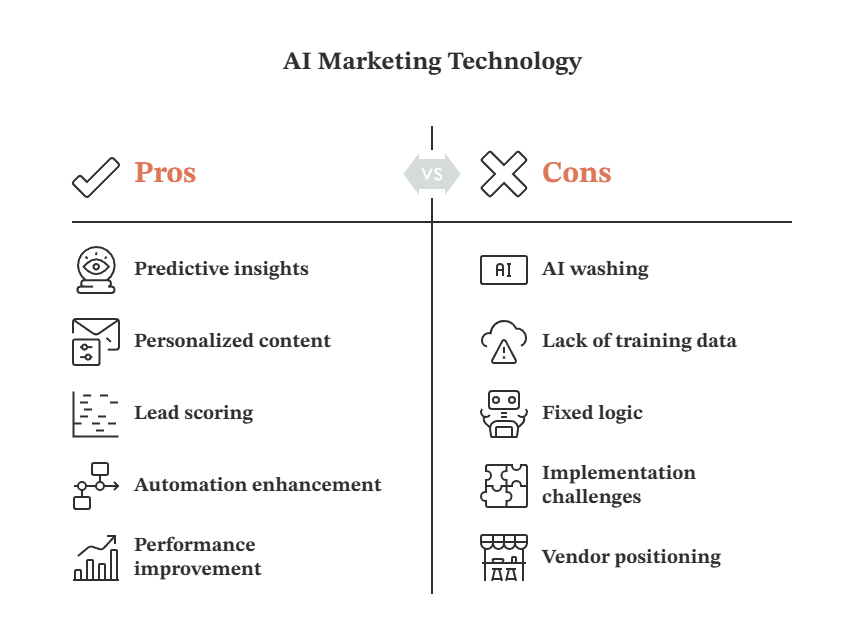
AI marketing technology is any software that uses machine learning, large language models (LLMs), or related AI methods to generate marketing output, make decisions, or predict outcomes that would otherwise need human judgment.
The software’s work is the test, not the badge it comes with. If a tool makes a prediction, scores a lead, or writes a draft using a learned model, it qualifies. This definition matters because it draws a hard line. It rules out tools that attach an “AI” label onto basic automation or rules-based logic.
A workflow that sends an email when someone submits a form is automation, and an AI badge on the dashboard does not change what the software is doing. The distinction is the practical core of AI in marketing explained: one type of system learns, the other repeats.
So many companies now use AI in marketing that defining it precisely changes which tools a marketing team buys. Around 94% of organizations use AI to prepare or run marketing strategies (von Hoffman, 2025), and 88% report regular AI use in at least one business function, up from 78% the year before (Singla et al., 2025).
When many products carry the AI label, marketers need a working definition that filters the pool down to the tools doing real AI work. Without it, every vendor on the shortlist sounds identical. That working definition also has to be wide, since the category covers machine learning in marketing alongside generative and conversational systems.
What separates real AI marketing tech from “AI washing”
Real AI learns from data and improves with use. Meanwhile, rules-based automation runs the same fixed logic every time, no matter what the data shows.
Three diagnostic questions sort one from the other:
- Does the output change when the inputs change in ways the rules did not plan for?
- Does the tool need training data to work?
- Does performance improve over time as more data flows through it?
A real AI marketing tool answers yes to all three, and a rules-based product answers no to at least two. Vendors who cannot answer these questions are selling AI-powered marketing automation in name only, where the label closes the deal and the technology does not match it.
The maturity data shows why the filter is worth running. Only 32% of marketing organizations have fully implemented AI, while 43% are still in the experimentation phase (von Hoffman, 2025). This means a large share of the market is buying tools faster than it sorts out which ones qualify.
Gartner’s AI Hype Cycle for Marketing tracks this same gap between expectation and working capability. It gives buyers a public benchmark for where each type of marketing AI technology sits, independent of vendor positioning (Gartner, 2026).
The takeaway for any evaluator is direct. Run the three diagnostic tests on every tool in a shortlist before the pricing conversation starts. The tools that pass are worth comparing on features, integration, and cost.
Real AI marketing tech vs. automation with an AI label
The three diagnostic tests for real AI marketing tech:
| Diagnostic test | Real AI marketing tech | Automation with an AI label |
| Output behavior. Does the output change when the inputs change in ways the rules did not plan for? | Yes. The tool adapts to new patterns in the data. | No. The tool runs the same fixed logic every time. |
| Training data. Does the tool need training data to work? | Yes. It learns from a body of examples or signals. | No. It works straight from hard-coded rules. |
| Performance over time. Does performance improve over time as more data flows through it? | Yes. It gets sharper through retraining and feedback. | No. It stays flat unless a developer rewrites it. |
A tool that earns three “yes” answers is genuine AI. Two or more “no” answers mean rules with a badge.
How AI marketing technology actually works
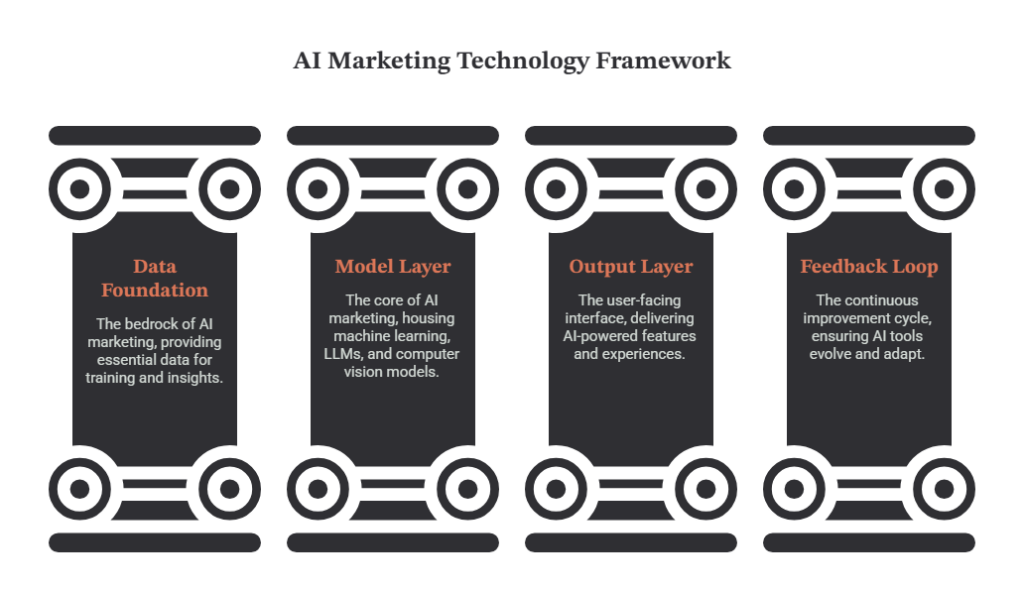
The last section drew the line between real AI marketing tools and software that only carries the label. The next question is how AI marketing works inside the tool, because how a tool is built, not how it is sold, decides whether it works. Every working AI marketing stack runs on four layers, and each layer limits how well the one above it can perform.
The data foundation
Every AI marketing tool depends on the data it trains on or pulls from. A model fed thin data produces thin output no matter how advanced the underlying technology is. The data layer splits into two types.
- First-party data comes from the customer relationship management (CRM) system, web analytics, purchase records, and direct customer interactions.
- Third-party data comes from the public web, licensed datasets, and outside providers.
First-party data gives the model context that no competitor has, which makes its predictions and recommendations specific to the business. Third-party data fills the gaps where internal data runs out, since it powers benchmarking against the wider market and scoring of net-new audiences. The mix decides output quality.
The stakes have risen because the path from question to answer has compressed. The search journey has collapsed from days of research down to a single 60-second interaction, driven by AI synthesis (IMPACT Team, 2026). A model working from weak data loses every one of those compressed moments.
The model layer
Three model families power the current generation of tools:
- Machine learning models handle prediction, classification, and clustering, which includes lead scoring, churn forecasts, and audience segmentation. This is the workhorse of machine learning in marketing.
- LLMs handle content generation, summarization, and conversation, which covers copywriting, chat agents, and search experiences.
- Computer vision models handle creative analysis and image generation. These models encompass ad-creative scoring, product photography, and visual personalization.
Two techniques bend these general-purpose models toward specific marketing work. Fine-tuning retrains a base model on a brand’s own data so the output matches the brand’s voice and rules. Retrieval-augmented generation (RAG) leaves the base model intact and feeds it the right information at query time, which makes it faster to deploy and easier to update.
The output layer
A trained model still has to reach the user, and the way a vendor packages it changes what the user gets. The same LLM can run a chatbot, draft content, power a search tool, or personalize a page, with no change to the model itself.
User-facing features fall into a short list of patterns. Recommendations, generated content, scored leads, predicted churn, and dynamic personalization cover most of what the marketing team sees in product demos.
Visitor behavior is changing, too. People arriving from AI platforms spend 8 seconds longer on site than search visitors while viewing 1.2 fewer pages on average (Ong, 2025). This means the tool has fewer chances to get it right.
The feedback loop
AI marketing tools improve through a defined feedback cycle, where user corrections, live performance data, and scheduled retraining feed signal back into the model. That loop separates an improving tool from a frozen one. A tool without a clear feedback mechanism plateaus fast, and its performance freezes at launch quality while competitors keep getting sharper.
The loop also shapes the marketing team’s content strategy. AI systems prioritize clarity and structure over clever content. These systems reward content that summarizes clearly, so a marketing team that feeds the loop with structured, well-organized assets sees its material surface more often (Ong, 2025).
The four layers explain why so many tool purchases underperform. When MIT Sloan researchers looked for enterprises that had undergone full-scale transformation with generative AI, they found none. The gains came instead from disciplined, workflow-driven work grounded in core business capabilities, not from chasing the most advanced model (Eastwood, 2026).
The data layer sets the limit, the model layer does the work, the output layer shapes the experience, and the feedback loop decides whether the tool keeps improving or stays still.
The four categories of AI marketing technology
Evaluating AI marketing tools starts with knowing which category each one belongs to. The Gartner Magic Quadrant for Multichannel Marketing Hubs and the Forrester Wave for AI-powered marketing platforms group AI marketing technologies by the work they do. Both line up with the four categories below:
Category 1: Predictive AI
Predictive AI forecasts what customers will do next, which covers lead scoring, churn prediction, lifetime value modeling, and audience propensity scoring. Audience propensity scoring is the one most marketers underuse, since it estimates how likely a given segment is to convert on a specific offer and connects predictive output directly to media decisions.
Supervised machine learning models train on historical customer data and then score new records against the patterns they learned. The output is a probability or a ranked list rather than a piece of content.
Predictive AI marketing pays off in three workflows, where three teams act on that output directly. Sales teams work the highest-scoring leads first. Retention teams target the customers most likely to leave. Media teams move budget toward the audiences most likely to convert.
This is the most mature category, with the longest track record and the most defensible return. About 89% of marketers report improved accuracy in predictive analytics since adopting generative AI tools to forecast customer behavior (HubSpot, 2026). Examples of Predictive AI include HubSpot predictive lead scoring, Salesforce Einstein, 6sense, and Bloomreach.
Category 2: Generative AI
Generative AI for marketing produces net-new content, which covers copy, images, video, and code, along with full creative variations for paid media. The technology behind it pairs two model types. LLMs handle text and code, while diffusion models handle images and video by starting from random noise and refining it into a finished asset based on the prompt. Both train on large public datasets and then get fine-tuned or prompted for marketing-specific outputs. Brand teams add their own data through fine-tuning, while channel teams shape day-to-day output through prompting and templates.
The value shows up in production volume and speed. AI content generation cuts the time from brief to first draft, supports creative variation across dozens of paid placements. It also speeds up the campaign ideation that used to wait on an agency cycle. Personalization at scale is where the strongest gains are emerging.
Adoption figures confirm the move. Nearly 75% of marketers report using AI for media creation, including video and images (Lyons, 2026). The work has moved out of the copy deck and into the full creative pipeline.
Maturity is uneven. The production efficiency gains are real, while brand voice drift and factual accuracy still need editorial review. Named examples include Jasper, Copy.ai, ChatGPT, Claude, Gemini, Adobe Firefly, and Midjourney.
Category 3: Conversational AI
Conversational AI marketing powers chatbots, virtual agents, voice assistants, and other interactive customer-facing experiences. The category replaced rule-based chat with assistants that understand intent, hold context, and answer in natural language. The architecture combines an LLM with a retrieval system, a structured knowledge base, and business logic. Retrieval pulls the right information at query time, while the knowledge base keeps the facts current. The business logic decides when to escalate to a human or trigger a workflow.
Where it delivers is in customer support deflection, lead qualification, sales enablement, interactive FAQ experiences, and AI-powered search on owned properties. The same assistant that answers a support question also captures an intent signal that feeds the rest of the marketing stack.
An intent signal means the assistant logs what the customer is asking about, how often, and at what stage of the journey. Sales and marketing teams use that signal to time outreach and shape campaign messaging.
Consumer behavior is reshaping budgets around this category. Advertisers are projected to cut display budgets by 30% in 2026 as consumers move toward AI chat interfaces on the open web (Lyons, 2026).
Maturity is rising fast. The jump from rule-based chatbots to LLM-powered assistants is the biggest recent change in the stack. Intercom Fin, Drift, Zendesk AI agents, Ada, and Sierra all belong in this category.
Category 4: Analytical AI
Analytical AI finds patterns, surfaces insights, and automates reporting across marketing data, so it sits behind the dashboards rather than in front of customers. The technology applies machine learning to behavioral data, media performance, attribution signals, and customer journey data. It looks for the correlations and anomalies a human analyst would miss in a spreadsheet of millions of rows.
Analytical AI pays off in attribution modeling, media mix modeling, anomaly detection, campaign optimization, and audience discovery. Marketing teams use it to settle attribution debates and reset media mix assumptions. Media mix modeling estimates each channel’s contribution to revenue and then recommends a budget split based on data rather than intuition. Marketers also use it to catch campaign issues before the monthly review surfaces them.
Most marketing teams now run this analysis as routine work. Over 92% of marketers are already using or plan to use SEO optimization for both traditional and AI-powered search engines to find data patterns (ALM Corp, 2026).
Maturity depends on company size. Analytical AI is mature for large enterprises with connected data and is maturing fast in the mid-market as warehouses and customer data platforms become standard. Established names in this category include Google Analytics 4 (GA4) with Advanced Analysis, Adobe Analytics AI, Amplitude, Segment with an AI layer, and Rockerbox.
| Category | Core use case | Maturity | Named example tools |
|---|---|---|---|
| Predictive AI | Forecasts customer behavior. Covers lead scoring, churn prediction, lifetime value modeling, and audience propensity scoring. | Mature. Longest track record and most defensible ROI of the four categories. | HubSpot predictive lead scoring, Salesforce Einstein, 6sense, Bloomreach |
| Generative AI | Produces net-new content. Covers copy, images, video, code, and creative variation for paid media. | Fast-moving and uneven. Real production efficiency gains, with brand voice and factual accuracy risk. | Jasper, Copy.ai, ChatGPT, Claude, Gemini, Adobe Firefly, Midjourney |
| Conversational AI | Powers chatbots, virtual agents, voice assistants, and AI-powered search on owned properties. | Rising fast. LLM-powered assistants are replacing rule-based chat across the category. | Intercom Fin, Drift, Zendesk AI agents, Ada, Sierra |
| Analytical AI | Finds patterns, surfaces insights, and automates reporting. Covers attribution, media mix modeling, anomaly detection, and audience discovery | Mature for large enterprises with connected data. Maturing fast in the mid-market. | Google Analytics 4 (GA4) with Advanced Analysis, Adobe Analytics, Amplitude AI, Segment with an AI layer Rockerbox |
The four categories work as a planning grid. Predictive AI tells the team who to target, generative AI builds what the team sends, conversational AI handles the live exchange, and analytical AI measures what worked. A stack that covers all four, sourced from tools that fit each category, is the working definition of a modern AI marketing stack.
Where AI marketing technology is actually delivering ROI
Adoption numbers and category maps do not tell a marketing team which investments pay back, or where the demos run ahead of the results. McKinsey’s research on generative AI in business finds that data maturity predicts return more than tool choice, and that pattern holds across every category below (Singla et al., 2025).
Proven ROI categories
Four use cases now carry enough track record to support the marketing AI ROI claim with measurable lift.
- Predictive lead scoring and churn modeling sit at the top of the list. The outputs are measurable, the math is defensible, and the savings show up directly in pipeline efficiency. Indian businesses report a 30% to 50% reduction in cost per lead (CPL) through AI-powered predictive models (CoderBox AI Marketing Team, 2026).
- Generative AI for creative variation in paid media is the second proven use case. The production efficiency gains are clear: the same brief produces dozens of ad variations, and the cost savings compound when the work is paired with AI bidding. AI targeting and real-time bid optimization reduce wasted ad spend by 30% to 50% (CoderBox AI Marketing Team, 2026). Better creative volume and tighter targeting are where most paid media teams find their first defensible ROI.
- Conversational AI for support deflection is the third proven category. Every ticket the assistant resolves is a measurable cost saving, and the dollar value tracks cleanly against headcount and average handle time. Support deflection is the clearest line on the AI marketing technology business case.
- Analytical AI for attribution and media mix modeling is the fourth proven use case. Analytical AI scores attribution more accurately than legacy models, especially for teams running across paid social, search, retail media, and offline channels. Better attribution drives better budget decisions, which improves the return on the other three categories.
AI personalization belongs here as well, but only when the data is in place. AI-driven personalization helped Yves Rocher achieve an 11-times increase in purchase rate compared with static recommendations (ALM Corp, 2026). That kind of result shows up only where the first-party data layer is solid. Without clean data, the personalization engine recommends the wrong things to the wrong people.
Unproven or overhyped categories
Three claims still run ahead of the evidence, and marketing teams should treat each one with extra scrutiny before committing budget.
Fully automated “AI agents” replacing marketing roles is the popular pitch in the market right now. In practice, vendor claims describe more than the systems do in production, where most working deployments still need human review at every important step.
AI-generated long-form content as a standalone strategy is the second overhyped use case. The tools produce volume, and volume is a different thing from authority. Search engines and AI synthesis layers reward content that demonstrates real expertise. Generic AI output does not clear that bar.
AI personalization without a strong first-party data infrastructure is the third. Point a personalization engine at thin or stale data, and it produces irrelevant recommendations at scale.
The variable that decides whether any of it works
Data infrastructure decides the outcome. Companies with clean first-party data, connected systems, and a working customer data platform (CDP) or data warehouse see ROI, while companies without that foundation see only demos, not results.
The infrastructure check is concrete. The CRM, web analytics, ad platforms, and CDP must share customer identity. The data must be current, and the pipeline must run on a schedule the marketing team controls.
Teams that fix the data layer first see compounding returns across all four categories. Predictive models score better leads. Generative tools draw on real brand voice examples. Conversational agents pull from accurate knowledge bases. Analytical AI runs on signal instead of noise.
Marketing teams that skip the data work see the reverse. The tools demo well, but the deployments stall, and the business case never lands.
How to evaluate AI marketing technology for your stack
The evaluation work decides whether AI marketing tools earn a place in your AI marketing stack or sit unused. With 75% of teams not currently using AI planning to adopt it within the next year (Lyons, 2026), almost every marketing team is about to do this work.
The four checks below run in order, and each one returns a clear go or no-go answer.
Start with the problem, not the tool
Shopping for AI tools before defining the marketing problem they should solve is how budgets get wasted. The process needs a target before it needs a vendor.
A short framework keeps the search focused on the business. Identify the outcome the team wants, assess the current cost or constraint, and name the success metric that will prove the tool worked.
If any of those three remain vague, stop shopping until they are defined. Vendor demos will only fill the gap with their own framing, and that framing rarely matches the business.
The data readiness check
Once the problem is clear, the next question is whether the data layer will support the tool. A tool that needs data the team does not have, cannot access cleanly, or will not maintain is a tool that will stall. The answer is to fix the data layer first or pick a different tool.
Each AI category sets its own minimum data standard. Predictive AI needs historical customer data. Generative AI needs brand voice examples. Conversational AI needs a structured knowledge base. Analytical AI needs connected event data across channels.
The integration reality check
A tool that clears the data check still has to plug into the rest of the stack. Native integrations with the CRM, CDP, analytics stack, and content systems are the working standard because the team needs the tool to read and write where the data already lives. Anything less forces manual workarounds that fail as data volume grows.
“Works with Zapier” is a different thing from a real integration. Zapier merely handles light task automation. A real integration moves customer-level data with identity intact, in both directions, on a schedule the team controls. Integration is also where most AI deployments lose momentum. Around 60% of enterprise leaders name risk and compliance, alongside legacy system integration, as their primary challenges (von Hoffman, 2025).
The vendor due diligence checklist
The fourth check covers the vendor:
- How the model is trained
- Where data flows
- What data retention policies are
- What opt-out options exist
- What the enterprise security posture looks like
This work matters more under current and emerging AI regulation. The EU AI Act and state-level U.S. privacy laws raise the bar on what vendors have to disclose. The Interactive Advertising Bureau (IAB) and the Association of National Advertisers (ANA) AI marketing guidelines give marketing teams a public benchmark for vendor practices (Interactive Advertising Bureau, 2019; Association of National Advertisers, n.d.).
Awareness still lags, though. Only 31% of individual contributors believe their leaders understand the AI technologies they promote (Lyons, 2026). A four-step checklist will improve awareness.
How AI marketing works in practice comes down to the order: problem first, data second, integration third, vendor fourth. A tool that checks all four is a tool worth buying.
The mistakes that waste AI marketing budget
There are mistakes that drain more AI marketing budget than any others. Each one is preventable and shows up in marketing teams asking, “What is AI marketing supposed to deliver?” after the spend is already done.
- Buying tools before defining the problem they solve. A shortlist built around vendor categories instead of internal use cases sends money toward features no one needs. Some 44% of software as a service (SaaS) marketing licenses sit underutilized or completely unused (ALM Corp, 2026).
- Treating AI tools as a replacement for strategy. Marketing AI technology speeds up the work that a strategy already defines. A tool pointed at no strategy produces more output, faster, with no improvement in where that output goes.
- Skipping the data foundation and expecting the tool to compensate. Teams that point AI at thin or disconnected data see the same result every time. While the demo looks impressive, the deployment underperforms within a quarter.
- Adopting generative AI for content production without a brand voice framework or editorial review. The model produces volume, but volume without guardrails dilutes brand authority. Around 30% of marketers report decreased search traffic as consumers move toward AI tools (HubSpot, 2026).
- Assuming the newest model is the best choice. The newest model is the least stable and the most expensive to run. A well-tuned older model produces equal or better marketing output at a fraction of the cost.
- Letting vendor demos drive the roadmap. AI Overviews on search engines already reduce traditional clicks by 34.5% (Ong, 2025). A click loss at that scale calls for a roadmap built on internal priorities, not on whatever vendor demoed last week
The mistake teams underestimate most is the data foundation gap, because every other mistake on the list compounds when the data layer is weak. No AI-powered marketing automation purchase fixes that.
“The data foundation gap is the mistake that decides every other mistake on the list. Teams treat it as plumbing and buy tools as the visible win. The result is a stack that demos well and underdelivers on every line of the business case.”
Scaling AI beyond productivity
Any honest version of AI in marketing has to account for where the conversation has moved. About 64% of businesses believe AI will increase overall productivity (Haan, 2026). In addition, nearly half of companies with over $5 billion in revenue have reached the AI scaling phase (Singla et al., 2025). The pressure on marketing teams has moved with it.
Some 59.8% of marketers fear AI could jeopardize their employment, up from 35.6% in 2023 (von Hoffman, 2025). Leaders who scale AI marketing technology against revenue, retention, and margin give their teams a clearer answer about whether the AI investment is working.
The four branches below map the reader’s situation to the next step.
- If the marketing team does not have clean first-party data yet, fix that before buying any AI marketing tool. Every tool bought now will underperform until the foundation is in place.
- If the team has the data and a clear problem, start with the AI category that maps to that problem. A four-category platform is the wrong purchase without the headcount to run it.
- If the team sits inside a large enterprise with mature data, the question is no longer whether to adopt but which category to invest in next, and how to measure the result honestly.
- If the primary goal is content production volume, treat generative AI as a process improvement. Volume gains compound only when the strategy already works.
The marketing teams that lead the next buying cycle are the ones that fix the foundation, pick the right category, and measure the result.
Where does your marketing team stand on the four-step framework right now? An AI MarTech readiness assessment maps the current stack against problem definition, data readiness, integration fit, and vendor due diligence. It then names the gaps to close before the next buying cycle.
Request an assessment or book a strategy consultation with the team to walk through the diagnostic against the team’s current stack.
Resources
- CoderBox AI Marketing Team. (2026). What is AI digital marketing & how it works in 2026. https://thecoderbox.com/what-is-ai-digital-marketing-2026/
- Gartner. (2026). The Future of Marketing: 5 Trends and Predictions for 2026. https://www.gartner.com/en/articles/future-of-marketing
- Haan, K. (2026, May 1). 22 top AI statistics and trends. Forbes Advisor. https://www.forbes.com/advisor/business/ai-statistics/
- HubSpot. (2026). 2026 marketing statistics, trends, & data: Marketing statistics every team https://www.hubspot.com/marketing-statistics
- IMPACT Team. (2026, May 1). AI for marketing in 2026: What to use, what to skip, and what to watch next.https://www.impactplus.com/learn/ai-for-marketing
- Jasper AI, Inc. (2026). Report: The state of AI in marketing 2026. Jasper. https://www.jasper.ai/state-of-ai-marketing-2026
- Lyons, J. (2026, May 6). 34 AI in marketing statistics: Industry trends in 2026. Shopify. https://www.shopify.com/blog/ai-marketing-statistics
- Ong, S. Q. (2025, July 16). 53 AI marketing statistics for 2025. Ahrefs. https://ahrefs.com/blog/ai-marketing-statistics/
- Singla, A., Sukharevsky, A., Hall, B., Yee, L., & Chui, M. (2025, November 5). The state of AI in 2025: Agents, innovation, and transformation. McKinsey & Company. https://www.mckinsey.com/capabilities/quantumblack/our-insights/the-state-of-ai
- von Hoffman, C. (2025, April 18). AI and marketing: What the stats show. MarTech. https://martech.org/ai-and-marketing-what-the-stats-show/
- Eastwood, B. (2026, January 7). Scaling AI for results: Strategies from MIT Sloan Management Review. MIT Sloan. https://mitsloan.mit.edu/ideas-made-to-matter/scaling-ai-results-strategies-mit-sloan-management-review
- Interactive Advertising Bureau. (2019, December). IAB artificial intelligence in marketing: Where brands and consumers meet through datahttps://www.iab.com/wp-content/uploads/2019/12/IAB_AI-for-Marketing-Report_Dec-2019_FINAL.pdf
- Association of National Advertisers. (n.d.). ANA ethics code of marketing best practices.https://www.ana.net/content/show/id/accountability-chan-ethicscode-final

Kim Greer
OFP Law
One of the best business decisions I ever made was to contract with 321 Web Marketing. Jonathan Gessert and his team are knowledgeable, efficient, and effective, making digital marketing goals easy to achieve and helping [...]

Kelly Cole
Business Benefits Group
My company hired 321 Web Marketing in February 2016 to resurrect our web site. We feel our web site is the face to our business and desperately needed a make over. 321 took us from blah to WOW effortlessly and what a difference [...]

Emily Hawkins
Diener & Associates
Thanks to 321 Web Marketing, the client has seen an increase in their search engine leads, averaging 12 qualified leads per month. The client has also achieved prominent Google Maps and search placement. The team [...]

Trevor Telesz
Paw Pals Pet Sitting
321 Web Marketing successfully translated the client’s design into a stunning and refreshed website, ensuring seamless functionality across all dynamic views. The team provided clear timelines and stuck to them, [...]

Corey Davis
Spartan Animal & Pest Control
321 Web Marketing is truly phenomenal at what they do. Their ability to communicate and describe the steps and actions that they are implementing, Alex Zarpas in particular, is excellent. Delivering on promises is all [...]

Alec Roberts
MFE Insurance
I can’t say it enough, Jonathan and his team have gone above and beyond since day one to accommodate our needs and meet our goals. I run a specialty insurance brokerage based in LA and once we found 321 we never looked [...]

Richard Wilbur III
Advantage.Tech
Thanks to 321 Web Marketing’s web development work, the client increased rankings and traffic from search engines. Also, their business secured prominent positions on Google Maps and industry-relevant, profitable [...]

Bruce Gemmill
FVCbank
After the website revamp, the client saw a steady rise in leads from search engines, resulting in additional traffic. 321 Web Marketing is highly punctual when it comes to deliverables, and internal stakeholders are [...]

Drew Weeks
VAE
321 Web Marketing delivered a sleek website that accurately portrays the size and quality of the client’s organization. All of their completed websites have received positive feedback from users who have been [...]

Ryan Masten
Masten Pools
321 Web Marketing has increased the client’s leads from zero to 53 monthly. Their SEO efforts pay off impressively due to a top-ranking position on Google and making the site the number one result for several [...]