


Table of Contents
- 1. Brand As a Search Variable
- 2. The Evolution of Brand Signals in Google's Systems
- 3. Branded Search Demand and Ranking Correlation
- 4. AI Overviews, Citation, and Entity Prominence
- 5. Trust, Social Presence, and Conversion Effects
- 6. Framework for Measuring Brand Authority in Search
- 7. Industry Implications
- 8. Conclusion

 Mar 20, 2026 ·
  20 min read ·
  Summarize in ChatGPT
Brand recognition operates as a measurable factor in search systems. Google states that trust is the most important component of its experience, expertise, authoritativeness, and trustworthiness framework, which guides how ranking systems judge content quality (Google Search Central, 2025). This guidance places credibility and external reputation at the center of search evaluation. When trusted sources reference a brand, search systems treat that brand as more reliable.
Data from AI-generated summaries demonstrates how recognition affects results. Seer Interactive studied 3,119 informational queries across 25.1 million organic impressions (Seer Interactive, 2025). When a brand appears as a cited source in an AI Overview, organic clicks rise by 35% and paid clicks rise by 91% compared to when the brand is excluded (Seer Interactive, 2025). Citations in generative answers correlate with higher user engagement.
User behavior redefines visibility. SparkToro reports that 360 out of 1,000 Google searches in the U.S. lead to clicks to the open web (SparkToro, 2024). Most searches end without a website visit. Citation in summaries and search features matters regardless of click-through.
Trust drives purchase decisions. The 2026 Edelman Trust Barometer surveyed 33,938 people across 28 countries (Edelman, 2026). This global sample shows how trust shapes company evaluations. Brand authority connects to ranking signals, AI summary citations, and user actions that lead to conversion.
Brand As a Search Variable
Search engines now answer questions directly on results pages, changing how people search and how brands gain attention.
In 2024, SparkToro reported that 360 out of every 1,000 Google searches in the U.S. led to clicks to the open web. In the European Union, 374 out of 1,000 searches resulted in open-web clicks (SparkToro, 2024). More than 60% of searches in both regions did not result in external website visits. User experience now occurs primarily in Google’s interface, making search result placement valuable even without clicks.
AI-generated summaries add another layer. A Seer Interactive study found that when no AI Overview appeared, average organic click-through rate (CTR) was 1.45%. When an AI Overview appeared without citing the brand, organic CTR dropped to 0.52%. When the brand appeared as a cited source in the AI Overview, organic CTR increased to 0.70% (Seer Interactive, 2025). Citation in generated answers drives higher click activity.
Google describes experience, expertise, authoritativeness, and trustworthiness as core quality signals in its guidance on helpful content (Google Search Central, 2025). Content must demonstrate reliability and credibility. This framework embeds brand reputation within Google’s quality evaluation.
This report treats brand recognition as a measurable search factor. Search engine optimization (SEO) improves a website’s visibility in organic results. Generative engine optimization (GEO) increases the likelihood that a brand appears as a cited source in AI summaries. Entity authority measures how strongly a search system recognizes a brand, company, or person as a trusted source for a topic. Branded search demand measures how often users include a specific brand name in queries.
This report uses documentation from Google Search Central, search behavior research from SparkToro, and performance data from Seer Interactive. It examines how branded demand, citation inclusion, and credibility signals connect to rankings, GEO visibility, and conversion outcomes in AI-driven search.
| Dimension | SEO (Search Engine Optimization) | GEO (Generative Engine Optimization) |
|---|---|---|
| Primary goal | Improve position in organic listings | Appear as cited source in AI-generated summaries |
| Unit of optimization | Individual page / URL | Entity (brand, company, author) |
| Visibility metric | Ranking position; organic CTR | Citation rate in AI Overviews |
| Content signal | On-page SEO, technical structure, backlinks | Entity authority, credibility, independent references |
| Measurement tools | Google Search Console, Ahrefs, Moz, Semrush | AIO research tools, citation tracking, entity monitoring |
| Click dependency | Requires click to deliver value | Delivers brand exposure even in zero-click searches |
| Trust alignment | E-E-A-T via page-level quality signals | E-E-A-T via entity-level reputation and citation |
The Evolution of Brand Signals in Google’s Systems

From Link Authority to Reputation Research
Early search systems relied on hyperlinks to judge importance and authority. Google now uses a wider set of signals. Its Search Quality Rater Guidelines instruct human raters to conduct formal “reputation research” when assessing websites and content creators (Google, 2025).
The guidelines direct raters to look beyond the website itself. Raters review independent sources such as news articles, Wikipedia pages, blog posts, magazine articles, forum discussions, and ratings from external organizations (Google, 2025). These instructions make third-party validation part of structured review.
Google states that quality raters do not directly change rankings. Their feedback helps Google evaluate and improve ranking systems (Google, 2025). Reputation research feeds into how Google tests and refines its algorithms. When raters consistently examine external reputation, that information becomes part of the quality framework.
Independent media coverage, third-party reviews, and reference listings serve as observable signals that raters examine. Because Google uses rater feedback to improve system performance, external reputation enters the ranking evaluation process.
| Source Type | What Raters Look For | Measurability for Brands |
|---|---|---|
| News articles | Independent coverage of the brand or creator | Media monitoring tools; count and sentiment of mentions |
| Wikipedia pages | Notable references and cited presence | Entity presence on Wikipedia; structured data |
| Blog posts | Third-party commentary and reviews | Backlink analysis; referring domains |
| Magazine articles | Industry publication features | Trade publication index; digital PR placements |
| Forum discussions | User-generated opinions and experiences | Reddit, Quora, niche forums; sentiment analysis |
| Ratings from organizations | BBB, industry certifications, review platforms | Star ratings, accreditation status, review volume |
Experience, Expertise, Authoritativeness, and Trustworthiness
Google defines experience, expertise, authoritativeness, and trustworthiness (E-E-A-T) as factors for judging content quality (Google Search Central, 2025). This framework explains how systems assess helpful and reliable content.
Google states that trust is the most important factor (Google Search Central, 2025). Content must show reliability and credibility. This priority places trust at the center of quality evaluation.
Google provides self-assessment questions for site owners. These questions cover who created the content, whether the site provides clear information about the author or organization, and whether readers would recognize the site as widely acknowledged as an authority on the topic (Google Search Central, 2025). The prompts connect search evaluation to public recognition and external perception.
When Google asks whether a site is widely acknowledged as authoritative, it links quality evaluation to external reputation. Recognition from independent sources supports authoritativeness. Consistent third-party references support trustworthiness. Brand recognition and credibility align with published evaluation standards.
| Component | Google’s Self-Assessment Questions | Brand Signal Connection |
|---|---|---|
| Experience | Does the content demonstrate first-hand experience with the topic? | Case studies, original research, industry participation |
| Expertise | Does the creator have the knowledge or skill for this topic? | Author credentials, bylines, professional background |
| Authoritativeness | Is the site widely acknowledged as an authority on the topic? | Third-party citations, media coverage, Wikipedia references |
| Trustworthiness | Is the content reliable and credible? | Independent reviews, reputation research, transparent sourcing |
External Recognition As a Measurable Variable
The inclusion of structured reputation research in the Search Quality Rater Guidelines provides a defined framework for examining brand authority (Google, 2025). Independent mentions in news coverage, third-party reviews, and reference sites exist outside a company’s website. These sources are visible and verifiable.
Because Google instructs raters to review these sources and uses rater feedback to improve ranking systems, external recognition becomes part of the quality evaluation process (Google, 2025). Public acknowledgment plays a role in assessing credibility.
Brand recognition appears in search behavior. Branded search demand measures how often users include a specific brand name in queries. This produces measurable query data. Citation in AI-generated summaries provides another clear indicator. Independent reputation signals and branded search demand offer concrete variables for studying brand authority in search systems.
Branded Search Demand and Ranking Correlation
Branded vs. Non-Branded Query Behavior
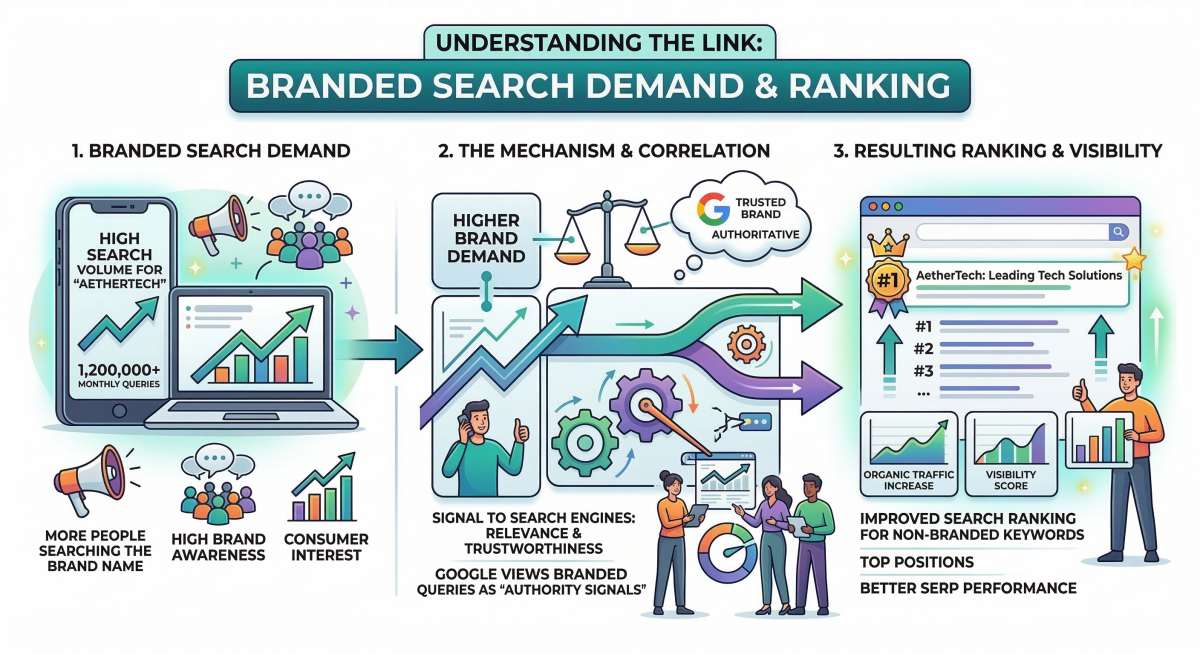
Search demand shows how often users look for specific brands. SparkToro analyzed 331,697,810 Google searches over 21 months to study query behavior (SparkToro, 2024a). Just over 44% of Google searches included a branded term (SparkToro, 2024a). Brand-related queries make up a large share of total search activity.
Branded searches signal prior awareness. When a user includes a company or product name in a query, they demonstrate familiarity with the brand. This behavior differs from general informational searches because the user already connects the brand to a topic or solution. The search confirms recognition.
Since more than 44% of observed searches in the dataset were branded, query data provides measurable evidence of brand exposure (SparkToro, 2024a). Marketers can track branded search volume, impressions, and clicks as clear signals of brand recognition.
| Metric | Value | Source / Notes |
|---|---|---|
| Total searches analyzed | 331,697,810 | SparkToro, 21-month study |
| Searches containing a branded term | 44%+ | SparkToro, 2024 |
| YoY growth in total Google searches | 21.64% | SparkToro, 2025 |
| U.S. zero-click rate | 58.5% | SparkToro, 2024 |
| EU zero-click rate | 59.7% | SparkToro, 2024 |
| U.S. open-web click rate | 36.0% | 360 per 1,000 searches |
| EU open-web click rate | 37.4% | 374 per 1,000 searches |
Zero-Click Search and Brand Exposure
Search visibility now extends beyond website visits. In 2024, 58.5% of Google searches in the U.S. and 59.7% of searches in the European Union ended without a click to an external website (SparkToro, 2024b). Most sessions ended within Google’s interface.
This pattern changes how exposure works. When a brand appears in search results, featured snippets, knowledge panels, or AI-generated summaries, users see the brand in context. The brand appears next to relevant information even without clicks.
Because more than half of searches end without an external visit, content teams must measure visibility at both impression and click levels (SparkToro, 2024b). Placement in AI summaries builds topic association. Repeated appearance in relevant results strengthens recognition even when traffic remains steady.
| Search Outcome | United States | European Union | Notes |
|---|---|---|---|
| Clicks to open web | 36.0% | 37.4% | External website visits |
| Zero-click (no external visit) | 58.5% | 59.7% | Ended within Google’s interface |
| Clicks to Google properties | 5.5% | 2.9% | Maps, Images, YouTube, etc. |
| Total searches analyzed | 331,697,810+ queries over 21 months | SparkToro dataset | |
Branded Demand As a Stability Indicator
Google search activity increased in 2024. SparkToro reports that total Google searches grew 21.64% year over year (SparkToro, 2025). Search usage continues to expand.
At the same time, the share of searches that send traffic to external websites remains limited, as shown by zero-click data (SparkToro, 2024b). Growth in total search volume does not guarantee equal growth in open-web visits.
Branded search demand provides a stable signal in this environment. When users search for a specific brand name, they show clear intent. These queries often lead to known listings or owned websites. Branded search volume works as both an awareness measure and a performance indicator. It reflects prior recognition and supports measurable acquisition in a search environment where click patterns vary.
AI Overviews, Citation, and Entity Prominence
AI Overview: Click-Through Rate Data
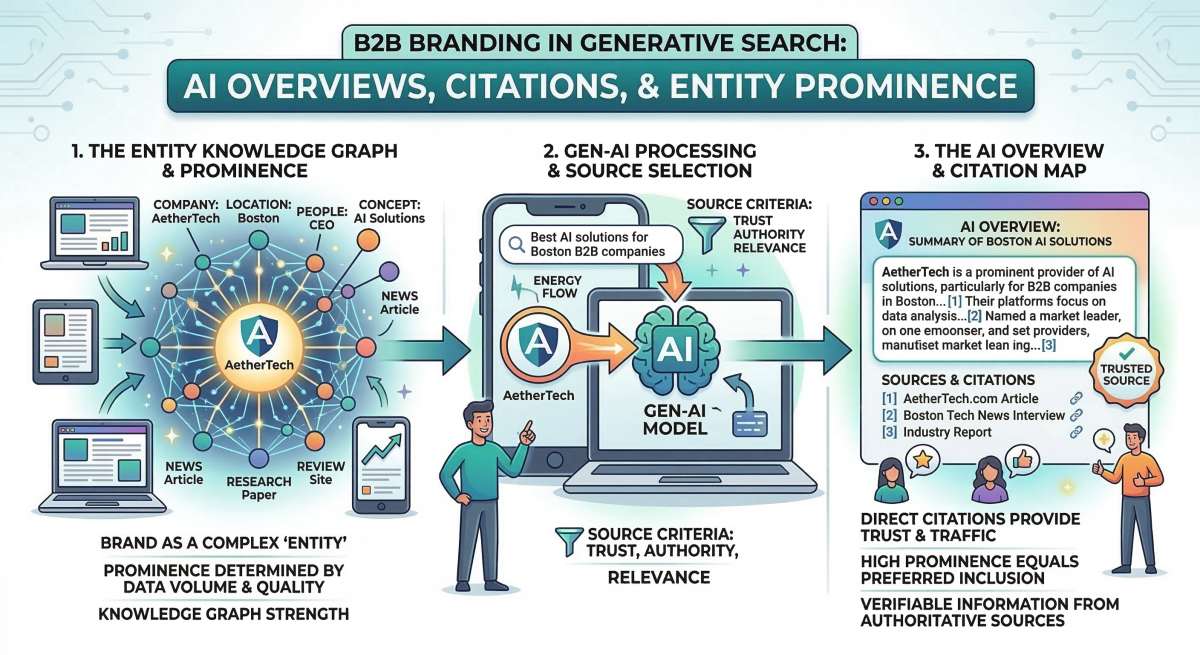
AI-generated summaries change how people use search results. Seer Interactive studied 3,119 informational queries across 25.1 million organic impressions and 1.1 million paid impressions to examine how AI Overview inclusion relates to performance (Seer Interactive, 2025). The dataset includes multiple client accounts and focuses on informational and educational searches.
The study compared results across different conditions: searches where no AI Overview appeared, where an AI Overview appeared without citing the brand, and where the brand appeared as a cited source in the summary. Seer found clear differences in engagement between cited and non-cited cases and reported that brands included in summaries received higher click performance (Seer Interactive, 2025).
| Condition | Organic CTR | Change vs. No AIO | Paid Click Impact |
|---|---|---|---|
| No AI Overview present | 1.45% | Baseline | Baseline |
| AI Overview — brand NOT cited | 0.52% | −64.1% | — |
| AI Overview — brand IS cited | 0.70% | −51.7% | — |
| Cited vs. Not Cited — Organic lift | — | +35% | — |
| Cited vs. Not Cited — Paid lift | — | — | +91% |
Seer states that correlation does not prove causation (Seer Interactive, 2025). Brands that receive citations may already have stronger recognition or higher baseline performance. The dataset does not isolate a single cause. The observed differences indicate that citation inclusion aligns with stronger click behavior within the measured sample.
When a brand appears in an AI Overview, the summary places that brand directly in the answer. Users see the brand at the moment they seek information. This placement creates a distinct layer of visibility on the results page, separate from traditional ranking position.
What Inclusion Signals
When a brand appears in an AI Overview, the system has selected that source while building the summary. AI systems assemble answers from indexed content by evaluating relevance and content quality. When a brand appears as a cited source, the system has judged the content suitable for inclusion.
Google’s guidance on helpful, reliable, people-first content describes experience, expertise, authoritativeness, and trustworthiness as quality factors (Google Search Central, 2025). The guidance encourages publishers to identify who created the content and to show whether the site is recognized as an authority on its topic. These criteria explain how Google frames content quality.
AI-generated summaries draw from Google’s indexed content. Inclusion occurs within an evaluation process that emphasizes credibility and transparency (Google Search Central, 2025). When a brand shows authority through independent references, consistent publication, and subject expertise, its content aligns more closely with these criteria.
When a brand appears as a cited source across multiple informational queries over time, that repeated inclusion provides observable evidence of entity prominence. The pattern shows sustained selection during summary generation.
GEO As Entity Optimization
GEO increases the likelihood that a brand appears as a cited source in an AI-generated summary. Traditional SEO focuses on improving position in organic listings. GEO focuses on inclusion in the summarized answer itself.
Because AI summaries draw from content tied to identifiable organizations and authors, GEO operates at the entity level. Brands must build recognition and documented credibility so that search systems select them as references during answer assembly.
One way to measure this process is to track citation rate across a defined set of queries. Citation rate equals the percentage of tracked searches in which the brand appears as a cited source. This metric complements traditional ranking measures by capturing visibility within summaries rather than only position on the page. As AI-generated summaries affect how users interact with results, citation inclusion serves as a measurable indicator of entity prominence.
Trust, Social Presence, and Conversion Effects
Edelman Trust Findings
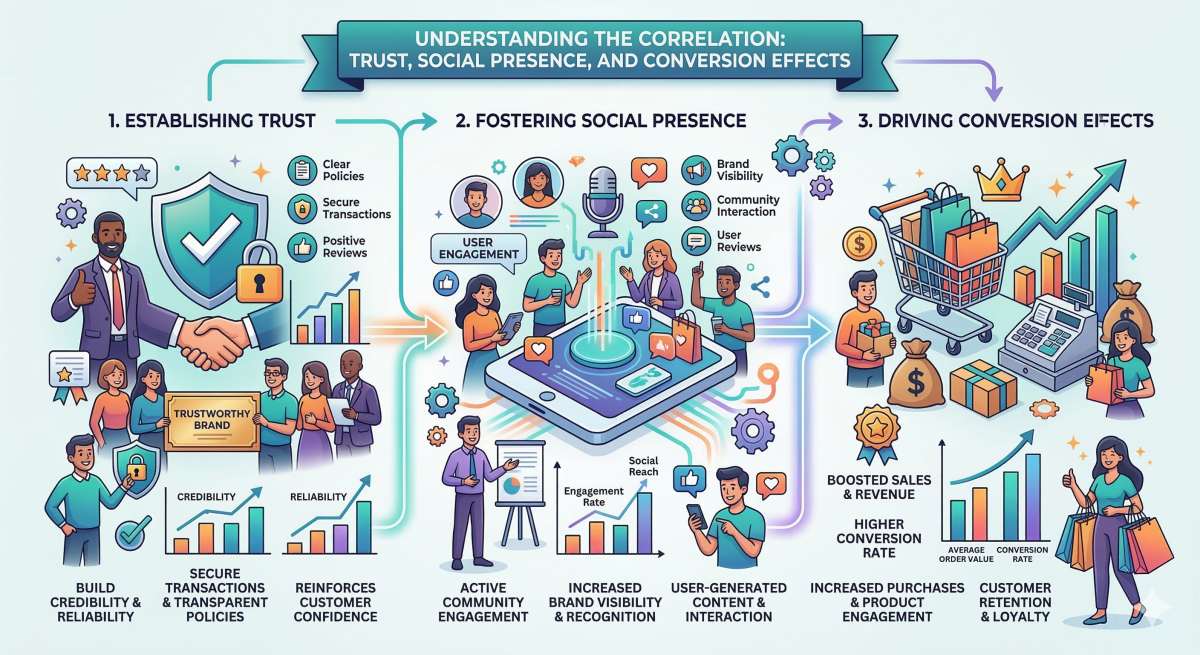
Trust influences how people judge information and make choices. The 2026 Edelman Trust Barometer surveyed 33,938 people across 28 countries between October 25 and November 16, 2025 (Edelman, 2026). This global sample offers broad data on how trust affects public behavior.
The study reports that 7 in 10 respondents are unwilling or hesitant to trust someone with different values, facts, or cultural backgrounds (Edelman, 2026). People trust those they see as aligned with their beliefs or identity. Trust grows more easily within familiar networks.
The study indicates that trust transfers from one source to another. Among respondents who trust influencers, 62% say they would trust or consider trusting a company they currently distrust if a trusted food or lifestyle influencer endorsed it (Edelman, 2026). Third-party support can change perception. When a trusted voice supports a brand, acceptance increases.
| Finding | Data Point | Source |
|---|---|---|
| Sample size | 33,938 | Edelman Trust Barometer, 2026 |
| Countries surveyed | 28 | Edelman, 2026 |
| Survey period | Oct 25 – Nov 16, 2025 | Edelman, 2026 |
| Unwilling or hesitant to trust those with different values | 70% | Edelman, 2026 |
| Would trust a distrusted company if endorsed by trusted influencer | 62% | Edelman, 2026 |
| Organic click lift when brand cited in AI Overview | +35% | Seer Interactive, 2025 |
| Paid click lift when brand cited in AI Overview | +91% | Seer Interactive, 2025 |
These findings apply to search and brand authority. Users judge brands within a wider social and information context. Media coverage, endorsements, and steady presence in credible spaces affect how people see a brand. Trust builds through repeated exposure and external validation.
In digital spaces, this process happens at scale. When a brand appears across trusted platforms and receives references from established sources, users view it as credible. Over time, this credibility affects how users respond to the brand in search results, ads, and content.
Trust influences conversion. When users see a brand as credible, they need less reassurance before acting. Endorsements and external references support that decision. Edelman’s data provides evidence that trust transfers through recognized intermediaries and increases openness to engagement (Edelman, 2026).
Branded vs. Non-Branded Conversion Behavior
Branded search behavior signals prior awareness. When users include a brand name in a query, they show recognition and intent. That intent comes from earlier exposure through media, marketing, or personal experience. Awareness reduces uncertainty at evaluation.
When uncertainty decreases, the likelihood of action increases. Users who already know a brand compare fewer options and move faster through the decision process. Generic searches require more research and comparison.
Search visibility in AI-generated summaries strengthens this pattern. Seer Interactive reports that when a brand appears as a cited source in an AI Overview, organic clicks increase by 35% and paid clicks increase by 91%, compared to when the brand is not cited (Seer Interactive, 2025). Citation places the brand in the answer itself, reinforcing recognition at the moment users seek information.
Higher click-through rates create more opportunities for conversion. When branded demand and citation inclusion work together, they increase exposure and engagement. Prior awareness combined with visible authority supports stronger performance across the customer journey.
Reputation As Conversion Infrastructure
Reputation supports conversion performance. According to Google’s Search Quality Rater Guidelines, raters conduct reputation research using independent sources, such as news articles, Wikipedia entries, blog posts, and ratings from external organizations (Google, 2025). Credibility depends on third-party validation.
Users rely on similar cues when they see a brand in search results. Media mentions, reviews, and references influence perception. A strong reputation increases confidence in a brand’s claims.
Conversion depends on accumulated credibility, not only page design or offer details. Independent reputation signals, branded search demand, and citation inclusion create conditions where users feel informed and confident when they act.
Framework for Measuring Brand Authority in Search
Core Metrics
Brand authority becomes useful when content teams measure it with clear data tied to published evaluation guidance and user behavior. One core metric is branded search demand. SparkToro analyzed more than 330 million Google searches over 21 months (SparkToro, 2024a); this large dataset shows that search behavior can be analyzed at scale. Tracking how often users search for a specific brand name monitors recognition trends directly in query data.
A second metric is AI citation rate. Citation rate measures the percentage of tracked informational queries in which a brand appears as a cited source in an AI Overview. Seer Interactive studied 3,119 informational queries across 25.1 million organic impressions and 1.1 million paid impressions (Seer Interactive, 2025). This scope shows that teams can measure citation inclusion across large impression sets. Tracking citation rate over time evaluates how often search systems select a brand as a source.
A third metric is topic-level citation breadth. This measure assesses how often a brand appears as a cited source across related informational queries. AI Overviews assemble answers from content chosen for relevance and quality (Seer Interactive, 2025). When a brand appears across several related topics, this repeated inclusion shows steady selection during answer generation.
A fourth metric is independent reputation coverage. Raters conduct reputation research using external sources according to Google’s Search Quality Rater Guidelines (Google, 2025). Teams can measure this by documenting verified third-party mentions and reviewing source credibility. This method aligns internal measurement with Google’s published evaluation process.
| Metric | Definition | Data Source | Measurement Method |
|---|---|---|---|
| Branded search demand | Frequency users search for a specific brand name | Google Search Console; SparkToro | Track branded query volume and impressions over time |
| AI citation rate | % of tracked queries where brand is cited in AI Overview | Seer Interactive methodology; AIO research tools | Monitor citation presence across priority informational queries |
| Topic-level citation breadth | Spread of citation across related informational queries | AI Overview tracking tools | Count unique topic clusters where brand appears as cited source |
| Independent reputation coverage | Verified third-party mentions from credible sources | Google Quality Rater Guidelines methodology | Document news articles, Wikipedia, reviews, ratings per Google’s framework |
| Search interface exposure | Visibility in results and summaries without requiring clicks | Search impression data; AI Overview monitoring | Track impressions, snippet inclusions, knowledge panel appearances |
A fifth contextual metric is exposure within the search interface. Most Google searches end without a click to an external website (SparkToro, 2024b). In this setting, appearing in search results and AI-generated summaries counts as measurable exposure, even without increased referral traffic. Monitoring summary inclusion alongside traffic data provides a fuller view of visibility.
Together, these metrics connect branded demand, citation inclusion, external validation, and search exposure within one structured measurement system.
Avoiding Vanity Metrics
Effective measurement focuses on data that aligns with published evaluation guidance and user behavior. Google’s Search Quality Rater Guidelines emphasize independent reputation research rather than internal audience numbers (Google, 2025). Follower counts and simple engagement totals do not appear in the evaluation instructions.
Citation inclusion can be observed directly in AI-generated summaries and tracked across defined queries (Seer Interactive, 2025). Branded search demand reflects actual user queries (SparkToro, 2024a). Independent reputation coverage matches Google’s published guidance on assessing credibility (Google, 2025). Metrics tied to these factors offer clearer insight into search authority than internal popularity measures.
Operational Model
An operational model combines three measurement steps. First, track branded search demand over time to monitor recognition trends in query behavior (SparkToro, 2024a). Second, measure AI citation rate across priority informational queries to evaluate how often search systems select the brand in AI Overviews (Seer Interactive, 2025). Third, review independent reputation coverage using structured analysis of third-party sources as described in the Search Quality Rater Guidelines (Google, 2025). This approach integrates recognition data, citation inclusion, and documented credibility into a single system for evaluating brand authority in search.
Industry Implications
Search performance now depends on how search systems evaluate entities, not just individual pages. An entity is a brand, company, or author that the system recognizes as a distinct source. Because AI systems build answers directly in results pages, brands compete to appear within those answers. This setup places more weight on recognized authority at the entity level.
Organizations must treat branding, content, and search as connected functions. Branded search demand shows how often users look for a specific brand. Citation inclusion shows whether search systems select that brand as a source in AI-generated summaries. Independent reputation signals show how external sources describe and reference the brand. These factors operate within the same evaluation environment. When content teams manage them in isolation, reporting becomes scattered and harder to interpret. When teams align around entity authority, performance data becomes clearer and more consistent.
A brand-first strategy does not replace SEO. SEO focuses on improving visibility in organic listings; a brand-first approach expands that effort. Content teams build recognition through steady subject expertise, clear authorship, credible references, and third-party validation. These actions strengthen how search systems assess credibility and decide which sources to include in results and summaries.
Performance teams should include brand measurement in regular search reporting. Tracking citation presence, branded search demand, and independent reputation coverage alongside rankings and traffic provides a more complete picture of visibility. This method connects marketing activity with how modern search systems judge credibility and select sources for inclusion.
Conclusion
Search systems evaluate brands as entities. An entity is a company, publisher, or author that the system recognizes as a distinct source. This evaluation affects both visibility and performance. When a brand gains recognition through clear expertise and independent validation, search systems treat it as credible. Credibility influences how systems rank content and choose sources for AI-generated summaries.
When a brand appears as a cited source in a generated answer, it enters the user’s information flow at the moment of inquiry. Users see the brand in the answer itself. Higher click-through rates for cited conditions indicate that this placement relates to stronger engagement. Branded search demand shows awareness and intent. When users search for a brand by name, they confirm recognition and interest. This pattern supports more stable acquisition because it reflects direct user intent rather than incidental discovery.
Trust affects more than ranking, it shapes conversion. When users view a brand as credible, they feel less uncertainty at the point of decision. Independent reputation coverage, endorsements, and steady exposure across trusted channels build confidence. That confidence carries through the purchase or sign-up process.
Content teams can measure brand authority through observable data. Branded search demand shows how often users look for the brand. Citation inclusion shows how often systems select the brand as a source. Engagement differences show how users respond when the brand appears in generated answers. Independent reputation coverage shows how external sources describe the brand. Together, these indicators demonstrate that brand authority operates as an input in modern search systems. It influences how content is evaluated, how entities are chosen, and how users act. Organizations that track and manage these indicators can align visibility, credibility, and conversion within one coordinated measurement approach.
Brand recognition functions as a measurable factor in how search systems evaluate content. Google’s E-E-A-T framework places trust as the most important component of quality assessment. When independent sources such as news articles, Wikipedia pages, and third-party reviews reference a brand, Google’s ranking systems treat that brand as more credible. The Search Quality Rater Guidelines instruct human raters to conduct formal “reputation research” using external sources, and that feedback helps Google refine its algorithms. Brands with stronger external recognition align more closely with the quality signals Google uses to determine rankings.
SEO focuses on improving a website’s position in organic search listings by optimizing individual pages. GEO focuses on increasing the likelihood that a brand appears as a cited source in AI-generated summaries, such as Google’s AI Overviews. While SEO operates at the page level, GEO operates at the entity level, meaning the brand, company, or author must be recognized as a credible source across topics. Both work together: SEO builds visibility in traditional results, and GEO builds visibility inside the AI-generated answers that now appear at the top of many search results pages.
Research from Seer Interactive across 3,119 informational queries and 25.1 million organic impressions shows a clear relationship. When no AI Overview appeared, the average organic click-through rate was 1.45%. When an AI Overview appeared without citing the brand, organic CTR dropped to 0.52%. When the brand was included as a cited source, organic CTR rose to 0.70%, a 35% lift in organic clicks and a 91% lift in paid clicks compared to not being cited. Being included in AI-generated summaries places a brand directly in the user’s information flow at the moment of inquiry.
SparkToro’s analysis of over 331 million Google searches found that 58.5% of U.S. searches and 59.7% of EU searches end without a click to any external website. Most search sessions now conclude within Google’s interface. In this environment, branded search demand, how often users search for a specific brand name. provides a stable performance signal because it reflects direct user intent and prior recognition. When someone searches for a brand by name, they already have awareness and familiarity, which leads to higher engagement rates and more predictable acquisition compared to non-branded queries.
Brand authority can be tracked through five core metrics. First, branded search demand measures how often users search for the brand name over time using tools like Google Search Console. Second, AI citation rate tracks the percentage of monitored informational queries where the brand appears as a cited source in AI Overviews. Third, topic-level citation breadth measures how widely the brand is cited across related topic areas. Fourth, independent reputation coverage documents third-party mentions from credible external sources, aligned with Google’s Quality Rater Guidelines. Fifth, search interface exposure monitors visibility within results pages and AI summaries, even when clicks do not occur. Together, these metrics connect recognition, credibility, and conversion within a single measurement system.
Resources
- Google Search Central – E-E-A-T and Quality Rater Guidelineshttps://developers.google.com/search/docs/fundamentals/creating-helpful-content#eeat
- Moz – Brand Signals and Search Visibilityhttps://moz.com/blog/category/brand
- SparkToro – Branded Search and Zero-Click Researchhttps://sparktoro.com/blog/
- Seer Interactive – Brand, AI Overviews, and Visibility Researchhttps://www.seerinteractive.com/insights/
- Edelman – Edelman Trust Barometerhttps://www.edelman.com/trust/trust-barometer
Kim Greer
OFP Law
One of the best business decisions I ever made was to contract with 321 Web Marketing. Jonathan Gessert and his team are knowledgeable, efficient, and effective, making digital marketing goals easy to achieve and helping [...]

Kelly Cole
Business Benefits Group
My company hired 321 Web Marketing in February 2016 to resurrect our web site. We feel our web site is the face to our business and desperately needed a make over. 321 took us from blah to WOW effortlessly and what a difference [...]

Emily Hawkins
Diener & Associates
Thanks to 321 Web Marketing, the client has seen an increase in their search engine leads, averaging 12 qualified leads per month. The client has also achieved prominent Google Maps and search placement. The team manages the engagement [...]
Trevor Telesz
Paw Pals Pet Sitting
321 Web Marketing successfully translated the client’s design into a stunning and refreshed website, ensuring seamless functionality across all dynamic views. The team provided clear timelines and stuck to them, keeping everything [...]

Corey Davis
Spartan Animal & Pest Control
321 Web Marketing is truly phenomenal at what they do. Their ability to communicate and describe the steps and actions that they are implementing , Alex Zarpas in particular, is excellent. Delivering on promises is all they have done for me [...]

Alec Roberts
MFE Insurance
I can’t say it enough, Jonathan and his team have gone above and beyond since day one to accommodate our needs and meet our goals. I run a specialty insurance brokerage based in LA and once we found 321 we never looked [...]
Richard Wilbur III
Advantage.Tech
Thanks to 321 Web Marketing’s web development work, the client increased rankings and traffic from search engines. Also, their business secured prominent positions on Google Maps and industry-relevant, profitable keywords. The client also [...]

Bruce Gemmill
FVCbank
After the website revamp, the client saw a steady rise in leads from search engines, resulting in additional traffic. 321 Web Marketing is highly punctual when it comes to deliverables, and internal stakeholders are impressed with the service [...]
Drew Weeks
VAE
321 Web Marketing delivered a sleek website that accurately portrays the size and quality of the client’s organization. All of their completed websites have received positive feedback from users who have been impressed by the UX/UI. The [...]

Ryan Masten
Masten Pools
321 Web Marketing has increased the client’s leads from zero to 53 monthly. Their SEO efforts pay off impressively due to a top-ranking position on Google and making the site the number one result for several local service keywords. The [...]