




 May 25, 2026 ·
  7 min read ·
  Summarize in ChatGPT
Key Takeaways
Zero-click search doesn’t mean zero value. Brand visibility, trust building, and influence still happen when your content appears in SERP features, even without a click.
Traditional metrics like organic sessions, CTR, and keyword rankings give an incomplete picture when SERP features compress clicks.
Layer new metrics alongside traditional ones: Search Console impressions, branded search volume, SERP feature ownership, share of voice, and AI citation presence.
Structure reporting around three layers: performance, influence, and attribution.
The metric most teams use to prove SEO is working, organic traffic, is becoming less reliable by the quarter. SEO has not stopped working; the search results page has changed what “working” looks like.
AI Overviews, featured snippets, knowledge panels, and People Also Ask boxes now answer queries directly on the results page. According to Ahrefs, the presence of these features has driven average click-through rates down by roughly 34.5%. Users are getting what they need without clicking, and the gap between SEO effort and traffic numbers is widening.
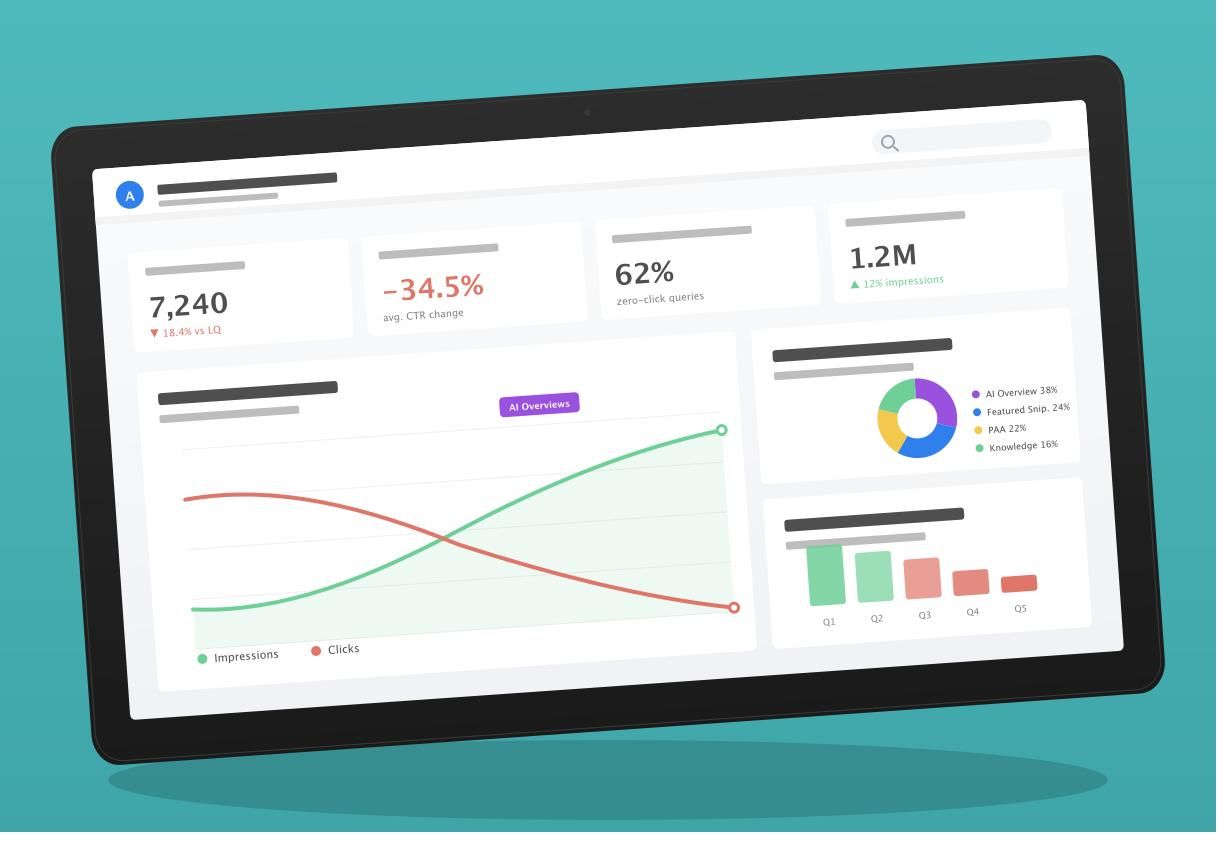
For in-house marketers reporting to leadership, agency strategists justifying retainers, and business owners evaluating their SEO investment, this creates a measurement problem. The work is producing results. The results just aren’t showing up where you’re used to looking.
What Zero-Click Search Actually Means for SEO
Zero-click search happens when users get what they need directly on the results page without clicking through to any website. The features driving this include:
- AI Overviews
- Featured snippets
- Knowledge panels
- People Also Ask boxes
This is not new. Featured snippets have provided on-SERP answers for years. What has changed is the scale.
AI Overviews now appear on a significant share of informational queries, synthesizing answers from multiple sources into a single response block above every organic listing. Google continues to expand where and how often these features appear.
The natural reaction is to treat this as a loss. If users aren’t clicking, what’s the point of ranking?
That instinct overlooks what zero-click visibility actually does. When your brand appears in an AI Overview or a featured snippet, users see your name, read your expertise, and form an impression of your authority, even without clicking. That impression influences which brands they trust when they are ready to buy and whether they come to you directly when the need becomes urgent.
The data supports this. According to Seer Interactive, sources cited in AI Overviews receive up to 35% more organic clicks than uncited sources in the same results. For cited sources, zero-click features create more click opportunity than not appearing at all.
Why Traditional SEO Metrics No Longer Tell the Full Story
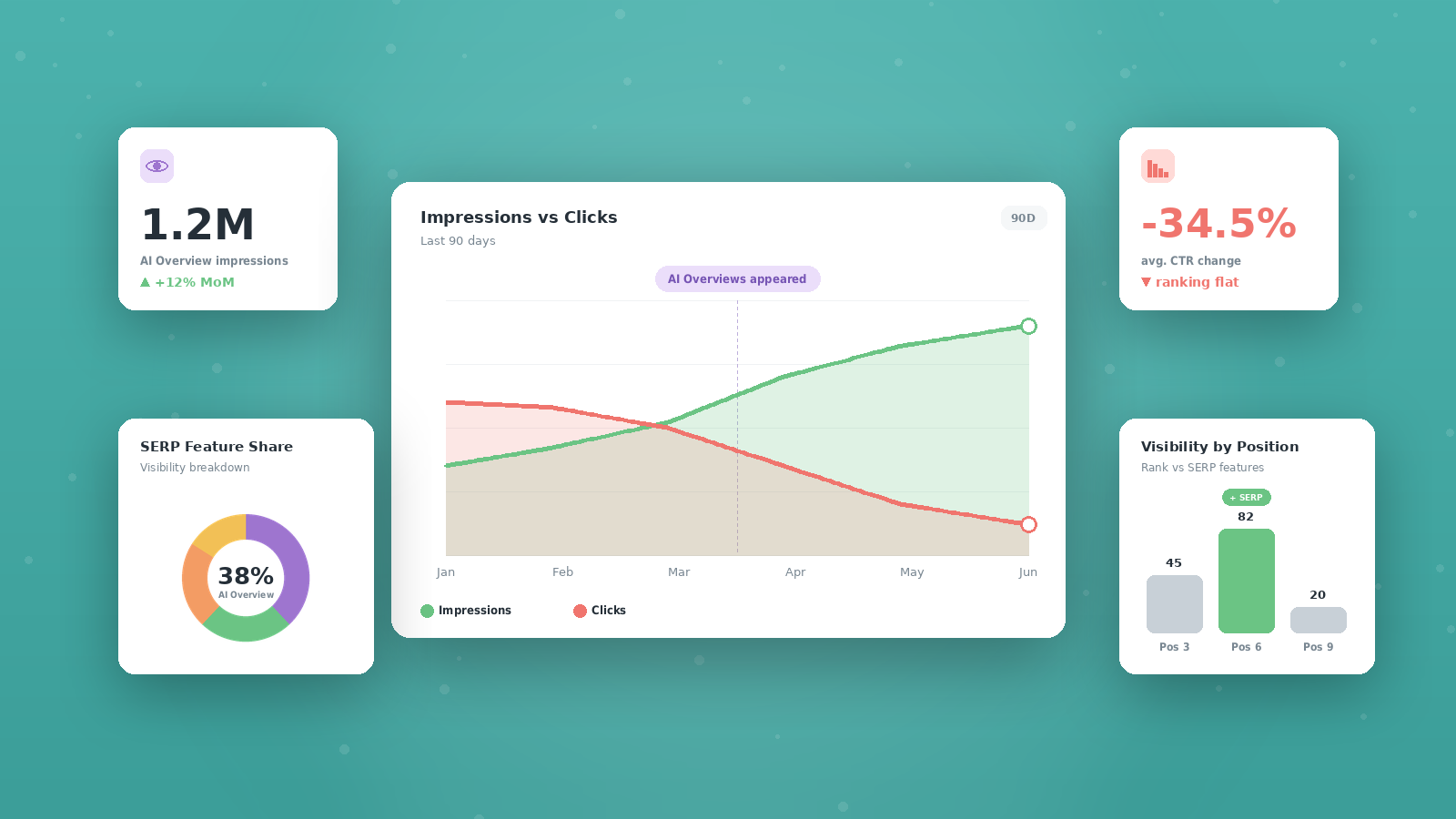
Most SEO reporting centers on organic sessions, click-through rate, and keyword rankings. These metrics are not obsolete, but when they are the only numbers in the report, they create blind spots that lead to bad decisions.
- Organic sessions miss visibility that doesn’t produce clicks. A page appearing in AI Overviews for thousands of queries can generate zero sessions in your analytics. If sessions are the only metric, that page looks like it’s failing when it may be one doing the most for brand awareness.
- CTR declines don’t always mean performance is declining. When an AI Overview appears above your listing, CTR drops even if your ranking hasn’t changed. Falling CTR without SERP feature context looks like an SEO problem when it’s actually a search environment change.
- Keyword rankings alone don’t reflect real visibility. A page ranking in position six that is cited in the AI Overview and appears in People Also Ask delivers more visibility than a page ranking in position three with no SERP features.
The risk is more than an incomplete picture. Teams that see declining traffic and respond by cutting content investment may be pulling back on the exact pages building the brand visibility that drives revenue over time.
Metrics That Matter in a Zero-Click Space
The goal is not to replace traffic and ranking data but to layer additional signals that show where SEO is generating value beyond clicks.
Search Console impressions and impression trends. Impressions tell you how often your pages appeared in results, regardless of clicks. When impressions rise while clicks are flat or declining, your content is reaching more people in an environment where SERP features compress clicks. Comparing impression trends against click trends for the same queries distinguishes true performance declines (both falling) from click compression (impressions stable or rising, clicks declining).
Branded search volume. How often people search for your brand by name is one of the most underused indicators in SEO reporting. When your content appears in zero-click features, users encounter your brand without clicking. Some portion later search for you directly. Track this in Google Search Console and Google Trends over time. A steady upward trend signals that zero-click visibility is translating into brand recognition.
SERP feature ownership. Tools like Ahrefs and Semrush track how many featured snippets, People Also Ask placements, and AI Overview citations your content holds across your target keyword set. A brand holding SERP features for 30% of its target queries has meaningfully different visibility than one ranking in the top five with no features.
Share of voice. This measures your brand’s visibility across a defined keyword set relative to competitors, independent of whether those queries generate clicks. Tracking share of voice at the keyword cluster level shows where you are strong, where competitors are outperforming you, and where the highest-value opportunities exist.
AI citation presence. Google Search Console does not currently separate AI Overview data from traditional organic data. Third-party platforms like Ahrefs and Semrush offer AI Overview citation tracking, and monitoring should extend to ChatGPT, Perplexity, and Gemini as well. This data is still early for most sites, but tracking it now establishes the baseline you will need as AI search adoption grows.
Engagement quality for traffic that arrives. When zero-click features compress total click volume, the traffic that does arrive matters more. Time on page, pages per session, scroll depth, and conversion rate tell you whether visitors who click through are finding value. High engagement from lower traffic volume often indicates better-qualified visitors.
Prioritizing by Business Type
Not every metric carries the same weight for every business:
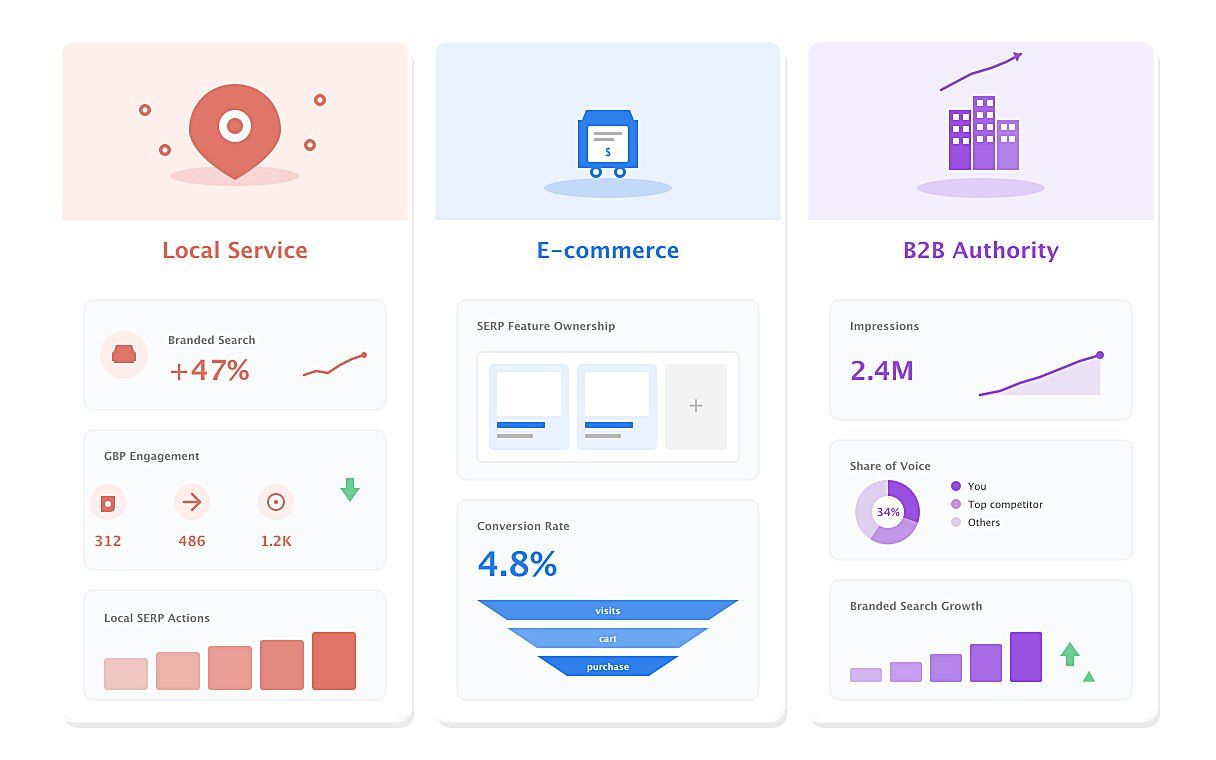
- Local service companies should prioritize branded search volume and Google Business Profile engagement, because local zero-click features often drive phone calls and direction requests rather than website visits.
- E-commerce brands should focus on SERP feature ownership for product queries and conversion rate on arriving traffic.
- B2B companies producing thought leadership should track impression trends, share of voice, and branded search growth as leading indicators that content investment is building authority.
Building an SEO Dashboard for the Zero-Click Era
A reporting dashboard built for the zero-click environment needs to answer three questions, not just one.
1. Performance: How is the investment performing? Conversions, revenue from organic, and pipeline contribution. These have always been the bottom line, and they remain the bottom line.
2. Influence: How much visibility are we building?
This is where the new metrics live:
- Impressions and impression trends
- Branded search volume growth
- SERP feature ownership
- Share of voice
- Direct traffic trends
- AI citation presence
These metrics show the value SEO is generating in spaces where clicks don’t happen but brand impact does.
- Attribution: Can we connect influence to outcomes? When branded search volume rises after a period of strong AI Overview presence, that’s a signal worth surfacing. When direct traffic grows alongside SERP feature gains, the connection is directional even if it’s not precise. User surveys asking new customers how they found you can surface touchpoints that analytics alone cannot capture.
This three-layer framework simplifies stakeholder conversations. Lead with performance. Show influence to explain how outcomes are being built. Use attribution to connect the two. When the objection is “traffic is down, so SEO isn’t working,” the influence layer gives you the data to reframe: impressions are up, branded search is growing, and the traffic that does arrive is converting at a higher rate.
That’s a different story than “SEO is declining.”
Build a Smarter SEO Measurement Framework
SEO measurement has to keep pace with how search actually works. The businesses that update their metrics framework to account for zero-click visibility, AI citation presence, and brand influence will make better strategic decisions than those relying on traffic as the sole indicator of success.
Start by auditing your current SEO reporting against the metrics covered in this article. Identify where the biggest measurement gaps exist. If your dashboard only shows traffic and rankings, you are missing the signals that explain what is actually happening in search.
321 Web Marketing helps businesses build SEO measurement frameworks and strategies designed for how search works today. Our team tracks performance across traditional rankings, AI visibility, and brand influence to give you the full picture of where your SEO investment is generating value.
Talk to our team about building an SEO strategy and reporting framework that captures the full scope of your search performance.
Kim Greer
OFP Law
One of the best business decisions I ever made was to contract with 321 Web Marketing. Jonathan Gessert and his team are knowledgeable, efficient, and effective, making digital marketing goals easy to achieve and helping [...]

Kelly Cole
Business Benefits Group
My company hired 321 Web Marketing in February 2016 to resurrect our web site. We feel our web site is the face to our business and desperately needed a make over. 321 took us from blah to WOW effortlessly and what a difference [...]

Emily Hawkins
Diener & Associates
Thanks to 321 Web Marketing, the client has seen an increase in their search engine leads, averaging 12 qualified leads per month. The client has also achieved prominent Google Maps and search placement. The team [...]
Trevor Telesz
Paw Pals Pet Sitting
321 Web Marketing successfully translated the client’s design into a stunning and refreshed website, ensuring seamless functionality across all dynamic views. The team provided clear timelines and stuck to them, [...]

Corey Davis
Spartan Animal & Pest Control
321 Web Marketing is truly phenomenal at what they do. Their ability to communicate and describe the steps and actions that they are implementing, Alex Zarpas in particular, is excellent. Delivering on promises is all [...]

Alec Roberts
MFE Insurance
I can’t say it enough, Jonathan and his team have gone above and beyond since day one to accommodate our needs and meet our goals. I run a specialty insurance brokerage based in LA and once we found 321 we never looked [...]

Richard Wilbur III
Advantage.Tech
Thanks to 321 Web Marketing’s web development work, the client increased rankings and traffic from search engines. Also, their business secured prominent positions on Google Maps and industry-relevant, profitable [...]

Bruce Gemmill
FVCbank
After the website revamp, the client saw a steady rise in leads from search engines, resulting in additional traffic. 321 Web Marketing is highly punctual when it comes to deliverables, and internal stakeholders are [...]
Drew Weeks
VAE
321 Web Marketing delivered a sleek website that accurately portrays the size and quality of the client’s organization. All of their completed websites have received positive feedback from users who have been [...]

Ryan Masten
Masten Pools
321 Web Marketing has increased the client’s leads from zero to 53 monthly. Their SEO efforts pay off impressively due to a top-ranking position on Google and making the site the number one result for several [...]