



Table of Contents
- 1. Introduction
- 2. Why Hiring Marketers Goes Wrong So Often
- 3. Mistake 1: Confusing Marketing Activity With Marketing Outcomes
- 4. Mistake 2: Hiring a Generalist When You Need a Specialist (Or Vice Versa)
- 5. Mistake 3: Confusing Marketing Leadership With Marketing Execution
- 6. Mistake 4: Expecting Senior Outcomes at Junior Pricing
- 7. Mistake 5: Choosing In-House When You Need an Agency (Or Vice Versa)
- 8. Mistake 6: Expecting Returns on the Wrong Timeline
- 9. Mistake 7: Hiring a Marketer to Build a Strategy You Should Define First
- 10. Mistake 8: Failing to Support the Marketer After Hiring Them
- 11. Mistake 9: Measuring the Wrong Things From Day One
- 12. Mistake 10: Cutting Marketing Budget at Exactly the Wrong Moment
- 13. How to Hire the Right Marketer the First Time
- 14. Build, Hire, or Partner: Choosing Your Marketing Model
- 15. How to Manage Marketing Without Marketing Expertise
- 16. Conclusion
- 17. Frequently Asks Questions

 Jul 13, 2026 ·
  28 min read ·
  Summarize in ChatGPT
Introduction
When hiring a marketing manager, business owners frequently draft a job description based on unrealistic expectations. They ask for more sales leads, a modernized website, and dominant search engine rankings. During the interview stage, they naturally select the candidate who speaks the most confidently about achieving those metrics.
Then, the harsh reality usually arrives six months later. The business has burned tens of thousands of dollars on salary. The website remains untouched. The sales pipeline has not moved an inch.
The financial penalty attached to this failure has climbed sharply over recent years. Companies no longer possess the operating margin to fund 12 months of trial and error. You cannot pay a bad hire to sit at a desk while they try to figure out your market. A misaligned hire consumes budget, stalls growth, and frustrates the sales department. In modern business, standing still for six months equates to moving backward.
This experienced-perspective guide is for business owners and founders preparing to make a marketing hire. It bypasses theoretical concepts and strips away industry jargon, instead focusing on the actual mechanics required to build a functional, revenue-generating marketing division. You will observe what bad decisions look like in practice and measure the realistic financial toll of a broken hiring process. From there, you will learn how to build a defensible system for your next move. This framework scales well. It applies directly to companies making a first marketing hire, evaluating an agency partnership, or recruiting a full-time executive to lead global operations.
Why Hiring Marketers Goes Wrong So Often
Marketing roles frequently experience misalignment between expectations and outcomes, making hiring decisions particularly challenging. When a company hires a financial controller, for example, the deliverables remain exact. The books close on time, or they do not. The math offers no room for interpretation.
When a company hires a marketer, the deliverables are often subjective and disconnected from actual revenue generation. This systemic failure stems directly from a mismatch between what business owners expect and how the marketing department creates financial value. Owners frequently treat marketing as a vending machine, expecting immediate sales spikes from long-term brand campaigns, setting the employee up for an impossible task. They judge performance based on immediate revenue rather than leading indicators like qualified pipeline growth or a measurable reduction in customer acquisition costs.
As a result, marketing turnover remains a persistent challenge, often driven by poor alignment between leadership expectations and daily marketing execution (Sheridan, 2023). The breakdown occurs because neither party agreed on the mathematical definition of success before the work began.
The business owner demands immediate closed deals, while the marketer focuses on generating social media views or raw website visits. When these two opposing views collide during a quarterly review, trust shatters. To prevent this collapse, leadership teams must establish firm, objective metrics on day one, forcing the marketing department to tie every single activity directly to sales velocity and pipeline contribution.
Bad Marketing Hires Cost More Than You Think
The true cost of marketing hires extends well beyond the base salary, and it becomes obvious when a bad hire fails. Most hiring plans start and stop with the base salary, but the full employer cost rises significantly once the company adds mandatory benefits, expensive software seats, specialized training, and heavy management time.
Wages and salaries typically make up just 70.1 percent of total employer pay, meaning a baseline salary calculation immediately leaves out roughly 30 percent of the actual financial burden (U.S. Bureau of Labor Statistics, 2026). When a business owner hires an incompetent marketer, they are not just burning the monthly paycheck. They are actively funding wasted advertising budgets, paying for unused technology subscriptions, and draining valuable hours from executive leadership who must constantly step in to fix broken campaigns.
| Compensation component | Share of total employer cost | Average cost per hour worked (private industry) |
|---|---|---|
| Wages and salaries | 70.1% | $32.36 |
| Benefits (insurance, paid leave, retirement, legally required) | 29.9% | $13.79 |
| Total employer compensation | 100% | $46.15 |
The secondary financial damage strikes even harder, as the cost of replacing an employee ranges from 50 percent to 200 percent of their annual salary (Dyerly, 2025). A single bad hire can set a company back months in pipeline generation, depending on the role and growth stage of the business. While the failing hire spins their wheels running ineffective tactics, competitors aggressively capture the market demand that your business should have secured. This stalls your company’s growth trajectory. Every dollar spent on the wrong strategy acts as a double penalty, draining your current cash reserves while simultaneously handing market share directly to competing firms that hired competent talent.
Furthermore, a failed hire heavily damages internal morale and cross-departmental trust. The sales team loses confidence in the marketing department when they consistently receive low-quality leads, leading to a fractured relationship that takes months to repair, even after a highly competent replacement finally enters the building. This loss of momentum paralyzes the entire revenue engine. Sales representatives stop following up on marketing-generated leads, assuming the data is useless. Rebuilding this internal alignment forces the new marketing leader to spend their first two quarters repairing political damage instead of launching fresh, revenue-generating campaigns.
How AI and Channel Fragmentation Raised the Stakes
The margin for error in marketing hiring has narrowed considerably. Generative AI has significantly altered digital visibility by increasing the volume of content competing for attention online. A few years ago, a company could publish average articles and still generate steady web traffic.
Today, that identical approach often produces little or no meaningful return. The baseline required to earn attention has risen drastically, meaning an inexperienced marketer producing mediocre assets will waste their production hours. If a new hire relies on generic writing and automated software rather than deep customer research, the business will remain invisible to its target audience.
Aggressive channel proliferation means buyers now fracture their attention across dozens of competing platforms. Your prospective customers no longer rely on a single trade publication or one major social network. Instead, they gather in niche newsletters, private digital communities, and specialized podcasts.
About 80 percent of the buying process now happens before a buyer ever talks to sales (Ruffolo, 2025). This reality places an enormous burden on the marketing department to educate and convert prospects unassisted. A marketer must accurately identify where these fragmented conversations happen and place highly targeted commercial messages in those spaces.
These compounding shifts have made marketing objectively harder, making the wrong hire far more expensive than in previous economic cycles. Owner expectations have simply not kept pace with how complex modern marketing actually is.
A tactical playbook that worked effectively in 2019 may no longer deliver the same results today. If an owner hires a marketer whose only skill involves running outdated playbooks, the business will burn cash while waiting for results that will never arrive. To survive this complexity, companies must hire strategic operators who know how to analyze data, adapt to algorithm shifts, and build a modern revenue system.
Why Business Owners Still Get This Wrong in 2026
In 2026, the same marketing hiring mistakes continue to destroy value across industries and company sizes. Business owners repeatedly fall into the trap of opinion-based hiring. They conduct interviews searching for candidates who share their personal aesthetic preferences, selecting individuals who simply agree with the founder’s taste in website layouts or branding colors. This subjective approach ignores the actual requirement of the role, which involves building operational systems that drive revenue. A founder ends up hiring a highly articulate designer disguised as a marketing director, leaving the business exposed when it comes to technical execution and pipeline generation.
Business owners also rely heavily on hope-based budgets, starving the department of operational capital while expecting absolute miracles. They hire a junior coordinator and hope that the inexperienced hire will somehow generate enterprise-level financial returns without a dedicated advertising budget. This disconnect places the new employee in an impossible situation from day one. The owner expects the junior marketer to outmaneuver big, well-funded competitors using nothing but free social media posts and sheer enthusiasm. When the employee inevitably fails to produce a massive pipeline from zero spend, the owner blames the marketer instead of recognizing their own severe miscalculation in resource allocation.
Executive leaders constantly default to pattern matching against outdated templates when evaluating talent. They hire for skills that mattered five years ago, ignoring the reality that modern marketing requires deep analytical capability alongside creative production. An owner might demand expertise in basic email newsletters or physical trade show coordination, while overlooking the absolute need for technical data analysis, customer acquisition modeling, and algorithmic strategy. By applying an obsolete hiring rubric to a modern business problem, business owners systematically filter out the exact technical talent they need to compete in the current market.
Mistake 1: Confusing Marketing Activity With Marketing Outcomes
The most frequent error business owners make is conflating output volume with actual business outcomes. Activity is the most common decoy in corporate decision-making. It looks like progress, sounds like progress, and fills up weekly reporting dashboards. However, activity does not pay the bills. If a business owner cannot distinguish between busywork and revenue-generating work, they will continue to reward the wrong behaviors.
The Volume Trap That Disguises Itself As Progress
High output often masks the complete absence of meaningful results. A failing marketer will point to the four blog posts they published, the three emails they sent, and the daily social media updates they managed. This volume trap disguises itself as forward momentum.
For example, an employee might spend 40 hours redesigning a brochure that no customer ever asked for. They might launch a complex email sequence that goes to an unsegmented, disengaged list. These activity patterns look highly productive to an outside observer. The marketer is visibly working hard, but that hard work produces absolutely nothing measurable for the sales pipeline.
Why Activity Reports Hide the Real Problem
Most marketing reports lead with what was done, rather than what changed. A standard activity report highlights impressions, clicks, and publishing frequency. These reports are designed to justify the marketer’s salary, not to inform the business owner about financial progress.
A business owner must learn to distinguish between defensive reporting and strategic reporting. If a weekly update only lists the tasks completed since Monday, the marketer is hiding behind activity. A useful report explicitly connects those completed tasks to a measurable shift in pipeline volume, sales velocity, or customer acquisition cost.
What Outcome-Focused Marketing Looks Like
Outcome-driven marketing operates differently in planning and execution. An outcome-focused marketer does not start their week by listing tasks. They start by identifying the business metric they need to move, and then they design the activities required to move it.
This approach surfaces real outcomes rather than activity totals. Instead of asking how many people visited the website, an outcome-focused marketer asks how many qualified accounts requested a sales conversation. Instead of tracking total email opens, they measure the percentage of the database that actively engages with commercial offers. This shift in questioning forces the entire marketing function to align with revenue generation.
Mistake 2: Hiring a Generalist When You Need a Specialist (Or Vice Versa)
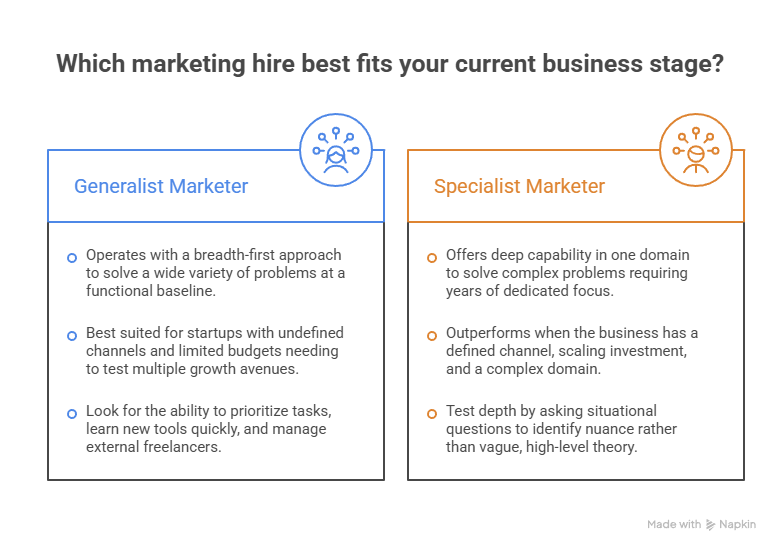
One of the most common hiring mismatches occurs when a business owner hires a generalist to solve a highly technical problem, or a specialist to build an entire department from scratch. This error produces disappointment on both sides. The diagnosis is a function of business stage, operational complexity, and existing capability.
The Difference Between Generalist and Specialist Marketers
Generalist marketers possess broad capability across multiple disciplines. They can write copy, manage basic advertising campaigns, update the website, and coordinate events. They operate with a breadth-first approach, solving a wide variety of problems at a functional baseline.
Specialist marketers offer deep capability in one domain. They are technical search engine optimization experts, enterprise paid media buyers, or highly technical product marketers. They exist to solve complex problems that require years of dedicated focus. A specialist is focused on optimizing a specific discipline rather than managing an entire marketing function. For example, a specialist marketer can maximize the conversion rate of a landing page using advanced analytics.
Signs You Actually Need a Generalist
When doing marketing hiring for startups with undefined channels and limited budgets, you almost always need a strong generalist. When a business does not yet know which marketing channel will drive growth, hiring a specialist is a financial risk. Strong generalist marketers are better suited than specialists in this scenario because they can test multiple channels simultaneously without demanding outside agency support.
When interviewing generalist marketers, look beyond a long list of software skills. Evaluate their ability to prioritize tasks, learn new tools quickly, and manage external freelancers. An excellent generalist acts as a highly effective project manager who can execute the baseline work themselves.
Signs You Actually Need a Specialist
A specialist outperforms a generalist when the business has a defined channel, scaling investment, and a complex domain. If your company spends $50,000 a month on paid search, relying solely on a generalist may introduce unnecessary risk. That level of spend requires an expert who knows bidding algorithms, audience exclusion lists, and technical attribution.
Evaluate a specialist marketer by testing their depth. Ask situational questions. A true specialist will immediately identify the nuance in the problem, whereas a generalist will offer a vague, high-level theory. Avoid mistaking confidence for genuine technical expertise.
Mistake 3: Confusing Marketing Leadership With Marketing Execution
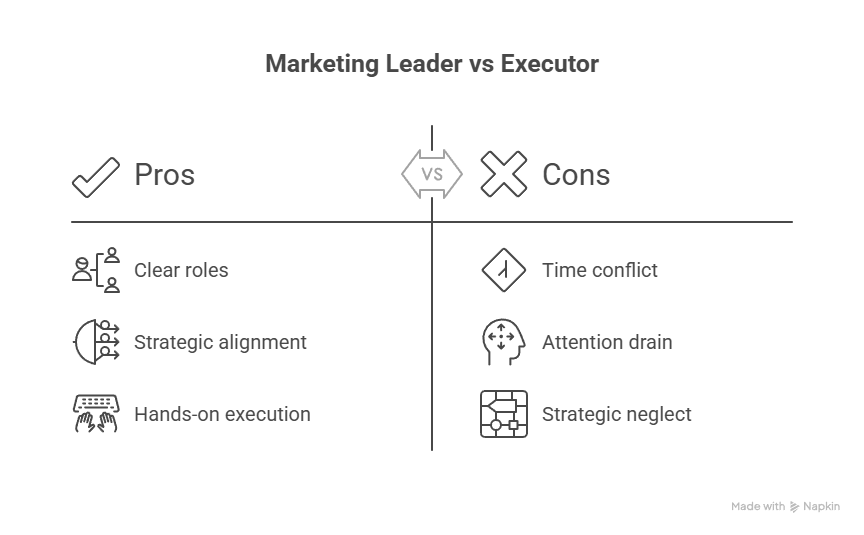
Failing to separate marketing leadership vs execution into distinct roles almost never works at scale. Leadership and execution are distinct disciplines that require different skill sets, daily schedules, and compensation structures. Expecting one person to fulfill both functions guarantees failure.
What a Marketing Leader Actually Does
Marketing leaders focus on strategic, organizational, and cross-functional work. They align the marketing department’s goals with the company’s financial targets. They manage budgets, hire external agencies, collaborate directly with the sales director, and report to the board. This high-level planning cannot be executed well by someone who is simultaneously writing blog posts full-time.
What a Marketing Executor Actually Does
Marketing executors handle hands-on production and refinement. They build email campaigns, configure the advertising platforms, and write website copy. They are hired to manage daily channel operations. Expecting an executor to suddenly set high-level corporate strategy is a recipe for misaligned output and wasted effort.
Why Asking One Person to Do Both Rarely Works
These two roles actively compete for time, attention, and cognitive mode. Execution requires deep, uninterrupted focus to produce quality assets. Leadership requires constant context-switching to manage people, resolve disputes, and adjust budgets. When a business owner asks one hire to lead and execute simultaneously, the employee inevitably defaults to the tactical execution they are most comfortable with, leaving the strategic leadership vacant.
Mistake 4: Expecting Senior Outcomes at Junior Pricing
A persistent disconnect exists between what business owners want to pay and what experienced marketing talent actually costs. Owners frequently budget for a mid-level manager but expect the strategic output of a seasoned executive. Underpaying for a role is one of the most predictable causes of a failed marketing hire.
The Real Cost of Marketing Talent in 2026
Current compensation benchmarks reflect the reality of the market. Tactical executors command a specific rate, while senior strategists who can independently drive revenue command a much higher premium. The widespread adoption of AI-driven productivity tools has not lowered the cost of genuinely senior marketing thinking. While software can speed up asset production, it cannot replace the strategic judgment required to position a company correctly.
The Hidden Cost of Underpaying for Marketing
When a business significantly underpays for a marketing role, it substantially increases the risk of failure. The immediate results are high turnover, a severe mismatch in seniority, and undelivered results. A junior hire placed in a senior role will freeze under the pressure, costing the company 12 to 24 months of lost momentum while competitors capture available market share.
How to Match Compensation to the Outcome You Need
You must align the compensation of a role to the actual financial outcome the business requires. If you need someone to run basic social media updates, a junior salary is appropriate. If you need someone to overhaul your lead generation engine and double your pipeline, you must pay market rate for an experienced leader. In many cases, hiring a fractional senior leader outperforms hiring a full-time mid-level employee at the same total cost.
Mistake 5: Choosing In-House When You Need an Agency (Or Vice Versa)
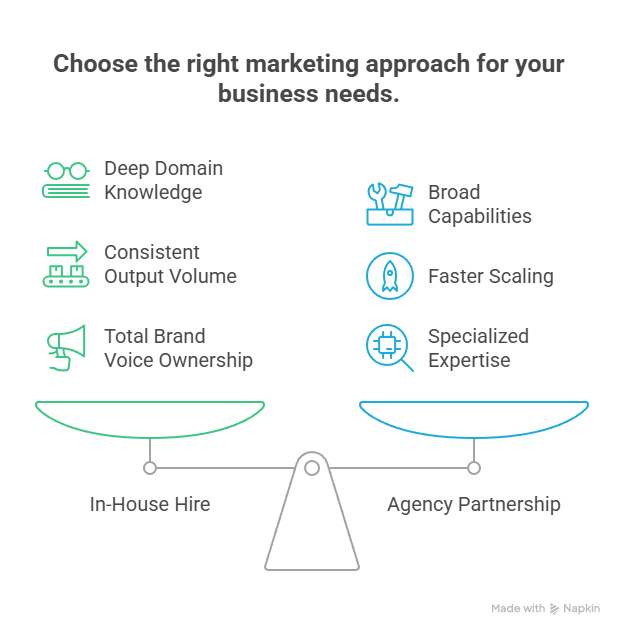
Business owners frequently approach the in-house marketing vs agency decision based on gut instinct rather than operational fit. This decision should function as a math equation based on capability needs, current scale, operational complexity, and available management bandwidth.
When an In-House Hire Makes Sense
An in-house hire outperforms an agency when the work demands deep domain knowledge, a consistent volume of daily output, and total ownership of the brand voice. Internal hires sit in sales meetings, talk directly to product teams, and absorb company culture. Authentic content is often easier to produce in-house because internal staff understand the product and customer context more deeply (Ruffolo, 2025). They deliver a level of internal fluency that an external agency cannot replicate.
When an Agency Partnership Makes Sense
An agency partnership outperforms an internal hire when the company requires broad capabilities, faster scaling, and specialized expertise. A strong agency brings a full bench of technical talent, including search experts, developers, and media buyers. They deliver immediate technical execution without the excessive overhead of hiring five separate full-time employees. Agencies start faster because the team, tools, and process already exist (RB Oppenheim Associates, 2026).
When a Hybrid Model Outperforms Either Alone
A highly effective marketing team structure involves placing a senior internal leader in charge of the business strategy and pairing them with an external agency that handles the technical execution. This hybrid structure scales smoothly at varying stages of company growth, keeping strategy inside the business while outsourcing the heavy technical lifting. The model works perfectly when the internal lead handles decisions, and the agency is strictly in charge of defined execution (RB Oppenheim Associates, 2026).
Mistake 6: Expecting Returns on the Wrong Timeline
A substantial gap exists between a realistic marketing ROI timeline and the immediate expectations of most business owners. Owners often want immediate sales from campaigns that require months to mature. This timeline misalignment remains a leading cause of premature terminations, sudden budget cuts, and broken trust between leadership and the marketing department.
Why Marketing Rarely Pays Back in 30 Days
Most marketing investments require months to produce attributable financial returns. Building brand awareness, ranking in search engines, and establishing trust with enterprise buyers cannot be forced into a 30-day window. While a few activities, like a targeted paid search, can produce short-term returns, they only function correctly when supported by a broader, long-term plan.
Realistic Time Horizons By Channel and Goal
In 2026, typical payback windows vary drastically by channel. Organic content frequently requires several months before meaningful commercial results become visible. Brand campaigns take even longer. Conversely, direct-response paid media can show returns in weeks. Your channel mix and goal selection directly determine your realistic return expectations.
How to Set Internal Expectations Before You Hire
You must align your leadership team, finance department, and the new marketing hire on realistic timelines before the work begins. Establish structured milestones that confirm operational progress without forcing premature judgments about final revenue outcomes. Track leading indicators during the first 90 days to confirm the strategy is moving in the correct direction.
Mistake 7: Hiring a Marketer to Build a Strategy You Should Define First
Failing to define your marketing strategy before hiring usually leads to highly disappointing outcomes. Establishing the foundational business strategy is the owner’s responsibility that cannot be fully delegated to a new employee.
Why Asking a New Hire to Define Strategy Often Fails
A new hire faces a severe context gap, a lack of internal authority, and a time deficit. They do not know the history of the product, the nuances of the sales cycle, or the preferences of the executive team. Expecting them to define the corporate direction in their first 30 days is a predictable failure pattern.
The Strategic Foundation You Need Before Hiring
You must provide a minimum level of strategic clarity before making any marketing hire. This includes defining the product positioning, the target audience, the core value proposition, and the exact success measures. Having this foundation in place accelerates the impact of any marketing hire, regardless of their seniority.
When You Genuinely Do Need a Strategist First
There are conditions where the right first hire is a strategist rather than a tactical executor. If the business is entering a new market or pivoting its product line, a senior strategist is required. You must structure this engagement explicitly to define the strategy first, setting up all subsequent tactical hires for long-term success.
Mistake 8: Failing to Support the Marketer After Hiring Them
Post-hire dysfunction routinely limits even the strongest marketing hires from succeeding. Marketing success depends on a working partnership between the marketer and the business, not a simple transactional handoff. If you hire a professional and then immediately isolate them from the core business, they will fail.
The Tools, Access, and Context Marketers Need
Marketers require specific software systems, clean data, direct access to decision-makers, and historical context to perform their jobs. The marketing technology market now includes more than 14,000 tools (Baiocchi, 2025). A mid-range tool stack adds $5,000 to $10,000 per year on top of salary costs (RB Oppenheim Associates, 2026). Denying these required inputs guarantees underperformance, regardless of the marketer’s raw talent. You cannot hire a builder and then refuse to provide them with the right tools.
Why Marketing Hires Need an Internal Sponsor
Internal sponsorship plays a mandatory role in unblocking decisions, defending the budget, and integrating the marketing function across other departments. The absence of a sponsor produces stagnation. When sales and marketing clash, the marketer needs an executive sponsor who can force alignment, rather than leaving the new hire to fight political battles alone.
The Quiet Ways Business Owners Undermine Their Own Hires
Owners frequently exhibit behaviors that destroy marketing effectiveness. These behaviors include reversing approved decisions without notice, bypassing the marketing leader to give direct instructions to junior staff, and engaging in public second-guessing during meetings. You must recognize and correct these patterns in real time, or your marketer will disengage.
Mistake 9: Measuring the Wrong Things From Day One
The measurement choices you make early in the relationship lock in years of misaligned expectations. Measurement is a strategic business decision, not a minor tactical detail. Tracking the wrong numbers forces the marketer to chase the wrong results.
The Vanity Metrics Owners Default To
Owners often request metrics that rarely connect to actual business outcomes. They ask for impression counts, follower growth, email open rates, and raw website traffic. These metrics persist because they look positive on a chart, despite being widely known to mislead leadership about actual revenue generation.
Choosing Metrics That Reflect Real Value
You must select metrics that connect daily marketing activity directly to revenue, customer retention, or measurable pipeline growth. Track qualified sales consultations, the cost of acquiring a new customer, and sales velocity. Metric frameworks built on these numbers survive extreme executive scrutiny and remain valid regardless of how digital channels change.
The Reporting Cadence That Actually Helps
You must structure how often you review marketing performance and determine the depth of those reviews. A weekly check-in should focus on leading indicators and task completion. A monthly review should analyze pipeline generation. This rhythm produces better operational decisions, whereas demanding daily revenue updates produces nothing but anxiety.
Mistake 10: Cutting Marketing Budget at Exactly the Wrong Moment
A recurring pattern exists where marketing becomes the first budget cut, often right before a long-term investment would have finally paid off. Stop-start marketing remains one of the most expensive financial behaviors a business owner can engage in. Marketing budgets have dropped to record lows, currently sitting at roughly 9.0 percent of company revenue (Moorman, 2026).
Why Marketing Is Always First on the Chopping Block
Structural reasons explain why the marketing budget for small business operations is treated as discretionary, while other functions are treated as fixed costs. Owners view marketing as an expense rather than a capitalized asset. Budget choices reflect this disconnect, with customer acquisition spend sitting 26 percent higher than retention spend, even though retention consistently delivers stronger performance (Moorman, 2026). This pattern reinforces itself across hiring and budgeting cycles, trapping the business in a cycle of underinvestment.
The Compounding Cost of Stop-Start Marketing
Repeated starts and stops destroy momentum, degrade organic asset value, and ruin team continuity. When you pause paid media campaigns for extended periods, performance can become less efficient as campaigns lose optimization momentum and require a new learning period when restarted. When you stop publishing content, search engines drop your ranking position. The long-term cost of these stop-start patterns vastly outweighs the temporary cash saved by the initial budget cut.
How to Defend Marketing Investment With Confidence
You must build a business case for sustained marketing investment using language that leadership and finance teams respect. Position marketing as a long-term financial investment with measurable returns, rather than as discretionary spend. Show the pipeline value generated by maintaining a steady budget over a 12-month period.
How to Hire the Right Marketer the First Time
If you want to know how to hire a marketer correctly, you can apply these operational lessons directly to your next hiring decision. The hiring process itself serves as the single most significant determinant of your future marketing outcomes. A brilliant strategy cannot survive an incompetent operator, but a highly competent operator can often fix a broken strategy.
Founders frequently treat hiring as an administrative burden, rushing through interviews to fill an empty seat. You must treat the hiring process as a high-stakes capital allocation decision. Every hour spent rigorously screening candidates saves hundreds of hours in future management time and prevents financial losses down the line.
Defining the Outcome Before You Write the Job Description
You must name the business outcome the hire is being made to produce before writing a single word of the job listing. The vast majority of failed hires happen because the business owner never defined what success looked like. They simply copied a generic marketing template from a competitor and posted it online.
Knowing whether you need a 20 percent increase in qualified lead volume or a complete corporate brand overhaul fundamentally transforms the entire process. The outcome dictates the job description, the interview structure, and your final evaluation criteria. If you do not define the financial target before reviewing resumes, you will default to hiring the candidate who sounds the most enthusiastic, rather than the candidate who possesses the technical skills required to hit the target.
Writing a Job Description That Filters for Fit
The structural elements of a strong job description should attract perfectly aligned candidates and repel poor fits. A functional job listing acts as a strict filter, not a marketing brochure. Common job description mistakes, like listing 50 required software skills without defining the actual business goal, produce heavily mismatched applicant pools that waste everyone’s time.
Instead of listing generic daily duties, focus the listing on the outcomes the candidate must achieve in their first six months. State plainly that the candidate will be expected to lower the cost per lead by 15 percent or launch three new geographic markets. When you publish hard deliverables, unqualified candidates will self-select out of the process, leaving you with a concentrated pool of serious operators.
Interviewing for Strategic Thinking, Not Just Tactics
Your interview structure must surface how a candidate thinks, not merely what they have done in the past. Anyone can memorize marketing terminology or claim credit for a campaign they only minimally supported. To uncover the truth, you must move away from standard behavioral questions and use intense, scenario-based exercises.
These practical exercises clearly differentiate strategic capability from basic tactical familiarity. Present the candidate with a real set of failing metrics from your own company history. Ask them how they would solve a pipeline deficit under a frozen budget. A tactical worker will suggest posting more frequently on social media. A strategic thinker will immediately ask to audit the sales conversion data to find the leaks in your existing funnel.
Build, Hire, or Partner: Choosing Your Marketing Model
Knowing when to hire a marketer means you must choose among three primary structural models based strictly on your company stage, operational complexity, and financial goals. Founders often assume they must immediately build an internal department, ignoring highly effective alternative structures.
The decision between building internally, hiring fractionally, or partnering externally is a financial calculation, not a matter of corporate pride. This choice should be revisited periodically as the company scales, not made once and permanently frozen. Forcing a stagnant model onto a growing company creates severe operational bottlenecks.
| Factor | Build a full in-house team | Hire a fractional leader | Partner with an agency |
|---|---|---|---|
| Best fit when | Product demands deep institutional knowledge and you have a large scaling budget | Scaling past founder-led sales but cannot yet fund a full-time CMO | You need broad capabilities, faster scaling, and specialized expertise |
| What you get | Marketers embedded with product teams and deep internal fluency | Senior strategy, a measurement framework, and management of junior staff | Copywriters, web developers, media buyers, and SEO technicians from day one |
| Speed to impact | Slowest, around a 12-month recruit and train cycle | Fast, a part-time senior layer added to existing staff | Fastest, talent and technology already in place |
| Main tradeoff | High cost and heavy management overhead | Part-time bandwidth rather than full ownership | Only works if you pick a true strategic partner, not an order-taker |
When Building a Full Internal Team Makes Sense
Investing in a complete in-house marketing function makes sense only when your product demands intense institutional knowledge and you possess a large scaling budget. Internal teams excel when the subject matter is highly technical, and the marketers must sit alongside the product developers every single day to understand the nuances of the offer.
However, owners consistently underestimate the price tag. A small in-house team costs between $120,000 and $250,000 per year just to maintain the functional baseline (RB Oppenheim Associates, 2026). You must accept this realistic financial cost, the 12-month timeline required to recruit and train the team, and the heavy management overhead that comes with this choice. Building in-house is a long-term capital expenditure, not a quick fix.
When Hiring a Fractional Leader Makes Sense
A fractional marketing leader delivers strategic value in particular stages of growth, particularly for businesses scaling past their initial founder-led sales motions. As companies move beyond founder-led sales and enter a more complex growth stage, the founder can no longer manage the marketing function on the side. However, the business rarely has the cash flow to support a two-hundred-thousand-dollar Chief Marketing Officer salary.
A fractional leader bridges this gap. Engagement structures that pair a part-time fractional executive with your existing full-time junior staff work exceptionally well. The fractional leader sets the high-level strategy, establishes the measurement framework, and manages the junior employees, elevating the output of the entire department without forcing the company to absorb a full-time executive payroll burden.
When Partnering With an Agency Makes Sense
An agency partnership can outperform internal hiring on cost, capability breadth, and speed to market in many situations. When you sign a contract with an agency, you instantly gain access to copywriters, web developers, media buyers, and SEO technicians. Attempting to hire that combination of talent internally would take six months and inflate your payroll. Many agencies can launch campaigns more quickly because the talent and technology infrastructure are already in place.
To succeed with this model, you must choose an agency that functions as a true strategic partner rather than a simple order-taking vendor. Passive vendors wait for you to tell them what to do, which defeats the purpose of hiring experts. Look for agencies that actively challenge your operational assumptions, tell you when your ideas are flawed, and bring their own hard data to the strategic planning meetings.
How to Manage Marketing Without Marketing Expertise
Non-marketing business owners can productively oversee a marketing department without needing to become marketers themselves. Management capability functions as a distinct operational skill that develops independently of technical marketing expertise. You do not need to understand the bidding algorithm of a paid search campaign to hold a marketing director accountable for the customer acquisition cost.
Effective management relies on establishing clear financial boundaries, defining the revenue targets, and measuring the department against strict business outcomes rather than tactical execution. When a business owner attempts to learn the technical tools just to manage the marketer, they waste valuable executive time and immediately frustrate the employee.
Asking Better Questions in Marketing Reviews
You must ask questions that will produce useful business information versus questions that will lead to defensive theater. If an owner asks why a social media post received low engagement, the marketer will immediately retreat into a defensive posture, blaming algorithm changes or time-of-day metrics. This conversation provides zero financial value to the company.
Instead, you must ask what the team stopped doing this week because it was not working. Ask how much pipeline a campaign generated relative to its budget. Ask what leading indicators prove the current strategy remains on track. These question patterns reveal whether a marketer is thinking clearly about the business rather than just checking off daily tasks. They force the employee to defend their strategy with hard data instead of creative theories.
Trusting Your Marketer Without Disappearing
You must balance giving a marketing hire room to operate with remaining highly engaged in the function. Both complete disappearance and intense micromanagement produce the same poor outcomes. When an owner abdicates responsibility, handing over the budget and walking away for three months, the marketer loses their connection to the corporate strategy. They begin operating in a silo, and their output slowly drifts away from the actual sales targets.
Conversely, when an owner micromanages the daily work, demanding to review every single email subject line, they bottleneck the entire department. The marketer stops thinking independently and simply waits for instructions. The correct operational balance requires a clear division of labor. Set the financial goal, approve the quarterly budget, and let the marketer decide the tactical execution unhindered.
Building a Feedback Loop That Improves Outcomes
Structure regular feedback that directly compounds into better marketing decisions over time. Feedback patterns that focus on business metrics strengthen the marketer, while feedback patterns focused on personal aesthetic preferences rapidly destroy their confidence. If the business leadership repeatedly rejects a landing page because they do not like a specific shade of blue, they train the marketer to optimize for the owner’s personal taste rather than the customer’s conversion rate.
A functional feedback loop relies on data. Review the lead volume weekly and the closed revenue monthly. If a campaign fails to hit the required metrics, evaluate the strategy and the spending allocation, not the font choices. This structured approach builds a high-performing department that scales predictably.
Conclusion
Business owners consistently lose capital by confusing busywork with outcomes, heavily underpaying for required seniority, and cutting marketing budgets right before the investment matures. By applying a strict marketing hiring framework to evaluate and manage talent, you stop burning cash and start building a highly functional revenue engine. The initial hiring decision dictates the entire trajectory of the department. The right hire, supported correctly by an engaged and disciplined leadership team, consistently delivers far more financial value than any single software tool, advertising channel, or individual campaign ever will.
Stop guessing on your next marketing hire. Contact 321 Web Marketing today to discuss your marketing strategy, hiring needs, and ideal partnership models before making your next financial investment.
Review our foundational resources on marketing strategy, agency selection, and measurement frameworks to build a profitable team that delivers measurable results.
Frequently Asks Questions
For a first hire, you almost always want a generalist. When you don’t yet know which channel will drive growth, a specialist is a financial risk because their depth is wasted on a problem you haven’t defined. A strong generalist can test several channels at once, manage freelancers, and find traction before you commit big money to one lane. Bring in a specialist later, once you have a proven channel and the spend to justify deep expertise.
It depends on your stage, not your preference. Build in-house when the work demands deep product knowledge and daily presence, and you have the budget to support it. Hire a fractional leader when you’ve outgrown founder-led sales but can’t yet fund a full-time CMO. Partner with an agency when you need broad capability and speed, since the talent and tools already exist. Many companies do best with a hybrid, keeping strategy internal while an agency handles execution.
Most marketing investments take months to produce attributable revenue, not weeks. Brand awareness, search rankings, and trust with serious buyers can’t be forced into a 30-day window. Direct-response paid media can show returns faster, but it works best alongside a longer-term plan. Set milestones for the first 90 days that prove the strategy is moving in the right direction, and judge final revenue later.
Track numbers that connect to revenue, not numbers that look good on a chart. Qualified sales conversations, customer acquisition cost, and sales velocity tell you whether the work is paying off. Impressions, follower counts, and email open rates rarely do. A useful report ties completed tasks to a measurable shift in pipeline, so review leading indicators weekly and pipeline generation monthly.
More than the paycheck. Wages and salaries make up only about 70.1 percent of total employer cost, which means the salary figure leaves out roughly 30 percent of the real burden once you add benefits, software, training, and management time. A poor hire also drains advertising budget and executive hours spent fixing broken campaigns. Budget for the full cost of the seat, not just the offer letter.
Cutting marketing is usually the most expensive thing you can do at the worst possible moment. Budgets have already fallen to roughly 9.0 percent of company revenue, and many owners pull back right before a long-term investment matures. Stop-start spending kills momentum, drops your search rankings, and forces paid campaigns to relearn from scratch. Acquisition spend already runs about 26 percent higher than retention spend even though retention performs better, so protect the steady investment and fix allocation instead of slashing the whole line.


Kim Greer
OFP Law
One of the best business decisions I ever made was to contract with 321 Web Marketing. Jonathan Gessert and his team are knowledgeable, efficient, and effective, making digital marketing goals easy to achieve and helping [...]

Kelly Cole
Business Benefits Group
My company hired 321 Web Marketing in February 2016 to resurrect our web site. We feel our web site is the face to our business and desperately needed a make over. 321 took us from blah to WOW effortlessly and what a difference [...]

Emily Hawkins
Diener & Associates
Thanks to 321 Web Marketing, the client has seen an increase in their search engine leads, averaging 12 qualified leads per month. The client has also achieved prominent Google Maps and search placement. The team [...]

Trevor Telesz
Paw Pals Pet Sitting
321 Web Marketing successfully translated the client’s design into a stunning and refreshed website, ensuring seamless functionality across all dynamic views. The team provided clear timelines and stuck to them, [...]

Corey Davis
Spartan Animal & Pest Control
321 Web Marketing is truly phenomenal at what they do. Their ability to communicate and describe the steps and actions that they are implementing, Alex Zarpas in particular, is excellent. Delivering on promises is all [...]

Alec Roberts
MFE Insurance
I can’t say it enough, Jonathan and his team have gone above and beyond since day one to accommodate our needs and meet our goals. I run a specialty insurance brokerage based in LA and once we found 321 we never looked [...]

Richard Wilbur III
Advantage.Tech
Thanks to 321 Web Marketing’s web development work, the client increased rankings and traffic from search engines. Also, their business secured prominent positions on Google Maps and industry-relevant, profitable [...]

Bruce Gemmill
FVCbank
After the website revamp, the client saw a steady rise in leads from search engines, resulting in additional traffic. 321 Web Marketing is highly punctual when it comes to deliverables, and internal stakeholders are [...]

Drew Weeks
VAE
321 Web Marketing delivered a sleek website that accurately portrays the size and quality of the client’s organization. All of their completed websites have received positive feedback from users who have been [...]

Ryan Masten
Masten Pools
321 Web Marketing has increased the client’s leads from zero to 53 monthly. Their SEO efforts pay off impressively due to a top-ranking position on Google and making the site the number one result for several [...]