



Table of Contents
- 1. What This Guide Covers
- 2. Why Brand Authority Matters Now
- 3. How Search Systems Evaluate Brand Authority
- 4. Branded Search Demand: The Clearest Authority Signal
- 5. Trust, Reputation, and Conversion
- 6. Brand Authority in AI-Driven Search
- 7. Building Authority Through External Presence
- 8. Citation As a Visibility Metric
- 9. Framework for Evaluating Brand Authority
- 10. Operational Practices
- 11. Risks and Limitations
- 12. Where Brand Signals Are Headed
- 13. Key Takeaways
- 14. FAQs

 Mar 27, 2026 ·
  19 min read ·
  Summarize in ChatGPT
What This Guide Covers
Search has moved beyond keywords and links. Today’s systems, both traditional rankings and AI-generated summaries, evaluate brands as entities with history, reputation, and patterns of reliability. They decide which sources to select and cite based on recognition and trust, not just page-level relevance.
This shift matters because visibility now forms in new ways. More than half of Google searches end without a click. Users get answers directly on the results page. When AI summaries appear, even high-ranking pages lose significant traffic while remaining visible only through citation. In this environment, your brand name showing up inside an answer may be the only exposure you get.
This guide explains how brand authority functions as a measurable signal in SEO and generative search. You’ll learn how systems evaluate trust, which signals connect brand strength to visibility, and how to measure brand impact when exposure happens inside summaries as often as on your website.
The analysis draws on Google’s quality guidelines, Edelman’s trust research, SparkToro’s zero-click data, and Seer Interactive’s AI Overview studies.
Why Brand Authority Matters Now

The Zero-Click Reality
SparkToro’s research shows that more than half of Google searches end without a site visit. Users receive answers, references, or context directly on the results page. Brand exposure can occur without a click, source names and citations appear inside summaries where users complete their research.
AI Summaries Change the Game
When AI Overviews appear, click-through rates drop sharply, up to 61% on informational queries, according to Seer Interactive’s research. But domains cited inside those summaries remain visible within the search interface. Users see your brand name even when they don’t visit your site.
This creates a new form of exposure. Your page can rank well in the traditional index and still be invisible if the AI system doesn’t select it for the summary. Citation inside the answer has become a primary form of visibility.
Trust Drives Decisions
Edelman’s Trust Barometer reports that more than 80% of respondents say they need to trust a brand before deciding to buy. Trust also influences loyalty and advocacy across both B2B and consumer markets. In search, this means users often select the name they recognize from a results page, and the presence of a known brand inside an AI citation list can guide later behavior even without an immediate click.
The Measurement Gap
Despite these shifts, many SEO programs still measure success through position tracking, session growth, and page-level performance. These metrics show who clicks, not who gets cited or referenced. As AI systems take on a larger role in summarizing and presenting information, this gap limits how well you can assess your actual presence in search.
| Shift | What’s Changing | Impact on Brand Visibility |
|---|---|---|
| Zero-Click Searches | More than 50% of Google searches end without a site visit (SparkToro) | Brand exposure happens on the SERP, not your site |
| AI Overviews | CTR drops up to 61% on informational queries (Seer Interactive) | Citation inside the answer replaces the click |
| Trust-Driven Decisions | 80%+ of buyers need to trust a brand before purchasing (Edelman) | Recognized names get selected from results pages |
| Measurement Gap | Most SEO programs track clicks and rankings only | Citation and reference visibility goes unmeasured |
How Search Systems Evaluate Brand Authority
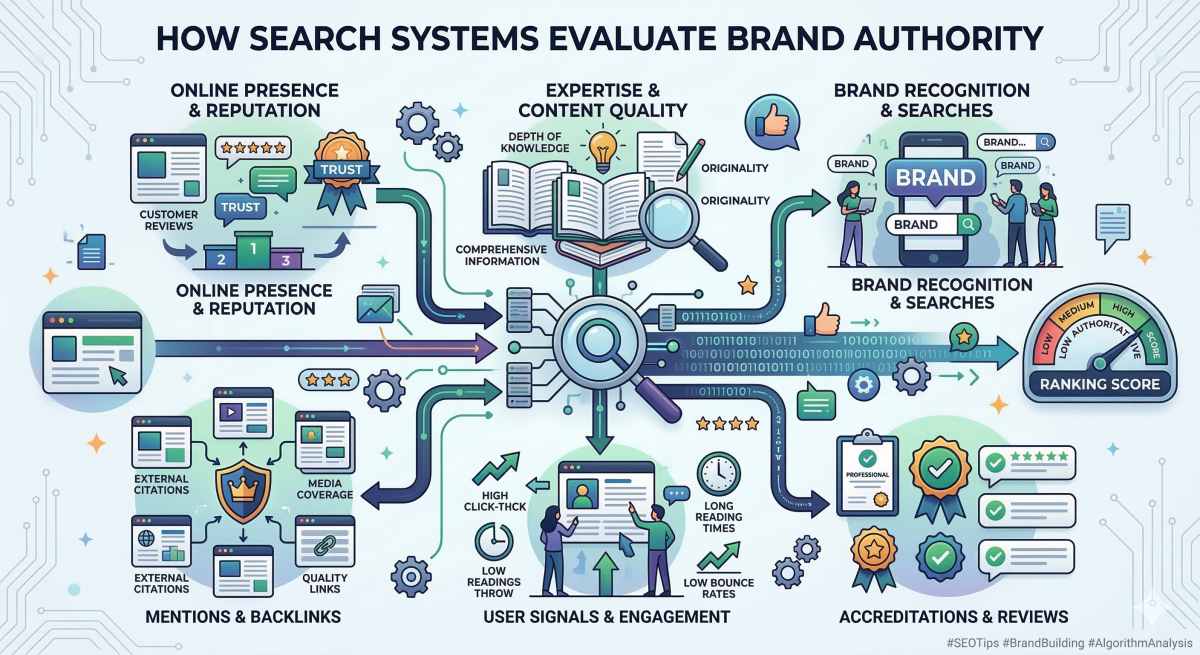
Understanding what systems look for helps you build the signals that matter.
From Keywords to Entities
Early search systems matched words on pages to words in queries. Link-based models added another layer, pages with more links from credible sites ranked higher. But this model treated pages as separate units. It didn’t account for who created the content, how often a source proved reliable, or whether users recognized the name behind the page.
Search systems have moved toward entity-based models. Instead of viewing each page in isolation, they identify organizations, brands, authors, and topics as connected entities. A brand becomes more than a domain, it becomes a known source with history, reputation, and relationships across the web.
How Entity Recognition Works
When a system recognizes your brand as an entity, it can link mentions across articles, profiles, reviews, and references. This allows evaluation of patterns: whether your source appears in trusted publications, whether experts cite it, whether users search for it by name.
Google’s Knowledge Graph and similar systems connect these signals. They associate your brand with specific topics, industries, and related entities. This context helps determine relevance and authority in ways a single page can’t demonstrate.
Quality Signals That Matter
Google’s Quality Rater Guidelines instruct evaluators to consider experience, expertise, creator credibility, and overall site reputation when judging content quality. While raters don’t directly influence rankings, their evaluations shape how systems assess quality signals at scale.
Key factors include:
Consistent topic coverage. Sites that publish regularly within defined subject areas demonstrate sustained expertise.
Clear authorship and editorial standards. Visible accountability signals reliability.
External validation. Mentions in trusted publications, analyst reports, and research provide independent confirmation of authority.
User recognition. Branded search demand shows that users seek out your name directly, a strong signal of established trust.
Why This Affects AI Systems Too
When AI tools retrieve and summarize information, they decide which sources carry enough weight to cite. Entity recognition allows these systems to draw from a pool of known and trusted brands rather than a broad set of pages that only match keywords.
Brand authority affects both whether you appear and how often you appear across related queries. In generative search, recognition and trust function as filters that determine which sources pass through to users.
| Quality Signal | What Systems Look For | Example |
|---|---|---|
| Consistent Topic Coverage | Regular publishing within defined subject areas | A cybersecurity firm publishing monthly threat analyses |
| Clear Authorship | Visible accountability and editorial standards | Named authors with bios and credentials |
| External Validation | Mentions in trusted publications and research | Coverage in analyst reports or trade journals |
| User Recognition | Branded search demand at scale | Users searching your company name directly |
Branded Search Demand: The Clearest Authority Signal
Branded search demand, queries that include your company name, product name, or closely associated terms, serves as one of the most direct signals of authority.
Why Branded Queries Matter
When users search for your brand by name, they demonstrate familiarity and intent that go beyond casual research. At scale, this creates a measurable pattern that search systems observe. Steady branded query volume indicates your source holds a place in users’ mental map of the market.
How Branded and Non-Branded Queries Differ
SparkToro’s research shows that navigational and branded searches result in site visits at much higher rates than broad informational queries, even as overall click-through rates decline. Users who already recognize your brand are more likely to move beyond on-page answers and summaries to access your site.
The Stability Effect
Moz’s analysis shows that sites with stronger branded search demand often experience greater ranking stability during major algorithm updates. When changes alter how systems weigh links, content, or technical signals, widely recognized brands tend to see less volatility than lesser-known sources.
This suggests brand demand correlates with long-term visibility resilience, not just current performance.
How to Measure Brand Demand
Branded vs. non-branded share. Compare the proportion of branded queries to non-branded queries in your search data. A rising share of branded searches often reflects growing awareness and trust.
Growth rate over time. Track branded search volume across quarters. Sustained growth suggests that marketing, public presence, and product performance reinforce recognition.
Autocomplete and related queries. When search systems suggest your brand name as users type, it reflects common user behavior at scale. Related query panels that cluster your brand with industry terms show how the system associates you within a topic space.
The Upstream Effect
Brand demand influences visibility before any individual page competes for a ranking. It shapes how search systems interpret relevance, which sources they consider familiar, and which names users recognize during research.
As AI summaries and reduced click behavior become more common, branded search demand provides a measurable way to track influence even when direct visits decline.
Trust, Reputation, and Conversion
Trust doesn’t just affect visibility, it affects what happens after exposure.
Trust as a Conversion Factor
In markets with high cost, risk, or long-term commitment, buyers look for signals that reduce uncertainty. Edelman’s research shows trust influences not just initial purchase decisions but also loyalty and advocacy. In search contexts, this means recognized brands often see higher engagement and conversion rates than unknown sources with similar content.
How Trust Affects Search Behavior
When a results page shows several sources, users often select the name they recognize or associate with expertise. Even when AI summaries answer a question directly, the presence of a known brand in the citation list can guide later behavior, users may return through branded search, visit directly, or reference the brand in internal discussions.
High-Consideration Markets
In software, professional services, healthcare, and financial services, buyers rarely act on a single interaction. They gather information across many sessions and consult multiple sources. Brand reputation helps filter options during this process. A source that appears reliable and familiar is more likely to receive attention at later stages: form submissions, meeting requests, pricing inquiries.
Trust Affects Content Perception
When a recognized brand presents data, case examples, or guidance, users often treat it as more credible than similar material from an unknown source. This affects engagement depth—users may spend more time on site, review more pages, or share material internally. These actions keep the brand part of the buying conversation as it moves across roles and departments.
The Form Barrier
Users often hesitate to submit contact details to unfamiliar sources. A recognized name can reduce this barrier. Brand authority supports both early-stage learning and later-stage conversion.
Connecting Trust to Outcomes
Higher engagement rates, stronger branded search growth, and increased direct visits often follow consistent visibility of a trusted source. While correlation doesn’t prove causation, these patterns align with the role trust plays in buyer research.
For your organization, this means brand authority functions as a performance factor, not just a reputation asset. It affects how search exposure translates into action.
| Trust Factor | Effect on User Behavior | Business Outcome |
|---|---|---|
| Brand Recognition on SERP | Users select the name they recognize | Higher click-through from results pages |
| Familiar Name in AI Citation | Guides later branded search or direct visits | Sustained visibility without immediate click |
| Credible Content Perception | Users spend more time, review more pages, share internally | Deeper engagement and cross-departmental influence |
| Reduced Form Barrier | Users more willing to submit contact details to known brands | Higher form completion and conversion rates |
Brand Authority in AI-Driven Search
AI systems follow a different process than traditional ranking. Understanding this process reveals why brand authority matters even more in generative search.
How AI Systems Build Answers
Instead of selecting and ordering pages by relevance, AI systems build responses. They interpret the query, retrieve documents from an index, extract passages, assemble a summary, and choose which sources to cite.
Google’s AI Overviews use a multi-source approach: the system runs several related searches, gathers information from multiple pages, and generates a combined summary with links to supporting sources. Visibility depends on whether the system retrieves and selects a passage from your content during summary construction, not just on your position in traditional listings.
Where Brand Authority Enters
At the retrieval stage, the system looks for content matching query intent with clear, factual material. During passage selection, it evaluates which sections best answer specific parts of the question.
Citation selection adds another layer. The system must decide which sources to display as references. Here, brand authority plays a direct role. A domain with long history, consistent publication in a topic area, and frequent mention by other trusted sources is more likely to appear as a reference than a new or isolated site.
Signals That Drive Selection
Domain history. Older sites with stable publishing patterns and clear topical focus often receive more consistent retrieval.
Third-party mentions. When respected publications, industry sources, or research outlets reference your brand, the system can connect those mentions to your recognized entity.
Cross-source consistency. When your brand presents the same facts, definitions, and claims across your site and external references, it reduces conflict in retrieval. This alignment makes it easier for systems to select and reuse your passages with confidence.
Content structure. Systems extract and evaluate at the passage level. Sections that open with clear answers followed by supporting details offer usable units for summary building.
The Repetition Effect
A recognized source may appear across multiple related queries, not because it matches every keyword, but because the system treats it as a reliable reference within a topic area. Over time, this repetition influences how users associate your brand with a subject.
Rethinking Search Performance
Visibility now includes how often your brand appears as a cited source during research, not just how many clicks a page receives. AI systems act as intermediaries that filter and frame information for users. Brands with established authority gain more chances to pass through that filter and remain present across the research process.
| AI Summary Stage | What Happens | Where Brand Authority Enters |
|---|---|---|
| Query Interpretation | System interprets user intent | Not directly affected by brand signals |
| Document Retrieval | System pulls content from index matching intent | Domain history and topical focus influence retrieval |
| Passage Selection | System extracts sections that answer specific parts | Content structure and clarity determine selection |
| Summary Assembly | System combines passages into a unified answer | Cross-source consistency reduces conflict |
| Citation Selection | System decides which sources to display as references | Brand recognition, third-party mentions, and domain authority drive citation |
Building Authority Through External Presence
Brand authority forms across more than your own website. Search and AI systems evaluate how your brand appears across the wider web.
Why External Validation Matters
When your brand appears in trusted third-party material, it gains independent validation. Analyst reports, trade journals, and major publishers apply editorial standards and attribution. These references allow search systems to associate your brand with defined subjects, organizations, and industries through entity recognition.
Types of External Presence
News and media coverage. Mentions in major publications and industry news create signals systems can connect to your entity.
Research and analyst reports. Coverage in formal research provides structured, attributable references that support authority evaluation.
Industry publications and trade media. Consistent presence in your sector’s key outlets builds topical association.
Professional networks and communities. Discussion in peer conversations and expert forums adds context about how your brand appears in professional discourse.
The Stability Connection
Moz’s research notes that sites and brands with frequent independent mentions across domains often show more stable performance during search system updates. This pattern suggests a relationship between widespread recognition and resilience.
Measuring External Presence
Track brand mentions across trusted domains. Monitor how often your brand appears in major publishers, analyst firms, and industry sources.
Monitor editorial backlinks. Links from recognized sources that appear in editorial context—not outreach—often signal genuine authority.
Track coverage in high-authority publications. Mentions in market studies, research papers, and trade media include structured language and clear attribution that supports consistent association between your brand and topic area.
Together, these signals describe your brand’s presence across the information landscape. A wide and consistent footprint increases the chances that search and AI systems will surface your brand as a reference during user research.
Citation As a Visibility Metric
When AI summaries answer questions directly on the results page, traditional metrics miss much of your actual exposure.
The Visibility You Can’t See in Analytics
SparkToro’s research shows more than half of searches end without a site visit. Many users complete research while staying on the results page. The only exposure your brand receives may come from how it appears inside summaries, panels, or citation lists.
Seer Interactive’s analysis adds detail: click-through rates fall sharply when AI summaries appear, but cited sources still gain screen placement. This creates repeated brand exposure during research sessions, even without clicks.
Metrics That Capture Citation Visibility
Citation frequency. Track how often your domain appears as a reference across a defined group of queries. This shows whether systems retrieve and use your content during answer construction.
Brand mention density. Some summaries cite a source once; others mention a brand multiple times across related queries. Tracking mention frequency over time shows whether you hold a stable position in a topic area.
Source persistence. A source appearing across multiple related queries or during query refinement suggests the system treats it as a reliable reference. A source appearing only once may match a narrow case but lack broader authority.
Why This Matters
These measures focus on system behavior rather than user action. They show how often your brand passes through retrieval and citation processes, explaining performance changes that traditional analytics miss, like strong branded search growth paired with flat site traffic.
Citation becomes a form of presence. It influences user perception during learning and evaluation, even without a visit. Tracking reference status helps explain how search systems present your brand within AI-driven results.
Framework for Evaluating Brand Authority
Brand authority can be assessed through four connected dimensions. Each reflects how systems and users recognize, trust, and reuse your source during research.
1. Search Demand Strength
Branded queries show whether users seek out your name directly. Key indicators:
- Growth in branded search volume over time
- Stable demand during algorithm changes
- Rising share of branded vs. non-branded queries
Strong demand reflects established awareness and trust. Stability during ranking changes indicates resilience.
2. Trust and Reputation Signals
External validation from credible sources provides independent confirmation. Key indicators:
- Coverage in respected publications and analyst reports
- Mentions in independent research
- References from recognized industry sources
These signals provide context that search systems can connect to your brand entity.
3. Authority Footprint Across Domains
How widely your brand appears across trusted sites affects retrieval opportunities. Key indicators:
- Presence across news, research, and industry sites
- Editorial backlinks from recognized sources
- Mentions in professional platforms and communities
A narrow footprint limits retrieval opportunities. A broad footprint increases the contexts where systems associate your brand with relevant topics.
4. Citation Presence in AI Summaries
Whether generative systems select your brand as a reference during answer construction. Key indicators:
- Citation frequency across related queries
- Persistence across query refinements
- Competitive share of citations within your topic area
High citation rates suggest systems treat your source as reliable. Low rates may indicate structure, evidence, or authority gaps.
How These Dimensions Connect
These signals work together. Strong branded demand without external references may limit system confidence. Wide mentions without branded search may signal visibility without recognition. Citations without persistence may reflect narrow relevance rather than broad authority.
Effective evaluation tracks all four dimensions and looks for gaps between them.
Operational Practices
Building and measuring brand authority requires coordination across teams and consistent tracking over time.
Brand Authority Audit
Map where your brand appears across news, research, and industry sites. Identify gaps in coverage and opportunities to expand presence in high-authority contexts.
Competitive Source Analysis
Compare which brands receive citations inside AI summaries for topics you care about. Track citation share changes over time to identify rising or falling authority within your category.
Entity Coverage Tracking
Monitor changes in branded search demand, mention volume, and citation frequency across reporting periods. Look for correlations between external presence and search performance.
Cross-Team Alignment
Public relations, content, SEO, and analytics teams need to work from the same definition of brand authority. Coverage in industry media should feed into search planning. Content teams can use external signals to guide topic focus. SEO teams can map where brand signals appear across queries and summaries.
Executive Reporting
Connect brand authority metrics to business outcomes. Review how changes in brand demand relate to lead quality, sales acceptance, and deal size. Compare citation trends with branded search and direct visits. Match trust indicators with conversion patterns.
| Practice | Owner / Team | Frequency | Output |
|---|---|---|---|
| Brand Authority Audit | SEO + PR | Quarterly | Map of brand presence across news, research, and industry sites |
| Competitive Source Analysis | SEO + Content | Monthly | Citation share comparison across AI summaries for target queries |
| Entity Coverage Tracking | Analytics | Monthly | Dashboard tracking branded search demand, mention volume, citation frequency |
| Cross-Team Alignment | All (PR, Content, SEO, Analytics) | Quarterly | Shared definitions, unified measurement framework |
| Executive Reporting | Analytics + Leadership | Quarterly | Report connecting brand authority metrics to lead quality, conversion, and revenue |
Risks and Limitations
Brand authority systems aren’t perfectly fair or fully transparent.
Scale Advantages
Large, established brands appear more often in news coverage, research reports, and high-profile publications. Search and AI systems draw from these sources when evaluating trust. This can make it harder for smaller or newer sources to gain visibility, even when their content meets quality standards.
Data Gaps
Most search platforms don’t provide direct reporting on AI citation behavior or entity weighting. You can see rankings, clicks, and impressions—but not how often a system retrieves or rejects your content during summary construction. Teams must rely on manual sampling or third-party tools with limited accuracy and scale.
Regulatory Uncertainty
Publishers and policymakers have raised concerns about how AI systems select and credit sources. Ongoing discussions focus on transparency, source rights, and treatment of original content. These debates may lead to changes in how systems display citations or how much control publishers retain.
Organizational Fragmentation
Building brand authority requires coordination across marketing, communications, and analytics. When these groups work in isolation, brand signals become fragmented. PR may drive coverage that SEO teams don’t track. Content teams may publish material lacking external validation. Without shared measurement, you can’t connect authority-building efforts to search outcomes.
These limits don’t block progress, but they define what’s realistic. Brand-led visibility depends on both external recognition and internal coordination.
Where Brand Signals Are Headed

Several trends point to the growing role of brand authority in search and generative systems.
Current Trajectory
AI summaries continue expanding across more query types—from informational searches into product research, service comparisons, and technical topics. As this layer grows, systems rely more on trusted sources to reduce error risk.
Entity-based evaluation shows deeper integration. Search platforms increasingly link content to established organizations, authors, and institutions. Structured knowledge systems help confirm identity and topic focus, strengthening the role of brand signals.
Emerging Patterns
Systems show increased use of structured data and reference sources. Research publications, major news outlets, and analyst firms publish in formats supporting clear extraction and attribution. This can reinforce visibility for brands already appearing in these environments.
Speculative Possibilities
Some possibilities remain unconfirmed but worth planning for:
Brand-level weighting. Instead of evaluating only page quality, systems may apply broader reputation scores reflecting citation history, external mentions, and institutional backing.
Paid placement in summaries. Platforms may allow brands to pay for labeled placement or preferred citation inside AI-generated answers, similar to current ad placements.
Formal authority scoring. Retrieval systems could assign internal trust values to domains based on consistency, accuracy, and external validation, affecting how often a source appears across topics.
These remain speculative. Treat them as planning inputs rather than confirmed direction.
Key Takeaways
Brand authority now functions as a core signal in how search and AI systems select and present sources.
Visibility has expanded beyond rankings. Citation inside AI summaries, branded search demand, and cross-web presence now shape exposure as much as page position. More than half of searches end without a click, your brand name inside an answer may be the only exposure you get.
Systems evaluate brands as entities. Search platforms connect mentions, references, and user behavior to build a picture of your authority within topic areas. This context influences both ranking and retrieval decisions.
Branded search demand signals trust. Users searching for your name by choice demonstrate recognition that systems observe. Strong branded demand correlates with ranking stability and retrieval preference.
External validation builds authority. Coverage in trusted publications, analyst reports, and industry sources provides signals that systems use to evaluate credibility. A broad footprint across the web increases retrieval opportunities.
Citation is a new form of visibility. Track how often your brand appears inside AI-generated summaries, not just clicks and rankings. Citation frequency, mention density, and source persistence reveal exposure that traditional analytics miss.
Trust affects conversion. Recognized brands see higher engagement and conversion rates. Authority supports both early-stage learning and later-stage action.
Measurement must evolve. Combine brand demand, external presence, and citation tracking with traditional metrics. Look for gaps between dimensions, strong demand without external validation, or wide mentions without citation presence.
Coordination is essential. Brand authority builds across PR, content, SEO, and analytics. Without shared definitions and measurement, efforts fragment and connections to search outcomes get lost.
Organizations that treat search systems as information filters, not just ranking engines, can plan more effectively for how users and machines encounter their brand during learning and evaluation.
FAQs
Brand authority is the measurable recognition and trust that search engines and AI systems assign to your brand as an entity, not just individual pages. It matters now because more than half of Google searches end without a click, and AI Overviews are reducing click-through rates by up to 61% on informational queries. In this environment, your brand name appearing inside an AI-generated summary or citation list may be the only exposure you get. Search systems have moved from evaluating pages in isolation to evaluating brands as entities with history, reputation, and patterns of reliability. This means visibility increasingly depends on whether systems recognize and trust your source, not just whether your page matches a keyword.
Branded search demand, queries where users search for your company or product by name, is one of the strongest signals of authority. When users seek out your brand directly, it demonstrates familiarity and intent that search systems observe at scale. According to Moz’s analysis, sites with stronger branded search demand often experience greater ranking stability during major algorithm updates, meaning widely recognized brands tend to see less volatility when ranking signals change. Branded searches also result in site visits at much higher rates than broad informational queries, even as overall click-through rates decline. Tracking your branded vs. non-branded query share, growth rate over time, and autocomplete presence gives you a measurable view of how recognition is building.
AI systems don’t just rank pages — they build answers. Google’s AI Overviews run multiple related searches, gather information from several pages, extract passages, assemble a summary, and then choose which sources to cite. Brand authority enters this process at multiple stages. During retrieval, systems favor domains with long history and consistent topical focus. During passage selection, they look for clearly structured content with direct answers followed by supporting details. During citation selection, they evaluate which sources carry enough weight to reference, and a domain with frequent third-party mentions, cross-source consistency, and established entity recognition is more likely to be cited than a new or isolated site. This means your brand’s reputation across the web directly influences whether you appear inside AI-generated answers.
Citation visibility measures how often your brand appears as a referenced source inside AI summaries, knowledge panels, and on-SERP answers, rather than how many clicks or rankings your pages earn. Traditional SEO metrics like position tracking, session growth, and page-level performance show who clicks, but they miss the exposure that happens when users complete their research directly on the results page without visiting your site. Key citation metrics include citation frequency (how often your domain is referenced across target queries), brand mention density (how many times you appear across related queries), and source persistence (whether your brand continues to appear as users refine their searches). These metrics explain performance patterns that traditional analytics can’t, like strong branded search growth paired with flat site traffic.
Building brand authority requires coordinated effort across four dimensions: search demand strength, trust and reputation signals, authority footprint across domains, and citation presence in AI summaries. Practically, this means conducting quarterly brand authority audits to map where your brand appears across news, research, and industry sites. It means running monthly competitive source analyses to compare which brands receive citations inside AI summaries for your target topics. It also requires cross-team alignment, PR, content, SEO, and analytics teams need to work from the same definition of brand authority so that coverage in industry media feeds into search planning and content teams can use external signals to guide topic focus. At the executive level, connect brand authority metrics to business outcomes by reviewing how changes in branded search demand relate to lead quality, conversion rates, and deal size.
Resources
- Google Search Central – E-E-A-T and Quality Rater Guidelineshttps://developers.google.com/search/docs/fundamentals/creating-helpful-content#eeat
- Moz – Brand Signals and Search Visibilityhttps://moz.com/blog/category/brand
- SparkToro – Branded Search and Zero-Click Researchhttps://sparktoro.com/blog/
- Seer Interactive – Brand, AI Overviews, and Visibility Researchhttps://www.seerinteractive.com/insights/
- Edelman Trust Barometerhttps://www.edelman.com/trust/trust-barometer
Kim Greer
OFP Law
One of the best business decisions I ever made was to contract with 321 Web Marketing. Jonathan Gessert and his team are knowledgeable, efficient, and effective, making digital marketing goals easy to achieve and helping [...]

Kelly Cole
Business Benefits Group
My company hired 321 Web Marketing in February 2016 to resurrect our web site. We feel our web site is the face to our business and desperately needed a make over. 321 took us from blah to WOW effortlessly and what a difference [...]
Emily Hawkins
Diener & Associates
Thanks to 321 Web Marketing, the client has seen an increase in their search engine leads, averaging 12 qualified leads per month. The client has also achieved prominent Google Maps and search placement. The team manages the engagement [...]
Trevor Telesz
Paw Pals Pet Sitting
321 Web Marketing successfully translated the client’s design into a stunning and refreshed website, ensuring seamless functionality across all dynamic views. The team provided clear timelines and stuck to them, keeping everything [...]

Corey Davis
Spartan Animal & Pest Control
321 Web Marketing is truly phenomenal at what they do. Their ability to communicate and describe the steps and actions that they are implementing , Alex Zarpas in particular, is excellent. Delivering on promises is all they have done for me [...]
Alec Roberts
MFE Insurance
I can’t say it enough, Jonathan and his team have gone above and beyond since day one to accommodate our needs and meet our goals. I run a specialty insurance brokerage based in LA and once we found 321 we never looked [...]

Richard Wilbur III
Advantage.Tech
Thanks to 321 Web Marketing’s web development work, the client increased rankings and traffic from search engines. Also, their business secured prominent positions on Google Maps and industry-relevant, profitable keywords. The client also [...]

Bruce Gemmill
FVCbank
After the website revamp, the client saw a steady rise in leads from search engines, resulting in additional traffic. 321 Web Marketing is highly punctual when it comes to deliverables, and internal stakeholders are impressed with the service [...]
Drew Weeks
VAE
321 Web Marketing delivered a sleek website that accurately portrays the size and quality of the client’s organization. All of their completed websites have received positive feedback from users who have been impressed by the UX/UI. The [...]

Ryan Masten
Masten Pools
321 Web Marketing has increased the client’s leads from zero to 53 monthly. Their SEO efforts pay off impressively due to a top-ranking position on Google and making the site the number one result for several local service keywords. The [...]