


 Mar 8, 2026 ·
  7 min read ·
  Summarize in ChatGPT
Withover 5 trillion searches annually, Google Search dominates the search engine market. A position that it has maintained for over two decades, necessitating that digital marketers optimize their campaigns to secure top positions on Google search engine results pages.

Generally, ranking on Google’s first search results page translates to greater visibility and click-through rates (CTR) for websites, as it is widely believed that results on the first page are most relevant and authoritative.
As competition for first-page visibility intensifies, it makes sense for marketers to continually tweak their search engine optimization (SEO) strategies to meet Google’s requirements for niche authority and relevance.
However, that pattern is now changing.
Since the initial rollout in 2024, Google AI overviews have been drastically changing the field of search results, especially impacting organic website traffic and clicks.
This article will help you understand how and why Google AIO impacts visibility and CTR, but first, what defines a Google AIO?
What are Google AIOs?
Google AI overviews are AI-powered, auto-generated summaries that often appear at the top of certain search results.
According to Google2, these summaries are meant to provide users with a quick snapshot of key information about a queried topic, enabling them to explore the web more easily.
AIOs typically have four core components:
- Concise answer: Usually a block of paragraphs that provides a direct and concise answer to a query.
- Highlights and key points: Follows the first paragraph, and includes a thematic breakdown of the answer in bullet points.
- Citations/sources: Available as embedded links and in a dropdown menu that points users to the sources of information provided in the response.
- “Dive deeper in AI mode”: A CTA, right at the bottom of the overview, directing users off the results page to a dedicated page where AI (Google Gemini) provides a more expansive answer for the given query.
Since AIO provides direct answers at the top of results pages, users feel less inclined to click through to websites that appear below the AIOs.
Consequently, many sites are seeing decreased visibility and lower CTR.
What the Data Says: Impact of AIO on SEO Strategies

Although AIOs appear to have taken over the top of Google SERP, AI overviews only appeared for about 16% of keywords by November, 2025, according to Semrush3.
The presence (or absence) of AIO in search results is dependent on the primary search intent of a given query:
- 57% of informational queries account for 57% of AIOs, a sharp decline from 91.3% in January, 2025.
- Commercial queries (18.57%)
- Transactional queries (~14%)
- Navigational queries (10%)
How AIOs Are Changing SEO and CTR Performance
Initially, it was easier to ignore AIOs since they generally targeted low-risk, informational queries that had little impact on ad revenues.
However, as Google continues to refine AIOs and focus on more competitive queries towards the end of 2025, it is no longer business as usual for digital marketers.
It is no longer enough for SEO strategies to target first pages; marketers must also refine SEO strategies to target AIOs.
Semrush research also shows that People Also Ask and Related Searches are practically guaranteed to appear alongside AIOs 90.03% and 95.3% of the time, respectively.
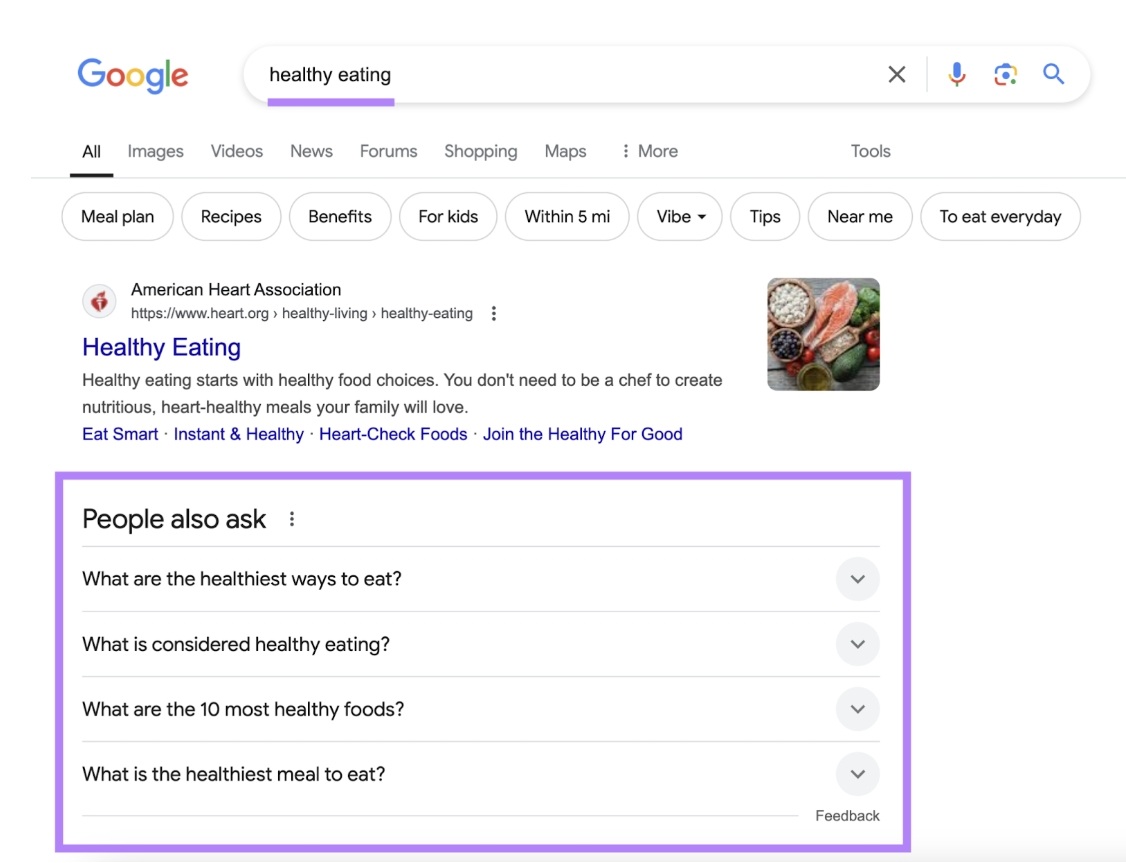
With most users’ attention strategically confined to AIOs and accompanying SERP features, sites listed in the results page are less visible, leading to a decline in both organic (down by up to 70%)4 and paid CTRs (down by up to 12% points) over time.
The rate of decline in CTR varies across keywords that trigger AIO.
Additionally, nDash reports that even when a site ranks at the top of the results page, users, in trying to skip AIOs, often skipped the top-ranking result to click the first runner-up.
These changes signal that it’s time for marketers to redesign their SEO strategies to effectively target AIOs, SERPs, and SERP features that appear alongside AIOs.
Adapting SEO Strategies for AIOs
Google maintains that foundational SEO best practices still apply in AI search. And at a high level, that’s true but execution now requires greater precision.
AI Overviews are not eliminating visibility opportunities. They are redistributing them.
Organizations that respond strategically rather than react defensively are better positioned to protect traffic and expand discoverability. Below are three priority adjustments.
1. Elevate Tool Sophistication
Modern search environments demand deeper visibility into SERP behavior.
Leading platforms such as Moz and Ahrefs have expanded their capabilities to track AI-triggered queries, citation patterns, and brand presence within AI-generated summaries.
For executive teams, this is less about “using tools” and more about upgrading insight infrastructure. Without AI-aware tracking, forecasting and performance modeling become increasingly unreliable.
The objective shifts from ranking alone to controlling share of visibility across both traditional and AI-driven results.
2. Rebalance Organic and Paid Exposure

AI Overviews compress organic click distribution, particularly for informational queries.
However, paid placements are not consistently paired with AI Overviews, and CTR erosion in paid search has generally been less severe.
For leadership teams evaluating channel allocation, this suggests a temporary rebalancing opportunity. Paid search can serve as a stabilizing lever while organic strategy evolves to compete in AI-dominated environments.
3. Prioritize Intent Where AI Saturation Is Lower
AI Overviews disproportionately target informational searches.
Commercial, transactional, and navigational queries currently face less AI competition and retain stronger click-through predictability.
This creates a near-term advantage for organizations that:
- Tighten intent alignment
- Refocus high-value landing pages
- Prioritize bottom- and mid-funnel keyword groups
As AI expands into additional search categories, that window may narrow. Strategic timing matters.
Overall Strategic Perspective
AI Overviews represent structural change, not collapse.
Visibility is no longer confined to “rank position.” It now includes citation inclusion, brand reinforcement within summaries, and cross-channel reinforcement.
Organizations that treat AI search as a measurable visibility layer rather than a threat to traditional SEO are more likely to preserve authority and market share as the SERP continues to change.
Looking Forward to More Competitive Google Search

Google’s AIO first started in 2023 as an experiment tagged Searched Generative Experience. In 2024, they brought the experiment to the public, starting with the U.S. market.
Today, Google AI Overview is available in 11 languages, serving more than 120 countries and territories.
Google has also been experimenting with the placement of the AIO block in various sections of the results page, as well as putting videos, forums, and People Also Ask ahead of sites in the results page.
Clearly, the platform is continuously working to find new ways to maximize outcomes. And for the everyday site owner and content creator, it could be very hard to keep up.
321 Web Marketing, a certified Google Partner, helps businesses, entrepreneurs, and content creators stay on top of the Google search evolution, ensuring that users always rank effectively across the board. Connect with us online to schedule your meeting today.

Kim Greer
OFP Law
One of the best business decisions I ever made was to contract with 321 Web Marketing. Jonathan Gessert and his team are knowledgeable, efficient, and effective, making digital marketing goals easy to achieve and helping [...]

Kelly Cole
Business Benefits Group
My company hired 321 Web Marketing in February 2016 to resurrect our web site. We feel our web site is the face to our business and desperately needed a make over. 321 took us from blah to WOW effortlessly and what a difference [...]

Emily Hawkins
Diener & Associates
Thanks to 321 Web Marketing, the client has seen an increase in their search engine leads, averaging 12 qualified leads per month. The client has also achieved prominent Google Maps and search placement. The team manages the engagement [...]
Trevor Telesz
Paw Pals Pet Sitting
321 Web Marketing successfully translated the client’s design into a stunning and refreshed website, ensuring seamless functionality across all dynamic views. The team provided clear timelines and stuck to them, keeping everything [...]

Corey Davis
Spartan Animal & Pest Control
321 Web Marketing is truly phenomenal at what they do. Their ability to communicate and describe the steps and actions that they are implementing , Alex Zarpas in particular, is excellent. Delivering on promises is all they have done for me [...]

Alec Roberts
MFE Insurance
I can’t say it enough, Jonathan and his team have gone above and beyond since day one to accommodate our needs and meet our goals. I run a specialty insurance brokerage based in LA and once we found 321 we never looked [...]

Richard Wilbur III
Advantage.Tech
Thanks to 321 Web Marketing’s web development work, the client increased rankings and traffic from search engines. Also, their business secured prominent positions on Google Maps and industry-relevant, profitable keywords. The client also [...]

Bruce Gemmill
FVCbank
After the website revamp, the client saw a steady rise in leads from search engines, resulting in additional traffic. 321 Web Marketing is highly punctual when it comes to deliverables, and internal stakeholders are impressed with the service [...]
Drew Weeks
VAE
321 Web Marketing delivered a sleek website that accurately portrays the size and quality of the client’s organization. All of their completed websites have received positive feedback from users who have been impressed by the UX/UI. The [...]

Ryan Masten
Masten Pools
321 Web Marketing has increased the client’s leads from zero to 53 monthly. Their SEO efforts pay off impressively due to a top-ranking position on Google and making the site the number one result for several local service keywords. The [...]