




 Sep 16, 2026 ·
  9 min read ·
  Summarize in ChatGPT
The 90-Day Standard
- Month 1: the agency learns your business.
- Month 2: the agency fixes your foundation and starts producing work.
- Month 3: the agency delivers data you can verify. If that sequence does not happen, the relationship is already off track.
You just signed with a new marketing agency. The contract is in place, the kickoff call is on the calendar, and the team is ready to move. Now what?
The first 90 days are the most important phase of any agency relationship, and often the most frustrating. The agency needs time to learn the business before it can produce informed work. You need to see progress before you trust the investment. Both timelines are legitimate, and managing the tension between them is what separates a strong onboarding from a slow drift into disappointment.
Whether this is your first agency or your third, the expectations should be the same. A strong agency follows a clear sequence: research the business, fix the foundation, produce measurable work, and deliver data the marketing team can verify. A weak agency skips steps, ships generic deliverables, and hopes activity looks enough like progress to hold the account.
This guide covers what should happen each month, what you should see as evidence, and what red flags tell you the relationship needs intervention before it costs another quarter.
Month | What a Strong Agency Delivers | The Red Flag to Watch For |
| Month 1 | Written roadmap, audit report, content plan, tracking setup | Three weeks pass after kickoff with no written deliverable |
| Month 2 | Website work, first content, paid campaigns active, regular updates | Content is generic and shows no connection to month-one research |
| Month 3 | Lead-source report, early CPQL, strategy adjustment, quarterly review | Reporting still centers on traffic with no qualified lead data |
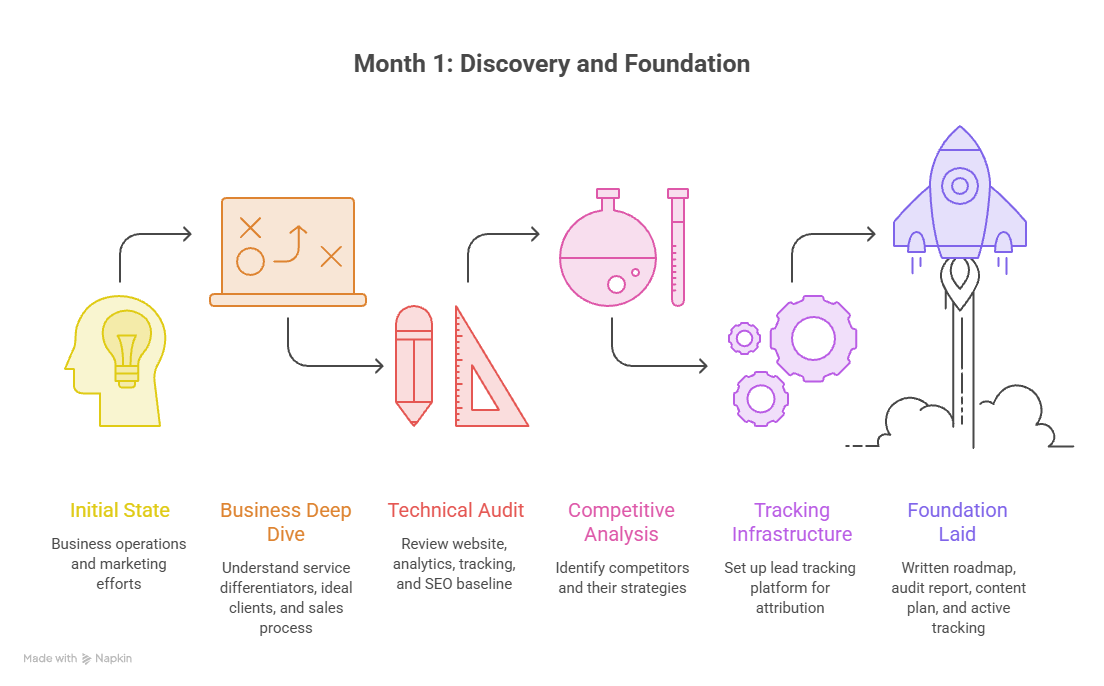
Month 1: Discovery and Foundation
The first month is diagnostic. The agency should spend it learning how the business generates qualified opportunities and how marketing connects to the sales process. That research should visibly affect the plan that follows.
What Should Happen
A deep dive into the business. Service differentiators, ideal client profile, competitive positioning, and sales process.
The agency should understand which services produce the largest contracts, which buyer types convert most often, and what objections stall deals. At larger organizations, this means stakeholder interviews beyond the primary marketing contact, including sales leadership, location managers, and subject matter experts.
A technical audit of the current state. The agency should review the website, analytics configuration, tracking setup, and SEO baseline before making changes. Google Search Console shows which searches currently bring visitors. GA4 configuration determines whether conversions are being counted accurately. Google Ads allows actions recorded in Analytics to count as conversions, and Google’s conversion documentation explains how those systems connect. If the wrong action is counted as a conversion, reporting starts on a false baseline.
A competitive analysis. The agency should identify who ranks for the searches that matter to your business and what those competitors are doing that you are not.
Tracking infrastructure. A lead tracking platform should be in place or actively being configured so phone calls and form submissions can be attributed to their source from day one.
What You Should See by Day 30
- A written roadmap connecting business priorities with the next 60 to 90 days of planned work
- An audit report that identifies specific problems in priority order
- A content and keyword plan explaining which searches the agency will target and why
- Tracking that is active or has an owner and a completion date
- For companies serving multiple markets, a plan for local SEO reporting that separates performance by location
Red Flags in Month 1
- The agency jumps straight to producing content or running ads without completing the business research
- No audit or baseline measurement is documented
- The kickoff call happens and then three weeks pass with no written deliverable
- The agency asks few questions about your sales process, deal size, or buyer profile
Month 2: Execution and Alignment
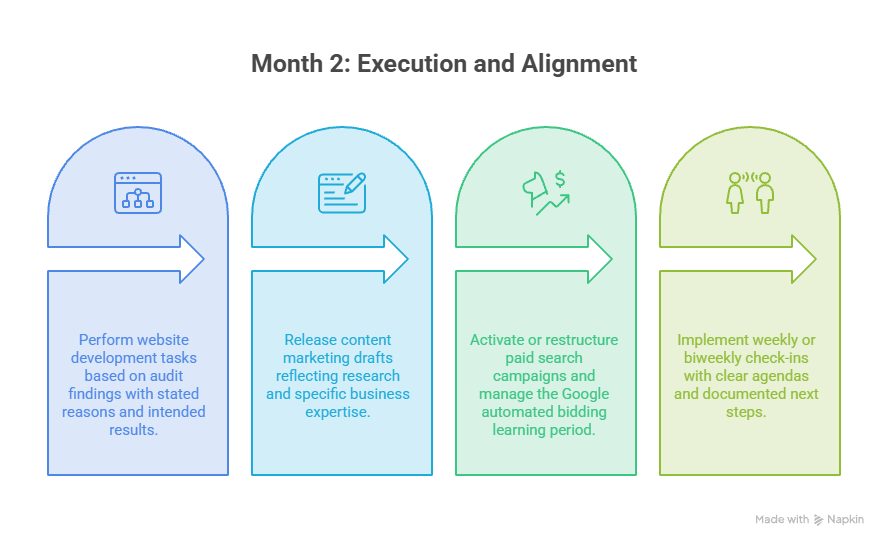
By month two, the agency should be producing work tied directly to the priorities identified in month one. The connection between the audit findings and the work being executed should be visible and explainable.
What Should Happen
Website work based on the audit. Different problems require different responses. A page that Google cannot access needs a technical fix before more content is added. A page that already receives qualified traffic may need clearer conversion paths. Each website development task should have a stated reason and a result it is meant to improve.
First content published. The first content marketing drafts should reflect information gathered during month one. A strong article contains questions, examples, and service details that match what buyers actually discuss before making a purchasing decision. Sales teams are a useful check: if the content sounds like something a competitor could have written without knowing your business, it is not specific enough.
Paid campaigns launched or restructured. If paid search is part of the engagement, month two is when campaigns should be active or restructured based on the account review. Google’s automated bidding can take up to three weeks to calibrate depending on conversion volume. The agency should set expectations for this learning period while still reviewing ad performance and lead quality.
Communication cadence established. Weekly or biweekly check-ins should be running by this point with clear agendas and documented next steps.
What You Should See by Day 60
- Website updates available for review
- Content moving through drafts and approvals that reflects your company’s actual expertise
- Paid campaign reports showing what changed and why
- Regular status updates with completed work and upcoming priorities
- A metrics dashboard or reporting view where early data is beginning to flow
Red Flags in Month 2
- Content is obviously generic, reads like it came from a content mill, or shows no evidence of the month-one research
- No communication happens unless you initiate it
- The agency responds to status questions with “we’re working on it” but cannot name what was completed this week
- For multi-location companies, location-level tracking is not in place or planned
Month 3: First Results and Adjustment
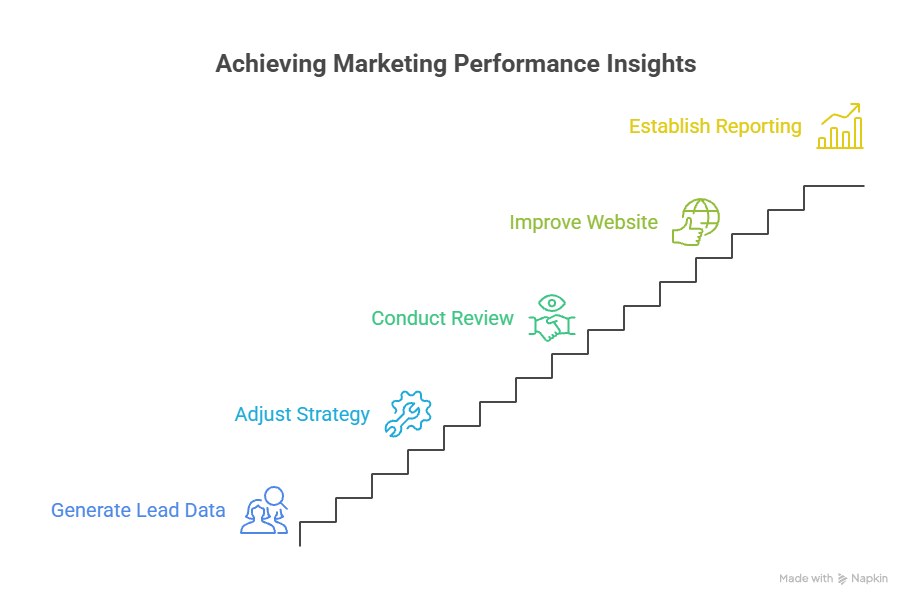
By month three, the agency should have enough early performance data to connect marketing activity to lead quality. The numbers may come from a small sample, but the reporting framework should be in place and producing data the marketing team can verify.
What Should Happen
A first monthly report with lead data, not just traffic data. The report should show which sources produced inquiries, how many of those inquiries met the company’s qualification standard, and what the early cost per qualified lead looks like by channel. A lead generation benchmark gives that number additional context, while the company’s own results show how performance changes over time.
Strategy adjustment based on what the first two months revealed. If organic traffic is growing but qualified leads are flat, the content plan may need to shift toward searches with stronger commercial intent. If paid search is producing volume but lead quality is low, targeting or keyword selection may need to change. The agency should name what it learned and what it is adjusting in response.
A quarterly review meeting. The first formal review should cover what worked, what did not, and what the plan for months four through six looks like. Both the executive summary and the tactical detail should be available for different audiences.
What You Should See by Day 90
- Lead sources traceable through call tracking and form records
- Reports that separate marketing activity from business results
- An early cost per qualified lead calculation, even if the sample is small
- A next-quarter plan that builds on what the data showed, not a copy of the original plan
- Your website should look and perform noticeably better than it did 90 days ago
- For larger engagements, both executive-level and tactical reporting showing where the program stands
Red Flags in Month 3
- The report is still centered on traffic, impressions, or “keyword visibility scores” with no lead data
- No lead tracking is in place after 90 days
- The strategy has not changed from the original plan despite two months of data
- You still cannot answer the question: how many qualified leads did we generate this month, and what did each one cost?
How Long Before You See Results
Marketing results follow different timelines by channel. Setting expectations before work begins prevents premature judgments about whether the program is working.
SEO: Expect to see meaningful organic traffic improvements in four to six months. Qualified leads from organic search typically follow in six to nine months. Google’s SEO Starter Guide notes that changes can take anywhere from hours to several months to appear in search results. The timeline depends on site history, competition, and the scale of the changes being made.
Paid search: Should generate leads within the first 30 to 60 days if the campaign is set up properly. Automated bidding learning periods and lead volume affect how quickly the data becomes reliable for optimization decisions.
Website: A rebuilt or redesigned site should launch within approximately 12 weeks, with conversion improvements visible once the pages receive relevant traffic.
Content: Individual pages may rank within weeks for lower-competition searches. Competitive terms take months. The agency should track which searches each page targets and how visitors respond after reaching the site.
The bottom line: if your agency cannot show you qualified lead data by month three, something is off. The sample may be small. The numbers may be early. But the measurement framework should be producing data you can verify.
For larger budgets ($15,000 or more per month): the timeline does not change, but the breadth of simultaneous activity should be wider. More locations covered, more content produced, more channels active, and reporting segmented by the business units leadership actually manages.
The First 90 Days at 321 Web Marketing
This is how we onboard every client. Month one: learn your business. Month two: fix your foundation and start producing work. Month three: deliver data.
For our SEO lead generation program, many clients begin seeing qualified inbound inquiries within 60 to 90 days, though timing varies by account, industry, and competitive environment.
Want to see what the first 90 days would look like for your company? Schedule a consultation and we will walk you through the process against your specific situation.

Kim Greer
OFP Law
One of the best business decisions I ever made was to contract with 321 Web Marketing. Jonathan Gessert and his team are knowledgeable, efficient, and effective, making digital marketing goals easy to achieve and helping [...]

Kelly Cole
Business Benefits Group
My company hired 321 Web Marketing in February 2016 to resurrect our web site. We feel our web site is the face to our business and desperately needed a make over. 321 took us from blah to WOW effortlessly and what a difference [...]

Emily Hawkins
Diener & Associates
Thanks to 321 Web Marketing, the client has seen an increase in their search engine leads, averaging 12 qualified leads per month. The client has also achieved prominent Google Maps and search placement. The team [...]

Trevor Telesz
Paw Pals Pet Sitting
321 Web Marketing successfully translated the client’s design into a stunning and refreshed website, ensuring seamless functionality across all dynamic views. The team provided clear timelines and stuck to them, [...]

Corey Davis
Spartan Animal & Pest Control
321 Web Marketing is truly phenomenal at what they do. Their ability to communicate and describe the steps and actions that they are implementing, Alex Zarpas in particular, is excellent. Delivering on promises is all [...]

Alec Roberts
MFE Insurance
I can’t say it enough, Jonathan and his team have gone above and beyond since day one to accommodate our needs and meet our goals. I run a specialty insurance brokerage based in LA and once we found 321 we never looked [...]

Richard Wilbur III
Advantage.Tech
Thanks to 321 Web Marketing’s web development work, the client increased rankings and traffic from search engines. Also, their business secured prominent positions on Google Maps and industry-relevant, profitable [...]

Bruce Gemmill
FVCbank
After the website revamp, the client saw a steady rise in leads from search engines, resulting in additional traffic. 321 Web Marketing is highly punctual when it comes to deliverables, and internal stakeholders are [...]

Drew Weeks
VAE
321 Web Marketing delivered a sleek website that accurately portrays the size and quality of the client’s organization. All of their completed websites have received positive feedback from users who have been [...]

Ryan Masten
Masten Pools
321 Web Marketing has increased the client’s leads from zero to 53 monthly. Their SEO efforts pay off impressively due to a top-ranking position on Google and making the site the number one result for several [...]