



Table of Contents
- 1. Introduction
- 2. The Inbound Conversion Problem: Why Traffic Alone Does Not Equal Revenue
- 3. Mapping Content to Buyer Intent: The Foundation of Conversion
- 4. Designing Conversion Paths for Every Intent Level
- 5. Lead Capture Mechanics: Optimizing Forms, CTAs, and Landing Pages
- 6. The Gated vs. Ungated Content Strategy
- 7. Lead Nurturing: Moving Leads Toward Sales Readiness
- 8. Lead Scoring and Qualification: Separating Signal From Noise
- 9. The Marketing-to-Sales Handoff: Ensuring Lead Follow-Through
- 10. Measuring Inbound Conversion Performance: Metrics That Matter
- 11. Diagnosing and Fixing Common Inbound Conversion Breakdowns
- 12. Building an Inbound Conversion System That Scales
- 13. Industry and Business Model Considerations
- 14. Conclusion
- 15. Frequently Asks Questions

 May 5, 2026 ·
  28 min read ·
  Summarize in ChatGPT
Introduction
Building organic traffic through SEO is now a standard strategy for many organizations. However, turning that traffic into revenue is a problem entirely different.
Search engine optimization (SEO) and content marketing have matured enough that steady traffic growth is a realistic outcome for organizations with sound investment and discipline. The harder problem is inbound marketing lead conversion, or what happens after the visitor arrives. Converting organic traffic into qualified, sales-ready leads remains a persistent bottleneck that separates inbound programs that generate revenue from those that only generate pageviews.
More than 67% of respondents in a Databox survey said organic traffic converts better than any other marketing channel. Even so, the median organic traffic-to-lead conversion rate is only 10% (Klein, 2022).
The traffic is there. The conversion infrastructure, the offers, forms, nurturing sequences, and qualification processes that turn visitors into pipeline, are not.
Several structural failures drive this gap between traffic and conversion. Content teams chase traffic volume over traffic quality, publishing content that ranks well but attracts visitors with no buying intent. Content topics drift away from where buyers are in their decision process, pulling in audiences who are far from a purchase. Conversion infrastructure draws in far less investment than content production. And when leads do get captured, marketing and sales often disagree on what a qualified lead looks like.
This guide provides a framework for converting organic traffic into leads. It covers the journey from the first site visit through lead capture, nurturing, and the marketing-to-sales handoff. Learn to map intent, score leads, and improve conversion paths. Each section builds on the last. Marketing leaders, content strategists, and revenue-focused leaders dealing with a specific breakdown can go directly to the section relevant to their situation.
The Inbound Conversion Problem: Why Traffic Alone Does Not Equal Revenue
Organic traffic growth is a legitimate achievement. But it is also an incomplete measure of success. Many organizations invest heavily in SEO and content marketing, watch their numbers climb, and still find their sales pipeline short on qualified leads. Traffic and revenue move in different directions because they are separate problems that need separate systems.
Research shows 98% of website visitors leave without taking any action (Klein, 2022). For every 100 people an inbound program earns through organic search, 98 walk out the door empty-handed.
The external environment makes this harder still. In 2024, nearly 60% of Google searches ended without a single click, as zero-click results and AI Overviews answered queries directly on the search page (Gonzalez, 2026). Organic traffic conversion optimization has become more urgent at exactly the moment most marketing teams are least prepared for it.
The structural failures behind this pattern are consistent across industries. The most common is a content strategy built around high-volume informational keywords that attract large audiences with no purchase intent. A visitor searching a broad educational term is rarely close to a buying decision, and no amount of inbound funnel optimization changes the outcome when the traffic source was never convertible.
Websites also rely on a single conversion path, usually a contact form or demo request, which only captures visitors already at the bottom of the funnel. Everyone else, the bulk of organic visitors, who are still researching or weighing options, leaves with no conversion opportunity in front of them. Generic or poorly targeted lead capture offers make this worse, presenting visitors with something entirely disconnected from what brought them to the page.
The result compounds over time. The marketing division reports healthy traffic growth, while the sales team gets a thin, inconsistent flow of low-quality leads. The two teams are measuring different things and drawing different conclusions from the same program.
Closing that gap between marketing and sales requires more than isolated fixes. Turning website traffic into sales leads demands systemic changes across content strategy, conversion path design, offer alignment, and measurement, each of which this article covers in depth.
Mapping Content to Buyer Intent: The Foundation of Conversion
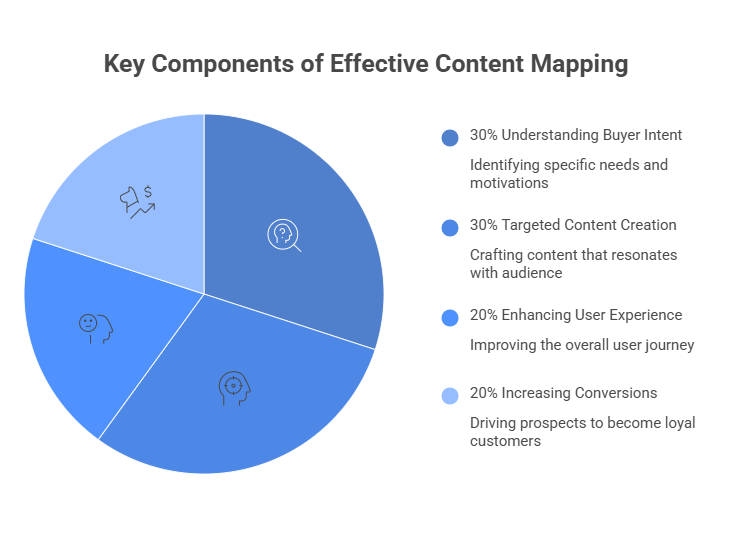
Content volume does not drive conversion; alignment does. Of all the variables that determine whether organic traffic produces leads, the match between content topics and a buyer’s decision-making stage matters most.
Better calls to action (CTAs), landing pages, and nurturing sequences improve results at the margins. When the content itself attracts visitors with no purchase intent, downstream fixes make little difference. The problem starts at the top of the system.
Data across 60+ articles shows that bottom-of-the-funnel (BOTF) content converts at 4.78%, roughly 25x higher than the 0.19% rate for top-of-the-funnel (TOF) content (Urich, 2026). Closing that distance requires a content strategy that deliberately targets buyers at every stage of their journey, not just the top. Buyer intent content mapping is how that strategy gets built.
The framework organizes content into the following stages:
Awareness-stage content addresses the problems and questions a prospect faces before considering specific solutions. It educates and builds trust, but it draws visitors who are still defining their problem. At this stage, they are not choosing a vendor.
Consideration-stage content helps prospects compare solutions, weigh trade-offs, and identify what should guide their decision. Comparison posts, framework guides, and solution-focused articles belong here.
Decision-stage content supports a prospect’s direct evaluation of a specific offering through case studies, competitor comparisons, pricing guidance, and proof points. This is the content that converts at the highest rate and gets the least investment in most programs.
Auditing existing content against this framework tends to reveal the same pattern: a portfolio heavy on awareness topics with limited conversion potential, and thin coverage of consideration and decision-stage queries where purchase intent runs highest. Rebalancing means giving BOTF content investment to match its conversion value, a principle central to any serious B2B inbound conversion strategy.
Keyword research and SERP analysis surface intent signals before content is written. A query like “what is project management” signals an awareness-stage visitor, while “project management software pricing” signals a buyer close to a decision. Google Search Console identifies which queries already drive traffic to existing pages, so marketing teams can prioritize conversion work where high-intent visitors already land.
TOF to BOTF conversion is not accidental. It follows a content strategy built around where buyers actually are, not just which keywords generate the most volume.
Designing Conversion Paths for Every Intent Level
Inbound programs offer one way to convert: a contact form, a demo request, or a “book a call” button. This works for a narrow slice of visitors. Research estimates only 3% of any market is ready to purchase at a given moment (Predictable Revenue, 2024). A single high-commitment path serves that 3% and leaves the remaining 97% (those still researching, comparing, or becoming problem-aware) with nowhere to go. Conversion path optimization starts with designing for where visitors are.
The answer is a layered system matched to each stage of visitor readiness. Each layer moves visitors toward sales engagement at a pace that fits their situation.
Awareness-stage visitors need low-commitment entry points. Email sign-ups, content series subscriptions, educational downloads, and interactive tools all capture a contact while delivering genuinely useful content. The exchange works because there is no pressure toward a conversation the visitor is not ready for.
| Intent Stage | Visitor Mindset | Recommended Conversion Paths | Example CTAs |
|---|---|---|---|
| Awareness | Researching a problem; not yet considering vendors | Email sign-ups, content series subscriptions, educational downloads, interactive tools | “Get the Beginner’s Guide,” “Subscribe to Weekly Insights” |
| Consideration | Comparing solutions and weighing trade-offs | Comparison frameworks, assessment tools, in-depth guides, webinar registrations | “Take the Assessment,” “Download the Comparison Guide” |
| Decision | Evaluating a specific offering for purchase | Consultation requests, demo sign-ups, free trial activations, pricing page interactions | “Request a Demo,” “Start Free Trial,” “Get a Quote” |
Consideration-stage visitors are actively weighing options. They respond to offers that go deeper: comparison frameworks, assessment tools, in-depth guides, and webinar registrations. These mid-funnel offers show that the organization understands where the visitor is and has something worth their time at that stage.
Decision-stage visitors need a clear, direct path. Consultation requests, demo sign-ups, free trial activations, and pricing page interactions all serve buyers close to a commitment. This is where pillar content lead generation pays off directly. High-intent visitors arriving through well-structured content find conversion points that match their readiness and move forward naturally.
Placement is as important as the offer itself. A demo request inside an awareness-stage article creates friction. A generic newsletter sign-up buried in a comparison guide misses the moment. Every conversion path should sit within content that matches its intent level, presented as a logical next step.
Running an audit of existing conversion paths reveals where the lead capture strategy for organic traffic falls short. The process is straightforward: map every active conversion mechanism to its intent level, identify which stages lack adequate offers, and flag high-traffic pages with no relevant conversion path. Consideration-stage pages tend to show the widest gaps and present the most immediate opportunity.
Lead Capture Mechanics: Optimizing Forms, CTAs, and Landing Pages
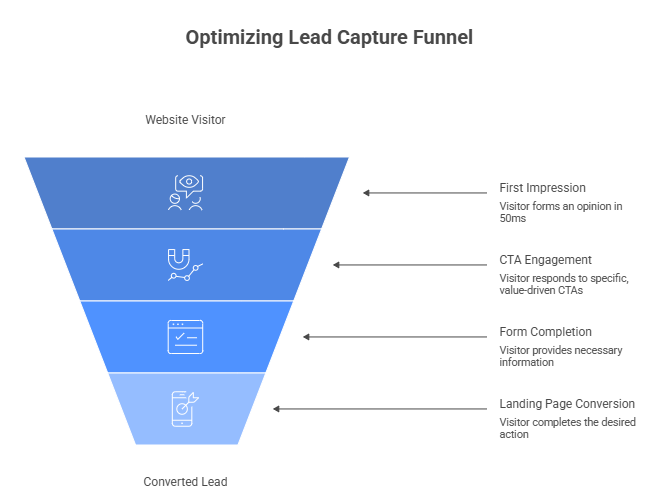
Getting a visitor to a page solves one problem. Getting them to convert once they arrive is another. CTAs, forms, and landing pages determine whether a willing visitor follows through or leaves without acting.
First impressions matter more than most marketing and sales teams realize. Users form an opinion of a website in just 50 milliseconds, well before they read a headline or evaluate an offer (Gonzalez, 2026). That initial reaction dictates whether they stay long enough to engage at all.
CTA copy is where SEO-to-lead conversion holds or breaks. A CTA that reads “Submit” or “Learn More” tells the visitor nothing about what they receive. Specific, value-driven copy like “Download the 2026 Benchmark Report” or “Get Your Free Content Audit” tells the visitor exactly what happens next and why it matters. CTAs also perform best when they appear within the content the visitor is already reading, at the moment the offer feels like a logical next step.
Form design follows the same principle. Asking for too much information too early kills conversion. A visitor downloading an educational guide does not need to provide their budget, company revenue, or team size. Collecting only what is needed at that stage, typically a name and email address, keeps friction low and completion rates high. Progressive profiling builds on this by collecting additional data across multiple interactions, creating a richer contact profile without overwhelming the visitor on their first conversion point.
Landing page structure determines whether a visitor who clicks a CTA completes the action or abandons the page. Strong landing pages remove navigation menus and competing links that pull focus away from the offer. They reinforce value with specific language, address common hesitations directly, and present one clear path to form completion. Moz increased conversions by 52% by optimizing landing pages with stronger headlines, showing how much copy and structure affect outcomes at this stage (Gonzalez, 2026).
Testing separates assumption from evidence. A/B testing CTA copy, headline variations, form length, and page layouts produces data on what moves conversion rates. Heatmap analysis shows where visitors focus and where they stop engaging. Form analytics identify which fields cause the most drop-off. Session recordings show the exact path a visitor takes before leaving, making friction points visible in ways aggregate data cannot.
Several mistakes consistently suppress performance. Vague offer language gives visitors no concrete reason to act. Cluttered layouts with competing elements divide attention and reduce the chance that any single action will be taken. Forms that collect information the organization does not use at that stage signal a poor experience. Mobile-unfriendly designs add friction for the growing share of organic visitors arriving from phones and tablets, where landing page conversion best practices around layout and load speed carry even more weight than on desktop.
CTA optimization for inbound marketing is an ongoing process. Each test produces data that informs the next iteration. Marketing teams that treat lead capture as a continuously-improving system outperform those that treat it as a one-time design decision.
The Gated vs. Ungated Content Strategy
Gating content behind a form is one of the key decisions in content offer strategy for lead generation. Gate everything, and risk pushing visitors away before they engage. Gate nothing, and lose the contact data needed to nurture and qualify leads. The right call sits between these two positions and depends on specific factors.
Content value is the first filter. A gate earns its place when the content behind it offers something worth the exchange: original research, a detailed framework, or a tool the visitor cannot find elsewhere. When competitors offer similar content for free, a gate sends visitors elsewhere (bounce) rather than converting them.
The intent stage matters just as much. Awareness-stage visitors are early in their research and sensitive to friction. A gate at this stage drives them toward ungated alternatives. Consideration and decision-stage visitors are already invested in finding a solution and far more willing to exchange their details for something directly relevant to their evaluation.
Downstream infrastructure also shapes the decision. An organization with strong nurturing sequences and lead scoring benefits from gating more content because captured leads move through a system built to convert them. Without that infrastructure, gating produces a contact list with no clear path to the pipeline.
Hybrid approaches resolve much of this tension. A preview of gated content lets visitors assess its value before committing. Optional registration for a downloadable version of an ungated article captures contacts without blocking access. Content upgrades, assets tied directly to the post being read rather than generic lead magnets, are among the most effective formats available.
One company increased email opt-ins by 1,650% after switching from generic lead magnets to contextual upgrades matched to individual posts (Klein, 2022). Lead magnet conversion optimization comes down to relevance: the closer the offer matches what the visitor is already reading, the higher the conversion rate.
Gated vs. ungated content strategy decisions should be tested. Measure the total downstream value each approach generates, including pipeline contribution, lead quality, and close rates. The data determines the right answer for each piece of content.
Lead Nurturing: Moving Leads Toward Sales Readiness
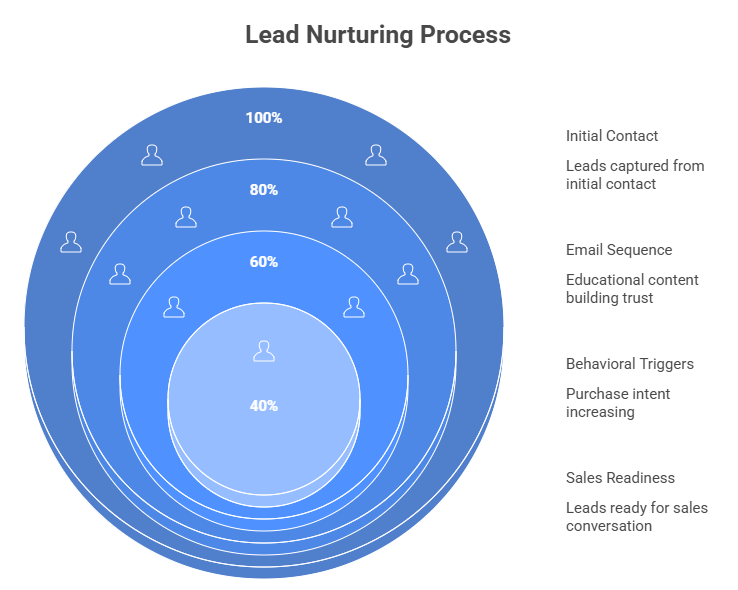
Capturing a lead starts the inbound conversion process, but does not finish it. Most organically captured leads are not ready for a sales conversation when they convert. Structured nurturing is what moves them from initial contact to genuine sales readiness.
The foundation is an email sequence that delivers progressively deeper value. Early emails address the problem the lead was researching when they first converted. As the lead engages, subsequent emails move into solution comparison, proof points, and decision-stage content, mirroring the buyer journey without forcing it.
One practical rule governs lead nurturing email strategy: 80% of email content should be educational, building trust and delivering value. The remaining 20% promotes the product or service directly (Klein, 2022). Marketing teams that invert this ratio send promotional content too frequently, erode trust, and lose contacts before they reach sales readiness.
Behavioral triggers sharpen the process. When a lead opens multiple emails, downloads additional content, or returns to key pages, those actions signal that the lead’s purchase intent is increasing. Automated workflows respond by adjusting cadence, content depth, and the type of offer presented. A lead who visits a pricing page mid-sequence should receive a more direct next-step offer than one still reading introductory content.
Nurturing extends beyond email. Retargeting ads keep the brand visible as leads research across other sites. Webinar invitations, social engagement, and personalized content recommendations add touchpoints that keep the brand and its expertise visible as the lead continues their research.
Several mistakes consistently undermine sales-ready lead nurturing. Sending the same content to the entire lead database, regardless of intent stage or engagement level, produces weak results. High-frequency sequences that prioritize volume over relevance accelerate unsubscribes. Nurturing content that never includes a contextual next-step offer leaves ready leads with no clear path forward.
Dormant leads need a separate approach. A dedicated re-engagement sequence with a specific offer gives inactive contacts a reason to return. Those who remain unresponsive after re-engagement should exit active nurturing to protect deliverability and keep the program focused on convertible contacts.
Measuring inbound marketing lead conversion through nurturing means tracking engagement progression, lead score advancement, and the rate at which nurtured leads reach sales-qualified status. These metrics show whether the program is working or whether content, cadence, or segmentation needs adjustment.
Lead Scoring and Qualification: Separating Signal From Noise
More leads do not automatically mean a better pipeline. Without a structured scoring and qualification framework, sales teams spend time on contacts that were never close to a buying decision, while genuinely ready leads wait too long for follow-up. Inbound lead scoring fixes this by assigning measurable value to each lead based on who they are and how they behave.
A scoring model draws from two data sources. The first is demographic and firmographic fit, which checks whether the lead matches the organization’s ideal customer profile (ICP) based on attributes like job title, company size, industry, and location. The second is behavioral engagement, which measures demonstrated interest through actions like content downloads, email opens, website visits, and return frequency.
Behavioral signals carry the most weight at the decision stage. A lead who views a pricing page, requests a demo, or downloads a competitive comparison is showing explicit purchase intent. These actions warrant a significant score increase and, depending on the threshold, can move the lead directly into sales-qualified status.
Scoring thresholds define three lead categories, and marketing qualified lead generation depends on getting these boundaries right. Marketing-qualified leads (MQLs) show enough engagement to warrant continued nurturing but are not yet ready for direct sales outreach. Sales-qualified leads (SQLs) have reached a threshold indicating genuine readiness for a sales conversation. Low-fit or disengaged contacts fall below both thresholds and should exit active nurturing.
Organic lead quality improvement depends on keeping the model current. Sales feedback, closed-won and closed-lost analysis, and periodic reviews of scoring weights all keep the model accurate as buyer behavior and business conditions shift. A scoring model built once and never updated produces inaccurate lead classifications as buyer behavior changes.
High-performing pillar pages should reach a visitor-to-lead conversion rate of at least 2.5% to operate at maximum value (Bailyn, 2025). Tracking conversion rates from raw lead to MQL to SQL shows where the scoring model works and where leads stall before reaching sales.
Marketing automation platforms and customer relationship management (CRM) systems handle the mechanical side of scoring. The reporting infrastructure around these tools should surface lead volume, score distribution, and stage conversion rates in a format that lets both teams identify where leads stall and what needs to change.
The Marketing-to-Sales Handoff: Ensuring Lead Follow-Through
A well-built inbound program can generate strong traffic, capture qualified leads, and move them through a structured nurturing sequence. All of that work loses its value if the handoff from marketing to sales breaks down. The marketing-to-sales handoff process is where inbound lead generation strategy either produces revenue or stalls at the finish line.
The breakdown is rarely accidental. Organizational misalignment on what constitutes a qualified, sales-ready lead is a primary reason inbound programs fail to generate revenue, leading sales teams to ignore inbound leads entirely. When marketing and sales use different definitions of lead quality and readiness, leads are passed too early, rejected without feedback, or left unworked in a CRM queue.
The fix starts with a shared, documented definition of both MQL and SQL that both teams have agreed to. This definition governs when leads move from nurturing to outreach and gives both sides a common standard to measure against. Without it, the handoff becomes a judgment call that produces inconsistent results.
A defined handoff workflow specifies exactly how leads move from marketing to sales. It covers routing, what context travels with each lead, including content engagement history, lead score, and key conversion events, and the expected response time once a lead reaches sales. A lead passed without context forces the sales team to start from scratch, slowing follow-up and reducing close rates.
Closed-loop feedback keeps the system accurate. Sales provides structured input to marketing on lead quality and readiness, and marketing uses that input to refine targeting, nurturing, and scoring. Without this feedback loop, the marketing team’s qualified lead generation runs on assumptions rather than evidence from actual sales outcomes.
A service-level agreement (SLA) between marketing and sales creates mutual commitment and accountability. Marketing commits to lead volume and quality standards. Sales commits to follow-up timeliness and reporting. This moves the handoff from an informal arrangement to a defined process with measurable expectations.
Culture determines whether these structures hold. Marketing and sales teams that share revenue goals and hold regular cross-functional pipeline reviews maintain clearer lead definitions and faster follow-up than those operating independently. When both teams treat closed revenue as a shared outcome, the handoff becomes a point of collaboration.
The quality of the marketing-to-sales handoff process directly determines whether the leads an inbound program generates ever become customers.
Source: Predictable Revenue. (2024). How to convert traffic into leads: 10 strategies. Predictable Revenue. https://predictablerevenue.com/blog/how-to-convert-traffic-into-leads-10-strategies/
Measuring Inbound Conversion Performance: Metrics That Matter
Traffic numbers tell one part of the story. Revenue tells the rest. Inbound conversion rate optimization requires a measurement framework that tracks performance at every funnel stage, from the first organic visit through to closed revenue.
The traffic-to-lead conversion rate measures the percentage of organic visitors who complete a conversion action. Segmenting this rate by content topic, intent stage, traffic source, and conversion path shows where the funnel performs well and where friction causes drop-off. A high traffic volume paired with a low conversion rate on a specific page points directly to a content-to-intent mismatch or a weak offer.
The lead-to-MQL conversion rate measures the percentage of captured leads that reach marketing-qualified status. A low rate signals that the nurturing program is not advancing leads effectively, whether due to poor segmentation, weak content, or a scoring threshold set too high. This metric holds the nurturing system accountable.
The MQL-to-SQL conversion rate measures the percentage of MQLs that the sales team accepts as sales-qualified. A consistently low rate points to misalignment between marketing’s qualification criteria and sales’ assessment of readiness, which brings the conversation back to the shared MQL and SQL definition covered in the previous section. Tracking this rate over time shows whether both teams are moving toward a tighter agreement.
SQL-to-opportunity and opportunity-to-customer rates complete the picture. These rates measure how effectively sales converts qualified leads into an active pipeline and then into closed revenue. Without these rates, the inbound program has no way to connect organic content investment to actual business outcomes.
Cost per lead and cost per acquisition give inbound marketing ROI measurement its financial context. These figures show whether inbound outperforms paid alternatives on a cost-per-revenue basis and flag where the program needs adjustment. They also give marketing leaders the data needed to justify continued investment.
Time-to-conversion metrics track how long an organic visitor takes to move through each funnel stage. Long dwell times at specific stages identify where leads stall, whether in nurturing, qualification, or sales follow-up. Organic SEO improvements typically take 4 to 12 months to produce significant lead volume, so marketing teams must read time-to-conversion data with that timeline in mind (Lahey, 2025).
Attribution reporting connects closed revenue back to the originating organic content and traffic source. A well-built inbound attribution model shows which pages, topics, and conversion paths generate the most valuable leads, measured by pipeline contribution and close rate, rather than raw lead volume. This moves investment decisions away from vanity metrics (the raw traffic and lead volume) and toward revenue outcomes like pipeline contribution and close rate.
A conversion performance dashboard brings all of this into one view. It should display conversion rates at each funnel stage, flag where volume or rate drops below target, and update frequently enough for marketing and sales teams to act before small issues compound. Built well, it becomes the operating instrument for continuous inbound conversion rate optimization across the full funnel.
Diagnosing and Fixing Common Inbound Conversion Breakdowns
Inbound funnel optimization starts with pinpointing which stage is underperforming before applying any fix. Generic solutions applied across the entire funnel waste time and hide the actual problem. Each failure pattern produces a distinct set of symptoms that point to a specific cause.
Before diagnosing a conversion breakdown, marketing teams need to rule out an external traffic cause first. When an AI Overview appears on a SERP, organic CTRs drop from 1.62% to just 0.61% (Gonzalez, 2026). A sudden drop in lead volume may reflect an AI-driven reduction in clicks, not a conversion system failure, and the two require entirely different responses.
High traffic with low lead capture points to one of three problems. The content attracts visitors with no buying intent, or the conversion paths are missing entirely or poorly matched to the visitor’s intent level (offering a demo request to someone still in early research, for example). Organic traffic conversion optimization at this stage means auditing content intent, mapping conversion paths, and testing offer relevance on the pages driving the most traffic.
High lead capture with low MQL progression is a nurturing problem. Weak segmentation sends the same content to leads at different intent stages, producing low engagement across the board. A scoring model with thresholds set too low accepts contacts who have taken only minimal actions, such as a single-page visit, inflating lead volume without reflecting genuine purchase intent.
High MQL volume with low sales acceptance points to a qualification mismatch. Marketing is passing leads that sales does not consider ready, which means the shared MQL definition needs revisiting. The fix is a formal review between marketing and sales teams that uses closed-lost deal data to identify which lead attributes and behaviors predict a won opportunity, and then updates the MQL definition to match.
High SQL volume with low close rates signals yet another problem. Either leads enter sales conversations too early, or the sales team’s outbound-trained approach does not fit inbound leads who arrive with prior research and specific questions. Unlike outbound prospects who may have had no prior contact with the brand, inbound leads arrive with prior research and specific questions, and sales teams trained primarily on outbound methods often lack the consultative approach these leads require.
Inconsistent performance across content topics or channels shows that inbound conversion rate optimization has been applied unevenly. High-performing content areas provide a ready-made template. Marketing teams should document the specific factors driving conversion on those pages, including intent stage, offer type, CTA placement, and conversion path structure, and then apply the same approach to underperforming areas.
Funnel stage conversion rates, cohort analysis, and content-level attribution make this diagnosis precise. Funnel stage rates isolate which transition loses the most leads. Cohort analysis tracks how groups of leads captured at the same time move through the funnel, revealing whether problems are consistent or tied to specific campaigns. Meanwhile, content-level attribution separates high-volume content from high-value content by showing which pages generate leads that actually close.
| Symptom | Likely Cause | Where in the Funnel | Primary Fix |
|---|---|---|---|
| High traffic, low lead capture | Content attracts visitors with no buying intent, or conversion paths are missing or mismatched | Top of funnel | Audit content intent; map conversion paths to intent levels; test offer relevance on high-traffic pages |
| High lead capture, low MQL progression | Weak segmentation, generic nurturing content, or scoring thresholds set too low | Mid-funnel (nurturing) | Strengthen segmentation; tighten scoring thresholds; deliver intent-matched nurturing content |
| High MQL volume, low sales acceptance | Marketing and sales disagree on what qualifies a lead | Marketing-to-sales handoff | Formal review using closed-lost data; update the shared MQL definition |
| High SQL volume, low close rates | Leads enter sales conversations too early, or sales applies an outbound-trained approach to inbound leads | Sales conversion | Refine SQL threshold; train sales on a consultative approach for inbound buyers |
| Inconsistent performance across topics | Conversion optimization applied unevenly across the content portfolio | Across the full funnel | Document what drives conversion on top pages; replicate that structure across underperformers |
Source: Gonzalez, C. (2026). How to make every click count with search experience optimization. Moz. https://moz.com/blog/search-experience-optimization
Building an Inbound Conversion System That Scales
Diagnosing a conversion problem and fixing it once is not the same as building a system that prevents the problem from recurring. Many inbound programs operate on ad hoc fixes: a new CTA here, a revised landing page there, a one-time nurturing sequence built for a single campaign. These fixes produce short-term gains, but they do not compound. A scalable inbound conversion system requires documented processes, automation infrastructure, and regular optimization cycles that improve performance as the organization produces more content and captures more data.
The difference between ad hoc tactics and a repeatable system comes down to five components.
Documented conversion playbooks define how each content type and intent stage should be handled. A playbook specifies the conversion path, offer type, CTA approach, and follow-up sequence for awareness-stage blog posts, consideration-stage guides, decision-stage case studies, and every other format the organization publishes. When a new team member creates content or a new campaign launches, the playbook provides a tested framework rather than a blank page. Teams that document their conversion approach maintain consistency as they grow; teams that rely on institutional knowledge lose consistency the moment a key contributor leaves.
Marketing automation infrastructure handles lead capture, scoring, nurturing, and routing at scale without requiring manual intervention for each lead. The workflows covered earlier in this guide, including behavioral triggers, progressive profiling, scoring thresholds, and handoff routing, need to live inside a marketing automation platform and CRM system that executes them automatically. Manual processes work when lead volume is low. They break when volume increases, and the breakage is silent: leads sit unnurtured, scores go un-updated, and handoffs are delayed without anyone noticing until pipeline suffers.
Content templates and conversion path blueprints allow the team to replicate proven structures across new topics and campaigns without redesigning the conversion framework each time. A landing page template that has been tested and optimized should not be rebuilt from scratch for every new offer. A nurturing sequence structure that works for one consideration-stage guide can be adapted for the next one with new content but the same proven architecture. Templates reduce production time and protect conversion performance by encoding what has already been learned.
Regular optimization cycles turn conversion data into systematic improvement. A quarterly review of conversion rates at each funnel stage, CTA performance, landing page metrics, nurturing engagement, and scoring accuracy identifies where the system is underperforming and where the next round of testing should focus. Without a defined cadence, optimization happens reactively, usually only after a visible problem surfaces. With a cadence, it happens continuously, and small improvements compound across the funnel over time.
Cross-functional alignment rituals keep marketing and sales operating as a unified revenue team. Weekly pipeline reviews surface handoff issues before they accumulate. Monthly conversion performance readouts give both teams visibility into how the full funnel is performing. Quarterly strategy sessions align on scoring adjustments, lead definition refinements, and content priorities for the next period. These are not optional meetings. They are the mechanism that keeps the shared definitions, SLAs, and feedback loops covered earlier in this guide from drifting out of alignment.
Not every organization needs all five components at the same level of maturity on day one. The right starting point depends on where the greatest conversion leverage exists today. An organization with strong content production but no documented conversion paths should start with playbooks and templates. An organization with adequate lead capture but a broken handoff should prioritize the SLA and cross-functional rituals. An organization scaling from dozens of leads per month to hundreds needs automation infrastructure before volume outpaces manual capacity.
The goal is not to build the entire system at once. It is to build it deliberately, starting where the impact is highest and expanding as each component proves its value. Inbound programs that treat conversion as a system rather than a series of isolated projects generate more pipeline from the same traffic and improve their performance with every cycle.
Industry and Business Model Considerations
The inbound conversion framework applies broadly, but the levers that matter most vary by business model. Knowing which elements to prioritize produces faster results than applying every tactic at once. The guidance below maps the most critical conversion priorities to five common business contexts.
B2B inbound conversion strategy centers on nurturing depth, lead scoring, and sales handoff quality. Sales cycles are long, buyers are cautious, and multiple stakeholders influence the final decision. Content must match the experience level of the audience. B2B pages targeting high-intent keywords should address specific product capabilities, integration requirements, and business outcomes rather than foundational concepts.
Beginner-level content fails to convert for high-intent keywords because searchers are typically experienced professionals looking for product differentiation (Urich, 2026). Case studies, ROI calculators, and detailed comparison content drive conversion more effectively than introductory material at this level.
Software-as-a-service (SaaS) and product-led growth companies center their conversion path on free trial or freemium activation. A qualified lead here is defined by product usage behavior, specifically whether the user reaches key activation milestones within the product, rather than by traditional marketing engagement signals like email opens or content downloads. Content marketing lead generation for SaaS programs should drive visitors toward trial sign-ups and in-product engagement rather than gated assets.
Professional services firms convert through trust. Thought leadership content, consultation offers, and expertise-led articles build the credibility that drives inquiries. Transactional CTAs rarely work here because buyers need demonstrated expertise before they trust a firm with sensitive, high-stakes work.
E-commerce businesses focus on email capture, first-purchase incentives, and product discovery pathways. Formal lead scoring and sales handoffs do not apply. Turning website traffic into sales leads means triggering email sequences based on browsing behavior, abandoned carts, and past purchases.
Local businesses need conversion paths built around direct contact actions: phone calls, appointment bookings, and direction requests. Standard inbound attribution models require adaptation here because conversions happen off the page, through calls and in-person visits, and tracking them requires call tracking software and location-based analytics.
Marketing leaders should identify which context most closely matches their business. They should prioritize the two or three conversion levers most relevant to that model and then build from there before expanding to the full framework.
| Business Model | Primary Conversion Path | Lead Qualification Focus | Key Conversion Lever |
|---|---|---|---|
| B2B | Demo request, consultation, gated decision-stage content | MQL and SQL scoring; sales handoff quality | Nurturing depth, case studies, ROI calculators |
| SaaS / Product-Led Growth | Free trial or freemium activation | Product activation milestones (in-product behavior) | Content that drives trial sign-ups and in-product engagement |
| Professional Services | Consultation request, expert content download | Trust signals and demonstrated expertise | Thought leadership and expertise-led articles |
| E-commerce | Email capture, first-purchase incentive, abandoned cart recovery | Browsing and purchase behavior (formal scoring not applied) | Behavioral email triggers, product discovery pathways |
| Local Business | Phone call, appointment booking, direction request | Off-site conversion tracking | Call tracking software, location-based analytics |
Source: Urich, K. (2026). How to increase organic leads (not just traffic). Grow and Convert. https://www.growandconvert.com/seo/how-to-increase-organic-leads/
Conclusion
Converting organic traffic into sales-ready leads is not a single tactic. It is a system, and every part must work together for the strategy to generate consistent revenue.
The framework in this article covers the full journey. It starts with mapping content to buyer intent, because attracting visitors with no purchase intent makes every downstream effort less productive. It moves through conversion path design, lead capture, the gated vs. ungated content decision, and nurturing sequences that advance contacts toward sales readiness. Lead scoring filters for contacts who are genuinely ready. A well-defined marketing-to-sales handoff gets those contacts to the right person at the right time. Measurement connects the entire effort back to the pipeline and closed revenue.
Trust runs through all of it. SEO to lead conversion depends not just on execution but on whether visitors believe the organization delivers on what its content promises.
Organizations that treat content and conversion as one integrated system extract significantly more value from their organic traffic investment than those that manage them separately. Organic lead quality improvement follows directly from that deliberate, continuous effort.
Start with an audit. Review each stage of the inbound funnel against this framework, identify the most significant breakdown, and commit to one high-impact fix first. A focused improvement at the right stage produces more results than broad changes spread thin across the entire funnel.
Share this article with sales leadership and cross-functional stakeholders. Blog traffic to leads is a common problem that demands shared definitions, aligned processes, and mutual accountability. Building that alignment starts with an understanding of how the full system works.
Subscribe for future updates on inbound marketing strategy, content marketing, lead generation, and revenue-focused SEO. Each issue builds on the frameworks covered here, with new data, case studies, and practical guidance for marketing leaders looking to convert organic traffic into leads at scale. Subscribe and stay informed on new optimization tactics today.
Frequently Asks Questions
The most common cause is misalignment between content topics and where buyers are in their decision process. Content built around high-volume informational keywords pulls in visitors who have no purchase intent, so even strong CTAs and landing pages cannot fix the gap. Other frequent causes include a single conversion path (such as only a “request a demo” button) that ignores the 97% of visitors who are not ready to buy, generic lead capture offers that do not match what brought visitors to the page, and a marketing infrastructure that captures leads but lacks the nurturing system to advance them. The fix usually starts at the top: audit your content against buyer intent stages, then add conversion paths suited to each stage.
A marketing-qualified lead (MQL) has shown enough engagement, through actions like email opens, content downloads, or repeat website visits, to warrant continued nurturing, but is not yet ready for a direct sales conversation. A sales-qualified lead (SQL) has reached a higher threshold that signals genuine readiness for sales outreach, often through behaviors like viewing a pricing page, requesting a demo, or downloading a competitor comparison. The distinction matters because passing leads to sales too early wastes time on contacts who are not ready, while holding genuinely qualified leads in nurturing too long lets opportunities cool. Both teams need a shared, documented definition of each category.
It depends on three factors: the value of the content, the intent stage of the typical reader, and your downstream nurturing infrastructure. Original research, detailed frameworks, or unique tools justify gates because the exchange feels fair. Awareness-stage content usually performs better ungated because gates send early-stage visitors to competitors. Consideration and decision-stage content can support gates because those visitors are already invested in finding a solution. Hybrid approaches often work best: a content preview before a gate, an ungated article with an optional registration for the downloadable version, or content upgrades tied directly to the post being read. The closer the offer is to what the visitor is already reading, the higher the conversion rate.
Expect 4 to 12 months for organic SEO improvements to produce significant lead volume. The timeline depends on your starting domain authority, the competitiveness of your target keywords, and how consistently you publish high-intent content. Time-to-conversion within the funnel adds another layer: even after leads are captured, nurturing cycles can stretch weeks or months before a contact reaches sales-qualified status. Marketing teams that read time-to-conversion data with this timeline in mind avoid premature judgments about whether the program is working.
Track conversion rates at every transition: traffic-to-lead, lead-to-MQL, MQL-to-SQL, and SQL-to-customer. High traffic paired with low lead capture means content attracts visitors with no buying intent, or conversion paths are missing or poorly placed. High lead capture paired with low MQL progression points to weak nurturing or scoring thresholds set too low. High MQL volume with low sales acceptance signals misalignment between marketing’s qualification criteria and sales’ assessment of readiness. High SQL volume with low close rates suggests leads enter sales conversations too early, or sales applies an outbound-trained approach to inbound buyers. Before assuming the funnel is broken, rule out external causes like AI Overviews suppressing clicks, which can cut organic CTRs sharply without any conversion failure on your side.
Resources
- Klein, E. (2022, April 19). 12 Tips To Convert Your Organic Traffic Into Qualified Leads. Serpstat.https://serpstat.com/blog/how-to-convert-organic-traffic-into-qualified-leads/
- Gonzalez, C. (2026, January 21). How to make every click count with search experience optimization. Moz.https://moz.com/blog/search-experience-optimization-and-seo
- Predictable Revenue. (2024, September 27). How to convert traffic into leads: 10 strategies. Predictable Revenue. https://predictablerevenue.com/blog/how-to-convert-traffic-into-leads-10-strategies/
- Urich, K. (2026, March 2). How to increase organic leads (+ why increasing traffic isn’t the same thing). Grow and Convert. https://www.growandconvert.com/seo/how-to-increase-organic-leads/
- Willoby, S., & Dean, B. (2025, November 24). Content strategy in 6 steps: A practical guide for 2026. Backlinko.https://backlinko.com/content-strategy
- Lorincz, N. (2024, November 28). 9 organic lead generation strategies to boost your ecommerce business. OptiMonk.https://www.optimonk.com/9-organic-lead-generation-strategies-to-boost-your-ecommerce-business/
- Bailyn, E. (2025, May 1). B2B SEO strategy: 2026 guide. First Page Sage. https://firstpagesage.com/seo-blog/b2b-seo-strategy/
- Lahey, C. (2025, March 26). What is organic SEO? And how to get started in 2025. Semrush. https://www.semrush.com/blog/organic-seo/
- Miller, A. (2025, February 12). How to generate more qualified B2B website traffic. Blend Marketing.https://www.blendb2b.com/blog/how-to-generate-more-qualified-b2b-website-traffic/
Kim Greer
OFP Law
One of the best business decisions I ever made was to contract with 321 Web Marketing. Jonathan Gessert and his team are knowledgeable, efficient, and effective, making digital marketing goals easy to achieve and helping [...]

Kelly Cole
Business Benefits Group
My company hired 321 Web Marketing in February 2016 to resurrect our web site. We feel our web site is the face to our business and desperately needed a make over. 321 took us from blah to WOW effortlessly and what a difference [...]

Emily Hawkins
Diener & Associates
Thanks to 321 Web Marketing, the client has seen an increase in their search engine leads, averaging 12 qualified leads per month. The client has also achieved prominent Google Maps and search placement. The team [...]

Trevor Telesz
Paw Pals Pet Sitting
321 Web Marketing successfully translated the client’s design into a stunning and refreshed website, ensuring seamless functionality across all dynamic views. The team provided clear timelines and stuck to them, [...]

Corey Davis
Spartan Animal & Pest Control
321 Web Marketing is truly phenomenal at what they do. Their ability to communicate and describe the steps and actions that they are implementing, Alex Zarpas in particular, is excellent. Delivering on promises is all [...]

Alec Roberts
MFE Insurance
I can’t say it enough, Jonathan and his team have gone above and beyond since day one to accommodate our needs and meet our goals. I run a specialty insurance brokerage based in LA and once we found 321 we never looked [...]

Richard Wilbur III
Advantage.Tech
Thanks to 321 Web Marketing’s web development work, the client increased rankings and traffic from search engines. Also, their business secured prominent positions on Google Maps and industry-relevant, profitable [...]

Bruce Gemmill
FVCbank
After the website revamp, the client saw a steady rise in leads from search engines, resulting in additional traffic. 321 Web Marketing is highly punctual when it comes to deliverables, and internal stakeholders are [...]

Drew Weeks
VAE
321 Web Marketing delivered a sleek website that accurately portrays the size and quality of the client’s organization. All of their completed websites have received positive feedback from users who have been [...]

Ryan Masten
Masten Pools
321 Web Marketing has increased the client’s leads from zero to 53 monthly. Their SEO efforts pay off impressively due to a top-ranking position on Google and making the site the number one result for several [...]