

Table of Contents
- 1. Key Takeaways
- 2. Abstract
- 3. Introduction
- 4. Guide and Readiness Checklist
- 5. 1. The Transition From Rankings to Citations
- 6. 2. How AI Systems Interpret Content
- 7. 3. Entity-Based Optimization
- 8. 4. Structured Data and Content Architecture
- 9. 5. Brand Authority and Trust Signals
- 10. 6. Content Depth and Comprehensiveness
- 11. 7. AI Search Readiness Audit Roadmap
- 12. 7.1 Confirm crawl access and preview settings
- 13. 7.2 Target mid-range search queries
- 14. 7.3. Audit structured data
- 15. 7.4. Monitor Performance in Search Console
- 16. 8. Conclusion
- 17. Frequently Asks Questions

 Apr 10, 2026 ·
  23 min read ·
  Summarize in ChatGPT
Key Takeaways
- Citations replace rankings as the primary goal. AI summaries dominate the top of search results, and nearly 60% of searches end without a click. Being cited in those summaries drives more visibility and engagement than traditional link placement.
- AI search assembles answers, not link lists. Google’s query fan-out breaks questions into sub-searches, gathers evidence from multiple sources, and builds a single response. Pages that cover topics in depth outperform those targeting narrow keyword phrases.
- Structured data is essential. JSON-LD markup (Article, ProfilePage, Organization schema) gives AI systems the labels they need to identify authors, entities, and topics accurately. Sites using structured data consistently see higher CTRs and engagement.
- Trust and authorship are top-tier signals. Google weights trustworthiness highest within E-E-A-T. Clear bylines, author bios, credible sourcing, and transparency about AI-assisted content production all strengthen citation eligibility. Pages with Featured Snippets have a 60%+ chance of appearing in AI Overviews.
- Optimize for entities and mid-range queries. AI systems interpret the web through real-world subjects, not keyword strings. Queries in the 501 to 2,400 monthly search range trigger AI Overviews most frequently, especially problem-solving and factual questions.
- Measure differently and audit now. Track citation presence, share of voice in AI summaries, and assisted conversions. Confirm crawl access, validate structured data, and monitor AI-related performance in Search Console to stay visible as search shifts toward generated answers.
Abstract
Artificial intelligence (AI) search has changed how people obtain information from the web. The old model displayed blue resource links to the user and ranked them by relevance. Today, many results pages begin with an AI summary that draws on multiple sources to provide a direct answer. Google’s AI Overviews and AI Mode reach more than 1 billion users each month. These AI-generative summaries break a question into smaller searches across related topics, then combine the results into a single response.
Technical clarity is crucial; AI systems read both structure and text. Structured data enables AI to identify authors, organizations, products, and topics with precision. Markup like Article, ProfilePage, and Organization schema provides labels for facts. Matching these labels to visible content reduces ambiguity.
User behavior also changes the way marketing teams measure success. A large share of searches now end on the results page. Instead of clicking through several links, users read the answer shown at the top of the page.
Because of this pattern, traffic volume alone no longer tells the full story. Marketing teams must also measure how often their content appears in AI summaries and how this influences users’ next steps.
Citation presence now carries real value. When a brand appears in an AI summary, users see the source alongside the answer. That visibility raises interaction across both organic and paid results. AI summaries also appear in a large share of modern searches, which means that citation placement affects the user’s journey.
The goal remains direct. Your content should appear among the sources that answer a question. Visibility depends on whether AI-powered search systems select your content as a trusted reference. Track citation presence, share of voice, and assisted sales to understand the effect of this structural shift.
Quality content and precise technical structure remain the strongest foundation. Pages that present clear facts, strong evidence, and credible authorship are easier for AI search systems to interpret and reference. Organizations maintaining this discipline position their websites to remain visible as search continues to move toward AI-generated answers.
Introduction
AI is changing how people find answers on the web, altering the basic structure of online search. Marketing leaders and technical marketers should treat it as a structural shift in information discovery rather than a simple product update. Nearly 60% of Google searches ended without a click in 2024 (Burton, 2025; Seer Interactive, 2025) as users increasingly read answers directly on the search results page, reducing visits to linked websites.
Google integrated generative AI into its main search system through AI Overviews and AI Mode (Google, 2025a; Stein, 2025). Industry analysis reports that AI Overviews appear in about 29.9% of observed search queries (Southern, 2025). AI Overviews provide short explanations that summarize a topic and link to supporting pages on the web. Users receive a clear answer first, then explore cited sources if they want a deeper discussion.
New AI answer systems continue to enter the market, yet Google still controls the largest share of search activity. Traffic studies report that Google sends more than 30 times as many visitors as the next-largest AI search platform (Seer Interactive, 2025). Because Google dominates, its search design changes affect almost every digital marketing program.
Marketing teams now discuss a discipline called generative engine optimization (GEO), which refers to strategies that help content get citations within AI-generated summaries. Unlike traditional ranking tactics aimed at improving page position in listings, GEO aims to increase the likelihood that a website or brand is referenced in generative summaries. This shift becomes necessary as direct visits decline and answer engines present information before users open a webpage.
Guide and Readiness Checklist
This guide covers how to assess the readiness of your website for AI search. It explains how AI collects web facts, builds summaries, and cites sources. Google uses “query fan-out,” running related searches to gather evidence before forming an answer.
The next sections detail key signals for AI citations, including structured data, clear topics, and visible author credentials. Preparing for these signals boosts presence in AI search results.

1. The Transition From Rankings to Citations
Digital marketing teams are faced with AI-powered search systems that require a new focus for 2026. While page ranking is still relevant, the main objective is to achieve citations in AI-generated summaries. Being cited ensures brand visibility (even without user clicks) as analysts describe this strategy as building a citation moat (McDonald, 2025b).
This shift becomes clear when you look at user behavior. Research from 2024 shows that close to 60% of Google searches ended without a click (Burton, 2025). Many users now read the answer directly on the search results page.
An AI Overview sits at the top of the page, occupying a large portion of the screen. From a technical perspective, on desktop screens, expanding an AI Overview pushes organic links down by about 220 pixels (Southern, 2025). Mobile layouts compress the space even more. In many cases, a user sees only the first one or two traditional results before scrolling (Southern, 2025). As a result, the AI-generated summary becomes the first point of contact between the user and the topic.
Visibility inside that AI summary creates a strong advantage. Studies show that brands cited in an AI Overview receive more interaction than brands that appear on the same page without a citation. Organic clicks rise by about 35%, while paid clicks rise by about 91% when a brand is cited in the AI summary (McDonald, 2025b). This shows that citation placement grabs user attention even when standard rankings remain the same.
Existing authority signals still influence which pages receive those citations. Pages that hold a Featured Snippet meet Google’s criteria for direct answers. Data shows that a page with a Featured Snippet has more than a 60% chance of being referenced in the AI Overview for the same query (Southern, 2025). This pattern suggests that the AI search system draws from sources that the search engine already considers reliable.
Traffic data confirms a changing search environment. As of September 2025, the organic click-through rate for queries that include AI Overviews fell to about 0.61% (McDonald, 2025b), down from 1.76% in June 2024. Even pages without AI summaries show a downward trend, with organic click-through rates dropping from 2.72% to 1.62% over the same period (McDonald, 2025b). Users either find answers faster or turn to other sources for information.
Lower click volume does not mean lower value, however. Google reports that visitors who arrive through AI features spend more time on the destination site (Google, 2025a). These visitors have already read a short summary before they click, which means they reach the page with a clearer interest in the topic (Burton, 2025). Because of this behavior, marketing teams must focus less on ranking position and more on total citation presence. A brand that appears frequently in AI summaries maintains visibility even as traditional traffic models lose strength.
Click-through rates for queries with and without AI Overviews present
| Metric | Jun 2024 | Sep 2025 | Change |
|---|---|---|---|
| Organic CTR with AI Overview | 1.76% | 0.61% | -65% |
| Organic CTR without AI Overview | 2.72% | 1.62% | -40% |
| Organic click lift when cited in AIO | — | — | +35% |
| Paid click lift when cited in AIO | — | — | +91% |
| Featured Snippet cited in AIO | — | — | >60% |
2. How AI Systems Interpret Content
AI search systems use a method that differs from that of traditional search engines. Older search systems matched keywords with indexed pages. AI-powered search systems gather facts from many sources and assemble a single response.
These systems now operate at a large scale. AI Overviews serve more than 1 billion users each month across more than 100 countries (Stein, 2025; Venkatachary, 2024). For digital teams, a clear grasp of how these systems gather and combine information is now part of basic search strategy.
Google uses a method known as “query fan-out” to build AI responses (Google, 2025a). When a user asks a complex question, the AI search system runs several related searches at the same time. Each search targets a different part of the topic. It then collects results from these related searches and assembles the evidence into a single summary (Google, 2025a; Stein, 2025).
This process helps the model gather links across multiple pages rather than relying on a single source. A simple question about parks for a family, for example, might trigger separate searches for dog rules, trails for children, and local weather conditions before the AI search system produces a single overview (Reid, 2023).
Google does not display an AI Overview for every query. The AI system activates the feature only when it judges that the summary adds value beyond the standard list of results (Google, 2025a). Studies show that AI Overviews appear in about 29.9% of observed searches (Southern, 2025).
Some query types trigger them more frequently than others. Problem-solving questions produce AI Overviews in roughly 74% of cases, while factual questions produce them in about 69% of cases (Southern, 2025). These features are most common among mid-range queries that receive between 501 and 2,400 searches per month (Southern, 2025).
Other AI systems follow a different process. ChatGPT, for example, often begins by drawing on information learned during training. The system activates a live search tool only when it needs current facts, location data, or details beyond its stored knowledge (Seer Interactive, 2025).
Research shows that ChatGPT runs a live web search for roughly 30% to 46% of user queries (Seer Interactive, 2025). This limited use of web retrieval places a higher value on topics that require fresh facts, ongoing updates, or detailed explanations.
Google also introduced a feature known as AI Mode for questions that require deeper analysis or multiple steps of reasoning (Google, 2025a). This system runs on a specialized version of the Gemini model, which plans how to gather information, collects supporting material, and revises its answer as it reads additional sources (Stein, 2025). The result is a response covering a subject in more detail than a typical search snippet.
Natural language processing also changes how queries behave. Small wording differences in a question do not usually produce completely different results. The system interprets the meaning of the request rather than matching a narrow keyword phrase (Seer Interactive, 2025).
Because of this behavior, websites that explain a subject in-depth tend to appear more often in AI citations than pages that focus on one keyword variation. By 2026, an effective search strategy calls for clear explanations, strong source signals, and structured information that these AI systems can extract with confidence.
3. Entity-Based Optimization
Search systems now interpret the web through entities rather than keyword strings. An entity is a clear subject, such as a person, company, place, or product. Older search models match a phrase on a page with the same phrase in a query. Modern systems focus on factual, real-world subjects and how those subjects connect. Because of this shift, the search strategy now moves toward GEO. For 2026, your website must provide clear facts for AI search systems to treat your brand as a trusted source on the topic.
Google still drives most search traffic on the web. It builds many AI responses using internal knowledge systems. One example is the Knowledge Graph, which maps entities and their relationships. Another example is the Shopping Graph, which holds more than 35 billion product listings from across the web (Google, 2025a; Reid, 2023). Google refreshes about 1.8 billion of these listings every hour to keep the data current (Reid, 2023). Brands that publish clear, structured data help these systems link products and services to the correct company entity.
Visibility in AI search tools also depends on which search engine supplies the underlying data. For OpenAI search products such as SearchGPT, Bing results show a strong influence. Research from Seer Interactive found that 87% of citations inside SearchGPT match pages that appear within Bing’s top 20 organic results (Seer Interactive, 2025).
The overlap with Google’s top results is lower at 56% (Seer Interactive, 2025). This pattern means that strong Bing rankings raise the chance that a page appears in AI citations within OpenAI systems. You should review how your pages perform on Bing compared with Google and address gaps that reduce exposure within AI-driven answers.
The frequency of AI Overviews also changes across industries and query types. In telecommunications, AI Overviews appear in about 56% of searches. The beauty and cosmetics category shows the lowest rate, at about 14% (Southern, 2025). Problem-solving questions trigger these summaries most often. About 74% of those queries produce an AI Overview (Southern, 2025).
AI-driven search systems aim to answer questions rather than guide users to one specific website. Natural language processing lets the model understand intent even when a question uses different wording. Small phrasing changes rarely alter the final answer in a major way (Seer Interactive, 2025). Because of this behavior, large language models (LLMs) reward sites that cover a subject in full rather than those that focus on exact keyword phrases.
This shift requires a new view of content strategy. Keywords still matter for discovery, but clear facts about your organization, products, and subject expertise are needed. AI models learn from their training data and use live web retrieval to gather new details when needed (Seer Interactive, 2025). Pages that explain a topic in depth and with original insight are more likely to become part of that knowledge base. Over time, this steady flow of high-quality information increases the likelihood that an AI search system cites your brand when it creates generative summaries.
| Industry | AI Overview rate |
|---|---|
| Telecommunications | 56.00% |
| Biotech | 38.25% |
| Healthcare | 33.67% |
| All queries (avg.) | 29.90% |
| Finance | 15.75% |
| Beauty & cosmetics | 14.00% |
4. Structured Data and Content Architecture

A clear technical structure helps AI search systems read a web page with accuracy. Large language models process natural language, yet they still depend on structured data to identify what each part of a page represents. Structured data provides labels that explain the meaning of text, images, and other elements. When a page uses these labels, Google’s AI systems read the content with less ambiguity and display it in search features such as rich results (Google, 2025c).
Evidence from published case studies shows measurable gains after sites add structured data. Nestle recorded an 82% increase in click-through rate for pages that appeared as rich results (Google, 2025c). Rotten Tomatoes saw a 25% increase in click-through rate after adding markup to 100,000 pages (Google, 2025c).
Similar patterns appear in engagement data. Food Network reported a 35% increase in visits after enabling search features on 80% of its pages. Rakuten also reported that users spent 1.5 times longer on pages that used structured data (Google, 2025c). These outcomes show how clear markup improves both discovery and user interaction.
For most websites, the preferred format for structured data is JavaScript Object Notation for Linked Data (JSON-LD). Google recommends JSON-LD because it separates structured data from page markup, reducing the risk of coding errors when developers deploy schema at scale (Google, 2025c; Google, 2026a). With this format, a site can attach labels to specific parts of a page. AI search systems then read those labels to identify details such as ingredients, calories, product features, or author credentials (Google, 2025c).
Site architecture also matters. Search engines examine complex pages by linking related items together. Schema markup supports this connection through nesting or through the @id property, which connects entities across the page (Google, 2026a). A recipe page that includes a cooking video illustrates this concept well. The page should connect the VideoObject schema to the Recipe schema. When the AI system sees that relationship, it gains a clear understanding of the page topic and the media attached to it (Google, 2026a).
Two schema types carry particular value for AI-ready content. The first is Article, which includes formats such as NewsArticle and BlogPosting. This markup identifies the author, title, and publication details. AI search systems use that information to display stronger titles and images in features such as AI Overviews (Google, 2025d).
The second is ProfilePage. This schema identifies creators and their expertise. When used correctly, it helps AI search systems associate a person with the content they publish (Google, 2025e).
The schema also supports the agentInteractionStatistic property, which records engagement signals such as likes, follows, or posts (Google, 2025e). These data points help search systems assess author credibility.
Structured data still operates within Google’s ranking and display rules. Correct markup improves eligibility for rich results, yet it does not guarantee that Google will display them. The system selects the format that fits the user’s query (Google, 2026a).
Errors in markup create additional risk. If the data does not match the visible content on the page, Google may issue a manual action that removes the page from rich result eligibility (Google, 2026a). To avoid this outcome, the markup must remain accurate and must describe only the content that users see on the page (Google, 2025c).
An organized page creates a clear data path for search systems. When labels, entities, and links align with the visible content, AI search systems interpret the information with confidence and cite the page as a reliable source.
How query characteristics influence whether Google generates an AI Overview
| Query characteristic | Detail | Value |
|---|---|---|
| Query type | Problem-solving queries | ~74% trigger AIO |
| Factual queries | ~69% trigger AIO | |
| Query format | Searches with AIO that contain a question | 31.6% |
| Searches without AIO that contain a question | 9.7% | |
| Avg. query length | Searches that trigger an AIO | ~4.29 words |
| Search volume sweet spot | Monthly volume range most likely to trigger AIO | 501 – 2,400 |
| Overall AIO rate | All observed search queries | ~29.9% |
| ChatGPT live search | Queries where ChatGPT runs a live web search | 30% – 46% |
| SearchGPT / Bing overlap | SearchGPT citations matching Bing top 20 | 87% |
| SearchGPT / Google overlap | SearchGPT citations matching Google top results | 56% |
5. Brand Authority and Trust Signals
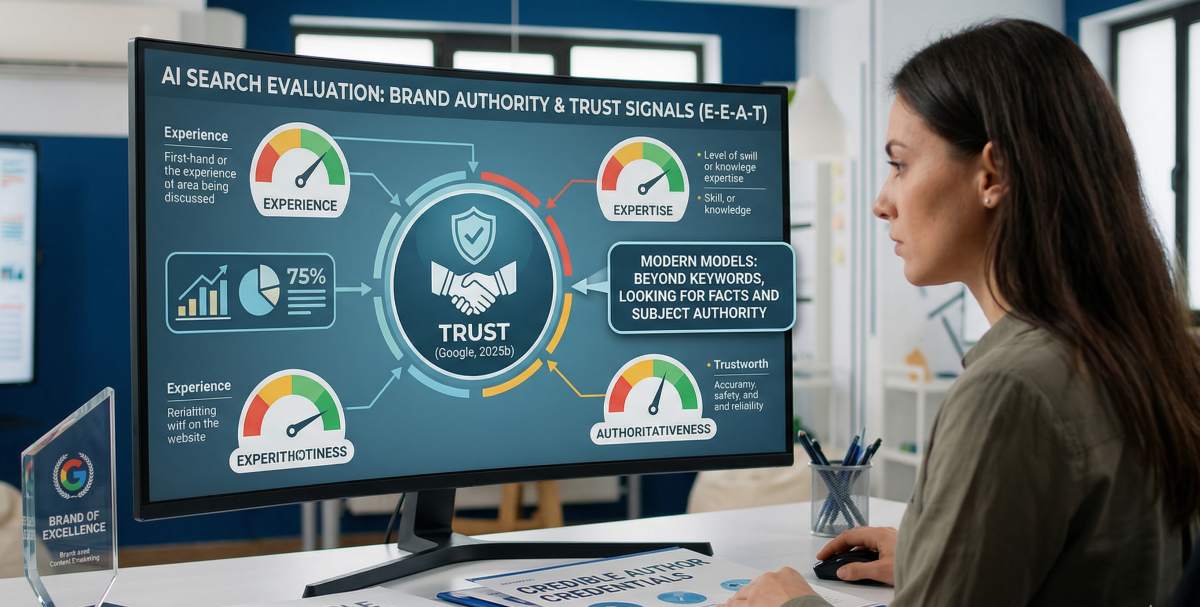
Brand authority acts as a core trust signal for AI search systems. Modern models do not rely on keyword matches alone. They look for sources that present clear facts and show subject authority. Google’s guidance describes this evaluation through Experience, Expertise, Authoritativeness, and Trustworthiness, (E-E-A-T). Of these, trustworthiness carries the greatest weight (Google, 2025b). Marketing teams must show their content comes from credible authors and their information is supported by reliable evidence.
Clear authorship helps build that credibility. Google advises publishers to explain who created the content, how the information was gathered, and why the page exists (Google, 2025b). A page needs to list the author by name and link to a biography page that explains the person’s background.
Structured data strengthens this signal. The ProfilePage schema identifies creators and connects them with their work. The agentInteractionStatistic property record engagement signals such as follower counts or post totals (Google, 2025e). These signals help AI search systems associate a creator with a topic area. If a team uses AI tools during writing or editing, the page should describe that process so readers understand how the material was produced (Google, 2025b).
Existing search signals also affect whether a page appears in AI summaries. Evidence shows that pages holding a Featured Snippet carry a higher chance of being cited in an AI Overview for the same query. In many cases, the probability exceeds 60% (Southern, 2025). This pattern suggests that the AI search system often selects sources that Google already trusts for direct answers. A strategy that aims for Featured Snippets, therefore, supports visibility in AI citations as well.
Trust becomes even more important when it concerns subjects that affect personal safety, health, or financial decisions. Google groups these topics under the label “Your Money or Your Life” or YMYL (Google, 2025b). In these fields, AI search systems lean more heavily on sources with verified expertise.
Data shows that AI Overviews appear frequently in these sectors. Telecommunications queries show the highest appearance rate at about 56%, while healthcare queries show a rate near 33.67% (Southern, 2025; Seer Interactive, 2025).
In the biotech sector, AI features appear in roughly 38.25% of converting searches. Finance queries show a rate near 15.75% (Seer Interactive, 2025). Community sites such as Reddit often rank in traditional search results, yet AI summaries mention them less often for YMYL topics. Instead, the AI search system favors established experts and well-documented sources (Southern, 2025).
These patterns also affect how users move toward a purchase or decision. AI features appear more often on queries linked with buying intent than on early research questions (Seer Interactive, 2025). Users who follow a citation from an AI summary tend to remain on the destination page longer than those who click a standard result (Google, 2025a; Burton, 2025). By the time they arrive, they already understand the main facts from the summary.
For that reason, a strong authority signal does more than build trust. It helps a brand appear in the answers that guide high-value decisions.
6. Content Depth and Comprehensiveness
AI search systems favor pages that explain a subject in depth and add new insights. Google’s guidance states that helpful content should give a full answer rather than a short recap of common facts (Google, 2025b).
To earn a citation in an AI response, a page must present material that adds clear value beyond what appears on many other sites. AI systems built on models such as Gemini 2.0 examine the web to locate pages that explain complex topics in detail, including math or software code (Stein, 2025). Pages that repeat well-known facts without new analysis rarely appear in these summaries.
Search patterns help explain when AI summaries appear. Data shows that about 31.6% of searches that produce an AI Overview contain a direct question. By contrast, only 9.7% of searches without an AI response take the form of a question (Seer Interactive, 2025).
Query length also matters. Searches that trigger an AI Overview average about 4.29 words (Seer Interactive, 2025). These patterns show that users ask more detailed questions when they expect a generated answer. Marketing teams should examine these longer queries because they show specific intent and produce more AI summaries.
Content depth also includes the way a page uses visual material. Image-based search has grown rapidly. Google Lens now processes about 12 billion visual searches each month, a fourfold increase over two years (Reid, 2023).
Visual signals help search systems interpret subjects that contain diagrams, products, or other visual details. Pages that combine text alongside clear images or video give the AI search system more evidence about the subject. When AI models apply methods such as query fan out, these assets help the system gather related information and form a single answer.
First-hand knowledge also improves credibility. Google recommends that publishers identify the author and explain how the material was researched (Google, 2025). Clear bylines and author pages show readers who produced the work and what experience the author has. When content teams use AI tools during drafting or editing, they should explain how those tools assisted the process.
The effect of these signals increases in subjects that affect health, safety, or finances. In those fields, search systems favor sources that present verified knowledge and detailed explanations (Google, 2025). A page that combines clear authorship, well-sourced analysis, and detailed coverage has a better chance of appearing in AI summaries for complex questions.
7. AI Search Readiness Audit Roadmap
Digital teams should review their websites now as search behavior changes. Traffic patterns show clear movement away from classic link clicks. Paid search results illustrate this trend.
Data shows that the click-through rate for informational queries without an AI Overview fell 32% since 2024. When an AI Overview appears on the results page, the drop in paid clicks reaches 68% (McDonald, 2025b). Marketing teams, therefore, need to confirm that their websites remain visible to AI systems that assemble search responses.
7.1 Confirm crawl access and preview settings
Begin with basic crawl access. Your robots.txt file should allow Googlebot to read the text and images that appear on the page. If the crawler cannot read your content, AI search systems cannot use it as a source in generative summaries.
Use the URL Inspection tool in Google Search Console to review how Google reads each page. The report shows the exact content returned to the crawler. It also shows whether preview controls, such as nosnippet or data-nosnippet, block parts of the page. These controls limit how Google displays content in search features. If they block key sections of the text, the search system will not use those passages in AI responses.
7.2 Target mid-range search queries
Next, examine the types of queries your content targets. Research shows that queries with monthly search volumes between 501 and 2,400 often trigger AI Overviews. These queries sit in the middle of the demand curve. They attract steady interest while still asking specific questions.
High-volume keywords receive strong competition and do not always produce AI summaries. Mid-range queries often contain more detail, which increases the chance that an AI search system will generate an answer. Content plans should therefore include clear explanations that address these focused questions.
7.3. Audit structured data
Structured data is still a core technical signal. Use Google’s Rich Results Test to confirm that your schema markup contains no syntax errors. The test checks whether the markup is consistent with the visible content on the page.
Content management systems require special attention. Platforms such as WordPress or Shopify rely on plugins to generate schema. Review those plugins to confirm that they follow current schema specifications. You should also check the Manual Actions report in Search Console. If Google flags structured data violations, the page becomes ineligible for rich results until you correct the problem.
7.4. Monitor Performance in Search Console
Measurement completes the audit process. Google places traffic from AI features inside the standard “Web” search category in Search Console reports (Google, 2025a). The Performance Report shows clicks, impressions, and query data for those visits.
Marketing leaders and marketers should track these numbers over time to measure how often their pages appear in AI responses. Third-party tools also help with this task. Platforms such as ZipTie track citation presence across multiple AI systems and provide a wider view of brand visibility (McDonald, 2025b).
A regular audit confirms that search crawlers can read your site. It also verifies that your technical setup remains valid. These checks help AI search systems locate and cite your content when they generate answers.
8. Conclusion
AI search is changing how the web presents information. A search results page no longer just presents a list of resource links. Modern search systems assemble answers from many sources and display them at the top of the results page. With this structural shift, visibility depends on whether a search system selects your content as a cited source. Organizations that prepare early will hold stronger positions as this model expands.
This change marks a break from traditional search habits. Ranking for one keyword no longer defines success on its own. Technical clarity forms the first step. Strong editorial work completes the process. When both elements appear together, a page becomes easier for AI search systems to read and cite.
Marketing leaders and technical marketers should approach this shift with a practical mindset. Generative engine optimization (GEO) places your brand within the information systems that shape modern search. AI-powered search systems already reach more than a billion users each month, and that number continues to grow. A careful audit of the AI readiness of your website will reveal where improvements are needed. Clear data structure, well-marked authorship, and detailed explanations help establish the trust signals that these AI search systems look for.
Your content should appear among the sources that answer a user’s question. As audiences move across AI tools, search engines, and voice assistants, visibility depends on whether those systems cite your material. Marketing and content teams should monitor citation presence, overall brand exposure, and assisted conversions to understand the full effect of their work.
Consistent quality and sound technical structure provide the strongest foundation. A website that presents clear facts, well-organized data, and credible authorship allows AI search systems to recognize it as a reliable online resource. Organizations that maintain this discipline will continue to appear in search results as the web shifts toward AI-driven answers.
Frequently Asks Questions
Generative engine optimization (GEO) refers to strategies that help content earn citations within AI-generated summaries. Unlike traditional SEO, which focuses on improving page position in search listings, GEO aims to increase the likelihood that a website or brand is referenced when AI systems like Google’s AI Overviews or ChatGPT assemble answers from multiple sources. As direct visits decline and answer engines present information before users open a webpage, GEO has become a necessary part of search strategy for 2026.
Google AI Overviews are AI-generated summaries that appear at the top of search results pages. They serve more than 1 billion users each month across more than 100 countries. When an AI Overview appears, it pushes organic links down by about 220 pixels on desktop screens, meaning users often see only the first one or two traditional results before scrolling. AI Overviews currently appear in about 29.9% of observed search queries, with problem-solving questions triggering them in roughly 74% of cases.
Google uses a method known as “query fan-out” to build AI responses. When a user asks a complex question, the AI search system runs several related searches at the same time, each targeting a different part of the topic. It then collects results from these related searches and assembles the evidence into a single summary. The system only activates an AI Overview when it judges that the summary adds value beyond the standard list of results.
Studies show that brands cited in an AI Overview receive significantly more interaction than brands that appear on the same page without a citation. Organic clicks rise by about 35%, while paid clicks rise by about 91% when a brand is cited in the AI summary. Additionally, visitors who arrive through AI features spend more time on the destination site because they have already read a short summary and reach the page with clearer interest. As the organic click-through rate for queries with AI Overviews has fallen to about 0.61%, citation presence has become more valuable than ranking position alone.
Structured data provides labels that explain the meaning of text, images, and other elements on a web page. It uses formats like JSON-LD to help AI search systems identify what each part of a page represents, such as authors, organizations, products, and topics. Google recommends JSON-LD because it separates structured data from page markup, reducing the risk of coding errors. Case studies show measurable gains from structured data implementation, including an 82% increase in click-through rate for Nestle and a 25% increase for Rotten Tomatoes.
Google evaluates content through Experience, Expertise, Authoritativeness, and Trustworthiness (E-E-A-T), with trustworthiness carrying the greatest weight. AI search systems look for sources that present clear facts and demonstrate subject authority. Clear authorship, detailed author biographies, and ProfilePage schema markup help AI systems associate creators with their areas of expertise. Pages holding a Featured Snippet have more than a 60% chance of being cited in the AI Overview for the same query, indicating that Google draws from sources it already considers reliable.
For subjects that affect personal safety, health, or financial decisions, AI search systems lean more heavily on sources with verified expertise. AI Overviews appear in about 56% of telecommunications queries, near 33.67% for healthcare queries, roughly 38.25% of converting biotech searches, and near 15.75% for finance queries. Community sites like Reddit rank in traditional results but appear less often in AI summaries for YMYL topics. Instead, the AI search system favors established experts and well-documented sources.
Problem-solving questions trigger AI Overviews most frequently, at roughly 74% of cases, followed by factual questions at about 69%. About 31.6% of searches that produce an AI Overview contain a direct question, compared to only 9.7% of searches without an AI response. The average query length that triggers an AI Overview is about 4.29 words, and the search volume sweet spot falls between 501 and 2,400 monthly searches.
Partially. ChatGPT runs a live web search for roughly 30% to 46% of user queries, and its search results show a strong connection to Bing rankings. Research found that 87% of citations inside SearchGPT match pages that appear within Bing’s top 20 organic results, while the overlap with Google’s top results is lower at 56%. This means that strong performance on both Google and Bing increases the chance that your content appears in AI citations across multiple platforms. Pages that explain a subject in depth with clear facts and structured data are more likely to be cited regardless of which AI system generates the answer.
Resources
- Burton, W. (2025, March 26). The Shift To Zero-Click Searches: Is Traffic Still King? Search Engine Journal.https://www.searchenginejournal.com/the-shift-to-zero-click-searches-is-traffic-still-king/
- Google. (2025, December 10a). AI Features and Your Website. Google Search Central.https://developers.google.com/search/docs/fundamentals/ai-features
- Google. (2025, December 10b). Creating Helpful, Reliable, People-First Content. Google Search Central.https://developers.google.com/search/docs/fundamentals/creating-helpful-content
- Google. (2025, December 10c). Intro to How Structured Data Markup Works. Google Search Central. https://developers.google.com/search/docs/appearance/structured-data/intro-structured-data
- Google. (2025, December 10d). Learn About Article Schema Markup. Google Search Central.https://developers.google.com/search/docs/appearance/structured-data/article
- Google. (2025, December 10e). Profile Page (ProfilePage) Schema Markup. Google Search Central.https://developers.google.com/search/docs/appearance/structured-data/profile-page
- Google. (2026, January 6a). General Structured Data Guidelines. Google Search Central. https://developers.google.com/search/docs/appearance/structured-data/sd-guidelines
- McDonald, T. (2025, November 4). AIO Impact on Google CTR: September 2025 Update. Seer Interactivehttps://www.seerinteractive.com/blog/aio-impact-on-google-ctr-september-2025-update
- Reid, E. (2023, May 10). Supercharging Search with Generative AI. The Keyword.https://blog.google/products-and-platforms/products/search/generative-ai-search/
- Schema.org. (2025, December 8). Getting Startedhttps://schema.org/docs/gs.html
- Seer Interactive. (2025). The Factors That Influence AI Search Visibility [Webinar PDF].https://cdn.seerinteractive.com/hubfs/Q1%20Seer%20AI%20Webinar_%20The%20Factors%20That%20Influence%20AI%20Search%20Visibility.pdf
- Southern, M. G. (2025, January 28). Google AI Overviews Found In 74% Of Problem-Solving Queries. Search Engine Journal. https://www.searchenginejournal.com/google-ai-overviews-found-in-74-of-problem-solving-queries/
- Stein, R. (2025, March 5). Expanding AI Overviews and introducing AI Mode. The Keyword. https://blog.google/products-and-platforms/products/search/ai-mode-search/
- Venkatachary, S. (2024, October 28). AI Overviews in Google Search expanding to more than 100 countries. The Keyword. https://blog.google/products-and-platforms/products/search/ai-overviews-search-october-2024/
Kim Greer
OFP Law
One of the best business decisions I ever made was to contract with 321 Web Marketing. Jonathan Gessert and his team are knowledgeable, efficient, and effective, making digital marketing goals easy to achieve and helping [...]

Kelly Cole
Business Benefits Group
My company hired 321 Web Marketing in February 2016 to resurrect our web site. We feel our web site is the face to our business and desperately needed a make over. 321 took us from blah to WOW effortlessly and what a difference [...]

Emily Hawkins
Diener & Associates
Thanks to 321 Web Marketing, the client has seen an increase in their search engine leads, averaging 12 qualified leads per month. The client has also achieved prominent Google Maps and search placement. The team manages the engagement [...]

Trevor Telesz
Paw Pals Pet Sitting
321 Web Marketing successfully translated the client’s design into a stunning and refreshed website, ensuring seamless functionality across all dynamic views. The team provided clear timelines and stuck to them, keeping everything [...]

Corey Davis
Spartan Animal & Pest Control
321 Web Marketing is truly phenomenal at what they do. Their ability to communicate and describe the steps and actions that they are implementing , Alex Zarpas in particular, is excellent. Delivering on promises is all they have done for me [...]

Alec Roberts
MFE Insurance
I can’t say it enough, Jonathan and his team have gone above and beyond since day one to accommodate our needs and meet our goals. I run a specialty insurance brokerage based in LA and once we found 321 we never looked [...]

Richard Wilbur III
Advantage.Tech
Thanks to 321 Web Marketing’s web development work, the client increased rankings and traffic from search engines. Also, their business secured prominent positions on Google Maps and industry-relevant, profitable keywords. The client also [...]

Bruce Gemmill
FVCbank
After the website revamp, the client saw a steady rise in leads from search engines, resulting in additional traffic. 321 Web Marketing is highly punctual when it comes to deliverables, and internal stakeholders are impressed with the service [...]

Drew Weeks
VAE
321 Web Marketing delivered a sleek website that accurately portrays the size and quality of the client’s organization. All of their completed websites have received positive feedback from users who have been impressed by the UX/UI. The [...]

Ryan Masten
Masten Pools
321 Web Marketing has increased the client’s leads from zero to 53 monthly. Their SEO efforts pay off impressively due to a top-ranking position on Google and making the site the number one result for several local service keywords. The [...]