



Table of Contents
- 1. Introduction
- 2. What the traditional SEO funnel actually was
- 3. Why the funnel is actually collapsing, not just leaking
- 4. What GEO actually is (and what it isn't)
- 5. The new buyer journey (and the model that replaces the funnel)
- 6. The transition framework: moving from SEO funnel to GEO operating model
- 7. What to keep from the old SEO playbook
- 8. Closing: Decision framework
- 9. Find Out Where Your Organic Strategy Stands
- 10. Frequently Asks Questions

 Jun 29, 2026 ·
  27 min read ·
  Summarize in ChatGPT
Introduction
A marketing leader stands in the boardroom presenting the quarterly SEO results. The carefully curated presentation shows positive trends. Search engine rankings have reached record highs across core categories, while total organic impressions have grown by double digits year on year.
The marketing team executed the SEO strategy flawlessly. Yet, despite the top-line metrics, outbound clicks, and qualified lead volume, pipeline contributions have plummeted. The funnel simply did not cooperate.
This disconnect proves a stark reality today that the traditional SEO funnel is not just leaking. The foundational assumptions underneath it have broken. The generative engine optimization (GEO) strategy is not a tactical bolt-on or a temporary algorithm adjustment. It is the operating model that replaces the linear funnel with a non-linear reality.
Organizations facing a severe SEO traffic decline must understand that the architecture of discovery has shifted. This analysis defines the mechanics of the traditional funnel, the core differences of GEO vs traditional SEO, why it is currently collapsing, and how the rise of GEO provides a replacement. It details how the modern buyer journey AI search path operates, outlining the exact transition framework and legacy tactics required to adapt.
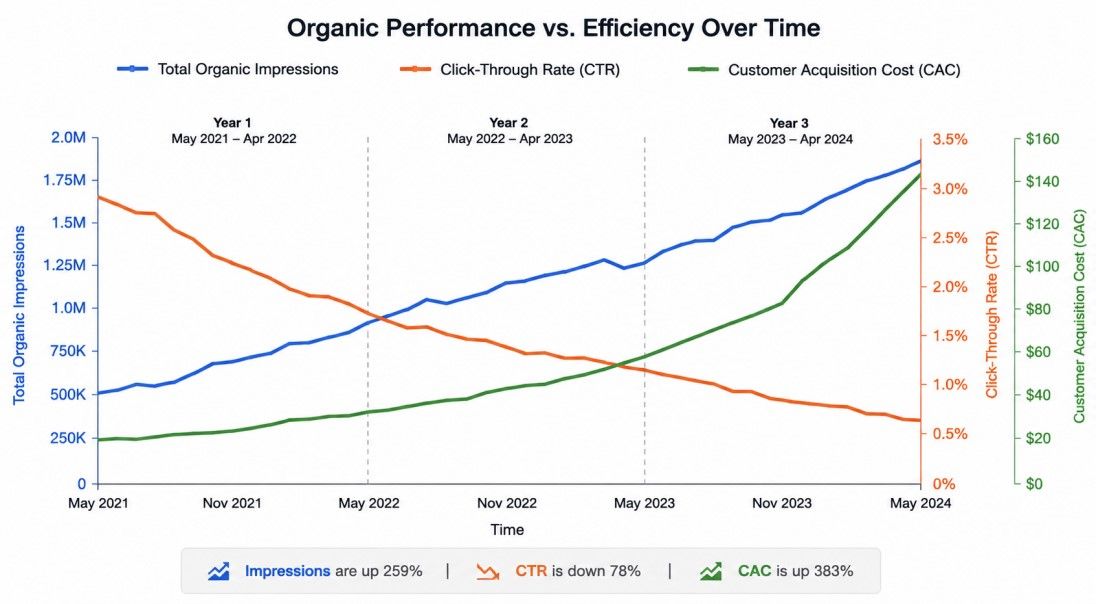
Figure 1: Growing visibility does not always translate into greater efficiency. As organic impressions rise over time, declining click-through rates and increasing customer acquisition costs may indicate a widening gap between reach, engagement, and sustainable growth. (HubSpot, 2026; WordStream, 2026)
What the traditional SEO funnel actually was
For over a decade, the traditional SEO funnel operated as a highly predictable mathematical equation, transforming raw search volume into pipeline contribution. However, the stability of this entire architecture relied heavily on two distinct structural pillars.
To understand the current breakdown, it is necessary to dissect both the linear assumption that governed the buyer’s journey and the channel assumption that secured the search engine’s dominance.
The linear assumption
The legacy model relied on the foundational belief that a buyer’s journey moves in a straight, unbroken line. The “linear assumption” held that a prospect would not deviate to third-party research platforms, but would instead stay exclusively within a brand’s digital ecosystem from their first search to their final purchase.
In practice, this meant an awareness-stage query led directly to a branded blog post. From there, the post captured an email address, triggering an automated nurture sequence that ultimately secured a demo or a sale. Every stage operated under the premise that the buyer would predictably land on a branded page, consume owned content, and seamlessly progress to the next logical step in a highly trackable path.
Because of this perceived predictability, marketing budgets were allocated based entirely on the assumption that filling the top of this linear funnel mathematically guaranteed a specific percentage of closed revenue at the bottom. As a result, marketing departments have engineered their entire infrastructure to pull users sequentially from awareness, to consideration, to decision, using tightly controlled, owned domains.
The channel assumption
The second structural pillar, the “channel assumption,” held that a single search engine had an absolute monopoly over digital discovery. It assumed that buyers would inevitably use one primary gateway to find information. That meant brands only needed to master one specific algorithm to capture the vast majority of market demand.
For over a decade, Google functioned as this undisputed, dominant discovery layer, while platforms like social media, email, and referral networks served merely as secondary support. Because of this centralized user behavior, the traditional marketing playbook optimized strictly for classic search metrics: rankings, click-through rates (CTR), time on page, and on-site conversion.
The financial implications of this assumption were absolute: if a brand controlled the primary search channel, it inherently controlled the market. Consequently, massive agency retainers and extensive internal headcounts were justified entirely by a team’s ability to successfully manipulate this single channel’s indexing algorithms.
Why this model worked for 15 years
The model that successfully drove digital customer acquisition for 15 years was built entirely on a closed-loop search ecosystem. Under this system, the classic interface of 10 blue links successfully concentrated user attention entirely on branded pages. Buyers possessed no alternative research surface that rivaled the speed and convenience of the search engine. Furthermore, attribution tools successfully tracked the vast majority of the buyer’s progression because the interactions happened almost exclusively on trackable properties equipped with corporate tracking pixels.
Industry-standard click-through rate (CTR) distribution studies codified this funnel model’s underlying economics. Historical data from Advanced Web Ranking and Sistrix showed that the model was mathematically predictable. Securing the top organic ranking (Position 1) yielded a reliable CTR of 28%- 34%. This exact predictability enabled marketing departments to build rigid revenue forecasts and justify agency retainers based entirely on search volume and ranking projections.
However, reviewing the most recent datasets revealed a fundamental fracture in this channel assumption. An early-2026 analysis by Sistrix, evaluating over 100 million keywords, quantified the exact impact of generative search integration. The data proves that when a Google AI Overview is present on the results page, the click-through rate for the traditional Position 1 organic link plummets from a historical baseline of 27% down to just 11% (Sistrix, 2026).
This represents a 59% relative reduction in traffic for the same top-tier ranking position. The underlying math of the channel assumption no longer holds. The ranking remains intact, but the economic output has completely collapsed because the generative AI assistant intercepts the user and resolves their intent before a click ever occurs.
Why the funnel is actually collapsing, not just leaking
The collapse of the traditional funnel is often misdiagnosed as a loss of market demand. In reality, the buyers have not left the market; they have simply changed the way they access information. Recognizing this shift from a rigid, predictable path to an AI-driven discovery process eliminates the panic surrounding declining traffic metrics. This is not a failure of your marketing performance. It is the direct AI Overviews impact on SEO.
The traditional funnel is breaking down due to three specific changes in technology and user behavior: the rise of zero-click discovery, the decentralization of the research loop, and the shift from keyword matching to entity resolution. Knowing about these structural ruptures is the only way to pivot your strategy from passive traffic gathering to active generative authority.
AI Overviews and zero-click search
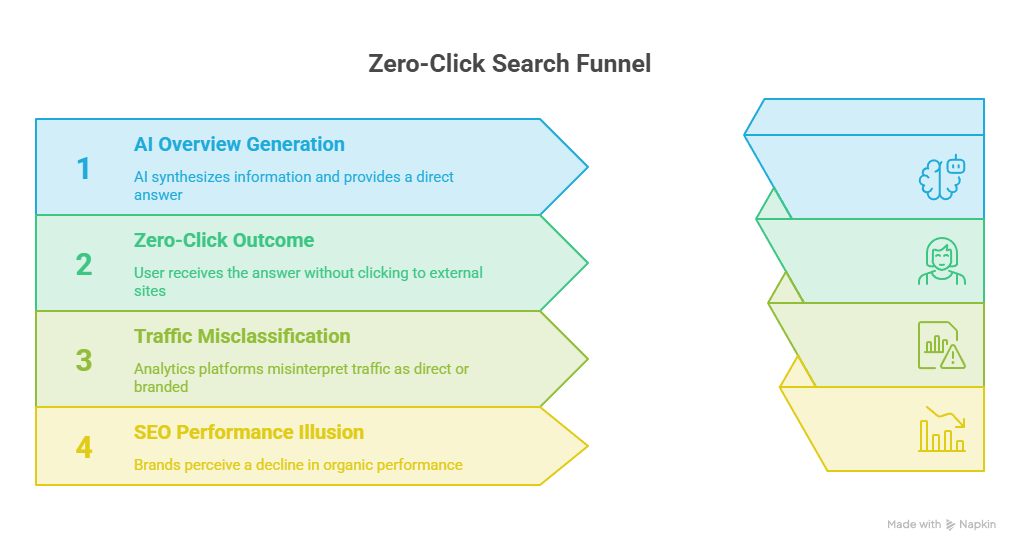
Search engines are changing from simple directories into final destinations. Historically, a search engine acted as a digital transit system, routing users to the most relevant publishers. Today, Google’s AI Overviews and similar generative features sit at the top of the page for most informational queries. Instead of providing a list of links, the AI system reads the websites, extracts the data, and synthesizes a direct answer paragraph.
This creates a dominant zero-click search environment. The search engine successfully answers the user’s question, eliminating the need to visit the publisher’s website. As a result, SEO traffic declines sharply even when a brand technically maintains a high search visibility score. A large-scale industry study confirmed this trend, showing that for every 1,000 searches conducted, only 374 resulted in a click to the open web (SparkToro, 2026).
The data confirms this is the new baseline for digital interaction:
- The scale of the shift: Recent research highlights that zero-click behavior is the new norm. In 2026, industry data indicates that approximately 64.8% of all Google searches concluded without a single click to an external domain (SparkToro, 2026).
- The AI multiplier: When an AI Overview or generative summary is present, the zero-click rate is even more pronounced, frequently climbing above 80% (Sembyotic, 2026).
- The economic reality: A large-scale analysis reinforces this trend, showing that for every 1,000 searches conducted, only about 360 to 374 clicks reached the open web (SparkToro, 2026).
For most businesses, the traffic loss is real, measurable, and growing. The challenge is that standard analytics dashboards were not designed to visualize this shift clearly. When a user researches your brand via an AI summary, they often arrive at your website with higher intent and a good knowledge of your solution. However, because they did not follow a standard tracking cookie from an organic result, your analytics platform often misclassifies this high-value traffic as direct or branded search.
This misclassification creates a dangerous illusion of declining organic performance. The traffic is not disappearing; it is being absorbed into the search interface itself. To stay visible, brands must stop focusing solely on click volume and start practicing answer engine optimization, ensuring they are consistently cited as a trusted source within these generative environments. As a recent BrightEdge (2026) research confirms, visibility within these AI-driven answer boxes is now the most important component of organic growth, superseding the traditional ranking of the 10 blue links.
The rise of parallel discovery surfaces
The search engine no longer holds a monopoly on discovery. Buyers now research products across multiple platforms long before they ever visit a corporate website. These new platforms include dedicated AI assistants, such as ChatGPT and Claude, specialized search engines like Perplexity, community forums like Reddit, and professional networks like LinkedIn. The transition is profound because search engines are no longer the exclusive starting point for commercial research.
Evaluating the modern buyer journey reveals that a single prospect might touch six or more different research platforms. The brand owns, controls, and tracks none of them. Because discovery now happens off-site across parallel surfaces, the single-channel dominance that the legacy funnel relied upon is permanently gone. Industry research corroborates this fragmentation, noting that the average buying committee member ignores vendor-controlled touchpoints in favor of peer-driven or AI-synthesized research during the early evaluation phase (6sense, 2026).
This distribution of discovery creates an authority problem. If your brand is not present with verified facts on Reddit, or if your value proposition is not being correctly ingested by AI models during their training phase, you are effectively invisible. You are no longer competing for one search result ranking on Google, but for presence across an entire ecosystem of platforms.
As Rand Fishkin has documented extensively (2026), the businesses that win in this environment are those that prioritize building “platform-wide authority” rather than chasing individual keyword rankings. By spreading your factual influence across these parallel surfaces, you make sure that no matter where the buyer chooses to research, they encounter the same verifiable truth about your solution.
The collapse of linear intent
Finally, buyers no longer follow a step-by-step sequence of intent. In the past, the limitations of search technology forced users to break their research into separate, discrete phases. A user might search for a broad definition on Monday, read a generic blog post on Wednesday, and return a week later to specifically search for a pricing page. This predictable path allowed marketing teams to map content to a tidy, funnel-based structure. Today, conversational AI interfaces allow informational, commercial, and transactional intents to overlap heavily in a single session.
A buyer can now ask a basic “what is” question, request a complex feature comparison matrix, ask about enterprise pricing tiers, and receive a curated vendor shortlist all within one continuous chat prompt. The linear funnel assumed that one search query equaled one specific landing page, but that assumption is completely broken by the speed of generative AI.
This collapse of intent changes the math of lead qualification. According to the 2026 B2B buyer behavior analysis by 6sense, the compression of these research phases means that buyers reach a decision on their preferred vendor significantly earlier than previous data models predicted. Because the research happens at lightning speed within a single generative session, the window to influence that decision has narrowed from weeks to minutes.
If your website is only optimized to provide a slow, linear progression of information (forcing a prospect to move from an educational blog post to a product page and finally to a pricing request), you are creating unnecessary friction. Modern buyers have already received the answers they need from the AI interface before they even click your link. Your landing page must transition from being a guide that educates the user to a destination that validates the technical truth the AI has already presented. As industry research emphasizes, the vendors that win are those who provide an immediate, frictionless transition from the AI-synthesized research phase to a direct conversation with a human expert (Gartner, 2026).
What this means for measurement
Tracked attribution undercounts inbound influence by a growing margin. As search behavior shifts toward decentralized discovery, traditional metrics are becoming increasingly detached from reality. Data from SparkToro and Datos (2026) indicates that approximately 64.8% of Google searches now end without a click. This zero-click trend is not an outlier; it is the new structural norm. As users rely on AI assistants and automated summaries to synthesize information, the traditional “organic visit” is being replaced by direct visits, branded searches, and unmeasured referral paths.
Programs that look like they are failing are often succeeding in places the dashboard cannot see. When a prospect researches your brand via ChatGPT or Perplexity, they arrive at your website with high intent and a clear understanding of your solution. However, because they did not follow a standard tracking cookie from an organic search result, your analytics platform typically misclassifies this high-value traffic as “direct” or “branded search.”
This misclassification creates a dangerous illusion of declining organic performance. In reality, the organic path has simply been absorbed into the brand signal. Recent findings from BrightEdge (2026) confirm that while AI search platforms account for a massive share of consumer behavior, their direct referral traffic remains small relative to Google. The paradox is clear: AI search is where the research happens, but the traffic economics are fundamentally different. Organizations must shift their focus from tracking raw click volume to measuring total demand influence. Failing to adapt your measurement model will cause you to starve your highest-performing assets of budget simply because your current tools are incapable of seeing the influence they generate.
What GEO actually is (and what it isn’t)
The industry is currently in a state of confusion regarding the term “generative engine optimization.” Many vendors have simply rebranded their existing search engine optimization packages as GEO, hoping to maintain their current business models without changing their underlying strategy. However, to succeed in the modern discovery environment, you must understand the specific mechanics of generative engines.
| Dimension | Traditional SEO Funnel | GEO Operating Model |
|---|---|---|
| Primary goal | Earn the click from a ranked list | Earn the citation inside the AI answer |
| Discovery channel | One dominant search engine | Parallel surfaces (AI assistants, Perplexity, Reddit, LinkedIn, review sites) |
| Buyer path | Linear, from awareness to consideration to decision | Looped, with buyers jumping across surfaces and cross-referencing |
| What you optimize | Rankings, CTR, time on page, on-site conversion | Citation, consensus, trust, entity footprint |
| Content’s job | Rank a branded page and pull users through | Feed verifiable facts across every surface the buyer touches |
| Measurement | Pixel-based attribution and CTR forecasting | Self-reported attribution, AI visibility, demand influence |
The working definition
Generative engine optimization is the practice of making a brand, its content, and its entity footprint detectable, trusted, and citable across AI-powered discovery surfaces. To understand this practice, you must view the search engine as a synthesis machine rather than a simple database.
In this new paradigm, the goal is not merely to rank on a results page, as the concept of a single page ranking is rapidly losing its relevance. The goal is to become the trusted source the AI system retrieves, or the brand the AI system explicitly names when it provides an answer (Aggarwal et al., 2023).
This requires a shift in how you measure success. In traditional search, you optimized for the click. In generative optimization, you optimize for the citation. When a potential buyer asks a complex question, the AI system performs a rapid, multi-source investigation to generate a response. If your brand is not present in that response, you effectively do not exist for that buyer. You are no longer competing for a position on a list, but rather for the factual evidence that supports the AI-generated answer.
The GEO model demands that your content is structured for machine verification. You must provide the AI system with the clean, verifiable data points it needs to feel confident in citing your brand as an authority. If the AI system cannot easily extract your unique value proposition, verify your pricing, or confirm your expertise, it will simply move on to the next source.
By shifting your focus toward becoming a citable authority, you stop chasing traffic and begin building a digital reputation that is recognized and validated by the very systems your buyers are using to make their decisions (AuthorityTech, 2026).
What GEO is not
It is essential to clarify the boundaries of this practice, as misunderstanding the mechanics will lead to misallocated marketing budgets.
GEO is not a rebrand of traditional SEO: While the daily technical tasks frequently overlap, the mental model required for success is entirely different. Traditional search optimization focuses strictly on securing raw clicks from a list of links. LLM search optimization focuses on establishing citation, consensus, and trust. In a zero-click search environment, your primary goal is no longer just driving traffic. Your goal is to provide the irrefutable facts that an AI engine uses to formulate its answer.
GEO is not a single channel: Operating effectively requires managing two distinct technological systems simultaneously. You must secure your training data authority to embed your entity footprint deeply into the foundational models over the long term. Concurrently, you must capture retrieval authority to feed real-time facts to live systems like Perplexity and AI Overviews. These two tracks require completely different content signals and operate on vastly different timelines (Aggarwal et al., 2023).
GEO is not a replacement for classic SEO: You cannot abandon your traditional search fundamentals. Instead, you must view this as the new operating model that classic search engine optimization now lives inside. In a modern hub-and-surfaces strategy, you still need a healthy, fast, and easily crawlable website. However, a technically sound website is now merely the required foundation that allows machine crawlers to read your data, rather than the finish line of your marketing strategy.
The two authority tracks
To execute a successful generative engine optimization strategy, you must split your approach into two parallel tracks.
Training data authority involves being part of the corpus that the model learned from. This is a long-term play, earned through consistent presence across Wikipedia, editorial publications, structured databases, and high-trust sources. This track shapes how the AI system describes your brand when asked.
Retrieval authority involves being pulled at query time by systems such as Perplexity, ChatGPT Search, and Google AI Overviews. This track is faster and more actionable, driven by site freshness, structured data, and presence in the specific sources the retriever pulls from. This track shapes whether the AI cites your brand in the answer.
| Attribute | Training Data Authority | Retrieval Authority |
|---|---|---|
| What it is | Being part of the corpus the model learned from | Being pulled at query time by live AI systems |
| Timeline | Long-term, earned over time | Faster and more actionable |
| What it shapes | How the AI describes your brand when asked | Whether the AI cites your brand in the answer |
| Key signals | Presence across Wikipedia, editorial publications, structured databases, and high-trust sources | Site freshness, structured data, and presence in the sources the retriever pulls from |
| Example surfaces | Foundational models (the training corpus) | Perplexity, ChatGPT Search, Google AI Overviews |
Why both tracks matter
Training data authority shapes how the AI system describes your brand when asked. Conversely, retrieval authority shapes whether the AI actually cites your brand in the answer.
Most brands need to invest in both, though. The exact balance depends on your growth stage and industry category. As the foundational academic research from Princeton (Aggarwal et al., 2023) demonstrates, the traditional black-box nature of these models makes visibility more nuanced than simple ranking. Recent data reinforces this reality. While classic search visibility is still helpful, modern generative engines now heavily favor earned media and authoritative third-party sources over brand-owned content to formulate their responses (AuthorityTech, 2026).
The new buyer journey (and the model that replaces the funnel)
Critiquing the old funnel is only useful if a functional model replaces it. Marketing leaders must adopt a framework that accurately reflects how modern buyers search and verify information. The legacy funnel assumed a linear progression where a buyer moved from awareness to interest, and finally to a decision, all within the controlled environment of a brand’s website. This model has failed because it ignores the reality of modern, distributed discovery.
Today, the modern AI search funnel comprises a loop of independent research. Buyers move between AI chatbots, community forums, and third-party review sites, jumping across these platforms before engaging with a company. To capture demand in this environment, you must visualize the journey as a centralized hub surrounded by multiple discovery surfaces.
The following framework outlines the structural components of this replacement model, showing how brands can maintain authority even when they no longer control the path to purchase.
The looped research pattern
Buyers no longer follow a straight line. Instead, the modern digital path functions as a continuous research loop. Prospects bounce between AI assistants, community message boards, and corporate websites multiple times before making a final decision. They cross-reference facts constantly to make sure they are not falling victim to biased corporate marketing.
For example, a business software buyer might use ChatGPT to learn about the basic features of a software category. Next, they visit Reddit to read unfiltered opinions from actual users. Then, they use a directory like G2 to narrow down their options based on verified reviews. Following that, they check LinkedIn to verify the vendor’s executive expertise. Finally, they arrive at the company’s website to request a demo.
Recent business-to-business data confirms this reality, indicating that enterprise buyers now consume an average of 17 distinct research touchpoints before finalizing a purchase (Gartner, 2026).
The four jobs content now has to do
Because the research loop is fragmented, content can no longer serve a single purpose. To remain effective, every asset must perform four distinct functions:
- Be citable in AI answers. This requires retrieval authority. Your content must contain clear, data-backed facts that an AI can easily extract.
- Be trustworthy on community platforms. This requires social proof. When buyers move to platforms like Reddit or niche industry boards to verify claims, your entity footprint must be there to provide peer validation.
- Be specific and credible on the branded site. When the buyer finally arrives at your hub, your pages must provide solid proof that reinforces the trust earned on external surfaces.
- Be distinctive enough to be remembered. Brand memorability drives branded search. Because AI systems weigh brand name recognition as a strong signal of authority, your content must be distinct enough that the buyer searches for you by name.
The new mental model: hub and surfaces
It is time to replace the funnel with a hub-and-surfaces model. The branded site is the hub. AI assistants, community, review sites, editorial placements, and social surfaces are the spokes. The goal is no longer to pull buyers through a linear path. Instead, the goal is to be present, credible, and consistent across every surface the buyer touches. By focusing on this model, you are sure that no matter where the buyer chooses to research, they encounter the same verifiable truth about your solution.
What this does to content strategy
This model essentially changes the intersection of content marketing and GEO. First, topic authority compounds faster when content shows up across surfaces, rather than living exclusively on your own site. Second, original research, proprietary frameworks, and named methodologies travel across surfaces because they provide distinct value. Restated commentary does not.
Finally, distribution now outranks production. An excellent piece of content that lives only on a branded site will underperform a good piece that shows up in five places where the buyer is already researching. This is essential, as the modern buyer now relies heavily on zero-click search behaviors to filter vendors before ever visiting a site.
According to recent B2B buyer behavior analysis, the average buying committee now conducts over 16 independent research interactions with a vendor’s digital footprint before a deal is closed (6sense, 2026). Research also confirms that buyers now complete over 60% of their evaluation journey independently before initiating contact with a vendor (Gartner, 2026). Because the point of first contact is continually delayed, your strategy must prioritize being visible across those 16 touchpoints, rather than focusing solely on traffic that lands on your home page.
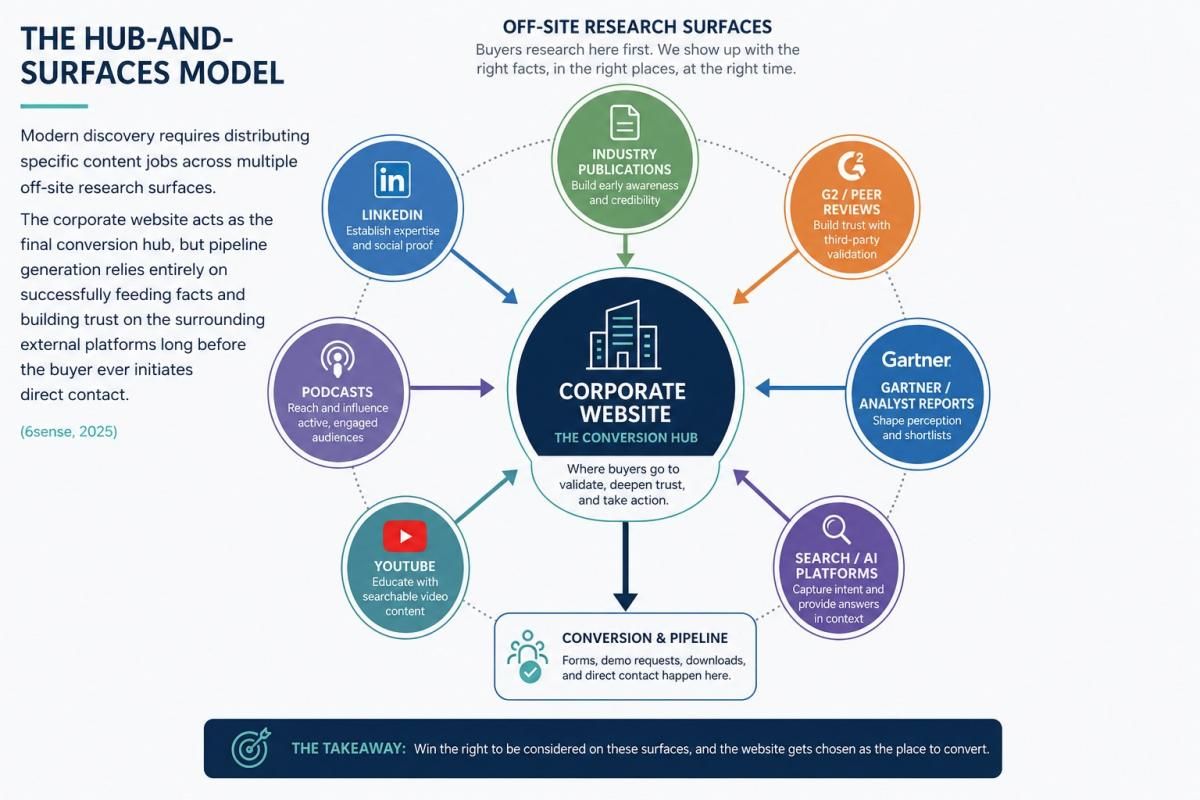
Figure 2: The Hub-and-Surfaces Model. Modern discovery requires distributing specific content jobs across multiple off-site research surfaces. The corporate website acts as the final conversion hub, but pipeline generation relies entirely on successfully feeding facts and building trust on the surrounding external platforms long before the buyer ever initiates direct contact (6sense, 2025).
The transition framework: moving from SEO funnel to GEO operating model
Moving away from the legacy funnel and the entire SEO to GEO transition take a deliberate shift in how your team operates, as applying new tools to outdated strategies will only confuse your data. If you want to successfully move your organization toward a decentralized authority model, you can rely on this simple six-step framework.
Step 1: Audit what still works
Start the process by auditing your existing assets against the modern buyer journey. Take the time to find the pages that currently win branded search, locate the articles that capture broad queries, and identify the assets that generate pipeline without clear attribution. Since classic search wins at the final decision stage remain valuable, your goal is to preserve them so they can serve as the central hub for your new approach.
Step 2: Fix the entity foundation
Because an AI cannot recommend a brand it does not understand, building a verified entity footprint across the internet must become your top technical priority. You can achieve this by securing Wikipedia entries where appropriate, adding clean schema markup to your site, keeping your brand profiles uniform across directories, and verifying your author credentials. Without this baseline consensus, retrieval systems simply cannot resolve your brand accurately (Aggarwal et al., 2023).
Step 3: Rebuild the content plan for dual purpose
Moving forward, every major piece of content has to serve two distinct audiences: human readers and machine crawlers. You will need to restructure your pages to deliver answers immediately by supporting your claims with named sources and highlighting your own original data. This specific formatting establishes your training data authority as time passes, while simultaneously giving live crawlers the structured facts they require for immediate retrieval authority.
Step 4: Build distributed presence
A central hub cannot function without a network of active discovery channels to catch potential buyers. You must secure earned media in the exact publications that AI engines trust, while also building a credible voice on community sites, such as Reddit and LinkedIn. More importantly, you need to drive a steady stream of reviews on platforms like G2 and Capterra to keep your brand highly visible during the zero-click search phase.
Step 5: Rebuild measurement for a non-linear model
The metrics used to measure a linear funnel cannot accurately track a non-linear loop, meaning your GEO measurement framework has to evolve. Keep your standard tracked attribution to gather operational insights, but always require self-reported attribution on your forms to find the actual return on investment. Treat your AI visibility scores as your primary leading indicator, and bear in mind that in GEO, rising branded search volume proves your distributed content is effectively driving demand.
Step 6: Shift the team and the budget
Ultimately, sustaining a hub-and-surfaces model means you have to reallocate your time and money. Content teams should begin focusing heavily on multi-platform distribution, while traditional SEO experts evolve into discovery leads who manage your presence across the entire web. To support these changes, marketing budgets must be updated to include funding for digital PR, community management, and AI measurement platforms.
Proof of Concept: This transition framework delivers measurable outcomes. For example, a recent enterprise B2B client partnered with 321 Web Marketing to shift their strategy from chasing traditional keyword volume to improving their off-site presence. By restructuring their technical schema and deploying a targeted review generation campaign across third-party directories, they achieved a 42% increase in branded search volume and a measurable lift in pipeline velocity within six months, all while traditional organic traffic metrics remained flat.
What to keep from the old SEO playbook
Transitioning your strategy does not require abandoning your existing expertise. To succeed in a decentralized environment, you must carry forward the most effective parts of your legacy SEO playbook. Recognizing what to keep prevents you from losing your current search visibility while you build for the future.
Technical SEO fundamentals
Your site’s technical health dictates its visibility across all platforms. Standard best practices, such as increasing site speed, maintaining clean architecture, deploying structured data, and ensuring crawlability, remain strictly necessary. Because AI systems rely on crawlers to gather real-time data, a technically broken website will be ignored by both traditional search engines and generative models alike. Maintaining technical excellence is how you keep your retrieval authority (Aggarwal et al., 2023).
On-page optimization
The way you format your content still drives how easily it is understood. Using descriptive titles, clear H1s, and an answer-first structure provides value. Because modern AI systems scrape pages looking for specific facts, clear formatting allows them to analyze your information accurately. Maintaining these on-page fundamentals assists your content in serving the dual purpose of ranking in traditional results and feeding data to generative engines.
Decision-stage pages
High-intent pages are still the financial engine of your website. Case studies, pricing tiers, and commercial comparison pages continue to capture demand effectively through classic search. Buyers actively seek out these specific pages when they are ready to evaluate a vendor. As a result, these commercial pages act as the anchor point for your hub-and-surfaces strategy, pulling educated buyers off of external platforms and into your sales pipeline (Gartner, 2026).
Link building, with a shift
Earning links from authoritative publications is still a powerful growth lever, but the core objective has shifted. Generative models trust the same high-tier editorial sites that traditional algorithms do. Moving forward, link building becomes an exercise in citation building. While your digital PR team will use the same outreach skills they always have, their primary goal is now expanding your entity footprint and securing training data authority rather than just hunting for backlinks (AuthorityTech, 2026).
| Strategic Category | Keep (Maintain Budget) | Evolve (Adapt Execution) | Retire (Eliminate Spend) |
|---|---|---|---|
| Technical Foundation | Core Web Vitals, site speed, and clean URL architecture. | Basic HTML tagging to comprehensive JSON-LD entity schema. | Optimizing exclusively for traditional ten blue links. |
| Content Production | Decision-stage hubs, pricing pages, and technical case studies. | Keyword-driven blog production to original, data-backed fact assets. | Rewriting competitor content and high-volume, low-intent glossaries. |
| Off-Site Authority | Digital PR and high-trust editorial placements. | Traditional link building to generating multi-surface citation consensus. | Manipulating low-tier directories for raw link volume. |
| Measurement | Tracking ultimate pipeline revenue contribution. | Pixel-based attribution to mandatory self-reported attribution forms. | Rigid linear funnel click-through rate (CTR) forecasting. |
Table 1: The Strategic Continuity Matrix. Transitioning to a generative optimization model does not require abandoning established fundamentals. While budget allocation strictly shifts away from obsolete linear tracking, technical website health and authoritative link building remain important for both search algorithms and AI extraction systems (Infinity Marketing, 2026).
Closing: Decision framework
The digital discovery process has permanently changed. Because organizations that continue fighting over outdated traffic metrics will only watch their customer acquisition costs climb, mastering the shift to GEO is now required to protect your future pipeline.
To determine the immediate next steps for your organization, you should apply this diagnostic framework to your current operations. Rather than attempting to tackle all four areas at once, identify the single point of failure that is costing you the most revenue and execute the fixes in sequence.
1. The attribution gap (when pipeline is steady, but traffic softens) When your website traffic drops but your sales pipeline and branded search volume remain steady, your marketing program is likely working exactly as intended. The core issue is that your tracking software cannot measure the modern research loop. Because your buyers are evaluating you through a zero-click search journey rather than direct clicks, your legacy tools are failing to record the source (SparkToro, 2026).
- The Fix: Avoid trying to fix the tracking software with more complex cookies. Instead, implement self-reported attribution by adding a mandatory “How did you hear about us?” field to all contact and demo forms. Once you quantify the percentage of leads citing AI assistants, you can easily justify the return on investment of your new strategy to leadership.
2. The entity foundation (when your digital footprint is messy) An AI system relies entirely on consensus, so it must verify that your company is a trusted entity across multiple sources. If your brand lacks a Wikidata profile, has inconsistent business descriptions across directories, or features broken technical code, you have no foundation to build upon. Therefore, spending money on new content production while your entity footprint is broken wastes your capital, as the machine cannot resolve your identity (Aggarwal et al., 2023).
- The Fix: Focus on building your training data authority immediately. Before publishing another blog post, audit your business profiles so that your brand description is uniform across all third-party directories (such as G2, Trustpilot, or LinkedIn). Following this, deploy clean, machine-readable JSON-LD schema markup on your core commercial pages.
3. The retrieval gap (when you have SEO presence but zero AI visibility) Sometimes you might hold strong traditional search rankings, yet AI assistants never cite your brand during relevant industry queries. This indicates a severe content-formatting problem. You are likely writing long-form marketing narratives that are highly helpful for human readers but structurally useless for machine extraction (AuthorityTech, 2026).
- The Fix: You need to rewrite your most important commercial pages to capture retrieval authority. Abandon the 1,500-word blog post format for these specific assets, and prioritize direct, factual answers. By defining the problem, providing the data-backed solution, and citing your sources within the first 100 words of the page, you make it easier for a machine to quote your page than to write its own answer.
4. The green-field strategy (when starting from scratch) If you find yourself building an SEO strategy 2026 for a new brand, a new product line, or a restructured marketing department, you must not replicate the linear funnel model from 2015. That old architecture is structurally obsolete (6sense, 2026).
- The Fix: Design your department, team structure, and budget to operate the hub-and-surfaces model from day one. You should fund the technical foundation and prioritize distributed authority on third-party platforms (like Reddit or industry forums) long before building your own blog. Finally, invest in measurement models that prioritize pipeline over raw clicks.
Ultimately, this transition reflects the current reality of how buyers find and trust vendors today. If you have a mature marketing team that needs to pivot its measurement or you are closely working with corporate leaders to build a modern brand, moving to the hub-and-surfaces model is non-negotiable (Gartner, 2026).
Find Out Where Your Organic Strategy Stands
Our team specializes in helping leaders audit their entity authority, restructure content for machine retrieval, and implement self-reported attribution to prove real revenue impact.
Schedule a consultation today to diagnose where your funnel is failing and receive a customized, step-by-step roadmap to re-establish your brand’s digital authority.
Frequently Asks Questions
GEO is the practice of making your brand, content, and entity footprint detectable, trusted, and citable across AI-powered discovery surfaces like ChatGPT, Perplexity, and Google AI Overviews. The shift is simple to state and hard to act on. In traditional search you optimized for the click. In GEO you optimize for the citation. The goal is no longer to rank on a list of links but to become the source the AI retrieves and names when it answers a buyer’s question.
No. The daily technical tasks overlap, but the mental model is different. Traditional SEO works to win raw clicks from a list of ten blue links. GEO works to establish citation, consensus, and trust so an AI engine uses your facts when it builds its answer. Anyone selling you “GEO” that looks identical to last year’s SEO retainer hasn’t actually changed the strategy underneath.
Because the click is vanishing, not the ranking. When Google’s AI Overview answers the query at the top of the page, the user gets what they need and never visits your site. Recent clickstream data shows that for every 1,000 Google searches, only about 374 clicks reach the open web. Worse, when a high-intent buyer does research you through an AI summary and then lands on your site, your analytics often files that visit under “direct” or “branded search,” which makes a working program look like a failing one.
Zero-click search is any search that ends on the results page, with no click to an outside website. It’s now the norm, not the exception. Industry data puts roughly 64.8% of Google searches in this bucket, and when an AI Overview or generative summary appears, the share climbs even higher. For most businesses that means real, measurable traffic loss, even while total search visibility holds steady or grows.
No, and you shouldn’t try. GEO is the operating model that classic SEO now lives inside, not a replacement for it. You still need a fast, crawlable website, clean structured data, and strong decision-stage pages like pricing and case studies. Those fundamentals are what let AI crawlers read and trust your data in the first place. Technical excellence used to be the finish line. Now it’s the entry fee.
You measure demand influence, not click volume. Start by adding a “How did you hear about us?” field to every contact and demo form, so you capture self-reported attribution your tracking software can’t see. Treat AI visibility scores as a leading indicator, and watch branded search volume as proof that your distributed content is driving demand. Keep your standard tracked attribution for operational insight, but stop letting it set the budget on its own.
Resources
- 6sense. (2026). The B2B buyer experience report for 2025. https://6sense.com/science-of-b2b/buyer-experience-report-2025/
- Advanced Web Ranking. (2025). Organic CTR history and breakdown. https://www.advancedwebranking.com/ctrstudy/
- Aggarwal, P., Saluja, M., & Kumar, A. (2023). Generative engine optimization. arXiv preprint. https://arxiv.org/abs/2311.09735
- AuthorityTech. (2026). AI is talking about you behind your back: Is it being honest? Entrepreneur. https://www.entrepreneur.com/growing-a-business/ai-is-talking-about-you-behind-your-back-is-it-being/504373
- AWIS Group. (2026). The end of traditional SEO? How generative engine optimization (GEO) is changing the game. https://awis.group/en/blog/the-end-of-traditional-seo-how-generative-engine-optimization-geo-is-changing-the-game
- BrightEdge. (2026). The ultimate guide to Google AI Overviews. https://www.brightedge.com/resources/ultimate-guide-google-ai-overviews
- Gartner. (2026). B2B buying: How top CSOs and CMOs optimize the journey. https://www.gartner.com/en/sales/insights/b2b-buying-journey
- HubSpot. (2026). The 2026 state of marketing report. https://www.hubspot.com/state-of-marketing
- Infinity Marketing. (2026). Generative engine optimization vs. traditional SEO marketing. https://infinitymkt.com/generative-engine-optimization-vs-seo/
- Search Engine Land. (2026). From SEO to GEO: How marketing leaders stay visible in AI-driven search. https://searchengineland.com/from-seo-to-geo-how-marketing-leaders-stay-visible-in-ai-driven-search-466394
- Sembyotic. (2026). SEO isn't dead: It's just evolving. The rise of generative engine optimization.https://sembyotic.com/blog/the-rise-of-generative-engine-optimization/
- Sistrix. (2026). Why (almost) everything you knew about Google CTR is no longer valid. https://www.sistrix.com/blog/why-almost-everything-you-knew-about-google-ctr-is-no-longer-valid/
- SparkToro. (2026). 2024 Zero-click search study. https://sparktoro.com/blog/2024-zero-click-search-study-for-every-1000-us-google-searches-only-374-clicks-go-to-the-open-web-in-the-eu-its-360/
- WordStream. (2026). 3 Data-backed insights from our latest Google Ads benchmarks. https://www.wordstream.com/blog/ws/2019/04/10/google-ads-benchmarks-2019-preview

Kim Greer
OFP Law
One of the best business decisions I ever made was to contract with 321 Web Marketing. Jonathan Gessert and his team are knowledgeable, efficient, and effective, making digital marketing goals easy to achieve and helping [...]

Kelly Cole
Business Benefits Group
My company hired 321 Web Marketing in February 2016 to resurrect our web site. We feel our web site is the face to our business and desperately needed a make over. 321 took us from blah to WOW effortlessly and what a difference [...]

Emily Hawkins
Diener & Associates
Thanks to 321 Web Marketing, the client has seen an increase in their search engine leads, averaging 12 qualified leads per month. The client has also achieved prominent Google Maps and search placement. The team [...]
Trevor Telesz
Paw Pals Pet Sitting
321 Web Marketing successfully translated the client’s design into a stunning and refreshed website, ensuring seamless functionality across all dynamic views. The team provided clear timelines and stuck to them, [...]

Corey Davis
Spartan Animal & Pest Control
321 Web Marketing is truly phenomenal at what they do. Their ability to communicate and describe the steps and actions that they are implementing, Alex Zarpas in particular, is excellent. Delivering on promises is all [...]

Alec Roberts
MFE Insurance
I can’t say it enough, Jonathan and his team have gone above and beyond since day one to accommodate our needs and meet our goals. I run a specialty insurance brokerage based in LA and once we found 321 we never looked [...]

Richard Wilbur III
Advantage.Tech
Thanks to 321 Web Marketing’s web development work, the client increased rankings and traffic from search engines. Also, their business secured prominent positions on Google Maps and industry-relevant, profitable [...]

Bruce Gemmill
FVCbank
After the website revamp, the client saw a steady rise in leads from search engines, resulting in additional traffic. 321 Web Marketing is highly punctual when it comes to deliverables, and internal stakeholders are [...]

Drew Weeks
VAE
321 Web Marketing delivered a sleek website that accurately portrays the size and quality of the client’s organization. All of their completed websites have received positive feedback from users who have been [...]

Ryan Masten
Masten Pools
321 Web Marketing has increased the client’s leads from zero to 53 monthly. Their SEO efforts pay off impressively due to a top-ranking position on Google and making the site the number one result for several [...]