



Table of Contents
- 1. Introduction
- 2. AI systems don’t rank brands. They resolve them as entities.
- 3. Why “getting cited by AI” is actually two problems, not one
- 4. The entity signals that make a brand legible to AI
- 5. What turns content from findable into citation-worthy
- 6. The off-site sources AI systems actually pull from
- 7. How to measure whether AI systems recognize your brand
- 8. The mistakes that quietly erode AI authority
- 9. A 90-day plan to start building AI-recognized authority
- 10. Where to start: a decision framework
- 11. Frequently Asks Questions

 Jun 8, 2026 ·
  24 min read ·
  Summarize in ChatGPT
Introduction
AI systems do not rank brands. These systems build a picture of what a brand is, who it serves, and how credible it is, based on consistent signals across many sources. A brand without that entity footprint stays invisible in AI-generated answers, regardless of where it ranks on Google.
Here is what that looks like in practice. A brand holds the No. 1 spot on Google for its category. Its domain authority is strong, its pages are indexed, and its traffic looks healthy. Then, a potential customer asks ChatGPT, Perplexity, or Google’s AI Overviews (AIO) for the best solution in that category, but the brand does not appear.
A competitor with fewer backlinks and half the traffic gets named instead. AI systems read it as a more credible, consistently described entity. This is the authority gap, and it is one of the central problems in AI brand visibility strategy today.
ChatGPT commands over 900 million weekly users as of February 2026 (Ali, 2026). AIO has already reduced daily traffic to Wikipedia by approximately 15% (Khosravi & Yoganarasimhan, 2026). These facts show how quickly ChatGPT and AI Overviews brand visibility have become a business-critical concern.
A strong search ranking does not carry over to AI-generated answers. The two systems use different criteria to decide what appears. Building brand authority for AI means satisfying two distinct systems, each with its own strategy.
The first is training data authority, the long-term presence that a brand builds across the web-scale datasets that AI models learn from. The second is retrieval authority, the signals that get a brand pulled into a live answer at query time by retrieval-augmented generation (RAG) systems. These two tracks form the framework for this article.
| Before (the brand ranks No. 1 on Google) | After (a buyer asks ChatGPT) |
|---|---|
| The brand ranks No. 1 on Google | The brand does not appear |
| Strong domain authority | Absent from ChatGPT answers |
| Pages fully indexed | Absent from Perplexity answers |
| Healthy organic traffic | Absent from Google AI Overviews |
| Traditional search visibility: Strong | AI search visibility: None |
AI systems don’t rank brands. They resolve them as entities.
A query typed into ChatGPT, Perplexity, or AIO does not trigger a ranked list of websites. The system instead draws on two separate processes.
The first is what the LLM already learned from its training data, built from billions of web pages, articles, and databases. The second process is RAG, which pulls live sources at query time to add fresh, specific information to the answer.
Together, these two processes determine what is included in an AI-generated answer. A brand that lacks presence in both is left out entirely.
This creates two questions every brand needs to answer. Does the AI system have a clear, stable picture of the brand from its training data? Does the brand appear in the sources the retrieval layer currently checks?
The standard for being included looks less like a backlink profile and more like Wikipedia’s notability standard. A brand needs repeated, consistent mentions across independent and credible sources. Thin third-party coverage, scattered descriptions, and contradictory positioning across platforms produce a weak entity signal, giving an AI model no reliable picture to work from.
This is where generative engine optimization (GEO) begins. Aggarwal et al. introduced the core academic framework for this field in their Princeton “GEO: Generative Engine Optimization” paper. Their research showed that adding citations, quotations, and statistics to content produced a 30-40% improvement in visibility within AI-generated answers (Aggarwal et al., 2023).
Entity authority for AI is built through verifiable signals and evidence. The rules that determined rankings in classic search engine optimization (SEO) do not transfer directly to AI systems. Brand signals for AI search follow a different logic entirely.
Geography adds a further layer. U.S.-developed models, such as Gemini and GPT, show a marked “entity-perception bias,” with preferences for U.S.-based entities regularly exceeding their global market share (e.g., 9 out of 10 getaway city recommendations are U.S.-based) (Rienecker et al., 2026).
For non-U.S. brands, this means the bar is structurally higher. More earned media, more authoritative co-mentions, and stronger entity definition are all needed to compete. The built-in geographic bias toward U.S.-headquartered entities is a documented, measurable factor in LLM brand recognition.
The bigger shift is in how search itself works. AI search infers intent and synthesizes answers from multiple sources into a unified narrative response, moving away from matching keywords to documents (Chen et al., 2025). Whether a brand appears in that response depends entirely on how well-defined, consistent, and credible its entity profile is across the sources the model draws from.
| Classic SEO Signals | AI System Signals |
|---|---|
| Backlink volume and domain authority | Frequency of authoritative third-party mentions |
| Keyword placement and density | Consistent brand description across sources |
| Page rank and SERP position | Entity presence in knowledge graphs and structured databases |
| Click-through rate signals | Co-occurrence with credible, topic-relevant entities |
| Technical site performance | Schema markup and machine-readable identity data |
| Content freshness for crawlers | Retrieval-layer presence in RAG-indexed sources |
Why “getting cited by AI” is actually two problems, not one
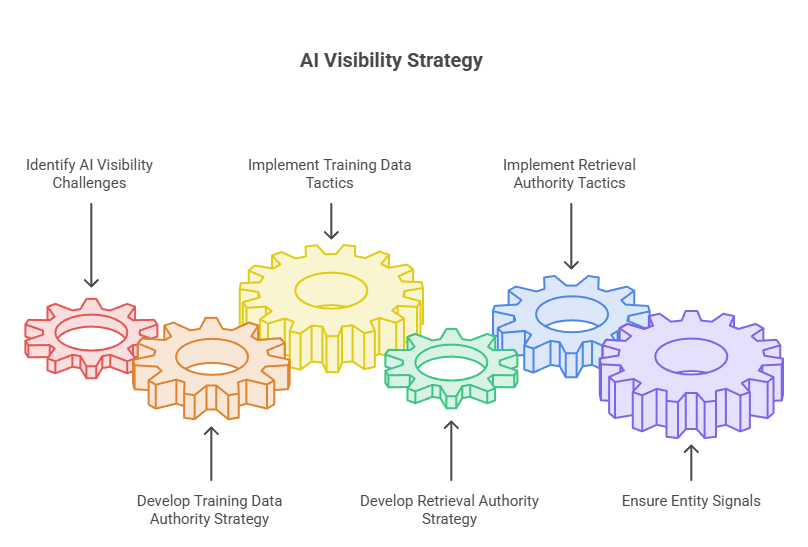
Most brands treat AI visibility as a single challenge. However, being cited by AI presents two distinct problems: training data authority and retrieval authority. Each requires a different strategy, a different timeline, and a different set of tactics. Solving only one produces incomplete results.
Training data authority
Training data authority is how well a brand is represented inside an AI system’s knowledge base. LLMs, such as GPT and Gemini, learn from web-scale datasets, including Common Crawl, Wikipedia, major editorial publications, and structured databases. A brand that appears consistently across these sources is encoded as a credible entity.
New brands take a long time to accumulate the volume of consistent, third-party mentions needed to register as credible entities in model training data. A brand earns that presence through sustained volume: editorial features, Wikipedia inclusion, structured database listings, and repeated brand co-occurrence in AI answers across authoritative sources.
This will take multiple years with no shortcuts. A brand with strong training data authority gets surfaced even when the model runs without live retrieval.
Retrieval authority
Retrieval authority is about what the AI model finds in real time when a question is asked. RAG-based systems, such as Perplexity, ChatGPT Search, and Google’s AIO, pull live sources at query time to supplement the AI model’s knowledge. The question is whether the brand appears in the specific sources the retrieval layer checks right now.
AI search systems have a systematic and overwhelming bias toward earned media over brand-owned content and social media posts. Earned media includes third-party reviews and independent publications (Chen et al., 2025). A brand’s own website and press releases carry less weight during retrieval decisions than independent sources.
Electronic Word of Mouth (eWOM) becomes a direct brand authority GEO asset. Digital channels amplify eWOM through AI-based algorithms, expanding reach beyond the usual word of mouth (Theodorakopoulos et al., 2025). For example, a G2 review posted three years ago still feeds into an AI-generated answer today.
Brand co-occurrence in AI answers depends heavily on where a brand appears across retrieval-heavy sources. Community platforms, review aggregators, and independent editorial coverage all feed directly into what RAG systems pull at query time. A brand absent from these sources is absent from the answer.
Retrieval authority is the faster, more actionable lever for most brands over the next 12 months. The sources that drive it (reviews, community posts, and editorial mentions) are achievable within that timeframe. For brands with strong classic SEO but limited AI visibility, retrieval authority is the right starting point.
| Training Data Authority Tactics | Retrieval Authority Tactics |
|---|---|
| Target web-scale datasets: Common Crawl, Wikipedia | Target RAG sources: Reddit, G2, Quora, and review sites |
| Build through long-term editorial PR | Build through earned media and community presence |
| Secure Wikipedia inclusion where notability applies | Generate reviews on G2, Capterra, and Trustpilot |
| Pursue features in major industry publications | Earn mentions in ranking organic search results |
| Maintain consistent brand descriptions across all sources | Keep content fresh and structured for retrieval indexing |
| Timeline: 2 to 5 years | Timeline: 3 to 12 months |
The entity signals that make a brand legible to AI
A brand that ranks on page one of Google but lacks a clear, machine-readable identity stays invisible to AI systems. AI systems need structured, consistent, and verifiable signals to resolve a brand as a real entity. Without those signals, the brand won’t appear in generated answers entirely.
AI visibility behaves like a probability distribution. A brand’s inclusion in a response varies across runs, prompts, and time, which makes one-off observations unreliable (Schulte et al., 2026). Brands aiming for ChatGPT brand mentions need to act as what researchers call “API-able” entities: structured, machine-readable, and consistently described across every platform that feeds AI retrieval (Chen et al., 2025).
Knowledge graph presence and structured identity
Entity authority for AI starts with a knowledge graph presence. A Wikidata entry, a Wikipedia article that meets notability criteria, a verified Google Knowledge Panel, and consistent sameAs references across profiles all signal the AI search systems that a brand is a real, defined entity. These signals give the model anchor points to build a reliable picture of the brand.
Brand name disambiguation matters. When two companies share the same name in adjacent industries, AI systems resolve the conflict by looking for the clearest, most consistent entity profile across authoritative sources. The brand with stronger knowledge graph signals wins that resolution.
Brands such as HubSpot, Shopify, and Stripe appear in AI-generated answers at rates that exceed smaller competitors with comparable traffic levels. Beyond traffic alone, the reason is their well-defined, consistent entity footprints across knowledge graphs, editorial publications, and structured databases.
Schema markup that describes the entity, not just the page
Schema markup gives AI systems machine-readable specifications about what a brand is. The organization schema with the founding date, founders, locations, and sameAs links builds a structured identity profile that feeds directly into how AI systems understand and describe a brand. FAQPage, Article, and Review schema all support direct answer extraction.
JavaScript Object Notation for Linked Data (JSON-LD) implementations get parsed more cleanly than microdata. JSON-LD sits in the page head, separate from the HTML content, making it easier for AI crawlers to extract without interference. This structural separation reduces parsing errors and increases the reliability of the data that AI systems read.
Domain authority reinforces all these signals. The study conducted by SE Ranking analyzed 129,000 domains and 216,000 pages specifically for ChatGPT and identified that referring domains are the No. 1 ranking factor for earning citations in its response. Sites with over 32,000 referring domains are 3.5x more likely to be cited by ChatGPT than those with fewer than 200. (Waterschoot, 2026). Schema and entity signals perform best when they sit on a domain that AI systems already read as credible.
Consistent brand description across owned and third-party properties
The same core positioning sentence needs to appear on the About page, LinkedIn, Crunchbase, G2, and in any editorial coverage. Inconsistent descriptions create conflicting signals that AI systems cannot resolve. A brand described differently on its own website versus on third-party platforms sends mixed signals about what it actually does.
This is one of the most avoidable gaps in how to get cited by AI search. AI systems cross-reference descriptions across sources to confirm a brand’s identity. When those descriptions disagree, the model loses confidence, and the brand loses its place in the answer.
A consistent, specific, and factually accurate positioning sentence kept identical across every profile removes that ambiguity. That single alignment step strengthens entity authority for AI across all platforms where AI systems look.
Entity audit checklist
Run this 10-point check on your brand.
- Does your brand have a verified Wikidata entry?
- Does a Wikipedia article exist where notability criteria are met?
- Is a Google Knowledge Panel present and accurate?
- Are sameAs references consistent across all profiles?
- Is the organization schema with the founding date, founders, and locations implemented?
- Is the JSON-LD schema implementation method used?
- Does the FAQPage or Article schema appear on key pages?
- Is the brand’s core positioning sentence identical on the About page, LinkedIn, Crunchbase, and G2?
- Does the brand appear in editorial publications with consistent descriptions?
- Does the domain have a referring domain profile that crosses the 32,000 threshold?
What turns content from findable into citation-worthy
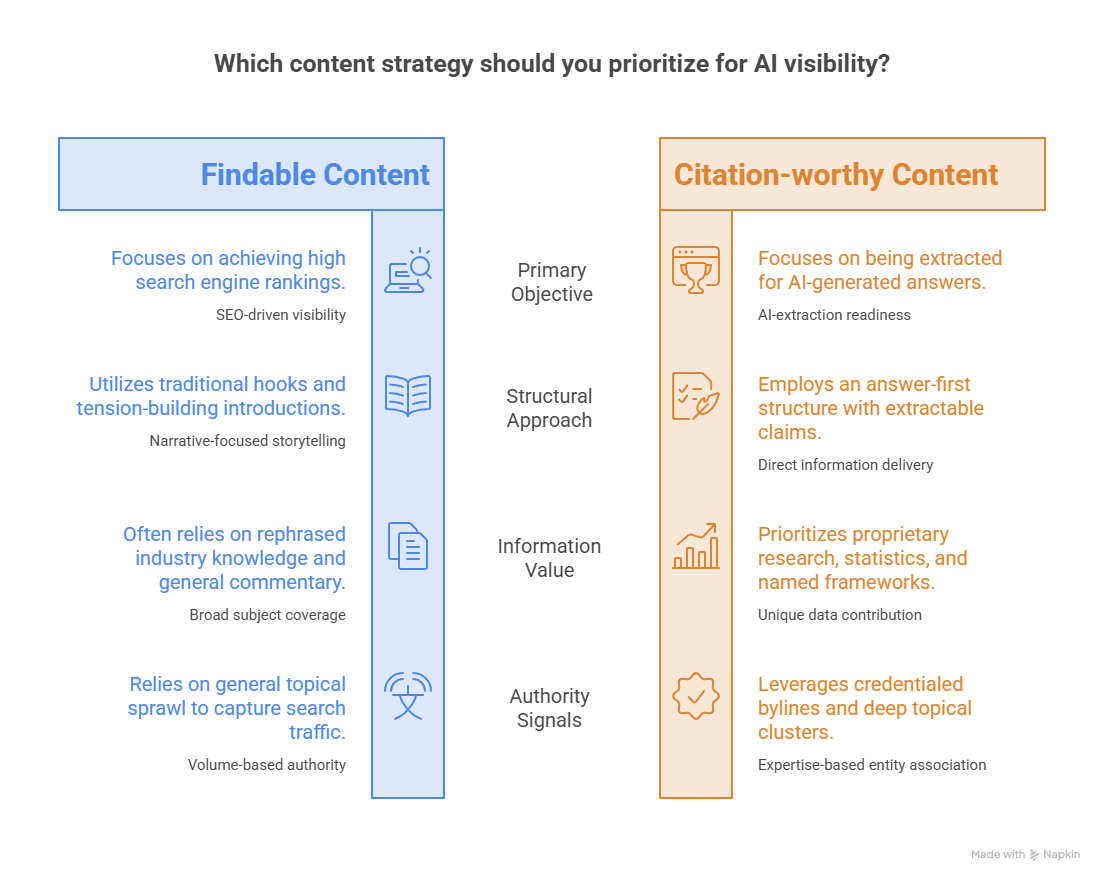
A page that ranks on Google is findable. A page that gets cited by AI is citation-worthy. These are two different standards requiring distinct approaches.
Ranking means AI systems can access the content. Citation-worthy means the content is structured, specific, and credible enough to be extracted from and included in a generated answer. Building brand authority for AI requires meeting both standards.
Answer-first structure
AI systems extract from pages that state the answer in the first 60 words and then support it with evidence. The classic intro format that hooks, builds tension, and delays the answer reduces citation probability. When the opening paragraph contains no direct, extractable claim, AI systems move to the next source.
Pages with quotes and statistics show 30-40% higher visibility in AI-generated answers compared to pages without them (Ali, 2026). Every paragraph needs a specific, verifiable claim. A sentence like “AI is growing fast” gives AI systems nothing to extract. A sentence like “ChatGPT commands over 900 million weekly users as of February 2026” gives them a citable, sourced fact.
Original data, named frameworks, and quotable claims
Proprietary research, survey data, and named methodologies get cited at higher rates than rephrased commentary. AI systems look for content that adds new information to the pool. Restated industry knowledge rarely qualifies as citation-worthy content.
A single named framework builds up over time. When a brand defines and consistently uses a named methodology, such as a scoring model or a repeatable decision process, that label becomes a citation anchor. AI systems associate the named concept with the source that defined it, then pull it into related queries.
Building brand authority for AI means creating content that other sources want to reference. Original data earns those references.
Author authority and first-party experience
Credentialed bylines strengthen citation probability. Verifiable credentials such as Certified Financial Planner (CFP), Certified Public Accountant (CPA), and Juris Doctor (JD) signal Experience, Expertise, Authoritativeness, and Trustworthiness (E-E-A-T). Google’s Search Quality Rater Guidelines identify these indicators as quality markers for source selection, and the same signals drive AI Overview source selection.
First-person examples and direct experience markers carry additional weight. A recommendation from a practicing professional citing direct outcomes ranks higher in AI extraction than a generalist article covering the same topic. E-E-A-T for AI search is both a content signal and an entity signal.
Authorship metadata flows into the entity graph. A named, credentialed author linked consistently to a brand and topic cluster strengthens that brand’s entity-topic association across AI systems. Author credentials also tell AI systems which entity to associate the content with, feeding directly into the brand’s entity graph.
Topical depth over topical sprawl
A set of 15 definitive pieces on a tight topic cluster will outperform 150 thin pieces spread across a broad subject. A topic cluster is a group of content pieces that cover one subject from every angle: definitions, comparisons, case studies, how-to guides, and data. AI systems build entity-topic associations from consistent, in-depth coverage in a defined area.
Organic Google traffic is the No. 1 predictor of AI Mode citation visibility. Sites with over 1.16 million monthly visitors are three times more likely to be cited in AI Mode than those with under 2,700 monthly visitors (Waterschoot, 2026). Brands that own a topic cluster earn the traffic signals that AI Mode uses to decide what to cite.
The off-site sources AI systems actually pull from
Most brands invest in their own website and assume that is where AI visibility gets built. It is not. AI systems pull citations from a distributed web of third-party sources, and the platforms that dominate those citations are external properties that brands do not own or control.
Editorial and industry publications
Industry publications are a primary citation source for AI systems, particularly for B2B categories. Publications with high domain authority and consistent editorial standards (such as Forbes, Harvard Business Review, TechCrunch, and vertical trade outlets) appear repeatedly in AI-generated answers across commercial topics. For DTC categories, lifestyle and product-focused publications with strong independent editorial standards carry comparable weight.
Digital PR investment must follow citation patterns. For B2B brands, that means targeting trade publications and industry news outlets that AI systems retrieve for professional queries. For DTC brands, it means securing placements in category-specific editorial sources that AI systems pull from for product and lifestyle queries.
A placement in a publication that AI retrieval systems actively draw from increases the chance of appearing in AI-generated answers. Brands that audit which publications appear in AI answers for their target queries will find a clear shortlist of placements worth pursuing.
Community platforms: Reddit, Quora, LinkedIn, and niche forums
Community platforms are now first-class off-site signals for GEO. As of January 2026, Reddit and LinkedIn were the two most cited domains across ChatGPT, Perplexity, and Google AI Mode (Ali, 2026). Quora has emerged as the single most commonly cited website within Google AI Overviews, specifically, fulfilling an essential part in addressing niche conversational queries (Ali, 2026).
AI retrieval systems value authentic, question-and-answer content because it closely matches how users phrase queries. A Reddit thread in which practitioners discuss a category problem, a Quora answer from a named expert, and a LinkedIn article from a credentialed professional all carry strong retrieval signals. These formats align with how AI systems extract and generate information.
Building a presence on these platforms requires genuine contributions. Brands that participate in relevant subreddits with helpful answers, maintain credible Quora profiles with complete credentials, and publish original thought leadership on LinkedIn build the kind of presence AI systems trust. Each platform’s guidelines prohibit promotional content. AI systems learn from authentic, community-validated content protected by these guidelines, so genuine participation earns retrieval weight.
Review and comparison sites
G2, Capterra, Trustpilot, and category-specific review aggregators are direct citation sources for commercial-intent queries. When a buyer asks ChatGPT or Perplexity for the best tool in a software category, those systems retrieve reviews from various platforms, which aggregate verified user experiences that AI models treat as credible third-party evidence.
SE Ranking identifies the presence on these review sites as a direct brand strength signal for AI citation (Waterschoot, 2026). A product with no reviews on these platforms is absent from AI-generated answers for commercial-intent queries. Perplexity citations for brands in software and service categories skew heavily toward review aggregators, making review generation a direct GEO asset.
AI citation source categories by signal strength
| Source Category | Citation Signal Strength | Recommended Action |
| Community platforms (Reddit, LinkedIn, Quora) | Very high | Build an authentic presence; answer questions directly |
| Editorial and trade publications | High | Pursue placements in retrieval-heavy outlets |
| Review and comparison sites (G2, Capterra, Trustpilot) | High for commercial queries | Prioritize review generation on category-relevant platforms |
| Wikipedia and structured knowledge bases | High for brand identity queries | Pursue inclusion where notability criteria are met |
| Niche forums and industry communities | Medium | Participate in forums where the target audience congregates |
| Brand-owned website | Lower relative to third-party sources | Optimize for retrieval; do not rely on it as a primary GEO asset |
How to measure whether AI systems recognize your brand
An AI brand visibility strategy requires measurement. A brand that invests in GEO without tracking its AI presence has no way of knowing if the work is producing results. The framework below covers how to run audits, which tools to use, and how to connect AI visibility to real business outcomes.
Prompt-based visibility audits
The starting point for any AI search optimization checklist is a structured prompt-based visibility audit. Brands run a defined set of prompts across ChatGPT, Claude, Gemini, and Perplexity to see if the brand appeared, how it was described, and what share of responses included a citation. The results give the brand a starting point: how often it appears, how AI systems describe it, and whether its competitors appear more frequently.
A single snapshot is unreliable. LLM outputs are probabilistic by nature, which means one query produces only a vague estimate of actual visibility. Stable brand visibility estimates require a rolling aggregation window of 2 to 4 weeks, which smooths out model variability and short-lived fluctuations from algorithmic updates (Schulte et al., 2026).
A monthly benchmark cadence works for most brands. Run the same prompt set at the start of each month, record the results, and compare against the prior month. Over 3 to 6 months, the brand builds a trend line showing whether citation frequency is increasing, which platforms respond to GEO efforts first, and where gaps remain.
Tools worth knowing
Several dedicated platforms now track AI visibility at scale. Here is a breakdown of the leading options:
- Profound tracks up to 10 answer engines, including ChatGPT, Perplexity, Gemini, Claude, and Copilot. It offers SOC 2 compliance and content workflow automation. Profound is best suited for large enterprise brands with deep budgets. The Growth plan costs $399 per month. https://www.tryprofound.com/pricing
- Peec AI targets agencies. It accommodates unlimited users and offers self-service configuration and per-brand pricing that scales across multiple client accounts. The Pro plan rate is $245 per month. https://peec.ai/pricing
- Otterly.ai covers core citation tracking. It is an accessible entry point for teams just getting started with AI visibility measurement. The Standard plan costs $189 per month. https://otterly.ai/pricing
- SE Ranking’s AI Visibility Tracker integrates into SE Ranking’s broader SEO platform. It tracks ChatGPT, AI Mode, and Perplexity, making it a useful option for teams already in the SE Ranking ecosystem. The Growth plan rate is $279 per month. https://seranking.com/subscription.html
- Ahrefs Brand Radar monitors brand mentions across 6 AI platforms using prompts drawn from real user queries. AI tracking is available from $199 per month as an add-on for teams already on Ahrefs. https://ahrefs.com/pricing
No single tool covers every platform equally. Brands relying on a single tool to get a complete picture of their AI brand visibility strategy end up with incomplete data.
Tying AI visibility to business outcomes
AI visibility produces measurable downstream results. Semrush research shows 50% of links in ChatGPT-4o responses point to business or service websites, which means a brand’s own technical infrastructure directly affects how often AI systems send traffic to it (Handley, 2025).
Branded search lift (the increase in the number of people typing the brand name directly into Google over time), direct traffic from AI referrers like ChatGPT and Perplexity, and assisted conversion data (where AI-referred traffic was part of the journey but not the final touchpoint before the conversion happened) all serve as downstream indicators of brand authority GEO progress.
Reporting progress honestly means separating what is measurable from what is inferred. Share of voice in AI responses, citation frequency, and sentiment trends are all measurable. Revenue attribution from AI mentions requires assisted conversion analysis and should be reported as pipeline influence.
| Metric | What to Track | Reporting Cadence |
| Brand mention rate | % of tracked prompts that include the brand | Monthly |
| Share of voice | Brand citations vs. top 3 competitors | Monthly |
| Sentiment score | Positive, neutral, or negative framing in AI answers | Monthly |
| Citation source breakdown | Which platforms and URLs AI systems cite for the brand | Monthly |
| AI referral traffic | Sessions from ChatGPT, Perplexity, and Copilot in GA4 | Monthly |
| Branded search lift | Month-over-month change in branded search volume | Monthly |
| Assisted conversions from AI | Pipeline influence from AI-referred sessions | Quarterly |
The mistakes that quietly erode AI authority
Most brands focus on building AI visibility. Only a few pay attention to the mistakes that pull it back down.
Each error below directly weakens generative engine optimization brand authority and reduces the chance of brand co-occurrence in AI-generated answers.
Publishing AI-generated filler at scale is the first mistake. Generic content with no original data, no named frameworks, and no first-person expertise signals low value to AI search systems. These pages dilute topical depth and weaken the entity-topic associations the brand has built.
Firms that use generative AI without proprietary data or a distinct brand persona lose the differentiation that makes their content citation-worthy (Cui et al., 2024). AI systems have no reason to cite it over a source with original research, a named author, or a verifiable credential.
Chasing mentions on low-trust publication networks produces no retrieval weight. AI systems filter these sources out. A single placement in a retrieval-heavy trade publication delivers more GEO value than dozens of low-quality syndicated posts.
Inconsistent brand descriptions across profiles create entity confusion. When an AI system finds three different positioning statements for the same brand across LinkedIn, G2, and the brand’s About page, it has no solid, structured entity foundation to refer to.
Ignoring community platforms because they fall outside traditional brand channels is a structural blind spot. Reddit, Quora, and LinkedIn are now among the most cited domains across major AI systems. A brand not found in these platforms is absent from the answers AI generates for the topics it claims to own.
Over-indexing on classic SEO rankings while ignoring retrieval sources creates a false sense of security. A brand that ranks well on Google but has no presence in community platforms, review aggregators, or independent editorial sources is cited less often in AI-generated answers, because retrieval systems pull from those off-site sources, not search rankings.
AI-generated misinformation carries substantial ethical and reputational risks that compound over time. Brands that publish unverified AI content or allow inaccurate AI-generated descriptions to circulate give AI systems false information to retrieve. Those inaccuracies then appear in AI-generated answers, determining how potential buyers perceive the brand (Theodorakopoulos et al., 2025).
“The mistake most brands underestimate is inconsistency. They invest in entity signals on their own site and ignore the contradictory descriptions sitting on every third-party profile they set up and forgot. AI systems read all of it.”
A 90-day plan to start building AI-recognized authority
Each phase of this plan builds on the one before it. Brands that skip Phase 1 and jump straight to content or outreach build on a weak entity foundation.
The business case for the investment is clear. The average LLM-referred visitor converts at 4.4x the rate of a traditional organic search visitor (Handley, 2025). That conversion premium makes the 90-day commitment justifiable to any leadership team evaluating where to allocate budget.
Days 1 to 30: Entity cleanup and audit baseline
The first phase is diagnostic. Brands audit their Wikidata entry, run a schema markup review, and sweep every owned and third-party profile for inconsistent brand descriptions. This work removes the friction that stops AI systems from resolving the brand as a credible entity.
The phase closes with the first AI visibility benchmark. Brands run a structured prompt set across ChatGPT, Claude, Gemini, and Perplexity, then record baseline citation frequency, share of voice, and sentiment. This benchmark becomes the reference point for measuring progress at Day 90.
The first 30 days form the AI search optimization checklist that everything else depends on. Without a solid entity foundation, AI systems have no clear picture of the brand to work from, and content gets excluded from AI-generated answers regardless of its quality.
Days 31 to 60: Content depth and original assets
Phase Two is about production. Brands identify the five topic clusters where AI visibility matters most in their category and then produce or rewrite two pieces for each cluster. Each piece follows an answer-first structure, leads with a specific sourced claim, and contains original data or a named framework.
This is where generative engine optimization brand authority compounds. A brand that publishes 10 well-structured, credentialed pieces across five tightly defined topic clusters builds a stronger entity-topic association than a brand with dozens of thin pieces spread across unrelated subjects.
The 4.4x conversion premium on LLM-referred traffic indicates that each piece of citation-worthy content that earns a retrieval slot is worth significantly more than an equivalent traffic gain from a traditional search ranking (Handley, 2025).
Days 61 to 90: Off-site authority push
Phase Three shifts the effort off the brand’s own domain. Brands target digital PR placements in retrieval-heavy publications, build authentic presence in relevant Reddit communities or forums, and generate reviews on G2 or category-specific platforms. Each of these off-site signals feeds directly into the retrieval authority.
Brands that integrate proprietary data and a distinct brand persona into this outreach build a footprint that competitors find difficult to replicate (Cui et al., 2024). A brand that earns mentions in community platforms, review sites, and editorial publications across 90 days builds retrieval signals that persist and compound over time.
The phase closes with the second AI visibility benchmark. Brands run the same prompt set from Day 30, record citation frequency, share of voice, and sentiment, and then compare against the baseline. The delta across those two snapshots is the measurable output of the 90-day investment.
90-day AI-recognized authority timeline
| Phase | Days | Focus | Key Deliverables |
| Phase 1 | 1 to 30 | Entity cleanup and baseline | Wikidata entry, schema audit, brand description sweep, AI visibility benchmark #1 |
| Phase 2 | 31 to 60 | Content depth and original assets | Five topic clusters identified, 10 answer-first pieces produced or rewritten |
| Phase 3 | 61 to 90 | Off-site authority push | Digital PR placements, community presence, review generation, AI visibility benchmark #2 |
Where to start: a decision framework
Search results used to be the finish line. Today, they serve as the entry point. AI systems now sit between the search bar and the buying decision, assembling a justified shortlist of brands they read as credible, consistent, and well-documented. Brands without a verified, consistent entity presence across those sources do not make the list, regardless of how well they rank on Google.
A brand that does not appear on that shortlist is invisible to buyers who never reach a traditional search results page. Building brand authority for AI is a set of decisions made in the right sequence. The three diagnostics below tell a brand exactly where to start:
If the brand has a strong classic SEO footprint yet no AI mentions, start with retrieval authority tactics. The entity foundation is likely solid. The gap is off-site presence in the specific sources that RAG-based systems pull from: community platforms, review aggregators, and retrieval-heavy editorial publications.
If the brand is new and has neither SEO authority nor AI visibility, run entity cleanup and digital PR at the same time. A Wikidata entry, consistent brand descriptions across all profiles, and early placements in authoritative publications build both training data authority and retrieval authority in parallel.
If the brand already appears in AI answers but the descriptions are inaccurate, the priority is source-level fixes. Identify which platforms AI systems are drawing from for that brand. Correct the information at those sources and then run a second AI visibility benchmark within 30 days to confirm the change appears in generated answers.
The window for early-mover advantage in AI brand visibility strategy is open now. Brands that build a clear, consistent, and well-cited entity presence today become the default recommendation as this channel grows. Each citation earned makes the next one easier, because AI systems reinforce entity signals they have already recognized.
Ready to find out where your brand stands in AI search? Request an AI visibility audit or book a GEO strategy session with us. We will run the brand through a structured prompt set across ChatGPT, Perplexity, Gemini, and Claude, map its current citation footprint, and identify the highest-priority actions for its specific situation. Book now and take that important next step today.
Frequently Asks Questions
Ranking and AI citation run on different criteria. Google rewards backlinks, keyword placement, and SERP position. AI systems instead resolve a brand as an entity, drawing on consistent third-party mentions, knowledge graph presence, and retrieval-layer sources. A brand with strong rankings but a thin or inconsistent entity footprint stays invisible in AI-generated answers.
Training data authority is how well a brand is represented inside an AI model’s knowledge base, built from web-scale datasets like Common Crawl and Wikipedia over several years. Retrieval authority is whether a brand shows up in the live sources a RAG system pulls at query time, such as reviews and community posts. That second track is achievable in 3 to 12 months.
AI systems pull heavily from third-party properties rather than brand-owned sites. As of January 2026, Reddit and LinkedIn were the two most cited domains across ChatGPT, Perplexity, and Google AI Mode. Editorial publications, Quora, and review aggregators like G2 and Capterra also feed directly into AI-generated answers.
Citation-worthy content states the answer in the first 60 words, then backs it with specific, verifiable claims. Original data, named frameworks, and credentialed authors all raise citation rates. Pages with quotes and statistics show 30 to 40 percent higher visibility in AI answers than pages without them.
Run a structured prompt set across ChatGPT, Claude, Gemini, and Perplexity, then track brand mention rate, share of voice, sentiment, and citation sources on a monthly cadence. Because AI outputs are probabilistic, one query is unreliable. Stable estimates need a rolling 2 to 4 week aggregation window.
AI systems need structured, consistent identity signals. These include a Wikidata entry, a Google Knowledge Panel, organization schema in JSON-LD, and consistent sameAs references across profiles. The brand’s core positioning sentence should read identically on its About page, LinkedIn, Crunchbase, and G2 so the model has no conflicting descriptions to resolve.
Retrieval authority can show movement in 3 to 12 months, while training data authority takes 2 to 5 years. A focused 90-day plan starts with entity cleanup and a visibility baseline, moves into content depth across five topic clusters, then shifts to off-site authority through digital PR, community presence, and review generation.
Resources
- Aggarwal, P., Murahari, V., Rajpurohit, T., Kalyan, A., Narasimhan, K., & Deshpande, A. (2023). GEO: Generative Engine Optimization. arXivhttps://arxiv.org/abs/2311.09735/
- Ali, A. (2026, April 26). Generative engine optimization (GEO): How to win in AI search. Backlinko.https://backlinko.com/generative-engine-optimization-geo/
- Chen, M., Wang, X., Chen, K., & Koudas, N. (2025, September 10). Generative engine optimization: How to dominate AI search. arXiv.https://arxiv.org/abs/2509.08919/
- Cui, Y. G., van Esch, P., & Phelan, S. (2024). How to build a competitive advantage for your brand using generative AI. Business Horizons, 67(5), 583–594.https://digitalcommons.coastal.edu/marketing-hrtm/3/
- Handley, R. (2025, July 21). We studied the impact of AI search on SEO traffic | Our findings. Semrush.https://www.semrush.com/blog/ai-search-seo-traffic-study/
- Khosravi, M., & Yoganarasimhan, H. (2026, April 17). Impact of AI search summaries on website traffic: Evidence from Google AI overviews and Wikipedia (v3). arXiv. https://arxiv.org/abs/2602.18455/
- Rienecker, J., Mpofu, K., Goel, N., Datta, S., Zhao, J., Danielsson, O., & Thorsen, F. (2026, March). Auditing preferences for brands and cultures in LLMs. arXiv. https://arxiv.org/abs/2603.18300/
- Schulte, J., Bleeker, M., & Kaufmann, P. (2026, April 10). Don’t measure once: Measuring visibility in AI search (GEO). arXiv.https://arxiv.org/abs/2604.07585/
- Theodorakopoulos, L., Theodoropoulou, A., & Klavdianos, C. (2025, May 26). Interactive viral marketing through big data analytics, influencer networks, AI integration, and ethical dimensions.https://doi.org/10.3390/jtaer20020115/
- Waterschoot, E. (2026, January 12). Get your website noticed by AI search engines (GEO). SE Ranking.https://seranking.com/blog/how-to-increase-visibility-in-ai-search-engines-geo/
Kim Greer
OFP Law
One of the best business decisions I ever made was to contract with 321 Web Marketing. Jonathan Gessert and his team are knowledgeable, efficient, and effective, making digital marketing goals easy to achieve and helping [...]

Kelly Cole
Business Benefits Group
My company hired 321 Web Marketing in February 2016 to resurrect our web site. We feel our web site is the face to our business and desperately needed a make over. 321 took us from blah to WOW effortlessly and what a difference [...]

Emily Hawkins
Diener & Associates
Thanks to 321 Web Marketing, the client has seen an increase in their search engine leads, averaging 12 qualified leads per month. The client has also achieved prominent Google Maps and search placement. The team [...]
Trevor Telesz
Paw Pals Pet Sitting
321 Web Marketing successfully translated the client’s design into a stunning and refreshed website, ensuring seamless functionality across all dynamic views. The team provided clear timelines and stuck to them, [...]

Corey Davis
Spartan Animal & Pest Control
321 Web Marketing is truly phenomenal at what they do. Their ability to communicate and describe the steps and actions that they are implementing, Alex Zarpas in particular, is excellent. Delivering on promises is all [...]

Alec Roberts
MFE Insurance
I can’t say it enough, Jonathan and his team have gone above and beyond since day one to accommodate our needs and meet our goals. I run a specialty insurance brokerage based in LA and once we found 321 we never looked [...]

Richard Wilbur III
Advantage.Tech
Thanks to 321 Web Marketing’s web development work, the client increased rankings and traffic from search engines. Also, their business secured prominent positions on Google Maps and industry-relevant, profitable [...]

Bruce Gemmill
FVCbank
After the website revamp, the client saw a steady rise in leads from search engines, resulting in additional traffic. 321 Web Marketing is highly punctual when it comes to deliverables, and internal stakeholders are [...]
Drew Weeks
VAE
321 Web Marketing delivered a sleek website that accurately portrays the size and quality of the client’s organization. All of their completed websites have received positive feedback from users who have been [...]

Ryan Masten
Masten Pools
321 Web Marketing has increased the client’s leads from zero to 53 monthly. Their SEO efforts pay off impressively due to a top-ranking position on Google and making the site the number one result for several [...]