



Table of Contents
- 1. Introduction
- 2. How Generative and Chat-Based Search Systems Work
- 3. The Relationship Between Traditional SEO and Generative Search Optimization
- 4. Content Structure and Formatting for AI Extractability
- 5. Writing for Conversational and Natural Language Queries
- 6. Building Topical Authority for Generative Search
- 7. Entity Optimization and Knowledge Graph Presence
- 8. Structured Data and Schema Markup for AI Readability
- 9. Optimizing for Specific Generative Search Platforms
- 10. The Role of Multimedia and Non-Text Content
- 11. Cross-Platform Brand Visibility and Citation Building
- 12. Content Refresh and Maintenance for Generative Search
- 13. Measuring Generative Search Performance
- 14. Common Mistakes in Generative Search Optimization
- 15. Building a Generative Search Optimization Roadmap
- 16. Conclusion: What Generative Search Actually Rewards
- 17. Where to Go From Here
- 18. Frequently Asks Questions

 May 18, 2026 ·
  28 min read ·
  Summarize in ChatGPT
Introduction
The search environment has shifted structurally, and the change is permanent. Users no longer want a list of links; they want direct answers, built from multiple sources, and delivered in seconds.
Google’s AI Overviews now appear before any search result. Bing Copilot weaves conversational AI into standard web search. Platforms like ChatGPT and Perplexity have built loyal audiences around one core promise: answer the question, skip the list.
The data confirms the changing user attitudes. Zero-click Google searches surged from 56% in 2024 to 69% in 2025. Most users now get what they need without having to click a single result. By 2026, 25% of traditional organic search traffic will move to artificial intelligence-assisted chatbots and virtual assistants (Maritz, 2026).
Strategies built around click-through rates and ranked links are losing ground. Zero-click content optimization has become a core concern for every team managing search performance. Organizations that adapt now will be better positioned as AI search continues to grow.
The search mechanism itself has shifted. AI models now sit between the user and the source. They read multiple pages, decide what to cite, and condense everything into one response. A source that does not get cited receives no mention, no referral traffic, and no visibility from that query, regardless of organic rank.
To optimize content for generative search, content strategists need to understand how citation decisions get made. They also need to build content that meets the criteria AI systems use to make those decisions.
This guide is a comprehensive resource for optimizing generative search. Understanding generative search is essential for those who already know traditional search engine optimization (SEO) and want a clear framework for what comes next.
It covers how generative and chat-based search systems select and cite sources. It also explains how to structure content for AI extractability and build entity authority and trust signals. In addition, the guide covers how to optimize for specific platforms and discusses ways to measure performance when standard metrics fall short.
Each section addresses a distinct layer of a chat-based search content strategy. SEO managers, content strategists, agency professionals, and in-house marketers will find relevant sections. Read end-to-end for the full framework, or go directly to the sections that address your specific needs.
How Generative and Chat-Based Search Systems Work
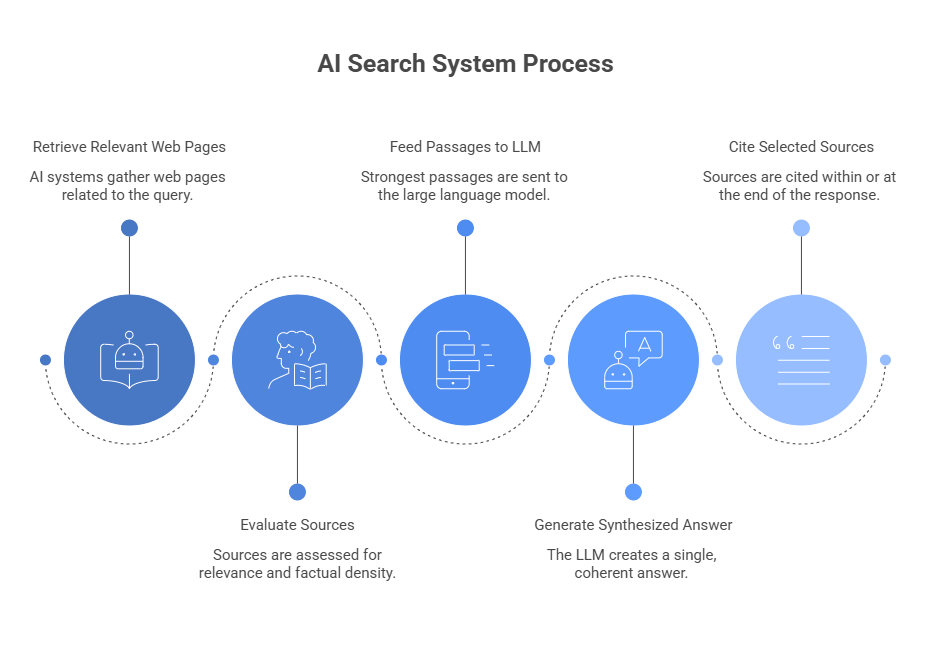
Understanding how AI search systems assemble summary responses is the starting point for any effective optimization strategy. These systems retrieve relevant web pages, evaluate each source for relevance and factual density, and feed the strongest passages into a large language model (LLM). The model generates a single synthesized answer and cites selected sources within or at the end of the response.
Most major platforms use a retrieval-augmented generation (RAG) architecture. Each platform applies it differently, but the underlying process remains the same.
Google AI Overviews generate summary responses at the top of the search results page. Google pulls from indexed web pages and displays citation links within the summary. Bing Copilot presents conversational AI responses alongside traditional results, with inline citations for each claim.
ChatGPT with web browsing retrieves live web content during a conversation. It then shows source links inside the response.
Perplexity functions as a dedicated answer engine, attaching explicit citations to every claim in its output.
| Platform | Retrieval Behavior | Citation Display | Optimization Priority |
|---|---|---|---|
| Google AI Overviews | Pulls from indexed web pages within Google’s existing search quality framework | Citation links displayed within the summary at the top of the search results page | Structured data, E-E-A-T signals, organic ranking, concise definitional content |
| Bing Copilot | Draws from content indexed by Bing and ranked according to Bing’s criteria | Inline citations for each claim alongside traditional results | Conversational content that addresses query chains within a single document |
| ChatGPT with web browsing | Retrieves live web content during a conversation based on relevance to the user’s prompt | Source links shown inside the response | Clear structure, consistent mentions across multiple independent websites |
| Perplexity | Functions as a dedicated answer engine with strong emphasis on citation quality and source diversity | Explicit citations attached to every claim | Clearly labeled, factually precise, self-contained passages with source differentiation |
The scale of adoption makes AI search content optimization a mainstream discipline. ChatGPT now serves 800 million weekly users and processes over 1 billion queries daily. Bing recorded a 10x increase in mobile app downloads following its AI integration (Radloff, 2025).
Across all platforms, source selection follows a consistent set of principles. AI search systems favor content that directly addresses the query. They prefer sources with established authority and a clear structure that makes accurate extraction straightforward.
When multiple credible sources agree on a claim, that consensus signals accuracy. This increases the likelihood of citation.
AI systems use these core criteria for citation: direct relevance, authority, clear structure, and factual precision.
ChatGPT search optimization and Perplexity search optimization follow the same underlying logic. Despite the platforms differing in how they display and attribute citations, their selection criteria remain the same.
The Relationship Between Traditional SEO and Generative Search Optimization
Generative engine optimization (GEO) builds on traditional SEO. The foundation that made the content rank high in Google remains the entry requirements for AI search visibility. What GEO adds is a second layer of decisions around content structure, entity signals, and citation-worthy writing.
The fundamental requirements include technical accessibility, content depth, backlink authority, and topical relevance. These are the criteria AI systems use to select sources beyond rank. Without them, content is unlikely to enter the retrieval pool.
SEO fundamentals carry over directly. AI retrieval systems depend on clean crawlability and proper indexing to access content. Pages that block crawlers, load slowly, or have poor site architecture are less likely to enter the retrieval pool, which is the candidate set of pages an AI search system evaluates before generating a response.
Domain authority and backlink signals continue to affect how AI systems assess source reliability. Topical relevance remains the primary filter for whether a page enters the candidate set. These signals have not changed; in fact, their importance has expanded.
Where GEO diverges is in what happens after retrieval. Traditional SEO targets a high ranking position. Generative search targets citation inclusion in a synthesized response.
A link can sit on page one and still be disregarded. This happens when content is poorly structured, claims are unsourced, or answers are buried in long paragraphs. AI search ranking factors extend well beyond position.
ChatGPT regularly cites pages at position 21 or lower in Google’s search results. This confirms that citation decisions respond to content quality and structure, not rank alone (Reslan, 2026). A landmark GEO study found that optimized content can increase visibility in AI responses by up to 40%. The strongest gains come from clearer structure, cited claims, and plain language (Reslan, 2026).
GEO content strategy introduces signals that traditional SEO does not address. AI systems cross-reference an organization’s website, third-party mentions, directory listings, and social profiles to verify entity identity. Content creators also lose direct control over presentation, as the AI system decides how sources are referenced.
Treating generative engine optimization content as a separate track from SEO misses the compounding value of a unified strategy. Strong SEO fundamentals feed AI retrievability. GEO-specific optimizations improve the depth and structure that traditional search algorithms also reward.
Content Structure and Formatting for AI Extractability
Of all the optimization levers in generative search, content structure is the most actionable. AI systems scan for specific information, isolate relevant passages, and extract what they need to build a response. Content organized to support that process gets cited.
Content that buries key facts in long, unbroken paragraphs is disregarded. Structure is not a formatting preference, but a retrieval signal.
The data make a strong case for treating structure as a first-order production decision. Fluency optimization, which means rewriting content for clarity and smooth flow, produces a 15-30% boost in AI citation rates. Integrating citations from reliable sources increases visibility in AI answers by over 40% (Strauss, 2024).
Content formatting and AI readability are measurable factors. These gains come directly from formatting decisions, such as using clear headings, sourcing claims, and using plain language. AI systems extract content that is easy to read and clearly attributed.
Content structure for AI extraction starts with headings. Descriptive headings tell AI systems what each section covers before they read the body text. A heading like “How to Audit Existing Content for GEO” signals scope and intent far more precisely than “Next Steps.”
Answer placement matters equally. AI systems favor content that leads with a direct answer and follows with supporting detail. A section that opens with a clear definition or conclusion and then expands with context and evidence mirrors the format AI models use when generating responses.
Different query types call for different formats. Definitions followed by explanations work for conceptual queries. Numbered steps, comparison structures, and cause-and-effect frameworks each map to the output patterns AI systems produce for process, evaluative, and analytical queries, respectively.
Source attribution is as direct an extractability signal as heading structure. Content that attributes statistics, quotes, and data points to named sources gives AI systems verifiable material to extract with confidence. Experience, Expertise, Authoritativeness, and Trustworthiness (E-E-A-T) generative search signals affect how AI systems judge content credibility, and explicitly sourced claims are a direct expression of those signals.
Long-form content AI extraction depends on logical organization across the full page. Complex information grouped into clearly labeled sections gives AI systems a clean path through the page. Summary paragraphs and labeled conclusion sections provide pre-synthesized statements that AI systems can lift directly without misrepresenting the surrounding context.
Content teams should assess whether each section opens with a direct answer. They should also check that headings accurately describe what follows and confirm that all statistics and claims carry source attribution. Embedding these standards into editorial templates ensures new content meets E-E-A-T requirements from the first draft.
Writing for Conversational and Natural Language Queries
Search queries are getting longer, more specific, and more conversational. Users who once typed “best CRM software” now ask, “what is the best CRM software for a small sales team with a limited budget.” AI interfaces accept and reward natural language input, and this has permanently changed how users form queries.
Approximately 15% of daily Google searches are entirely new queries. A growing share takes the form of full questions rather than keyword strings (Maritz, 2026). Voice commerce is projected to reach $80 billion in annual value, confirming that conversational query behavior extends well beyond typed search (Maritz, 2026).
Content that uses full-question phrasing and conversational sentence structure gets retrieved more often. AI systems match user queries against source content at the passage level. A page that mirrors the natural language a user would type or speak gains a structural advantage in retrieval.
Natural language content optimization is a retrieval signal. It affects whether AI systems can locate and extract the right content for a given query. Content teams that write in plain, conversational language build pages that AI systems can precisely match to natural language queries .
The most direct application is question-based subheadings. When a content section opens with a heading that matches real user query phrasing, AI systems can locate and extract that section with precision. FAQ content AI search performance improves when questions reflect the actual language users bring to chat interfaces.
Answers must also stand alone. AI systems extract individual passages without the surrounding paragraphs that provided context on the original page. Every answer must make complete sense on its own, whether it is a definition, a recommendation, a process step, or a comparison.
Conversational content optimization means anticipating follow-up questions within the same piece. Chat-based search is multi-turn by nature, so content that addresses the next logical question within the same document stays relevant across a wider range of query variations.
The balance to maintain is between accessibility and authority. AI systems value substantive, well-sourced content regardless of tone. A chat-based search content strategy that pairs plain language with analytical depth and clear source attribution serves both human readers and AI retrieval systems equally well.
Building Topical Authority for Generative Search
Topical authority is the degree to which a website is recognized as a credible source across a defined subject area. In traditional search, it influenced rankings. In generative search, it determines whether AI systems consistently select and cite a site’s content across multiple related queries.
Each time an AI system retrieves a page from the same site across different queries, it builds a retrieval pattern. That pattern associates the site with authority on that subject. The more consistently a site appears across related queries, the stronger that pattern becomes.
The data shows the compounding value of this approach. Applying GEO methods to content at position 5 in search results produces a 115.1% increase in visibility within AI summaries. Top-performing content strategies also deliver a 15-30% improvement in subjective impression metrics, which measure how much screen real estate a brand occupies in AI-generated responses (Strauss, 2024).
Topical authority AI search optimization starts with content depth. A site that covers a topic from foundational concepts through advanced subtopics signals to AI retrieval systems that it offers a complete body of knowledge. Coherent, interconnected coverage builds the consistent retrieval pattern that AI systems associate with authority.
Internal linking reinforces that signal. When related content pieces link to each other in a logical structure, crawlers and retrieval systems recognize the site as a unified knowledge source. This strengthens the site’s topical authority.
Original research, proprietary data, and first-hand expertise further strengthen topical authority. AI systems that encounter a site as a primary source for unique data develop a retrieval pattern that compounds over time. Content that adds something genuinely new earns a primary source position, making direct citation more likely.
Pillar content AI optimization maps directly to how generative search retrieval works. A pillar-and-cluster architecture enables AI retrieval systems to cite multiple pages across a family of related queries. Content depth AI search performance builds on itself as AI systems encounter the same source across an expanding range of queries.
Entity Optimization and Knowledge Graph Presence
AI search systems do not cite anonymous sources. Before including a brand, organization, or author in a response, an AI model needs to recognize that entity as distinct, well-defined, and credible. Entity-level optimization makes that recognition possible by building verified profiles, consistent brand information, and third-party mentions that AI systems cross-reference.
In one documented experiment, an AI model ignored an official source and repeated a fabricated narrative planted on Reddit and Medium (Reslan, 2026). The false consensus across multiple platforms outweighed the single authoritative source.
AI systems prioritize cross-source agreement. An organization’s directory listings, third-party mentions, social profiles, and knowledge base entries collectively carry more weight than any single page on its own site. Consistent signals across multiple platforms are what drive entity recognition.
Successful entity optimization requires cross-platform consistency. Accurate profiles on Wikipedia, Wikidata, and Crunchbase anchor a brand’s identity in the knowledge sources AI systems actively reference (Reslan, 2026). A Google Business Profile and consistent NAP data across directory listings and industry databases reinforce that the entity is real and verifiable.
Author identity carries equal weight. Content attributed to clearly identified, credentialed individuals with established bylines and publication histories carries stronger entity signals. AI systems use author-level entity recognition to assess source credibility, which directly affects how often AI search platforms consistently cite them.
Each additional third-party reference expands the corroboration network AI systems use to validate the entity. Industry publications, academic references, and media outlets all contribute to this network. Knowledge graph optimization AI recognition compounds as these mentions accumulate, building a web of signals that reinforce brand mentions AI search visibility over time.
Entity SEO AI search performance ties directly to E-E-A-T signals. These signals carry even more weight in generative search, where AI systems make higher-stakes decisions about which sources to include in a synthesized answer. Strong, consistent entity signals across the web give AI systems the confidence to cite an organization.
Structured Data and Schema Markup for AI Readability
Structured data is the most direct communication channel between a website and an AI system. Well-written content tells a human reader what a page is about. Meanwhile, schema markup tells a machine the same.
Schema uses a standardized vocabulary to label content elements so machines can read and interpret them without ambiguity. This allows AI systems to accurately categorize, extract, and cite page content. For teams working to optimize for AI search engines at a technical level, schema markup AI search implementation is the most precise lever available.
Structured data has expanded well beyond traditional rich snippets. It now acts as a primary data feed that trains large language models on how to interpret product details, brand attributes, content type, and authorship (Reynolds et al., 2026). An organization that implements schema markup across its site gives AI systems a structured map of its content.
Several schema types are most relevant to generative search optimization. The Article and BlogPosting schema define content type, author, publication date, and topic. Organization and Person schema reinforce entity identity and authorship, connecting directly to E-E-A-T signals.
FAQPage and HowTo schema align content with the formats AI systems use to answer common query types (Reynolds et al., 2026). FAQPage mirrors how AI systems retrieve direct answers. HowTo organizes step-by-step content for procedural queries.
Product, Review, and AggregateRating schemas serve e-commerce content that AI shopping tools reference for purchase recommendations. Speakable schema identifies sections suited for voice-based AI delivery. BreadcrumbList schema clarifies site architecture for retrieval systems moving through the site.
| Schema Type | Primary Function | Best Used For |
|---|---|---|
| Article and BlogPosting | Defines content type, author, publication date, and topic | Editorial content, blog posts, news articles, thought leadership |
| Organization and Person | Reinforces entity identity and authorship, connecting to E-E-A-T signals | Brand identity, author bylines, leadership profiles, expert attribution |
| FAQPage | Mirrors how AI systems retrieve direct answers to common questions | FAQ sections, support content, frequently asked questions |
| HowTo | Organizes step-by-step content for procedural queries | Tutorials, guides, instructional content, process documentation |
| Product, Review, AggregateRating | Serves e-commerce content that AI shopping tools reference for purchase recommendations | Product pages, review sections, comparison content, e-commerce catalogs |
| Speakable | Identifies sections suited for voice-based AI delivery | Voice search content, audio-friendly summaries, podcast-style snippets |
| BreadcrumbList | Clarifies site architecture for retrieval systems moving through the site | Multi-level site navigation, hierarchical content libraries |
Implementation requires validation and ongoing maintenance. Google’s Rich Results Test confirms correct formatting before deployment, and Google Search Console surfaces errors as content updates. Content teams that update schema alongside content edits maintain the accuracy that AI systems rely on when extracting and citing information.
Structured data generative search performance depends on content quality, entity signals, topical authority, and technical accessibility working together. Schema markup alone does not guarantee AI citation. What it does is remove ambiguity and improve content comprehension, giving content optimization AI search programs the strongest possible position when all other signals are competitive.
Optimizing for Specific Generative Search Platforms
Each generative search platform retrieves, synthesizes, and cites content differently. A platform-aware optimization approach adjusts content format, heading structure, and citation density to match each platform’s retrieval behavior. Understanding how each platform selects sources is what separates a generic GEO strategy from one that produces consistent citation results.
Optimizing for Google AI Overviews starts with knowing that AIOs currently appear on 21% of keywords (Reslan, 2026). Informational and how-to searches drive the majority of these instances. Content that ranks well organically is more likely to appear in an AIO.
Structured data and E-E-A-T signals are important in Google AI overview source selection. AIOs operate within Google’s existing search quality framework, so these signals matter more here than on other platforms. The format favors concise definitional and explanatory content that the system can lift directly and present to users.
Bing Copilot integrates conversational AI responses alongside traditional search results. It draws from content indexed by Bing and ranked according to Bing’s criteria. Conversational content optimization is particularly relevant here, as Copilot rewards content that addresses query chains within a single document.
Integration with Microsoft’s broader ecosystem creates additional surface areas for brand visibility. This includes Microsoft Edge, Bing sidebar, and Windows search. These touchpoints extend reach well beyond the standard results page.
ChatGPT with web browsing retrieves content during a live conversation based on relevance to the user’s prompt. Clear, well-structured content gives the model cleaner material to extract and summarize. Multi-source AI answer optimization matters here because sources with consistent mentions and references across multiple independent websites get retrieved more frequently.
Perplexity functions as a dedicated answer engine with a strong emphasis on citation quality and source diversity. Passages that are clearly labeled, factually precise, and self-contained are easier to extract and attribute accurately. AI citation optimization on Perplexity depends on source differentiation as much as content quality.
Platform-specific optimization works best as a complement to foundational content quality, authority signals, and technical accessibility. The platforms differ in retrieval behavior, but they share the same core selection criteria: relevance, credibility, clarity, and corroboration. Strong foundational signals determine the baseline, and platform-specific adjustments improve the margin.
The Role of Multimedia and Non-Text Content
Generative search optimization extends beyond text. AI models are increasingly multimodal. They process and reference images, video, audio, and other non-text formats when generating responses (Radloff, 2025).
Content teams that treat multimedia as an active optimization asset give AI retrieval systems more material to reference, extract, and cite.
Every multimedia element needs metadata that AI systems can read. Images require descriptive, keyword-relevant alt text and captions. Without that metadata, an image stays invisible to AI retrieval systems regardless of how relevant it is.
Content structure for AI extraction applies to every asset type on a page. Each asset type requires its own layer of machine-readable metadata. Text, images, video, and audio all need to be readable by AI systems to be citable.
Video content needs accurate transcripts, structured chapter markers, and descriptive metadata. These elements allow AI systems to reference specific video segments in response to relevant queries. A video without a transcript is inaccessible to text-based retrieval systems.
Original images, charts, diagrams, and data visualizations carry more retrieval value than stock photography. AI systems favor original and informative visuals because they provide information that the model can accurately describe and attribute. Stock images contribute nothing to natural language content optimization because they carry no informational value.
ChatGPT’s shopping integration shows where multimedia optimization is heading. The platform uses visual product cards featuring images, star ratings, and pricing to present product comparisons directly within the chat interface (Radloff, 2025). For e-commerce teams, this confirms that product images, structured pricing data, and rating metadata are active retrieval assets.
Detailed show notes, full transcripts, and structured metadata make podcast and audio content retrievable and citable. These elements strengthen content formatting, AI readability, and contribute to multi-source AI answer optimization.
Knowing how to get cited by AI search systems across content formats comes down to one principle: if AI systems cannot read it, they cannot cite it.
Cross-Platform Brand Visibility and Citation Building
Generative search visibility is not built on a single website. AI search systems assess source authority by cross-referencing multiple independent sources. A brand’s presence across the wider web directly affects how often AI systems cite it.
An organization that builds a strong cross-platform citation profile gives AI engines more corroborating evidence. This increases both the frequency and confidence of citations.
AI search systems strongly favor earned media over brand-owned content when selecting sources (Tor.app, 2026). Earned media means third-party coverage, independent reviews, and references from sources the brand does not control.
Cross-platform AI search visibility grows with each independent source that mentions, cites, or references the brand. Each mention adds another data point to the corroboration network that AI systems use to assess authority.
Earning mentions, quotes, and references on authoritative industry publications, news outlets, and media platforms is the highest-value activity in this effort. Contributing guest content, expert commentary, and thought leadership to third-party platforms builds citation trails. AI systems encounter these trails across multiple independent sources during both training and live retrieval.
Community platforms carry particular weight. Maintaining an active brand presence on Reddit, Quora, and similar high-authority communities is critical. These platforms serve as primary training data sources for large language models (Tor.app, 2026).
Brand mentions on these platforms compound as conversations accumulate. This creates community-level corroboration that AI systems treat as a strong consensus signal.
Entity SEO AI search performance benefits from accurate, maintained profiles on industry directories, professional networks, and review platforms. Collaborative content generates mutual citations across multiple domains, including research partnerships, co-authored reports, and expert roundups. This multi-source validation strengthens ChatGPT search optimization and FAQ content AI search performance simultaneously.
AI citation optimization compounds over time. Each earned mention and third-party reference adds another node to the corroboration network AI systems use to validate a source. Each new signal reinforces the ones already in place.
Content Refresh and Maintenance for Generative Search
Recency is one of the most measurable factors in how AI search selects sources. About 80% of AI-driven traffic goes to pages updated within the last two years. Content older than four years accounts for only 3.6% of AI-referred traffic (Reynolds et al., 2026).
AI search accelerates content decay. Retrieval systems actively favor recently updated sources. Pages that have not been refreshed lose ground to more current competitors, regardless of their original quality.
A content maintenance framework for generative search starts with a regular audit cadence. Content teams should evaluate high-priority pages for factual accuracy, data currency, and alignment with current best practices. Pages targeting queries where recency matters most, such as industry statistics, platform comparisons, and best practice guides, need the most frequent attention.
Updates should go beyond date stamps. Refreshing statistics, examples, and references signals that the content shows the present state of the subject. This strengthens topical authority AI search optimization without requiring a full rewrite.
Revising structure and formatting to align with changing AI extraction patterns extends long-form content AI extraction performance. Expanding existing content to cover new subtopics and emerging questions builds content depth and AI search performance over time. A page that addressed ten questions at publication and now addresses fifteen becomes a stronger retrieval candidate.
Monitoring AI responses for target queries shows which competitor content is being cited. This identifies the specific gaps the refreshed content needs to fill. Content teams can use this information to prioritize updates that directly address citation gaps.
Pages that previously earned AI citations and have since decayed are the highest-return targets for refresh. The authority signals are already established, and the update restores recency without rebuilding credibility from scratch. Generative engine optimization content that has decayed is always easier to restore than building citation authority from zero.
Measuring Generative Search Performance
Measuring performance in generative search is harder than tracking traditional organic ranking. A citation in an AI-generated response does not always produce a click. The brand awareness built through AI visibility rarely appears in standard analytics.
Organizations that apply traditional SEO measurement frameworks to GEO miss important signals. They fail to notice the AI citations that influence decisions without generating clicks. They also miss the brand awareness built through synthesized responses that never appear as referral traffic.
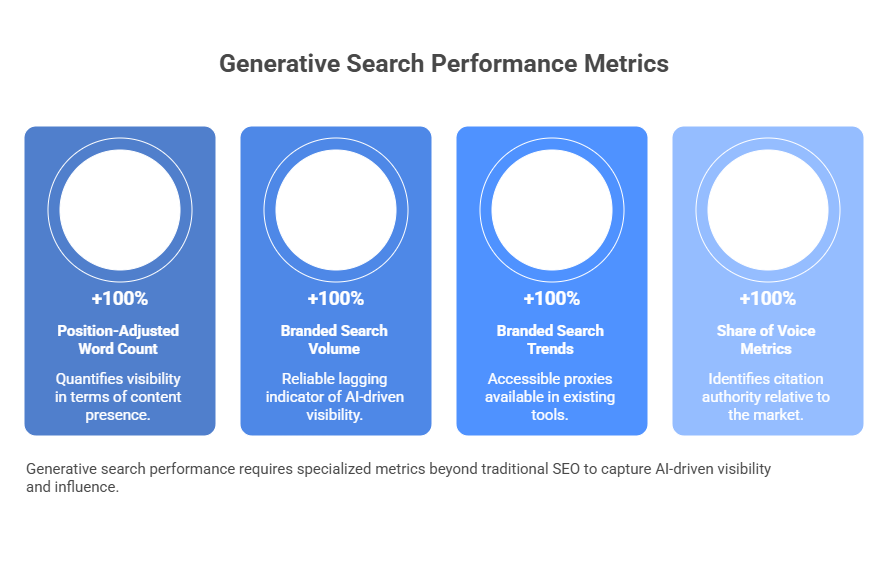
Specialized metrics fill the gap. Position-Adjusted Word Count measures the space a brand occupies in a synthesized AI response (Strauss, 2024). It quantifies visibility in terms of content presence rather than ranking position.
This metric captures what click-through rates miss. A brand can earn AI visibility and influence user decisions without generating a single direct click. This is the core zero-click content optimization challenge that generative search measurement must address.
Branded search volume acts as a reliable lagging indicator of AI-driven visibility (Strauss, 2024). When AI systems cite a brand consistently across multiple queries, users begin searching for that brand directly. This appears as an increase in branded search volume over time.
Branded search trends are among the most accessible proxies available. They appear in tools every organization already uses and require no specialist platform. A complete framework also tracks Google Search Console impression and click data, referral traffic from ChatGPT, Perplexity search optimization monitoring, and Bing Copilot.
Share of voice metrics show which competitors AI systems cite more frequently for the same queries. This identifies where the organization’s citation authority is weakest relative to the market. Building a dashboard for measuring AI search performance requires pulling all of these signals into one reporting view.
| Metric | What It Measures | Data Source | Why It Matters |
|---|---|---|---|
| Position-Adjusted Word Count | Space a brand occupies within a synthesized AI response | AI visibility tracking platforms | Quantifies visibility in terms of content presence rather than ranking position |
| Branded Search Volume | Direct searches for the brand name following AI exposure | Google Search Console, keyword research tools | Acts as a reliable lagging indicator of AI-driven visibility |
| Google Search Console Impressions and Clicks | Search visibility and click-through performance for tracked queries | Google Search Console | Captures traditional search performance trends alongside AI-driven shifts |
| Referral Traffic from AI Platforms | Visitors arriving from ChatGPT, Perplexity, and Bing Copilot | Web analytics platforms | Identifies which AI platforms convert citations into actual site visits |
| Share of Voice | Frequency of competitor citations relative to the brand for the same queries | AI monitoring tools | Reveals where citation authority is weakest relative to the market |
| AI Citation Frequency | How often AI search platforms retrieve and cite the brand’s content | Generative search tracking tools, knowledge graph optimization tools | Direct measure of citation success across platforms |
| Structured Data Validation | Accuracy and coverage of schema markup across the site | Structured data validation reports | Confirms technical foundation that supports retrieval and citation |
Knowledge graph optimization, AI monitoring tools, structured data generative search validation reports, and AI visibility tracking platforms each contribute a distinct signal layer. Benchmarks should focus on directional trends rather than precise figures. GEO measurement is still maturing, and point-in-time snapshots carry more variance than equivalent SEO metrics.
Common Mistakes in Generative Search Optimization
The biggest mistake in GEO is dropping traditional SEO basics for unproven tactics. Strong SEO still forms the foundation of generative search visibility. Content optimization for AI search depends on the same technical accessibility, crawlability, and domain authority that traditional search has always required.
When GEO and SEO run as separate programs, both suffer. Traditional SEO loses the boost that content depth and entity signals provide. GEO loses the crawlability and domain authority that traditional SEO builds.
Over-optimizing content structure stops working quickly. Research shows that writing in an authoritative tone alone does not improve AI visibility. AI models resist stylistic manipulation (Strauss, 2024).
Keyword stuffing also fails. AI models punish forced keyword density the same way traditional search algorithms do. This leads to lower extraction rates (Strauss, 2024).
Content written for machines loses engagement. It also loses the authority signals that both AI and traditional search systems need.
Several other mistakes hurt GEO results. Focusing on one platform ignores cross-platform AI search visibility. This visibility drives compounding citation authority.
Treating GEO as a one-time project is another error. The content will miss the continuous monitoring that AI search ranking factors demand. Content needs ongoing maintenance.
Gating content behind paywalls or login walls blocks AI retrieval systems. This removes the content from the candidate pool entirely. Quality and authority do not matter if AI cannot access the material.
Expecting fast results sets unrealistic benchmarks. Authority builds gradually in this discipline. Learning how to optimize for AI search engines requires patience and consistency. Long-term commitment matters most.
Building a Generative Search Optimization Roadmap
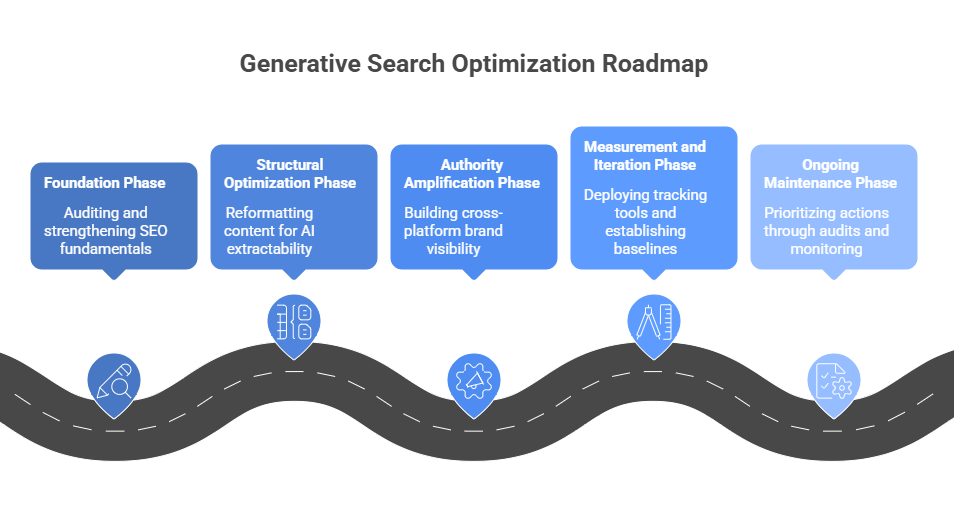
A GEO roadmap turns this generative search optimization guide into a list of prioritized actions. It matches these actions to the organization’s current maturity level, available resources, and strategic priorities. Each phase produces what the next phase needs, so skipping steps weakens results later.
Foundation Phase
The foundation phase audits and strengthens traditional SEO fundamentals. It also improves content quality, structured data, and entity presence. These conditions make generative search visibility possible.
Later phases work well with a solid foundation phase. Content recency is a core priority from the start. Data from early 2025 shows it as a primary driver for AI citation (Maritz, 2026).
Content freshness is an immediate action item. Do not wait until later stages to address it.
Structural Optimization Phase
The structural optimization phase reformats high-priority content for AI extractability. It implements schema markup across the site. It also aligns content architecture with pillar-and-cluster strategies.
Pillar-and-cluster architecture creates multiple entry points for AI retrieval across related queries. When AI systems encounter the same site across different subtopics, they build a retrieval pattern that reinforces topical authority. This increases the likelihood of AI overview source selection.
Authority Amplification Phase
The authority amplification phase builds cross-platform brand visibility. It earns third-party citations. It also strengthens author and organization entity profiles.
These phases move the content from technically sound to actively citation-worthy. The content now combines clear structure, verified entity signals, and sourced claims. AI systems can extract and present this content with confidence.
Measurement and Iteration Phase
The measurement and iteration phase deploys generative search tracking tools. It establishes performance baselines. It builds reporting frameworks that make data-driven decisions possible.
Measuring AI search performance at each stage creates a feedback loop. This loop turns a one-time roadmap into a continuous optimization program.
A well-executed GEO content strategy to optimize content for generative search produces measurable results. AI-driven visibility can produce commercial outcomes even when traditional traffic metrics decline. This is because AI citations reach users at the decision point, where intent is highest.
Ongoing Maintenance Phase
Prioritize actions through content audits, competitive analysis, and query-level AI citation monitoring. This keeps effort focused on what moves results.
The ongoing maintenance phase covers regular content refresh and platform-specific monitoring. It also includes competitive citation analysis. This keeps the program current as AI search behaviors continue to develop.
Conclusion: What Generative Search Actually Rewards
Generative search does not require abandoning the principles that have always made content worth reading. It requires applying them precisely.
Every element in this guide points toward the same outcome. Content structure, E-E-A-T generative search signals, entity authority, schema markup, and pillar content AI optimization all serve one goal. They create content that AI systems can find, read, trust, and cite.
The case for acting now is straightforward. Microsoft’s framework draws a precise distinction between three approaches (Montti, 2026). SEO helps content get found. AEO helps AI explain it clearly. GEO helps AI trust it and recommend it.
Organizations that invest in all three build visibility across every layer of the search experience. This spans from the traditional results page to the AI recommendation layer. Decision intent increasingly concentrates in that AI layer.
Optimizing for Google AI Overviews and other generative platforms yields the most direct returns. AI search content optimization is an active performance lever. Organizations that treat it as one now build advantages that compound as generative search grows.
AI platforms are refining their retrieval and citation behaviors. Measurement tools are still building the capability to reliably track citation frequency, sentiment, and share of voice. These tools continue to develop across platforms.
The organizations best positioned for long-term success build strong, adaptable foundations today. They stay flexible enough to adjust their approach as platforms mature. The measurement ecosystem will mature alongside them.
Organizations that apply this framework today build citation authority and topical depth. Generative search rewards these qualities. This advantage grows as AI adoption continues to increase.
Where to Go From Here
Start with a comprehensive audit. Content teams, SEO managers, and marketing leaders should assess their current content, technical infrastructure, entity presence, and cross-platform visibility against the principles in this guide to identify the highest-priority gaps. Then, share this resource with content, SEO, and marketing leadership to align the team on a unified GEO approach that strengthens the existing search and content strategy.
The transition to AI-powered search is already underway, and the organizations that act now build the citation authority and topical depth that compound in their favor over time.
Get updates on GEO, AI search, content strategy, and technical SEO developments, as well as on the changing arena of search visibility and digital marketing. Subscribe today.
Frequently Asks Questions
Generative engine optimization is the practice of optimizing content so AI search systems like ChatGPT, Perplexity, Google AI Overviews, and Bing Copilot will retrieve, trust, and cite it in their generated responses. GEO builds on traditional SEO rather than replacing it. SEO targets a high ranking position on the search results page, while GEO targets citation inclusion in a synthesized AI response. The same fundamentals apply, including technical accessibility, content depth, backlink authority, and topical relevance. GEO adds a second layer focused on content structure, entity signals, and citation-worthy writing. Notably, ChatGPT regularly cites pages at position 21 or lower in Google’s search results, which confirms that citation decisions respond to content quality and structure, not rank alone.
AI search systems use a retrieval-augmented generation architecture. They retrieve relevant web pages, evaluate each source for relevance and factual density, and feed the strongest passages into a large language model that generates a synthesized answer with citations. Source selection follows four core criteria: direct relevance to the query, established authority, clear structure that makes accurate extraction straightforward, and factual precision. When multiple credible sources agree on a claim, that consensus signals accuracy and increases the likelihood of citation. Fluency optimization, which means rewriting content for clarity and smooth flow, produces a 15-30% boost in AI citation rates, and integrating citations from reliable sources increases visibility in AI answers by over 40%.
Three structural changes deliver the largest gains. First, descriptive headings tell AI systems what each section covers before they read the body text, with question-based subheadings matching real user query phrasing. Second, answers must lead each section and stand alone, since AI systems extract individual passages without the surrounding paragraphs that provided context on the original page. Third, every statistic, quote, and data point needs source attribution, which gives AI systems verifiable material to extract with confidence. Different query types call for different formats: definitions followed by explanations work for conceptual queries, numbered steps work for process queries, and comparison structures work for evaluative queries.
AI search systems do not cite anonymous sources. Before including a brand or author in a response, an AI model needs to recognize that entity as distinct, well-defined, and credible. Entity optimization works through cross-source agreement: an organization’s directory listings, third-party mentions, social profiles, and knowledge base entries collectively carry more weight than any single page on its own site. Accurate profiles on Wikipedia, Wikidata, and Crunchbase anchor a brand’s identity in the knowledge sources AI systems actively reference. A documented experiment showed that an AI model ignored an official source and repeated a fabricated narrative planted on Reddit and Medium because the false consensus across multiple platforms outweighed the single authoritative source. This confirms that consistent signals across multiple platforms drive entity recognition.
Several schema types directly support generative search optimization. Article and BlogPosting schema define content type, author, publication date, and topic. Organization and Person schema reinforce entity identity and authorship, connecting directly to E-E-A-T signals. FAQPage schema mirrors how AI systems retrieve direct answers, while HowTo schema organizes step-by-step content for procedural queries. Product, Review, and AggregateRating schemas serve e-commerce content that AI shopping tools reference for purchase recommendations. Speakable schema identifies sections suited for voice-based AI delivery, and BreadcrumbList schema clarifies site architecture for retrieval systems. Schema markup alone does not guarantee AI citation, but it removes ambiguity and improves content comprehension when other signals are competitive.
Traditional SEO metrics miss important signals because a citation in an AI-generated response does not always produce a click. A complete framework tracks several specialized metrics. Position-Adjusted Word Count measures the space a brand occupies in a synthesized AI response, quantifying visibility through content presence rather than ranking position. Branded search volume acts as a reliable lagging indicator: when AI systems cite a brand consistently across multiple queries, users begin searching for that brand directly. Share of voice metrics show which competitors AI systems cite more frequently for the same queries. Additional signals include Google Search Console impression and click data, referral traffic from ChatGPT and Perplexity, and AI citation frequency tracked through specialized monitoring tools. Benchmarks should focus on directional trends rather than precise figures, since GEO measurement is still maturing.
Resources
- Aggarwal, P., Murahari, V., Rajpurohit, T., Kalyan, A., Narasimhan, K., & Deshpande, A. (2024, June 28). GEO: Generative engine optimization (Version 3). arXiv. https://doi.org/10.48550/arXiv.2311.09735
- Maritz, S. (2026, January 27). Answer engine optimization (AEO): The comprehensive guide for 2026. CXLhttps://cxl.com/blog/answer-engine-optimization-aeo-the-comprehensive-guide/
- Montti, R. (2026, January 22). Microsoft's guide to winning in AEO & GEO. Search Engine Journal. https://www.searchenginejournal.com/a-breakdown-of-microsofts-guide-to-aeo-geo/565651/
- Ploszek, L. (2026, March). Breaking content & SEO silos to build entity authority in AI search. Search Engine Journal. https://www.searchenginejournal.com/breaking-content-seo-silos-entity-authority/
- Radloff, R. (2025, May 16). How AI is changing paid search in 2025. Seer Interactive. https://www.seerinteractive.com/insights/how-ai-is-changing-paid-search-in-2025
- Reslan, T. (2026, March 25). Is AEO/GEO just SEO hype? What the data actually shows. CXL.https://cxl.com/blog/is-aeo-geo-just-seo-hype-data/
- Reynolds, W., Haigler, N., Shirk, C., & Stinnett, J. (2026, February 17). What is generative engine optimization (GEO) & how does it impact SEO?. Seer Interactive. https://www.seerinteractive.com/insights/generative-engine-optimization-geo-impact-seo
- Strauss, J. (2024, May 24). Optimizing content for generative search engines resulted in 40% more visibility. Seer Interactive. https://www.seerinteractive.com/insights/optimizing-content-for-generative-search-engines
- Tor.app. (2026, February 23). Mastering generative engine optimization in 2026: Full guide. Search Engine Land.https://searchengineland.com/mastering-generative-engine-optimization-in-2026-full-guide-469142

Kim Greer
OFP Law
One of the best business decisions I ever made was to contract with 321 Web Marketing. Jonathan Gessert and his team are knowledgeable, efficient, and effective, making digital marketing goals easy to achieve and helping [...]

Kelly Cole
Business Benefits Group
My company hired 321 Web Marketing in February 2016 to resurrect our web site. We feel our web site is the face to our business and desperately needed a make over. 321 took us from blah to WOW effortlessly and what a difference [...]

Emily Hawkins
Diener & Associates
Thanks to 321 Web Marketing, the client has seen an increase in their search engine leads, averaging 12 qualified leads per month. The client has also achieved prominent Google Maps and search placement. The team [...]

Trevor Telesz
Paw Pals Pet Sitting
321 Web Marketing successfully translated the client’s design into a stunning and refreshed website, ensuring seamless functionality across all dynamic views. The team provided clear timelines and stuck to them, [...]

Corey Davis
Spartan Animal & Pest Control
321 Web Marketing is truly phenomenal at what they do. Their ability to communicate and describe the steps and actions that they are implementing, Alex Zarpas in particular, is excellent. Delivering on promises is all [...]

Alec Roberts
MFE Insurance
I can’t say it enough, Jonathan and his team have gone above and beyond since day one to accommodate our needs and meet our goals. I run a specialty insurance brokerage based in LA and once we found 321 we never looked [...]

Richard Wilbur III
Advantage.Tech
Thanks to 321 Web Marketing’s web development work, the client increased rankings and traffic from search engines. Also, their business secured prominent positions on Google Maps and industry-relevant, profitable [...]

Bruce Gemmill
FVCbank
After the website revamp, the client saw a steady rise in leads from search engines, resulting in additional traffic. 321 Web Marketing is highly punctual when it comes to deliverables, and internal stakeholders are [...]

Drew Weeks
VAE
321 Web Marketing delivered a sleek website that accurately portrays the size and quality of the client’s organization. All of their completed websites have received positive feedback from users who have been [...]

Ryan Masten
Masten Pools
321 Web Marketing has increased the client’s leads from zero to 53 monthly. Their SEO efforts pay off impressively due to a top-ranking position on Google and making the site the number one result for several [...]