



Table of Contents
- 1. Introduction
- 2. The Evolution of the Social Media and SEO Relationship
- 3. How Social Media Generates Search-Relevant Signals
- 4. Brand Building Through Social Media and Its SEO Impact
- 5. Trust, Social Proof, and E-E-A-T Signals
- 6. Content Amplification: Using Social Media to Earn Links and Authority
- 7. Platform-Specific Strategies for SEO Impact
- 8. Social Media, Entity SEO, and Knowledge Graph Optimization
- 9. Social Media and Local SEO
- 10. Social Media and Generative AI Search Visibility
- 11. Measuring the SEO Impact of Social Media
- 12. Organizational Alignment: Integrating Social Media and SEO Teams
- 13. Common Mistakes That Undermine the Social-SEO Relationship
- 14. Building an Integrated Social-SEO Strategy Roadmap
- 15. Building Long-Term Search Visibility Through Social-SEO Integration
- 16. Implement Your Social-SEO Integration Strategy
- 17. Frequently Asks Questions

 May 12, 2026 ·
  37 min read ·
  Summarize in ChatGPT
Introduction
Does social media activity directly impact search engine optimization (SEO)? The question of how social media affects SEO has sparked debate for years. But asking whether social media shares work as a direct ranking factor overlooks the real mechanism. What social media does is build brand awareness, trigger name searches, help search engines verify businesses across platforms, and establish authority through content sharing and mentions.
This happens through specific pathways. When people discover a brand on social media, they search for the company by name. Journalists and bloggers find content on social platforms and link to it from their websites. Search engines see a consistent presence across multiple platforms and recognize businesses as established entities.
Search has changed how it evaluates content quality. Google’s Experience, Expertise, Authoritativeness, and Trustworthiness (E-E-A-T) framework guides quality raters who assess websites. Entity recognition systems verify that brands are real by checking if they appear on LinkedIn, YouTube, and other social media platforms. AI search tools, such as ChatGPT and Perplexity, check whether brands exist across multiple channels before citing them as sources.
This shift makes social media a core part of organic search strategy. Organizations need frameworks that connect social media activity to search results. Understanding social media and SEO strategy helps marketing teams align these channels for maximum impact.
This guide covers six areas where social media powers SEO. The initial sections examine how social media activity creates search signals through brand awareness, content sharing, entity verification, E-E-A-T building, and user behavior. The platform chapters detail strategies for various social media platforms. The measurement sections show how to track social media brand visibility SEO metrics, including branded search growth, backlinks from social sharing, and gains in entity visibility. The final sections cover team alignment and implementation steps.
The Evolution of the Social Media and SEO Relationship
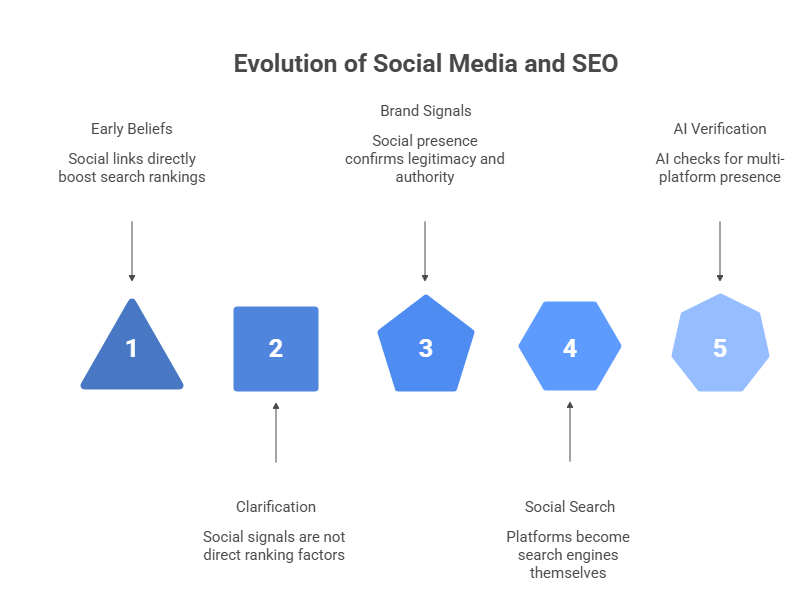
The connection between social media and SEO has moved through three phases. Early digital marketers thought social links worked like regular backlinks. They assumed shares and likes directly boosted search rankings.
In the second phase, the role of search engines was clarified. Do social signals affect SEO as direct ranking factors? Google has consistently maintained that social signals and search rankings are not directly connected. Follower counts or likes do not function as direct algorithmic ranking factors (Crestodina, n.d.). This ended the debate about whether tweets or shares directly improved rankings.
In the third phase, it was recognized that seeing a brand on social media often leads to branded searches. Journalists and influencers use social platforms to find content to link to. Search engines rely on a brand’s presence across multiple platforms to confirm legitimacy.
Several key changes reshaped how social media and SEO work together. Google shifted its focus to brand signals and entity recognition. The E-E-A-T framework checks if the author has real experience, verified expertise, recognized authority, and trustworthiness. Social media helps prove this through consistent activity across platforms.
Search results now show social profiles directly. Knowledge panels display LinkedIn profiles and YouTube channels next to website information. Social presence has become part of how brands appear in search results.
Additionally, social media platforms have begun functioning as search engines themselves. Users research products on YouTube and TikTok before checking Google. People find local businesses through Instagram location tags. Professionals discover companies through LinkedIn searches. Reddit communities answer specific questions. Social optimization affects discoverability before users reach traditional search.
Generative AI search added another factor. AI search tools, such as ChatGPT, Perplexity, and Google’s AI Overviews, check if brands appear on multiple platforms before citing them. These AI systems verify that businesses exist across channels before using them as sources.
Google’s quality standards have become more stringent. The search engine has been actively targeting and deindexing Private Blog Networks (PBNs) since at least 2017 (LinkBuilding HQ, 2025a). This shows algorithms prefer real authority signals. Social media provides real signals, such as customer comments, shares from industry professionals, and discussions in active communities.
Understanding this evolution changes how marketing teams work. When social teams build brand awareness, SEO teams get more branded searches. When SEO teams create strong content, social teams share it with journalists who add backlinks. Understanding how social media influences Google rankings helps teams strategically optimize both channels.
Organizations that align social media activity and SEO see stronger results. Social visibility helps search engines recognize brands, while a stronger search presence attracts more people to social platforms. This integrated cycle builds rankings faster than managing each in isolation.
How Social Media Generates Search-Relevant Signals
Social media creates search-relevant signals through six distinct pathways. Each pathway works independently while building overall search performance.
1. Brand Awareness and Branded Search Volume
Social media introduces brands to people who have never heard of them. These new audiences later search for the brand name on Google. Search engines track this branded search volume as a signal of brand authority.
Companies with growing branded search traffic rank better for both branded and non-branded terms. When Google sees many people searching for a brand name, it treats that brand as more authoritative for related topics.
2. Content Amplification and Link Earning
Social media platforms put content in front of journalists, bloggers, and industry influencers. These professionals discover valuable content through their social feeds. They link to it from their own websites and publications.
These editorial backlinks improve domain authority and search rankings. The links come from editorial decisions rather than paid placements. Understanding social media content amplification SEO helps teams maximize the impact of content distribution.
Research examining over 23 million social shares found that higher social signals are strongly associated with search rankings. Social signals correlate with improved search engine results page (SERP) rankings (Brandignity, n.d.). This correlation exists because social sharing leads to link earning. Content that goes viral reaches more potential linkers.
3. Entity Recognition and Knowledge Graph Signals
Search engines and AI use consistent profiles across platforms to confirm business identities. Verified LinkedIn accounts, active YouTube channels, and professional X profiles offer proof of legitimacy.
When a business name, logo, and description match across LinkedIn, YouTube, and X, Google can connect these profiles to the website and confirm it is a real business. This consistency helps search engines categorize the business correctly.
4. E-E-A-T Reinforcement
Thought leadership content on LinkedIn demonstrates Expertise. Expert commentary on industry trends shows Experience. Professional engagement in discussions builds Authority. In addition, responsive customer service and transparent communication contribute to Trustworthiness.
Google’s raters check for genuine expert authorship. Active, professional social profiles help confirm the brand’s credibility.
5. User Engagement and Behavioral Signals
Social media traffic arrives at websites with specific patterns. Visitors from social platforms spend time on the site, view multiple pages, and complete actions like signing up or buying. User engagement signals social SEO performance through measurable behavioral metrics.
When visitors stay on a page for more than three minutes, click to other pages, and complete forms, Google sees the content that answers the question. Strong engagement metrics from social traffic contribute to site quality assessment.
6. Cross-Platform Content Indexing
YouTube videos appear directly in Google search results. LinkedIn articles rank for professional queries. Pinterest pins show up in image and product searches. Reddit threads rank for informational questions.
This indexed social content expands total search visibility beyond the main website.
| Pathway | Mechanism | SEO Outcome |
|---|---|---|
| Brand Awareness and Branded Search Volume | Social exposure prompts users to search the brand by name on Google | Higher branded search volume signals brand authority and lifts rankings for branded and non-branded terms |
| Content Amplification and Link Earning | Journalists, bloggers, and writers discover content through social feeds and reference it editorially | Editorial backlinks improve domain authority and search rankings |
| Entity Recognition and Knowledge Graph Signals | Verified, consistent profiles across LinkedIn, YouTube, and X confirm a single business entity | Search engines categorize the business correctly and surface it in knowledge panels |
| E-E-A-T Reinforcement | Thought leadership, expert commentary, peer endorsements, and responsive engagement build credibility | Quality raters assess the brand as more trustworthy, training the AI systems that influence rankings |
| User Engagement and Behavioral Signals | Visitors from social platforms spend more time on site, view multiple pages, and complete actions | Strong engagement metrics contribute to site quality assessment |
| Cross-Platform Content Indexing | YouTube, LinkedIn, Pinterest, and Reddit content gets indexed by Google directly | Total search visibility expands beyond the main website |
How These Signals Connect to AI Search
Approximately 73.2% of SEO experts believe that external backlinks are a primary factor in determining whether a brand appears in Google’s AI Search Overviews (LinkBuilding HQ, 2026). Social media helps earn these backlinks through content distribution and relationship building. AI search systems check cross-platform presence before citing sources.
Why Indirect Signals Matter More
These pathways work indirectly rather than as direct ranking factors. Social media shares don’t boost rankings on their own. The amplification from shares leads to links, which boost rankings.
Brand mentions on social platforms don’t directly improve search position. The branded searches resulting from those mentions signify authority. Buying 10,000 fake social shares is easy, but it will not convince real journalists to link to the content.
The indirect nature makes these signals harder to fake and longer-lasting. Direct ranking factors are easily manipulated and can lose value when Google updates its algorithm. Indirect pathways require real brand building and audience development, which creates signals that persist over time.
Search algorithms favor signals of genuine audience interest. When journalists discover content on social media and choose to link to it, this editorial decision creates lasting SEO value.
The combined effect across all six pathways creates a stronger SEO impact than any single direct ranking factor.
Organizations can measure social media’s search impact through specific metrics. Branded search volume indicates growth in brand awareness. Backlink acquisition reveals content amplification success. Entity visibility in knowledge panels indicates that Google now recognizes the brand as established. Metrics such as average session duration, pages per visit, and conversion rate demonstrate engagement value. Social content rankings expand the total search footprint.
Brand Building Through Social Media and Its SEO Impact
Social media builds the brand recognition, reputation, and trust that modern search algorithms reward. Strong brands rank higher in search results, as Google sees many people searching for them by name, which shows users trust them. Understanding social media brand visibility SEO helps organizations optimize brand-building efforts for search performance.
How Brand-Building Activity Translates to SEO Benefits
Brand-building social media activity creates five specific SEO benefits. Each benefit delivers measurable improvements in search performance.
Branded search volume and social media activity drive the first benefit. When people see a brand on social media, they later search for it by name. This branded search volume is one of the strongest signals of brand authority that search engines can measure. Companies with growing branded search traffic rank better for both branded and non-branded queries.
In a recent industry survey, 34.8% of respondents identified increased brand visibility as one of their most improved SEO outcomes (Morton, 2025). This improvement stems from a consistent social media presence, creating repeated brand exposure.
Branded SERP real estate expansion forms the second benefit. Active and optimized social profiles appear in branded search results alongside the organization’s website. A branded search might show the website, LinkedIn profile, YouTube channel, and X account all on page one. This comprehensive display reinforces credibility by providing multiple verified touchpoints that confirm the brand’s legitimacy.
Brand association development creates the third benefit. Social media content about specific topics helps search engines understand what the brand is. When Google sees a brand consistently discussing cybersecurity, it ranks that brand for cybersecurity-related searches, not just the company name. These associations expand organic visibility beyond branded terms.
Brand mention accumulation produces the fourth benefit. Social media content gets shared, discussed, and referenced on other platforms and publications. These conversations generate brand mentions across the web. Search engines count brand mentions as SEO value even without links. These unlinked mentions signal that the brand matters in the industry.
Building a reputable online presence is critical, as 81% of customers conduct product research before making a purchase (Cariño, 2026). Social media brand building ensures the brand appears during this research phase. Brands with strong social presence capture attention earlier in the buying process.
Establishing a cross-platform brand identity enables the fifth benefit. When AI search tools find the same brand name, logo, and message across multiple platforms, they trust it enough to cite it as a source. This consistency increases the likelihood of citations in AI-generated answers.
Optimizing Social Media Brand Building for Search Impact
Social and SEO teams should approach social media brand building with specific search outcomes in mind. Consistency across platforms builds stronger entity signals than sporadic activity. Organizations should maintain complete, verified profiles on core platforms that match their brand information.
If a brand wants to rank for “email marketing software,” its social content should answer questions about email marketing software. This topical consistency helps search engines associate the brand with relevant subject areas.
Engagement with industry influencers generates downstream link opportunities. Social teams should identify journalists and bloggers who cover their industry. When brands engage with journalists on social media, those journalists later discover and link to the brand’s research and resources.
Brand name usage should remain consistent across all social media content. Variations in company name spelling create entity confusion. Search engines need clear, consistent signals to build strong brand associations.
Expert insights shared on LinkedIn get likes and shares while proving to Google that real experts run the brand. This content is also discovered by journalists looking for expert sources.
Social teams should track branded search volume alongside traditional social metrics. Growth in branded searches proves that social visibility drives search behavior. This metric connects social media activity directly to SEO outcomes.
Trust, Social Proof, and E-E-A-T Signals
Social media activity builds the trust dimension of SEO through direct trust signals and social proof. These signals make users more likely to click on search results, content creators more likely to link to the brand, and quality raters more likely to rate the brand as trustworthy. Understanding branding trust social media SEO helps organizations build credibility that search engines reward.
Google’s internal Search Quality Rater Guidelines mention the word “trust” 191 times, underscoring its importance in content evaluation (Haynes, 2026). E-E-A-T is an evolution of the quality framework designed to help human raters train Google’s AI systems (Spike Interactive, 2025a).
How Social Media Builds E-E-A-T Signals
Experience is demonstrated through social content that shows real-world work. A software company can’t post new updates without knowledge from real developers, and a restaurant can’t share cooking videos without an actual kitchen. Behind-the-scenes posts show the actual work. Customer interaction screenshots prove the brand handles real customer situations.
Expertise shows through thought leadership posts and expert commentary on industry news. When a cybersecurity company explains a new vulnerability within hours of discovery, it proves technical knowledge. Educational content that teaches complex topics establishes the brand as an authority. Participation in professional discussions on LinkedIn shows ongoing engagement with industry challenges.
Authoritativeness builds through social proof that others recognize the brand’s authority. Social media E-E-A-T signals strengthen when industry professionals follow, engage with, and endorse the brand. Having 1,000 industry professionals as followers beats having 10,000 random followers. Professional endorsements and peer recognition appear through tagged posts and collaborative content.
Media mentions generated by social visibility show journalists consider the brand newsworthy. Invitations to speak at conferences or contribute to industry panels prove that organizers view the brand as authoritative. Raters trust third-party recognition more than brand self-promotion.
Trustworthiness is reinforced through transparent communication and responsive customer engagement. Brands that answer questions publicly show confidence in their expertise. Consistent brand messaging across platforms proves the organization has clear values. When brands admit mistakes and correct information, they demonstrate integrity.
How Quality Raters Consider Social Presence
Human quality raters evaluate search results for Google’s quality evaluation process. These raters may check the brand’s social media presence when assessing E-E-A-T. Their evaluations train the AI systems that influence rankings.
When raters research a brand in search results, they check multiple sources. Active LinkedIn profiles with professional content support expertise assessment. YouTube channels with educational videos demonstrate depth of knowledge. Responsive customer service visible on X proves authentic engagement.
Social signals are not direct ranking factors, but quality raters use them to judge trustworthiness. Social proof SEO trust signals include verified profiles, consistent activity, and authentic engagement. When raters compare two brands, and one has verified profiles with daily activity while the other has outdated profiles, brands with verified accounts and consistent activity appear more credible.
Raters also assess author credibility for content published on websites. When an article author has an active LinkedIn profile showing relevant experience, raters can verify expertise. Authors without social presence raise credibility questions.
Auditing Social Presence Through an E-E-A-T Lens
Organizations should audit their social media presence using E-E-A-T criteria. Brand trust signals search engines evaluate include consistency, authenticity, and expert engagement across platforms. For experience signals, post behind-the-scenes content from actual projects. Share customer interaction examples. Include product testing videos.
For expertise signals, post regular expert commentary on industry news. Create educational content that explains complex topics. Participate in professional groups.
For authoritativeness signals, track quality followers, not just quantity. Document endorsements from industry peers. Record media mentions and speaking invitations.
For trustworthiness signals, measure response time to customer questions. Check consistency between social messaging and website content. Review the accuracy of past predictions and statements.
Verify that each author has a social profile. Content creators should maintain LinkedIn profiles showing their credentials. Subject matter experts (SMEs) should engage in discussions relevant to their areas of expertise.
Document improvements in a tracking system. Set monthly reviews of follower quality, engagement authenticity, and E-E-A-T alignment to help maintain standards.
Content Amplification: Using Social Media to Earn Links and Authority
Strategic social media content distribution earns the editorial backlinks and content citations that directly improve domain authority and search rankings. A significant majority of marketers (89%) specifically create content to earn backlinks from authoritative sources (LinkBuilding HQ, 2026).
Social media provides the distribution channel that puts link-worthy content in front of people who can link to it. This forms the basis of a social media backlink strategy that prioritizes visibility among publishers and content creators.
How Content Amplification Drives Link Acquisition
Journalists, bloggers, and industry writers discover linkable content through their social media feeds. These professionals follow relevant accounts and hashtags related to their coverage areas. When brands share original research or expert analysis on social platforms, writers notice and reference it in their publications.
Writers link because the research contains data they need for their articles, not because brands asked them to. This editorial decision gives the links SEO value and supports a reliable social media link-earning strategy.
Discussion around original research and thought leadership motivates other content creators to cite the work as a source. When a brand publishes proprietary data on LinkedIn, industry peers debate the findings. When people write posts analyzing the data, they link to the original research to support their arguments.
Consistent social engagement builds relationships with influencers, industry peers, and community leaders. These relationships create a network of potential amplifiers who share and link to the organization’s content. When brands regularly engage with an influencer’s posts, that influencer becomes familiar with the brand and may share or link to their content.
Viral or high-engagement social moments drive widespread visibility and secondary coverage. When a data visualization gets thousands of shares, media outlets notice. These articles include links to the source, strengthening social media and domain authority through secondary exposure.
Content Types That Drive Link Acquisition
Original research and proprietary data lead link acquisition because they provide unique information. Survey results, industry benchmarks, and trend analyses are frequently cited.
Comprehensive resource guides earn links because they serve as reference materials. A complete guide to a technical topic becomes the source that other writers link to when covering that subject. Content marketing remains a powerful lead generator; companies with active blogs receive 67% more monthly leads than those without (Cariño, 2026).
Expert roundups and collaborative content generate links from participants. When a brand publishes an article featuring insights from 10 industry experts, each expert shares it. Their websites and newsletters often link back to the roundup.
Visual assets, such as infographics and data visualizations, are embedded on other websites with attribution links. Publishers looking for visuals to support their articles discover these assets through social sharing. People share infographics because they convey data more quickly than text.
Contrarian or thought-provoking perspectives on industry topics spark discussion and citations. When a brand challenges conventional wisdom with evidence, supporters and critics both link to the original piece. The debate generates more links in a shorter time period.
Building a Content Amplification Workflow
Organizations should build systematic workflows for content amplification. Start by identifying link-worthy content assets before publication. Determine which pieces have citation potential based on uniqueness, data quality, or comprehensive coverage.
Create a distribution plan for each asset. Identify relevant hashtags, communities, and influencers who would find the content valuable. Schedule multiple social posts across platforms.
Engage with journalists and bloggers who cover related topics before publishing content. Share their work and provide thoughtful comments. When the brand publishes link-worthy content, these relationships make journalists more likely to cover and link to it.
Track downstream link acquisition using backlink monitoring tools. Connect new backlinks to specific social amplification campaigns. This measurement proves the connection between social distribution and link earning.
Platform-Specific Strategies for SEO Impact
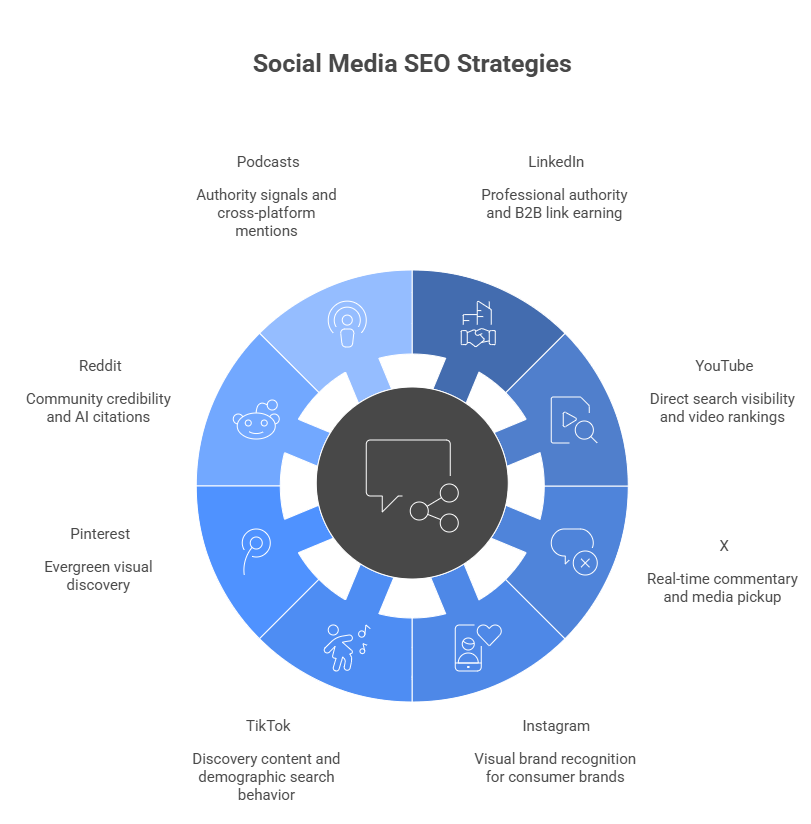
Different social media platforms contribute to SEO through distinct mechanisms. For example, LinkedIn earns backlinks, YouTube ranks in video search, and TikTok drives branded searches.
Social platforms have become search destinations; YouTube and TikTok ranked second and fifth globally in 2024 (LinkBuilding HQ, 2025b). Platform optimization now affects discoverability before users reach traditional search engines. Organizations need strategies that address both in-platform search and Google search benefits.
LinkedIn: Professional Authority and B2B Link Earning
LinkedIn SEO authority building starts with professional thought leadership that reinforces E-E-A-T signals. Article publishing on LinkedIn demonstrates expertise through long-form content. Expert commentary on industry news shows active engagement with current developments.
Engagement on LinkedIn and other professional networks is effective for drawing professional backlinks and B2B mentions (Brandignity, n.d.). When executives and SMEs publish insights on LinkedIn, industry journalists discover and cite them. These citations generate editorial backlinks from authoritative publications.
Content shared on LinkedIn reaches decision-makers who run industry blogs and publications. These professionals link to valuable resources when creating their own content. This creates ongoing link-earning opportunities.
LinkedIn activity generates branded search behavior. When professionals engage with a brand’s thought leadership on LinkedIn, they later search for that brand by name. This branded search volume signals brand authority to Google.
YouTube: Direct Search Visibility and Video Rankings
YouTube content is indexed directly by Google and appears in universal search results. Video carousels show YouTube videos for how-to queries, product reviews, and educational searches. AI-generated responses increasingly include YouTube videos as visual sources.
YouTube SEO social media optimization creates a significant additional search visibility channel. Keyword-rich titles help videos rank for target queries. Detailed descriptions with timestamps improve relevance signals. Transcripts make video content searchable and accessible.
The chapter markers let users jump to specific sections, improving engagement metrics. Titles, descriptions, transcripts, and chapter markers help videos rank both on YouTube and in Google search results. A well-optimized video can capture traffic that would otherwise go to blog posts.
X: Real-Time Commentary and Media Pickup
X serves real-time commentary and expert threads that generate brand visibility. Social media thought leadership SEO benefits from participation in trending industry conversations, putting brands in front of journalists monitoring those topics. Quick responses to breaking news demonstrate expertise and timeliness.
Media pickup from X activity contributes to branded search volume and link earning. Journalists discover expert sources through their X feeds. Insightful threads get quoted in articles with attribution links.
When X posts drive clicks, and those visitors spend time reading the content, these engagement signals show Google the content is valuable.
Instagram: Visual Brand Recognition for Consumer Brands
Instagram strengthens brand recognition through visual brand building. Product discovery posts introduce brands to new audiences. Behind-the-scenes content shows real people working at the company, making the brand feel more trustworthy.
This visual presence generates branded search behavior, particularly for consumer-facing and e-commerce brands. Users discover products on Instagram, then search for the brand name on Google to make purchases. When many people search for a brand name after seeing it on Instagram, Google ranks that brand higher for related product searches.
TikTok: Discovery Content and Demographic Search Behavior
TikTok shows content to users who have never heard of the brand. This exposure drives branded search spikes as viewers search for brand names after seeing videos.
TikTok increasingly functions as a search engine for younger demographics researching products, services, and experiences. Users search within TikTok for reviews, tutorials, and recommendations. Brands with optimized TikTok content capture this search behavior before it reaches Google.
Pinterest: Evergreen Visual Discovery
Pinterest visual content is indexed by Google and appears in image search results. Pins drive sustained referral traffic because they stay visible in search results for months or years. Unlike social posts, which disappear from feeds, pins continue to generate traffic.
Pinterest serves as a discovery platform for product, design, and lifestyle-related searches. Users search Pinterest for home decor ideas, recipes, and fashion inspiration. Brands in these categories benefit from optimized pin descriptions and board organization.
Reddit: Community Credibility and AI Citations
Reddit requires authentic participation in relevant communities. Promotional content gets rejected, but genuine expertise builds brand credibility. Helpful answers to community questions establish authority.
Reddit discussions are indexed by search engines and increasingly referenced by AI search systems in generative responses. When ChatGPT or Perplexity pulls information from Reddit threads, brands that actively participate gain visibility. These citations introduce brands to new audiences.
Reddit users who click through engage deeply because they’re seeking specific answers, not just browsing. This deep engagement shows Google that the content answers real questions.
Podcasts: Authority Signals and Cross-Platform Mentions
Podcasts generate brand mentions and cross-platform backlinks. Guest appearances on industry podcasts reach engaged audiences. Hosted shows establish brands as thought leaders.
Podcast show notes include links to guests’ websites and resources mentioned. These backlinks come from contextually relevant content. Audio content contributes to entity recognition, as podcast platforms and directories consistently reference brand names.
Prioritizing Platform Investment
Organizations should prioritize platforms based on industry, audience, content strengths, and specific SEO signals needed. Social sharing and organic traffic patterns vary by platform, with B2B companies benefiting most from LinkedIn’s professional network and link-earning potential. E-commerce brands should focus on Instagram, Pinterest, and TikTok for visual discovery.
Companies with educational content should invest in YouTube for direct search visibility. Brands targeting media coverage need an active X presence. Organizations in advice-oriented industries should participate in relevant Reddit communities.
| Platform | Primary SEO Contribution | Best-Fit Audience | Recommended For |
|---|---|---|---|
| Editorial backlinks from journalists, branded search behavior, E-E-A-T signals through thought leadership | Decision-makers, industry journalists, B2B buyers | B2B companies, professional services, executives building authority | |
| YouTube | Direct indexing in Google search, video carousels, citations in AI-generated responses | Researchers using how-to and product-review queries | Companies with educational, demonstrative, or tutorial content |
| X | Real-time media pickup, journalist source discovery, branded search lift | Journalists, industry commentators, news-driven audiences | Brands targeting media coverage and breaking-news commentary |
| Visual brand recognition, branded search behavior for product discovery | Consumer audiences researching products and lifestyle topics | E-commerce, retail, lifestyle, and consumer-facing brands | |
| TikTok | Branded search spikes, in-platform search visibility for younger users | Younger demographics researching products, services, and experiences | Consumer brands targeting Gen Z and younger millennial audiences |
| Indexing in Google image search, sustained referral traffic from evergreen pins | Users searching home decor, recipes, fashion, and design ideas | Visual product categories: home, food, fashion, weddings, design | |
| AI search citations, indexed thread visibility, deep engagement signals | Users seeking specific answers and authentic peer recommendations | Advice-oriented industries and brands building topic authority | |
| Podcasts | Brand mentions, contextually relevant backlinks from show notes, entity recognition | Engaged listeners interested in long-form expert discussions | Thought leaders and brands building cross-platform authority |
Social Media, Entity SEO, and Knowledge Graph Optimization
Social media profiles and activity contribute to the SEO of social media entities. This practice establishes the brand as a well-defined entity that search engines and AI systems can accurately identify, categorize, and associate with specific topics. Verified and consistent social media profiles reinforce a brand’s entity identity, assisting AI search systems in cross-referencing information (LinkBuilding HQ, 2025b).
Entity SEO differs from traditional keyword optimization. Traditional SEO optimizes individual pages for specific search terms. Entity SEO builds brand recognition across platforms so Google can connect all profiles and understand the business as one unified company.
How Social Media Supports Entity Optimization
Verified, complete, and consistently branded profiles across major platforms reinforce the brand’s identity. When Google’s knowledge graph checks if a business is legitimate, it looks for active LinkedIn profiles, verified X accounts, and YouTube channels with consistent branding.
Consistent naming, descriptions, imagery, and contact information across all social profiles help search engines recognize that all profiles belong to the same company. If a brand uses slightly different names on different platforms, search engines struggle to connect them. Exact matches in business name, logo, and description help algorithms recognize the unified entity.
Linking social profiles to the organization’s website and vice versa creates a network of connections. Website about pages should link to all official social profiles. Social profile bios should link back to the website. These two-way links prove to Google that the social profiles and website all belong to the same real business.
Publishing content on social platforms that consistently addresses specific topics helps search engines understand the brand’s specialties. When a cybersecurity company posts about data breaches, encryption, and threat detection across LinkedIn, X, and YouTube, search engines associate that entity with cybersecurity. This helps the brand rank for related searches.
Earning mentions, tags, and references from other verified accounts is like a vote of confidence. When industry leaders tag a brand or quote its content, these endorsements strengthen the brand’s knowledge graph position. AI systems use these third-party validations to assess authority.
Entity Signals and Generative AI Search
Generative AI engines and LLMs like ChatGPT and Perplexity extract data from social media posts to curate real-time answers for users (LinkBuilding HQ, 2025b). Understanding social media and knowledge graph optimization helps brands improve their visibility in AI-generated responses. AI systems evaluate cross-platform brand presence and consistency when deciding which entities to cite.
When AI considers citing a brand, it checks multiple signals. Does the brand have verified accounts on major platforms? Do these accounts use consistent branding? Does the brand regularly publish content about relevant topics?
Brands with strong entity signals across platforms get cited more often. When AI systems see consistent activity across platforms, they trust the brand enough to cite it as a source. Social profile search results now include knowledge panels, featured snippets, and AI-generated summaries sourced from verified social accounts.
Organizations should regularly audit their entity signals. Check brand name consistency across platforms. Verify all social profiles link to the website. Confirm profile descriptions mention the same expertise areas. The audit will show where inconsistencies make it harder for search engines to recognize and trust the brand.
Social Media and Local SEO
Social media helps local businesses rank higher in “near me” searches and on Google Maps. Social media local SEO strategies integrate social presence with location-based search optimization. Local businesses should view their social media presence as an integral part of their local search visibility strategy. Local intent is massive in search; 4 in 5 searches have local intent, and 76% of people who search for something “near me” visit a related business within 24 hours (Cariño, 2026).
How Social Media Supports Local SEO
Community members who encounter the business on social media platforms later search for it by name. When someone sees a local restaurant’s Instagram post, they search for “restaurant name + city” on Google. This drives local branded search volume.
Social media interactions, including localized reviews and check-ins on platforms like Facebook, directly improve visibility in local search listings (Brandignity, n.d.). Customer photos and reviews on social platforms show Google that real people visit and trust the business.
Local community engagement on social media drives local media coverage and backlinks. Community building SEO benefits include stronger local authority signals, increased brand mentions from community partners, and improved relevance for location-based queries. When a business sponsors a community event and posts about it, local news outlets cover the story and link to the business website.
Accurate location information across social profiles corroborates the business’s Google Business Profile. The business address, phone number, and hours should match exactly across Facebook, Instagram, X, and the website. When Google sees the same address everywhere, it confirms the business location is correct.
Localized content on social platforms tells Google the business operates in that specific city or neighborhood. Posts about local events, neighborhood news, and community involvement show geographic relevance.
Integrating Social Media and Local SEO Strategies
Post location-tagged content consistently. Encourage customers to check in and tag the business location. Respond to all reviews and comments to build community engagement.
Share content from other local businesses to build relationships that lead to local backlinks. Use local hashtags and location tags in every post to increase discoverability for nearby searchers.
Social Media and Generative AI Search Visibility
Social media activity influences whether and how brands appear in generative AI search responses. Understanding social media and generative search visibility helps organizations optimize for both traditional search engines and AI platforms.
AI agents, such as GPTBot and ClaudeBot, now account for approximately 33% of organic search activity, highlighting a shift toward real-time info fetching (Park, 2026). AI search platforms check if a brand appears on multiple platforms before trusting it as a source.
How Social Media Connects to Generative Search Visibility
Brand mentions, discussions, and citations across social platforms indicate that the brand is present on multiple platforms. When ChatGPT or Perplexity searches for information, it looks for brands mentioned across multiple platforms. A brand discussed on LinkedIn, quoted on X, and featured in YouTube videos appears more authoritative than a brand on only one platform.
Off-site reputation is vital for AI visibility; roughly 34% of AI citations originate from PR-driven coverage, with another 10% coming from social channels (Park, 2026). Social media and AI search citations work together—social media contributes directly to this citation pool.
Thought leadership content published on social platforms can be directly retrieved and cited by AI search systems. LinkedIn articles explaining industry trends get pulled into AI responses. YouTube videos demonstrating technical processes get cited when users ask how-to questions.
The brand’s social media reputation and engagement patterns determine whether AI systems cite the brand. AI systems check for active social profiles, expert engagement, and professional participation. Brands that feature real people commenting and sharing content are prioritized over those with few followers or fake engagement.
Social-driven branded search volume signals brand authority to AI systems. When many people search for a brand by name, AI systems interpret this as a signal that the brand matters.
Positioning Social Media for AI Search Visibility
Publishing expert content on LinkedIn, YouTube, and X reaches both human readers and AI systems. Brands should maintain consistent messaging across platforms to strengthen cross-source validation. When AI systems find the same brand voice, expertise claims, and factual statements across multiple platforms, they trust the information more.
In addition, organizations should track AI citations alongside traditional backlinks. Brand monitoring tools track when AI systems cite social content. This measurement helps teams understand which types of social content generate AI visibility.
Measuring the SEO Impact of Social Media
Measuring the downstream SEO impact of social media activity is challenging because it doesn’t directly boost rankings. Social and SEO teams need a framework to track how social activity drives search results. Integrated social SEO measurement connects social media metrics with search performance outcomes. Data shows that 81% of marketers believe social media activity has successfully increased exposure, traffic, and leads for their brand (LinkBuilding HQ, 2025b).
Organizations should track seven key metrics. Branded search volume tracking in Google Search Console and keyword research tools monitors whether social media campaigns correlate with increases in brand-name search volume. Referral traffic analysis segmented by social platform measures which platforms send visitors, and the engagement quality.
Backlink acquisition tracking using link analysis tools identifies links earned from content amplified through social channels and measures social-to-link conversion rate over time. SERP feature monitoring tracks the presence of social profiles in branded search results and measures the expansion of the branded SERP footprint.
Share of voice and brand mention tracking across social and web sources measures brand visibility growth that contributes to entity authority and AI search citation potential. Social media brand awareness SEO impact manifests through correlation analysis between social media campaign activity and organic search performance trends, which identifies patterns of downstream search impact.
Generative AI citation monitoring tracks whether the brand’s social media content is retrieved and cited by AI search platforms.
Isolating social media’s contribution to SEO from other factors remains difficult. Social and SEO teams should use directional correlation, controlled experiments, and multi-touch attribution frameworks to build a defensible case.
A case example in the home services industry showed that while organic clicks dropped 20% due to AI Overviews, leads increased by 35% as a result of branded visibility (Spike Interactive, 2025b). This proves brand-building through social media can offset algorithm changes.
Organizations should build integrated social-SEO dashboards that display branded search trends, backlink acquisition from social campaigns, and social profile visibility in search results. Teams should connect social metrics directly to search outcomes when presenting to stakeholders.
Organizational Alignment: Integrating Social Media and SEO Teams
Most organizations miss the full potential of social media SEO integration because social media and SEO teams operate separately, with distinct goals, metrics, and limited coordination. To survive in a complex digital environment, 37.7% of SEO professionals report that their organizations have increased focus on cross-functional operations (Morton, 2025).
Siloed teams undermine brand consistency; if different teams tell different stories, AI systems and search engines are likely to perceive the brand as “confusing” (Morton, 2025). Understanding branding trust social media SEO requires teams to work together rather than independently. Organizational alignment unlocks compounding benefits.
Social and SEO teams should establish shared key performance indicators (KPIs) that connect social activity to search outcomes. Track branded search volume, backlink acquisition, content amplification reach, and entity visibility. Stop evaluating social purely on engagement and reach metrics.
Create workflows where teams share insights. SEO insights, such as keyword research and search intent data, should guide social content topics. Social engagement data should identify content topics that warrant search-optimized development.
Build joint content amplification processes. The SEO team identifies high-value content that needs social distribution. The social team executes amplification strategies to maximize link earning, brand mentions, and branded search impact.
Conduct regular cross-functional planning sessions. Social and SEO teams should review performance data together, share competitive intelligence, and align on campaigns. Identify opportunities where each team can strengthen the other’s work.
Develop unified reporting that presents social and SEO as a single integrated system. Start with small collaborative pilots that demonstrate value before proposing full structural integration.
Common Mistakes That Undermine the Social-SEO Relationship
Organizations make frequent strategic and tactical errors that prevent them from capturing the full SEO value of their social media investment. Understanding how social media affects SEO helps teams avoid these common pitfalls.
Treating Social Media and SEO As Separate Disciplines
Treating social media and SEO as entirely separate disciplines misses the compounding benefits that emerge when the two align around shared goals for brand visibility and authority. When social teams focus only on engagement and SEO teams focus only on rankings, neither team sees how social visibility drives branded searches or how SEO content needs social distribution to earn links.
Organizations should establish shared KPIs that connect social activity to search outcomes. Track branded search volume growth, backlink acquisition from social amplification, and entity visibility in knowledge panels.
Optimizing Only for Platform Engagement Metrics
Optimizing social content solely for likes, comments, and shares, without considering search-relevant outcomes such as link earning, branded search generation, or entity authority building, limits impact. Content that gets high engagement but doesn’t support SEO goals misses link-earning and branded search opportunities.
Social teams should evaluate social content based on whether it supports SEO goals alongside engagement metrics. Ask whether each piece of content has citation potential, addresses topics the brand wants to rank for, or targets influencers who can amplify it.
Neglecting Social Profile Optimization
Neglecting social profile optimization leaves profiles incomplete, inconsistently branded, or disconnected from the organization’s website and structured data. This weakens the entity signals that social profiles should reinforce. Search engines use social profiles to verify a brand’s legitimacy and identity.
Organizations should audit all social profiles to ensure complete information, verified accounts, and consistent branding that matches the website. Profile descriptions should include the same expertise areas and keywords that matter for search rankings. All profiles should link back to the website.
Publishing Content Only on the Website
Publishing thought leadership and expert content only on the organization’s website without distributing it through social media channels limits amplification potential and reduces cross-platform visibility. Social media content syndication SEO strategies help content reach journalists and influencers on social platforms who could link to it. Content that stays on the website misses these opportunities.
Google’s latest quality guidelines have increased the emphasis on “paraphrased” content (from 3 to 25 mentions), devaluing brands that merely parrot existing information without adding expert insight (Haynes, 2026). Original expert content needs to be distributed across platforms to earn citations and build authority.
Social teams should create distribution plans that share expert content across relevant social platforms. Identify which platforms reach the target audience and potential linkers. Schedule multiple posts that highlight different aspects of the content.
Failing to Build Media Relationships
Failing to build relationships with journalists, bloggers, and content creators misses the highest-value link-earning opportunities that social amplification can generate.
Social teams should identify and engage with media professionals in their follower base. Share their work, provide thoughtful comments, and establish recognition before pitching content. When the organization publishes link-worthy content, these relationships increase the likelihood of coverage.
Ignoring Emerging Platforms
Ignoring emerging platforms and communities such as Reddit, TikTok, and niche industry forums where brand discussions and content citations increasingly influence AI search retrieval and entity evaluation reduces visibility. AI search systems pull information from diverse sources beyond traditional social platforms.
Organizations should monitor where industry conversations take place and participate authentically. Reddit discussions are indexed by search engines and cited by AI systems. TikTok functions as a search engine for younger demographics. Industry forums build topic authority.
Measuring ROI Without Search Impact
Measuring social media ROI without accounting for downstream search impact leads to undervaluing social investment and to potential budget reductions that inadvertently weaken SEO performance. When teams measure only engagement metrics, they miss the benefits that social media offers.
Social and SEO teams should track metrics like branded search growth, backlinks from social amplification, and entity visibility alongside traditional social metrics. Connect new backlinks to specific social campaigns. Monitor branded search volume changes after social visibility increases.
Building an Integrated Social-SEO Strategy Roadmap
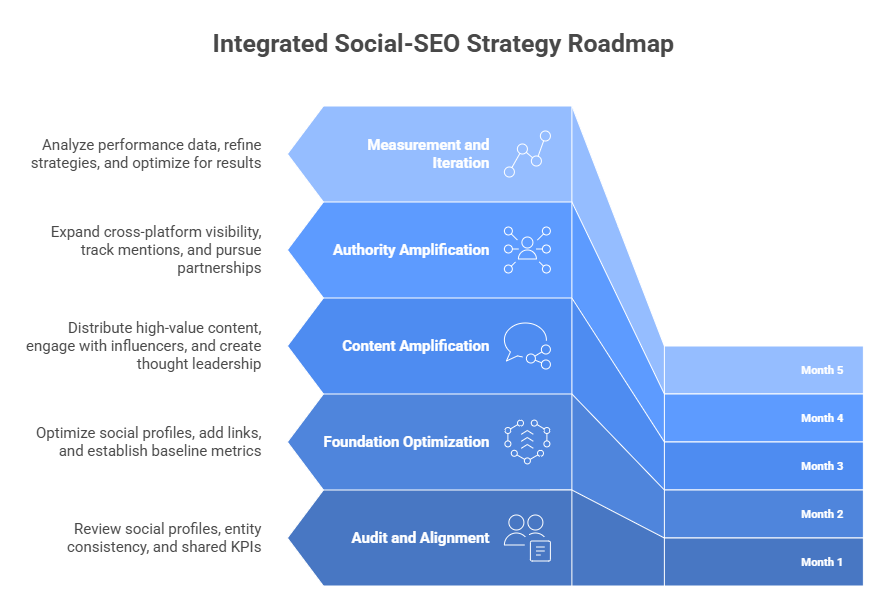
Organizations can translate this framework into a phased implementation roadmap that aligns social media and SEO strategy around shared brand visibility, trust, and authority goals. It typically takes 3.1 months (roughly 10 weeks) to see a noticeable ranking improvement after acquiring a high-quality backlink (LinkBuilding HQ, 2026).
Phase 1: Audit and Alignment
Audit social profiles for complete information, verified accounts, and consistent branding. Review whether high-value content gets distributed through social channels.
Check entity consistency by comparing brand names, logos, and descriptions across all social profiles and the website. Evaluate whether social and SEO teams share goals and coordinate campaigns.
Establish shared KPIs that connect social activity to search outcomes. Keep track of branded search volume, backlinks from social amplification, entity visibility in knowledge panels, and social referral traffic quality.
Phase 2: Foundation Optimization
Optimize all social profiles for entity recognition and branded SERP presence. Complete all profile fields, secure verified accounts, and ensure brand names match exactly across platforms.
Add social profile links to the website’s about page and contact page. Include social profile URLs in schema markup. Link from social profiles back to the website.
Set a baseline measurement of branded search volume in Google Search Console. Trace backlinks from social amplification using link analysis tools. Monitor the quality of social referral traffic through engagement metrics.
Phase 3: Content Amplification
Develop processes for distributing high-value content through social channels. Identify link-worthy content before publication based on uniqueness or data quality. Create distribution plans that specify platforms, hashtags, and influencers to target.
Engage with journalists, bloggers, and industry leaders in the follower base. Share their work and provide comments to build relationships before pitching content.
Create thought leadership content optimized for both social engagement and search authority. Topics should align with target keywords while addressing audience questions. Content should demonstrate expertise through original insights.
Phase 4: Authority Amplification
Expand cross-platform brand visibility and earn mentions from authoritative sources. Increase presence on platforms where the target audience is active. LinkedIn for B2B, YouTube for educational content, TikTok and Instagram for consumer brands, and Reddit for community-driven industries.
Track mentions from industry peers, media outlets, and influencers using brand monitoring tools. Influencer marketing SEO impact grows when individual SMEs have active social profiles linked to their website bios.
Pursue collaborative content and partnerships that generate mutual cross-platform citations. Expert roundups, co-hosted webinars, and podcast guest appearances all build authority.
Phase 5: Measurement and Iteration
Refine the integrated social-SEO measurement framework based on performance data. Conduct correlation analysis between social campaigns and organic search performance. Look for patterns where social visibility increases precede branded search growth.
Connect new backlinks to the social campaigns that amplified the content. Track branded search spikes that follow increases in social visibility. Monitor improvements to entity visibility in knowledge panels.
Use performance data to optimize content topics, platform prioritization, and amplification strategies. Increase investment in content types that generate strong social-to-link conversion. Shift resources toward platforms that drive qualified referral traffic.
Sequencing Actions
Teams with incomplete social profiles should prioritize foundation optimization before content amplification. Organizations with strong social presence but weak SEO should focus on establishing measurement frameworks.
B2B companies should prioritize LinkedIn optimization and relationship-building with journalists. E-commerce brands should focus on visual platforms and influencer partnerships. Companies with educational content should invest in YouTube optimization and in participating on Reddit.
Small companies should start with one or two platforms where their audience concentrates, rather than spreading across all channels. Focus on quality execution on fewer platforms before expanding.
Building Long-Term Search Visibility Through Social-SEO Integration
Social media activity connects to modern SEO through six mechanisms: brand building, E-E-A-T reinforcement, content amplification, entity recognition, cross-platform visibility, and AI search positioning. Direct traffic remains a high-value signal; 81% of social media users eventually click through to the brand’s primary website (LinkBuilding HQ, 2025b).
Organizations seeking to achieve high search visibility should recognize social media as part of a unified brand authority strategy. Every social post, expert article, and community comment builds the trust and visibility signals that search engines and AI platforms use to determine who deserves to be found.
Integration of social media and SEO requires strategic patience and organizational commitment. The benefits of an aligned approach compound over time. It builds competitive advantage through social media and topical authority that competitors struggle to replicate.
Implement Your Social-SEO Integration Strategy
Conduct a cross-functional audit of current social media and SEO operations to identify integration gaps and missed opportunities for compounding social-SEO value. Next, convene social media, SEO, content, and brand stakeholders for an alignment session. You can then establish shared objectives, define collaborative workflows, and agree on integrated metrics that will guide strategy and investment decisions. This builds the foundation for sustained cross-platform brand visibility search results.
Subscribe today to receive updates on integrated digital marketing strategy, social media and SEO best practices, brand authority building, generative search optimization, and the ever-growing relationship between social platforms and search visibility.
Frequently Asks Questions
No. Google has consistently maintained that social signals like follower counts, likes, and shares are not direct algorithmic ranking factors. Social media affects rankings indirectly through six pathways: brand awareness that drives branded searches, content amplification that earns editorial backlinks, entity recognition across platforms, E-E-A-T reinforcement, user engagement signals, and cross-platform content indexing. These indirect signals are harder to fake than direct ranking factors and create longer-lasting SEO value.
Social media reinforces all four E-E-A-T components. Experience shows through behind-the-scenes content and customer interaction examples. Expertise builds through thought leadership posts and expert commentary on industry news. Authoritativeness develops through professional endorsements, media mentions, and speaking invitations. Trustworthiness comes from transparent communication, responsive customer engagement, and consistent messaging across platforms. Google’s quality raters may check a brand’s social presence when assessing E-E-A-T, and their evaluations train the AI systems that influence rankings.
The right platform depends on industry and audience. LinkedIn drives professional backlinks and B2B mentions, making it ideal for B2B companies and executives building authority. YouTube content gets indexed directly by Google and appears in video carousels, which suits brands with educational content. X generates media pickup and journalist source discovery. Instagram, TikTok, and Pinterest support visual brand recognition for consumer and e-commerce brands. Reddit discussions are increasingly cited by AI search systems like ChatGPT and Perplexity.
AI search systems verify brands across multiple platforms before citing them as sources. Approximately 34% of AI citations originate from PR-driven coverage, with another 10% coming from social channels. AI systems check whether a brand has verified accounts on major platforms, uses consistent branding, and regularly publishes content about relevant topics. Brands discussed across LinkedIn, X, and YouTube appear more authoritative than brands present on only one platform, which increases the likelihood of being cited in AI-generated responses.
Local intent dominates search, with 4 in 5 searches having local intent and 76% of “near me” searchers visiting a related business within 24 hours. Social media supports local SEO by driving local branded search volume when community members later search for the business by name, generating localized reviews and check-ins on platforms like Facebook, building local media coverage and backlinks through community engagement, and corroborating Google Business Profile information when address, phone, and hours match exactly across platforms.
Social-driven SEO results compound over time rather than appearing immediately. It typically takes about 3.1 months, roughly 10 weeks, to see noticeable ranking improvement after acquiring a high-quality backlink. Branded search volume growth, entity visibility in knowledge panels, and AI search citations build gradually as social activity accumulates. A case example in the home services industry showed that while organic clicks dropped 20% due to AI Overviews, leads increased by 35% as a result of branded visibility built through brand-building efforts, demonstrating that social-SEO integration offsets algorithm changes over time.
Resources
- Brandignity. (n.d.). The link between social media engagement and search rankings. Brandignity. https://www.brandignity.com/2025/05/the-link-between-social-media-engagement-and-search-rankings/
- Cariño, J. J. (2026, April). 6 reasons why SEO is still relevant in 2025 (and beyond!). Brandignity. https://www.brandignity.com/blog/6-reasons-why-seo-is-still-relevant-in-2025-and-beyond/
- Crestodina, A. (n.d.). How does social media affect SEO?. Orbit Media Studios. https://www.orbitmedia.com/blog/how-does-social-media-affect-seo/
- Haynes, M. (2026, February 23). 4 sites that recovered from Google's December 2025 core update – what they changed. Search Engine Journal. https://www.searchenginejournal.com/4-sites-that-recovered-from-googles-december-2025-core-update/
- LinkBuilding HQ. (2025a, January 17). Link building strategies in 2025: What's in, what's out?. https://www.linkbuildinghq.com/blog/link-building-strategies-2025/
- LinkBuilding HQ. (2025b, December 24). Exploring how social media contributes to SEO ranking. LinkBuilding HQ. https://www.linkbuildinghq.com/blog/exploring-how-social-media-contributes-to-seo/
- LinkBuilding HQ. (2026, March 13). Link building statistics you have to know in 2026. https://www.linkbuildinghq.com/blog/link-building-statistics-2026/
- Morton, K. (2025, October 2). Moving beyond E-E-A-T: Branding, survival and the state of SEO. Search Engine Journal. https://www.searchenginejournal.com/moving-beyond-e-e-a-t-branding-survival-state-of-seo/
- Park, L. (2026, January 9). 5 key enterprise SEO and AI trends for 2026. Search Engine Journal. https://www.searchenginejournal.com/5-key-enterprise-seo-ai-trends-2026
- Southern, M. G. (2024, April 24). Google E-E-A-T: What is it & how to demonstrate it for SEO. Search Engine Journal. https://www.searchenginejournal.com/google-e-e-a-t-how-to-demonstrate-first-hand-experience/474446/
- Spike Interactive. (2025a, October 25). E-E-A-T & brand signals: Building authority for AI-driven search. Spike Interactivehttps://spikeinteractive.net/e-e-a-t-brand-signals-ai-search/
Kim Greer
OFP Law
One of the best business decisions I ever made was to contract with 321 Web Marketing. Jonathan Gessert and his team are knowledgeable, efficient, and effective, making digital marketing goals easy to achieve and helping [...]

Kelly Cole
Business Benefits Group
My company hired 321 Web Marketing in February 2016 to resurrect our web site. We feel our web site is the face to our business and desperately needed a make over. 321 took us from blah to WOW effortlessly and what a difference [...]

Emily Hawkins
Diener & Associates
Thanks to 321 Web Marketing, the client has seen an increase in their search engine leads, averaging 12 qualified leads per month. The client has also achieved prominent Google Maps and search placement. The team [...]
Trevor Telesz
Paw Pals Pet Sitting
321 Web Marketing successfully translated the client’s design into a stunning and refreshed website, ensuring seamless functionality across all dynamic views. The team provided clear timelines and stuck to them, [...]

Corey Davis
Spartan Animal & Pest Control
321 Web Marketing is truly phenomenal at what they do. Their ability to communicate and describe the steps and actions that they are implementing, Alex Zarpas in particular, is excellent. Delivering on promises is all [...]

Alec Roberts
MFE Insurance
I can’t say it enough, Jonathan and his team have gone above and beyond since day one to accommodate our needs and meet our goals. I run a specialty insurance brokerage based in LA and once we found 321 we never looked [...]

Richard Wilbur III
Advantage.Tech
Thanks to 321 Web Marketing’s web development work, the client increased rankings and traffic from search engines. Also, their business secured prominent positions on Google Maps and industry-relevant, profitable [...]

Bruce Gemmill
FVCbank
After the website revamp, the client saw a steady rise in leads from search engines, resulting in additional traffic. 321 Web Marketing is highly punctual when it comes to deliverables, and internal stakeholders are [...]

Drew Weeks
VAE
321 Web Marketing delivered a sleek website that accurately portrays the size and quality of the client’s organization. All of their completed websites have received positive feedback from users who have been [...]

Ryan Masten
Masten Pools
321 Web Marketing has increased the client’s leads from zero to 53 monthly. Their SEO efforts pay off impressively due to a top-ranking position on Google and making the site the number one result for several [...]